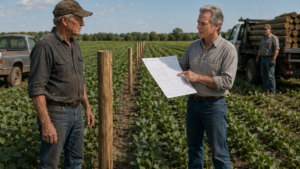
They Kept Sending Freight Trucks Down His Private Farm Road—Until He Found Who Had Changed the Map
Chapter 1: The Truck That Should Never Have Been There
James Carter knew the sound of every machine that belonged on his farm.
The old tractor rattled at idle. The feed truck from town had a loose heat shield that buzzed on the hill. His own diesel pickup coughed twice on cold mornings before settling into a steady growl.
The sound outside the storage barn at 7:15 that morning belonged to none of them.
Air brakes hissed.
James stopped with one hand on the barn door.
Then came the low churn of a heavy diesel engine and the crunch of gravel under more weight than the road had ever been built to carry.
He stepped outside.
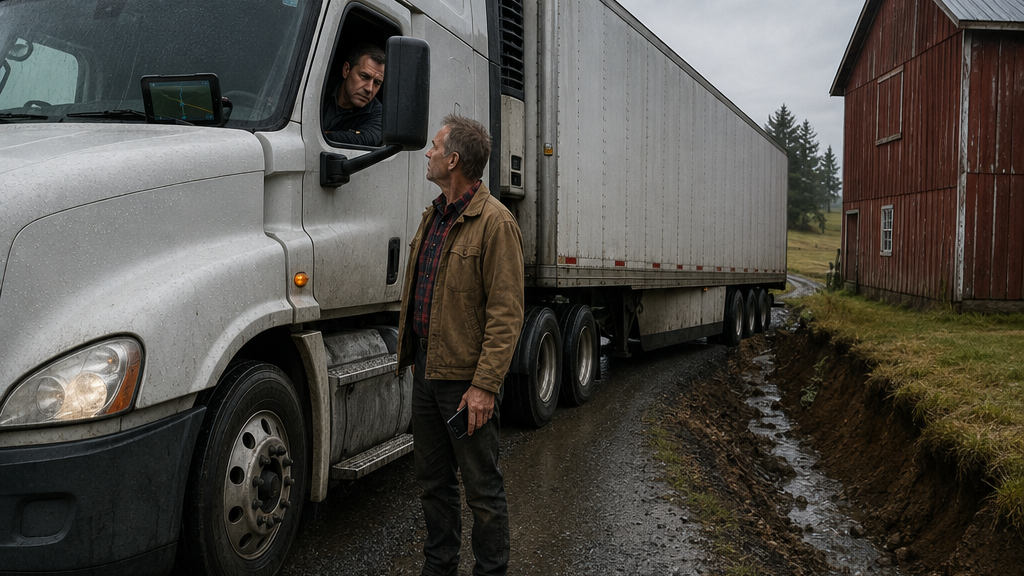
A refrigerated eighteen-wheeler was coming toward him.
For several seconds James simply stared.
The white tractor filled most of the road. Its mirrors reached toward the blackberry growth on one side and the drainage ditch on the other. Behind it, the long refrigerated trailer seemed impossibly large against the red barn, the wet pasture, and the Douglas firs beyond the fence.
James walked into the road and raised one hand.
The truck slowed.
The driver rolled down his window.
“Morning.”
“You lost?”
The driver glanced toward a mounted screen beside his steering wheel.
“Trying to get through to Route 14.”
“This doesn’t go through.”
The driver looked past James toward the barn as though expecting another road to appear behind it.
“My route says it does.”
James wiped rain from his forehead with the back of his wrist.
“This is my driveway.”
The driver blinked.
James pointed behind the truck. “Private road. You came through my gate.”
The driver looked at his screen again.
James had built the road six years earlier, though “built” made it sound easier than it had been. For two winters he had hauled equipment across the pasture to reach the storage barn. One wet January, a tractor had sunk nearly to its axle in the field, and James had spent half a day digging it out.
That spring he hired a grader for the base, rented a compactor himself, and laid the final gravel in sections whenever he could afford another load.
A quarter mile from the county road to the barn.
Not elegant. Not public. But his.
The driver turned the screen slightly.
A blue route line ran straight across James’s property.
James leaned closer.
The route did not end at the barn.
On the screen, it continued through.
“That’s wrong,” James said.
The driver gave a small, uncomfortable shrug. “I don’t make the maps.”
“Who do you drive for?”
“Meridian Freight.”
James looked at the company name on the cab door.
“Your dispatcher sent you this way?”
“It’s in the route package.”
That bothered James more than he expected.
He had assumed the driver had typed an address into a phone and followed whatever shortcut appeared. But this looked different. The screen displayed his road as if it belonged naturally between two legitimate stretches of roadway.
James pointed toward the gate.
“You’ll have to back out.”
The driver exhaled.
“I can’t turn here?”
“Not without tearing up the shoulder.”
The driver looked at the mud-dark edge of the road.
James could see him calculating the distance.
Finally the man nodded.
“All right.”
James walked ahead of the truck while it began reversing. At the narrower bend he stood in the grass and motioned the driver away from the ditch.
It took almost fifteen minutes.
When the trailer finally cleared the gate, the driver stopped beside James.
“You might want to call somebody,” he said through the open window.
“I plan to.”
“No, I mean about the map. If it’s in there, somebody else is going to get it too.”
James watched the truck return to the county road.
“That road’s recorded private.”
The driver lifted one hand.
“I believe you.”
Then he pulled away.
James remained at the gate after the engine noise faded.
Two deep tire impressions ran along the gravel.
Near the bend, several stones had been pushed into the soft shoulder.
Nothing serious.
Not yet.
He told himself the whole thing was ridiculous but simple. A bad routing entry. A driver following instructions. One phone call would fix it.
That afternoon James found the county folder in the bottom drawer of his desk.
He kept more paperwork than he liked to admit. Tax maps. Equipment receipts. Fence invoices. A survey from years ago. The road documentation was behind the survey.
He read the description twice.
Private access serving the Carter parcel.
Exactly as he remembered.
He set the paper on his desk and felt some of the irritation leave him.
There it was.
Black ink.
County stamp.
The world could make mistakes, but paper did not suddenly change because somebody’s computer drew a blue line.
He almost called Meridian that afternoon.
Instead, he decided to wait.
The driver knew now. Maybe he would report it himself. Maybe dispatch would correct the route before James ever had to explain.
James had never liked making a problem larger than necessary.
Most problems on a farm were solved by fixing the thing in front of you.
A broken hinge did not require a meeting.
A clogged culvert did not need a committee.
If someone drove down the wrong road and you told him, he turned around.
That should have been the end of it.
Two mornings later, James was carrying a battery charger from the shop when he heard diesel brakes again.
He looked toward the gate.
Another eighteen-wheeler was turning in.
Chapter 2: Every Driver Had the Same Route
Before breakfast the following Monday, James counted three separate sets of truck tracks on his road.
He stood near the gate with his coffee cooling in one hand.
The gravel was still damp enough to hold impressions. Dual tires had pressed parallel grooves through the crown and shoved loose stone toward both edges.
James knew one set came from the truck he had stopped.
The others did not.
That meant trucks had come through when he was elsewhere on the farm.
He set the mug on a fence post and walked the road.
At the first bend, fresh tire marks ran dangerously close to the ditch. Near the barn, a wider patch showed where one driver had apparently tried to swing around.
James crouched and touched the displaced gravel.
He had spent years maintaining that road with a tractor blade and rented roller.
Now drivers he had never met were using it while he was not even there to stop them.
He went inside and called Meridian Freight.
The first person transferred him twice.
The third introduced herself as Jessica Martin, dispatch supervisor.
James kept his voice level.
“I’ve got your trucks coming down a private farm road.”
There was a pause filled with keyboard tapping.
“What road?”
James gave her the county road number, then explained the turn, the gate, and the access to his barn.
More typing.
Jessica said, “I see the route.”
“That’s the problem.”
“It’s listed as through-access.”
“It isn’t.”
Another pause.
“It shows approved commercial access on my side.”
James leaned back in his chair.
“Approved by who?”
“I couldn’t tell you that.”
“Well, I can tell you who owns it.”
He pulled the county document closer.
“I do.”
Jessica’s tone changed slightly, not becoming rude, but flattening into the sound of someone working through a problem category she had seen before.
“Sir, drivers follow the approved routing feed. If the mapping data is incorrect, that usually has to be corrected through the navigation provider.”
“They’re your trucks.”
“Yes.”
“They’re damaging my road.”
“I understand.”
“No, I don’t think you do.”
James stopped himself.
For a second he heard his own irritation and disliked it.
Jessica said, “I can submit a routing ticket.”
“Will that stop the trucks?”
“It flags the route for review.”
“That wasn’t my question.”
“I can’t manually change commercial routing from dispatch.”
James looked through the office window toward the road.
“So what happens today?”
“I’ll note the address and request review.”
“And the drivers?”
“I can put a caution note in the system.”
“Private road isn’t a caution.”
Jessica did not answer immediately.
Then she said, “I’ll make the note as specific as I can.”
James wrote down her name and the time of the call on the back of an envelope.
It was the first thing he recorded.
He did not know yet how much that would matter.
For three days, no trucks came.
James began to think the ticket had worked.
On the fourth morning, rain fell hard enough to leave water standing in shallow depressions beside the barn.
James was checking a leaking section of gutter when a refrigerated truck rolled through the gate.
He stepped into the road.
The driver stopped.
James walked to the cab.
“This is private property.”
The driver frowned and looked at his mounted display.
“I’m on an approved route.”
“No, you’re not.”
The driver pointed at the screen.
“Commercial access. Right there.”
James looked.
The same blue line.
The same path across his land.
The truck sat idling while rain ran off the trailer roof.
“You’re the third driver who’s shown me that.”
“Then somebody ought to fix it.”
“I called your company.”
The driver glanced behind him.
“Can I turn around at the barn?”
James looked toward the open area.
The soil beyond the gravel was saturated.
“No.”
The driver sighed.
As he began reversing, one set of trailer wheels drifted toward the outer edge.
James raised both hands.
“Stop.”
The truck halted.
The right rear tires had sunk halfway off the compacted gravel.
The shoulder gave way beneath them with a soft cracking sound.
A strip of wet gravel slid into the ditch.
The driver leaned from the window.
“Am I clear?”
James stared at the broken edge.
Then, instead of answering, he reached into his jacket for his phone.
He took a photograph.
The driver looked confused.
James photographed the truck number.
Then the tires.
Then the damaged shoulder.
“What are you doing?”
“Starting late.”
“Starting what?”
“A record.”
James walked closer.
“Tell me exactly what your route screen calls this road.”
The driver read it.
“Approved commercial access.”
James photographed the screen with the driver’s permission.
The words were small, but visible.
Then he wrote the time on the same envelope where he had recorded Jessica’s name.
The driver eventually backed out.
James spent the next hour pulling displaced gravel away from the ditch so runoff would not wash more of the edge away.
That afternoon he called Meridian again.
Jessica answered after a transfer.
“I filed the ticket,” she said before James finished explaining.
“Your truck was here this morning.”
“I see the note.”
“The driver showed me the route.”
“Yes.”
“It still says commercial access.”
“The mapping review is pending.”
“How long?”
“I don’t have a timeline.”
James looked at the muddy photograph on his phone.
“Who approved it?”
“I don’t know.”
That answer stayed with him.
Not because Jessica sounded evasive.
She sounded as though she genuinely did not know.
The following week another truck came.
Then another.
Some drivers apologized.
One insisted James must be mistaken because the route was listed in the company system.
One turned around immediately.
Another complained about losing forty minutes.
James stopped arguing.
He recorded.
Date.
Time.
Truck number.
Company marking.
Direction of travel.
Whether the driver entered fully or turned around.
By the second week, he had moved from the back of an envelope to a yellow legal pad.
At the top of the first clean page he wrote:
MERIDIAN ROAD USE.
Then he drew columns.
The act felt excessive.
It also felt necessary.
That evening James sat at his kitchen table, reading through the entries.
What had begun as an irritating mistake now had repetition, timestamps, and truck numbers.
It had a shape.
He turned to a fresh line.
Outside, another diesel engine changed pitch on the county road.
James looked toward the window.
Then he wrote the date before the truck had even reached the gate.
Chapter 3: The Price of Letting It Continue
The road edge collapsed under James’s tractor on a Thursday morning in June.
Not enough to tip the machine.
Enough to make his stomach drop.
The right rear tire slid several inches as the gravel beneath it broke away. James stopped, lowered the loader bucket, and eased the tractor back toward the center.
When he climbed down, he found a crescent-shaped section of shoulder crushed into the ditch.
He stood there looking at it.
The damage had begun as loose stone.
Then ruts.
Then shallow cracks.
Now the road was physically narrowing.
James walked to the barn and retrieved his phone.
He photographed the collapse from three angles.
By then photography had become habit.
So had the log.
Nine trucks one week.
Eleven the next.
Twelve after that.
Not all had driven the full length. Some turned around at the gate after James stopped them. Some entered while he was in another field. A few reached the barn before realizing there was no public road beyond it.
But each carried weight.
Each pressed against the same edges.
James called a road contractor he had used before.
The contractor came two days later and walked the quarter mile with a measuring wheel.
He kicked at one of the broken shoulders.
“How much heavy traffic you running on this?”
“I’m not.”
The contractor looked at him.
James handed over the legal pad.
The man scanned several lines.
“Semis?”
“Refrigerated mostly.”
“You build this base for that?”
“No.”
The contractor nodded toward a soft section near the bend.
“That’s what it looks like.”
They walked farther.
At the place where James had photographed the sinking trailer wheel weeks earlier, the contractor crouched.
“The edge is pumping.”
James frowned.
“Meaning?”
“Water gets under it. Heavy axle comes across, pushes the base outward. Then you lose support.”
He stood.
“You’ve got several spots starting.”
James pulled up the old photograph on his phone.
The contractor compared it to the damaged shoulder in front of them.
“That’s exactly where it began.”
For the first time, James felt a grim satisfaction.
He had proof.
Then he disliked himself for feeling pleased about damage to his own road.
“What would it cost?”
The contractor took measurements, made notes, and promised an estimate.
It arrived the next afternoon.
Six thousand two hundred dollars.
James read the number twice.
He had expected three or four.
He called the contractor.
“That includes what?”
“Excavating the failed edge, rebuilding base, compacting, new gravel, drainage cleanup. I’d rather fix it once.”
James looked through the window at the road.
Six thousand two hundred dollars was not ruinous.
That almost made it worse.
It was the kind of number a company could dismiss as small and a farm owner could feel every time he wrote a check.
James added the estimate to a folder.
The folder now held printed photographs, copies of county documents, notes from his calls, and three pages from the truck log.
He should have felt organized.
Instead he felt late.
He had spent the first weeks assuming common sense would solve the problem.
He had no photograph of the first truck.
No truck number.
No record of the first conversation.
Only his memory and a driver he might never find again.
His pride had told him that keeping records was unnecessary because ownership was obvious.
Now he understood that obvious things could disappear quickly once a computer system described them differently.
The mistake he made next came from the same pride.
James bought two heavy temporary barricades from a farm-supply yard and placed them inside the gate, leaving enough room for his pickup but not enough for a semi.
He added a plain private-road sign.
No threats.
No theatrics.
Just a barrier.
For one day, it worked.
On the second afternoon, James heard a horn.
A Meridian truck had entered before the driver realized the barricades narrowed the road.
The trailer was already committed to the turn.
The driver stopped halfway across the entrance, blocking part of the county-road shoulder.
James walked down.
The driver climbed from the cab.
“You can’t leave this like this.”
James looked at the barricades.
“It’s my road.”
“You’ve got no turning room.”
“You weren’t supposed to turn in.”
“My route told me to.”
“That’s between you and Meridian.”
The driver stared at him.
“It becomes everybody’s problem when I can’t safely back onto that road.”
A pickup slowed behind the trailer.
Then another vehicle.
James felt the situation change.
He was legally certain of the boundary.
Practically, he had created a hazard.
The driver was not trespassing out of defiance. He had followed a route and now had fifty feet of trailer sitting where traffic moved at highway speed.
James moved one barricade.
They spent fifteen minutes guiding the truck backward.
When it finally cleared, the driver did not insult him.
That somehow made James feel worse.
“You need them to fix the route,” the driver said.
James looked at the barricade.
“I know.”
“No, I mean above dispatch. Because we keep getting it.”
Then the driver left.
James dragged both barricades away from the entrance.
The neighboring farmer stopped later after seeing the backed-up traffic.
“Heard you had some excitement.”
James told him what happened.
The farmer studied the damaged shoulder.
“You call a lawyer?”
“No.”
“Why not?”
“Because I shouldn’t need one to tell a freight company this isn’t their road.”
The neighbor gave him a look.
James knew it immediately.
It was the same look he had given people years ago when they insisted they could repair something themselves long after the repair had become more expensive than the original problem.
That evening James found the name Karen Miller through a local property office referral.
He almost did not call.
Then he looked at the $6,200 estimate.
Karen met him two days later.
Her office was plain, with county maps rolled into a rack and survey copies stacked beside a printer.
She listened without interrupting while James explained the trucks, the calls, the road damage, and the barricade.
When he finished, she asked, “When did the first truck come?”
“Early April.”
“Exact date?”
James hesitated.
“I can get close.”
“Photo?”
“No.”
“Truck number?”
“No.”
Karen looked at him over the folder.
“When did you start documenting?”
James knew where this was going.
“After the second or third one.”
“Which?”
“I don’t know.”
She nodded, not accusing him.
“That’s a weakness.”
“I know.”
“Not fatal. But a weakness.”
James handed her the later photographs.
Karen stopped at the image of the refrigerated trailer sinking into the shoulder.
She compared it with the contractor’s estimate.
“This helps.”
“He said the damage matches repeated heavy loads.”
“That helps too.”
Then she looked at the truck log.
“These entries are good.”
James almost laughed.
“I hated writing every one.”
“That’s usually how useful records work.”
She turned another page.
“Did Meridian ever tell you why their system lists the road as commercial access?”
“They said navigation data.”
“That’s not an answer.”
“I know.”
Karen leaned back.
“If their drivers are consistently seeing the same classification, we need to find out where that classification comes from.”
James folded his arms.
“The county record says private.”
“Ownership and routing data aren’t the same thing.”
“They ought to agree.”
“They often do. Until they don’t.”
She picked up a pen.
“I want the parcel map, the recorded road description, and whatever public-facing transportation layer the county uses.”
James frowned.
“I brought the deed information.”
“I’m not asking who owns the land.”
Karen tapped the photograph of the driver’s route screen.
“I want to know what the map thinks this road is.”
James looked at the image.
For weeks he had been proving that trucks were using his road.
Karen was asking a different question.
Why did every system seem to believe they were supposed to?
She slid the folder back toward him.
“Before we argue about damage, easements, or notice, find me the map entry that supposedly authorizes commercial access.”
James picked up the folder.
For the first time since the trucks started coming, the problem no longer felt like something happening on the surface of his road.
It felt buried somewhere else.
And he had no idea who had put it there.
Chapter 4: Someone Had Changed What the Road Meant
The county map showed James Carter’s road in a color he had never seen before.
He leaned toward the clerk’s monitor and pointed at the thin line running from the county road, through his gate, past the storage barn, and onward toward a secondary road that did not physically connect to his property.
“What does that mean?”
The clerk followed his finger.
“That layer?”
“Yes.”
She clicked the line.
A small information panel opened beside the map.
James saw his parcel number, a route identifier, and a category that made his jaw tighten.
Commercial access.
“There,” he said. “That’s wrong.”
The clerk did not answer immediately. She switched layers, clicked again, then pulled up another record.
James stood at the counter with Karen Miller’s list folded in his shirt pocket: parcel map, recorded road description, transportation layer, access classification, source if available.
He had expected the county to make him argue.
Instead, the clerk looked puzzled.
“Your recorded access document doesn’t say commercial.”
“I know.”
“It says private agricultural access serving the parcel.”
“I know that too.”
She glanced at him.
“Then this transportation designation isn’t coming from the property record.”
James straightened.
“Where is it coming from?”
“That’s what I’m trying to see.”
For the next several minutes she moved between screens.
James watched his road change identities depending on which layer she opened.
On the assessor’s parcel map, it was exactly what he believed it to be: a narrow private access line crossing his land.
On the recorded document, it served his parcel and barn.
On another transportation-facing layer, however, the line continued as though it belonged to a larger road network.
Same gravel.
Same ditch.
Same gate.
Different truth on the screen.
James thought about every driver who had looked at him as if he were the one misunderstanding where he stood.
“Can the county change that?” he asked.
“Not from here.”
“You’re the county.”
The clerk gave him a patient look.
“This layer aggregates outside transportation data. We display some of it. We don’t necessarily originate every classification.”
James almost laughed.
“So nobody owns the mistake.”
“I didn’t say that.”
“No. Everybody just displays it.”
She clicked into the route information again.
“There’s a source code attached.”
James leaned closer.
“What source?”
“I need to trace it.”
The clerk disappeared into a back office and returned with an older workstation open to an administrative database.
She typed the route identifier.
A date appeared.
Then another code.
Then a short notation.
TEMPORARY ACCESS REVIEW.
James felt a small shift inside him.
“Temporary?”
“That’s what the submission category says.”
“When?”
She read the date.
It was nearly eight months earlier.
Months before the first refrigerated truck had appeared beside James’s barn.
“What was being reviewed?”
“I can’t tell from this screen.”
She scrolled.
“There was a regional detour evaluation around then. Highway work, bridge restrictions, freight-routing alternatives. This could have been part of that.”
“Could somebody have marked my road by mistake?”
“Certainly possible.”
“Could somebody have marked it on purpose?”
The clerk hesitated.
“Also possible. But an access submission isn’t the same thing as changing ownership.”
“I understand that.”
He did now.
That distinction mattered more than it would have a month earlier.
James had spent weeks fearing that some bureaucratic entry had somehow weakened his legal hold over the road. But the deed and access documents had not changed.
The ground still belonged to him.
What had changed was the version of the road machines were reading.
The clerk printed the private-access record and the transportation-layer entry.
James held the sheets side by side.
One described reality.
The other described permission that had never existed.
“Can you tell who submitted it?”
“Not from the public record.”
“Can anyone?”
She considered that.
“There may be an originating organization ID.”
She returned to the older system.
James waited.
A printer rattled behind the counter.
Someone at another desk answered a phone.
Outside, a pickup crossed the courthouse parking lot.
Then the clerk stopped scrolling.
“I found an organization code.”
James felt his shoulders tighten.
She copied it onto a piece of paper.
“What does it mean?”
“I don’t have the full organization directory here.”
“Then how do I find out?”
“I can send a request to transportation records.”
“How long?”
“Could be a few days.”
James exhaled through his nose.
A few days once would have seemed unreasonable.
After two months of trucks, it sounded almost efficient.
“Send it.”
She nodded.
Before leaving, James asked one more question.
“If this commercial designation disappeared tomorrow, would the private record still be here?”
“Yes.”
“You’re sure?”
The clerk turned the parcel document toward him.
“This is the recorded property information. Nothing I’ve found today changes it.”
For the first time in weeks, James felt something loosen.
Not victory.
But ground beneath his feet.
He drove home with the printed records on the passenger seat.
A Meridian truck passed him going the opposite direction about six miles from the farm.
He watched it in the mirror until it disappeared.
At the kitchen table, James spread the papers beside his truck log.
The contradiction looked almost absurd when reduced to two sheets.
PRIVATE AGRICULTURAL ACCESS.
COMMERCIAL ACCESS.
He called Karen.
She answered on the third ring.
“What did you find?”
“The county didn’t classify it commercial.”
“That’s useful.”
“They’re displaying somebody else’s classification.”
“More useful.”
“And the commercial entry started as something called a temporary access review.”
Karen went quiet.
“When?”
James gave her the date.
“That’s before your first documented truck.”
“Months before.”
“Any source?”
“Organization code. County’s tracing it.”
Karen asked him to send photographs of everything.
James scanned the documents.
An hour later she called back.
“This is better than I expected.”
James looked toward the road.
“How?”
“Because your ownership record is clean. We’re not fighting over whether your road is private. We’re fighting over why a separate routing system says commercial traffic can use it.”
“So somebody entered it.”
“Someone or some system submitted something. Don’t jump farther than the records.”
James rubbed his forehead.
“You always take the satisfying part out of things.”
“That’s why you called me.”
“I called because the neighbor made me feel stupid.”
“That may also be useful.”
James almost smiled.
Then Karen’s voice sharpened.
“James, until we know who originated that submission, don’t contact Meridian about it yourself.”
“Why?”
“Because right now they think you have a damaged-road complaint. I want to know what they knew before we tell them what we know.”
James disliked that immediately.
Waiting felt too much like doing nothing.
But doing things his own way had already given him an incomplete early record and a barricade incident.
“All right.”
The transportation-records reply arrived the next afternoon.
James opened it on his computer.
The message contained a source reference, a regional detour file number, and an organization name.
He read the name once.
Then again.
Meridian Freight Logistics.
James called Karen without getting up from the chair.
“They submitted it.”
“Send me the record.”
“You said temporary detour review.”
“I said the category began that way.”
James looked at the date.
Eight months before the first truck.
Long before Jessica told him it was merely a navigation issue.
The route had not appeared from nowhere.
Somebody connected to Meridian had placed his private road into the system months before any driver ever turned through his gate.
And now James had to find out whether they had made a mistake—or decided his road was a shortcut worth taking.
Chapter 5: The Shortcut Nobody Wanted to Own
Meridian Freight’s attorney admitted the route submission existed before he denied that it meant what James thought it meant.
James sat across from Karen in her office with the phone on speaker between them.
“We recognize the file number,” the attorney said. “That does not mean Meridian designated Mr. Carter’s property as a permanent commercial corridor.”
Karen glanced at James.
“No one said permanent.”
There was a pause.
“The submission was connected to a temporary regional detour analysis.”
“Then why was it still routing your trucks eight months later?”
“That is precisely what we are reviewing.”
James stared at the yellow truck log lying open beside him.
Karen had marked the first call to Jessica, the first photograph, the contractor estimate, and every later truck entry with colored tabs.
The pages that had once felt tedious now looked like a timeline Meridian could not dismiss with one sentence.
The attorney continued.
“Third-party routing platforms ingest information from multiple sources. Data can persist after an original use case expires.”
Karen said, “Did Meridian submit the access information?”
“We submitted route candidates during the detour analysis.”
“Was Mr. Carter’s road one of them?”
Another pause.
“Yes.”
James leaned forward.
Karen lifted one finger, stopping him from speaking.
“Did Meridian verify the road was public or commercially accessible before submitting it?”
“I don’t have the answer to that.”
“Then get it.”
The call ended with promises of additional review.
James pushed his chair back.
“So they did it.”
Karen shook her head.
“They submitted a route candidate. We still don’t know why.”
“You heard him.”
“I heard enough to keep asking.”
James walked to the office window.
“This whole time they’ve been saying navigation problem.”
“It was a navigation problem.”
“They created the navigation problem.”
“Possibly.”
James turned.
“Karen.”
She met his eyes.
“You want this to be simple because simple gives you somebody to be angry at. I want it accurate.”
That irritated him precisely because he knew she was right.
Two days later Meridian asked for another call.
This time Gregory Nelson joined.
His voice was lower than James expected, controlled without sounding polished.
“I oversee regional operations,” Gregory said. “I’ve reviewed the detour file.”
James spoke before Karen could.
“Then tell me why my driveway is in it.”
Gregory did not object to the word.
“Last fall, bridge load restrictions affected our normal freight path. Our planning team evaluated alternative connections.”
“My road doesn’t connect.”
“On several mapping layers, it appeared that it did.”
“Because you submitted it.”
“Not initially.”
James went still.
Gregory explained that an older digital road line already appeared to extend beyond James’s barn, likely based on incomplete base-map geometry. During the detour analysis, Meridian’s planning software identified it as a possible connection. Someone in route planning then submitted candidate-access data without confirming the road on the ground.
“So somebody looked at a computer,” James said, “saw a line, and decided my property was a highway.”
“I wouldn’t characterize it that way.”
“How would you?”
“As an unverified route candidate that should have expired.”
“But didn’t.”
“No.”
For the first time, Gregory sounded less defensive than tired.
“The submission fed into systems we don’t fully control. Once accepted into several commercial datasets, it propagated.”
James looked at Karen.
There it was.
No secret easement.
No scheme to take his land.
Something almost more ordinary.
A bad assumption entered into one system, copied into another, trusted by another, until forty-ton trucks treated it as reality.
Karen asked, “When did you first learn Mr. Carter disputed the route?”
Gregory paused.
James felt the room change.
“Our dispatch records show a complaint in April.”
Jessica’s call.
James looked down at his own note—the time and her name written first on an envelope, later copied into the log.
“And what happened?” Karen asked.
“A routing review was opened.”
“Was the route suspended?”
“No.”
James spoke quietly.
“Why?”
Gregory took a moment.
“Because at that point our internal system still showed it as approved access.”
“I told your company it was private.”
“I understand.”
“No, you understand now.”
Gregory did not argue.
Karen asked when the complaint reached regional operations.
“Late May.”
James counted backward in his head.
Late May.
Before the twelve-truck week.
Before the shoulder collapse.
Before the $6,200 estimate.
Karen asked, “And did you suspend it then?”
“No.”
“Why not?”
Gregory’s answer came slowly.
“We were already dealing with reduced capacity on the standard route. Removing this connector from the system without confirming the access issue would have added mileage to several contracted runs and pushed additional freight onto a road with its own seasonal restrictions.”
James stared at the speaker.
For weeks he had imagined discovering a person who simply did not care.
Gregory did care.
That was almost worse.
He had weighed James’s complaint against delivery mileage and decided the trucks should keep moving while the company checked.
“You knew it might be private,” James said.
“I knew it was disputed.”
“And you left it active.”
“Yes.”
No corporate wording softened it.
Just yes.
James had expected denial. The admission cooled his anger into something narrower.
Gregory continued.
“I should also be clear. I don’t believe Meridian has any right to an easement across your property. I’ve seen nothing supporting that.”
James looked at Karen.
That answer removed one fear he had carried since the county map.
There was no hidden attempt to acquire his road.
No paper waiting somewhere to tell him he had lost what he built.
Gregory said, “The original failure appears administrative. The continuing-use question is different.”
Karen replied, “We agree.”
After the call, James remained seated.
Karen closed her notebook.
“You look disappointed.”
“I thought I’d feel better finding out nobody was trying to steal the road.”
“You should.”
“I do.”
“But?”
James looked at the log.
“But they knew enough to stop.”
Karen nodded.
“That matters more than the original mistake.”
James had spent weeks asking who put his road into the system.
Now he knew.
Someone evaluating a detour had trusted a map instead of the land. The designation had outlived its purpose. Systems copied it.
None of that required bad intent.
Then Gregory learned there was a real owner objecting and allowed the route to remain active because shutting it down was inconvenient.
That required a choice.
Karen slid the contractor estimate beside the truck log.
“Your claim is stronger after notice than before it.”
James touched the pages.
Every entry after late May suddenly carried different weight.
Those trucks were no longer simply evidence of a mapping error.
They were evidence of what happened after Meridian knew the map might be wrong.
Karen began listing damages they could support: physical repair, documented interference, professional costs, additional route-use consequences.
“Fourteen thousand is defensible as a demand,” she said. “That doesn’t mean we get fourteen.”
James barely reacted to the number.
Karen noticed.
“What?”
“I keep thinking about the screen.”
“What screen?”
“The first driver’s. Blue line right through my barn like the road continued.”
Karen waited.
James looked toward the rolled county maps.
“If they pay me and leave that line there, what stops another truck?”
“Nothing guaranteed.”
“What if Meridian removes it but the other systems don’t?”
“That is something we need to address.”
Karen capped her pen.
Then she asked the question that finally made the dispute feel larger than the estimate on the table.
“James, decide what you actually want before I send anything.”
“I want them off my road.”
“That’s the immediate answer.”
“What other answer is there?”
“Money for past damage is one thing. Correction of the originating data is another. Written non-use is another. Getting every downstream mapping provider corrected may be harder and slower.”
James said nothing.
Karen pushed the draft demand toward him.
“So when they offer you money—and they probably will—are you trying to recover what this already cost you?”
She tapped the map.
“Or are you trying to make sure the road becomes yours again everywhere that matters?”
Chapter 6: Fourteen Thousand Dollars Was Not the Real Demand
The settlement draft contained a dollar amount, a confidentiality clause, and six pages of careful language.
It did not contain one sentence promising that trucks would stop being routed down James Carter’s road.
James read it twice at his kitchen table.
Then he called Karen.
“You’ve seen this?”
“I have.”
“Where’s the route correction?”
“It isn’t there.”
“Where’s the non-use agreement?”
“Also not there.”
He looked through the window.
The shoulder outside had been temporarily patched with gravel he had spread himself so he could move equipment safely until the larger repair was done.
“What exactly are they settling?”
“Property damage and disputed costs.”
“Disputed?”
“That’s their word.”
James pushed the draft away.
“How much?”
“They’re offering less than our fourteen-thousand-dollar demand, but enough to cover most of the repair estimate and some fees.”
“I don’t care.”
Karen went quiet.
A month earlier, James would have cared.
Six thousand two hundred dollars still mattered. So did the legal bills. Farm money did not become imaginary simply because a principle had entered the dispute.
But James had learned something while watching trucks follow that blue line.
Repairing the gravel without repairing the information would only make a better road for the next driver to damage.
“Can they actually correct it?” he asked.
“They can withdraw their originating submission and send correction notices to the commercial feeds they use.”
“And every map?”
“No one controls every map.”
“So make them correct what they control.”
“That’s what I recommend.”
“And put in writing that Meridian won’t route commercial traffic through here.”
“Yes.”
James reread the proposed settlement.
The money suddenly looked like the least interesting part.
He remembered building the road in sections, waiting until he could afford gravel, running the compactor after dinner because rental time was costing him by the hour. He had built it so he would not have to wait on anyone else to reach his barn in winter.
That independence had become part of the problem.
When the first truck appeared, he had believed his word should be enough.
When it was not, he waited.
When the company dismissed him, he tried a barrier.
Every step had carried the same stubborn thought: I shouldn’t need anybody else to defend what is mine.
Yet the county clerk had found the source record.
Karen had forced him to preserve the right evidence.
The contractor had connected physical damage to repeated heavy loads.
Even the drivers had shown him what their systems were telling them.
James had not become less independent by accepting help.
He had simply stopped confusing independence with isolation.
“Reject it,” he said.
Karen paused.
“Think about that for a minute.”
“I have.”
“The offer is not meaningless.”
“I know.”
“If this gets harder, the costs increase.”
“I know that too.”
“And there is no guarantee every third-party system updates immediately even if Meridian withdraws the data.”
James looked at the patched road.
“I’m not asking them to control everything. I’m asking them to undo what they did and stop using it themselves.”
“That’s reasonable.”
“Then why would I sign something that doesn’t say it?”
Karen let out a short breath.
“Good.”
James frowned.
“Were you testing me?”
“No. I was making sure you understood what you were refusing.”
She sent Meridian a revised response that afternoon.
The demand still sought fourteen thousand dollars based on the repair estimate, documented loss of use, and professional costs.
But James cared more about three additional requirements.
Meridian had to formally withdraw the route-access submission tied to his road.
It had to notify the commercial mapping and routing providers to which the designation had propagated.
And it had to agree in writing that its drivers would not use the road as commercial through-access.
The response went out on a Monday.
Nothing came back Tuesday.
Nothing Wednesday.
By Friday, James expected a counteroffer.
None arrived.
The following week, silence continued.
The trucks, however, became less frequent.
James recorded two.
Then one.
The next week there were none for four days.
On the fifth morning, a tractor-trailer slowed near his gate, hesitated, and continued along the county road.
James watched from beside the barn.
He wondered whether Meridian had begun quietly warning drivers while its lawyers refused to say so.
Karen told him not to assume.
“Silence can mean they’re working internally,” she said.
“Or waiting me out.”
“Also possible.”
“What do you think?”
“I think guessing costs nothing and proves nothing.”
James laughed despite himself.
“You must practice saying things like that.”
“I bill for them.”
Three weeks passed.
The road remained damaged but usable.
James stopped checking his email every hour.
He repaired a hinge on the barn.
Changed hydraulic lines on the tractor.
Cleared weeds from the ditch.
Ordinary work returned in pieces, though the folder on his kitchen table remained thick enough to remind him that nothing was finished.
One afternoon he opened an online commercial map.
His road still appeared.
The blue line still crossed the property.
He zoomed in until the barn roof was visible beneath it.
That small digital line angered him more now than the first truck had.
The physical road and the digital road had become two separate things.
One belonged to James.
The other belonged to anyone whose system believed it.
His phone rang.
Unknown number.
James almost let it go.
Then he answered.
“James Carter.”
“Mr. Carter, this is Gregory Nelson with Meridian Freight.”
James straightened.
Gregory’s voice was different from the conference call.
No attorney.
No speakerphone.
No careful interruptions.
“I wanted to speak with you directly,” Gregory said.
James looked at the blue route on his computer screen.
“About what?”
There was a brief pause.
Then Gregory said, “About the fact that those trucks should have been stopped sooner.”
Chapter 7: The Call That Finally Changed the Route
Gregory Nelson did not begin with an offer.
He began with an admission.
“Those trucks should have been stopped sooner.”
James stayed standing beside his desk.
On the computer screen, the commercial map still showed the blue line cutting across his property, through the gate, past the barn, and toward a road that did not exist.
For several seconds he said nothing.
Gregory continued.
“When your first complaint came in, dispatch treated it as a mapping issue. That was understandable at the time. What wasn’t acceptable was what happened after regional operations learned the access was disputed.”
James looked at the truck log.
“Late May.”
“Yes.”
“And the route stayed active.”
“Yes.”
The word landed differently now that Gregory had called alone.
No attorney softened it.
No one said alleged, potential, or under review.
James asked, “Why?”
Gregory was quiet long enough that James heard office noise on the other end—a door closing, someone speaking faintly farther away.
“Because removing it immediately would have created problems on several contracted runs.”
“You told me that already.”
“I know.”
“That wasn’t the whole answer?”
“No.”
James waited.
Gregory said, “I thought we could verify the road status before it mattered.”
James looked out the window toward the patched shoulder.
“It already mattered.”
“I understand that now.”
“You understood enough then to know it might be private.”
“Yes.”
“And you decided delivery schedules were worth the risk.”
Gregory did not answer immediately.
Finally he said, “That is a fair description.”
James had imagined hearing those words for weeks.
He had imagined satisfaction.
Instead he felt tired.
Not defeated. Not relieved.
Simply tired of being forced to translate something obvious into forms, photographs, invoices, route codes, and legal language before anyone considered it real.
Gregory cleared his throat.
“We are prepared to resolve the financial claim.”
James glanced at the draft settlement still lying near the printer.
“That’s not what held it up.”
“I know.”
“Then why are you calling?”
“Because your revised demand requires us to correct the originating submission, and I wanted to explain what that actually involves.”
James sat down.
“Go ahead.”
Gregory said Meridian could withdraw the route-access entry it had submitted during the detour review. It could issue correction notices to its contracted commercial routing providers. It could place a permanent internal prohibition on routing company drivers through James’s property.
But once the data had spread into outside systems, those systems would update on their own schedules.
“We cannot guarantee every map disappears immediately,” Gregory said.
“I never asked you to.”
“Our attorney was concerned your wording could be interpreted that way.”
“Then change the wording.”
Gregory paused.
James continued.
“I want your submission withdrawn. I want the systems you sent it to notified that the route is private and not approved for commercial access. And I want your drivers told not to use it whether some screen still shows a blue line or not.”
“That is possible.”
“Then do that.”
“There is one issue.”
James leaned back.
Of course there was.
Gregory said, “The company is willing to make the payment before every correction is fully processed. We would need a release when payment is issued.”
“No.”
“I expected that answer.”
“Then why ask?”
“Because I need to know whether there is any version you would accept.”
James looked again at the computer map.
The blue line seemed absurdly thin for the trouble it had caused.
“You want me to sign away the dispute while the road still exists in your system.”
“The internal prohibition could be immediate.”
“But the submission?”
“That would be filed as part of the settlement process.”
James shook his head even though Gregory could not see him.
“No.”
“Mr. Carter—”
“James.”
Another pause.
“James, I’m not asking you to trust that nothing happened.”
“That’s exactly what you’re asking me to do. You’re asking me to take the money first and trust the correction comes after.”
Gregory said nothing.
James felt his old instinct rising—the impulse to end the call, handle it himself, refuse everything rather than let another person control the terms.
He stopped.
That instinct had already cost him once.
So instead of hanging up, he asked, “What can you do today?”
Gregory answered more quickly.
“I can issue a regional driver alert today. I can remove the road from Meridian’s internal preferred routing immediately. I can authorize the formal withdrawal request today. The outside providers will need processing time.”
“And the written non-use?”
“I can approve it.”
“Then send all of that to Karen.”
Gregory exhaled.
“All right.”
“And payment comes after she confirms the withdrawal has been filed.”
“That will slow the settlement.”
James looked out at the road.
“I’ve been waiting since April.”
Neither man spoke for a moment.
Then Gregory said, “Fair enough.”
The written terms arrived the next morning.
Karen called James before he had finished reading them.
“They moved.”
“I see that.”
“The non-use language is stronger.”
“Strong enough?”
“I want one clarification on contractors operating under Meridian dispatch. Otherwise, yes.”
“And the route submission?”
“Withdrawal confirmation is attached.”
James opened the attachment.
The same detour file number that had first led back to Meridian appeared near the top.
Below it was a request to remove the private road from commercial-access routing data and mark it unsuitable for through freight.
For months, James had collected evidence showing what had been done.
This was the first document showing someone undoing it.
Karen said, “There’s also an interim instruction to dispatch.”
James found it.
Effective immediately, Meridian drivers and contracted carriers were prohibited from using the Carter private access road regardless of third-party navigation guidance.
James read that sentence twice.
“So if a driver’s map still sends him here?”
“He’s supposed to ignore it.”
“That should’ve happened in April.”
“Yes.”
There was no point pretending otherwise.
The final agreement took several more days.
The company paid the verified road-repair costs, part of James’s professional expenses, and additional compensation that brought the settlement near the demand Karen had prepared.
There was no public apology.
No dramatic admission.
No courthouse.
Gregory did not lose his job, as far as James knew.
Jessica Martin remained at dispatch.
The world did not rearrange itself to prove James right.
It simply corrected one line.
The outside mapping systems took longer.
For nearly two weeks, James could still find versions showing his road as through-access.
Meridian’s trucks stopped coming anyway.
Then one provider removed the connection.
Another changed the road to private access.
A third continued displaying the physical road but no longer routed commercial traffic through it.
James checked less often after that.
The contractor returned in early fall.
The failed shoulder was excavated. Soft material came out. New base went in. The drainage edge was rebuilt and compacted. Fresh gravel covered the sections that had carried the worst damage.
James watched the roller make its final pass.
The surface looked almost new.
Not exactly.
He could still see where the repairs began if he knew what to look for.
That suited him.
One morning after the contractor finished, James climbed into his tractor and drove from the barn toward the county road.
The tires rolled over firm gravel.
At the bend where the refrigerated trailer had once sunk into the shoulder, the repaired edge held cleanly.
He slowed near the gate.
Months earlier he had stood there believing ownership should be obvious enough to protect itself.
Now there was a modest private-access marker beside the entrance, properly placed and visible from the county road.
James had once considered signs like that unnecessary.
He no longer did.
A freight truck passed on the county road.
It did not slow.
It did not signal.
It continued toward the proper route and disappeared beyond the trees.
James watched it go.
Then he turned the tractor around and drove back toward the barn.
Behind him, the fresh gravel held only one set of tracks.
His own.
The story has ended.