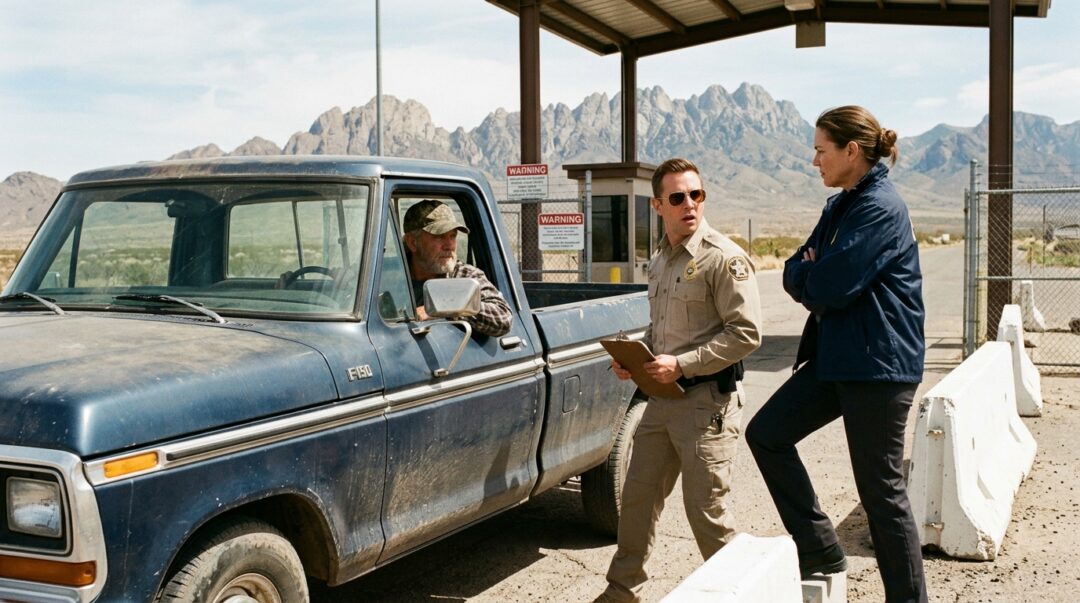
Where The Desert Highway Trembled Under The Organ Mountains
CHAPTER 1: THE HEAT MIRAGE ON ROUTE SEVENTY
The midday sun beat down upon the caliche flats of Doña Ana County like a blacksmith’s hammer upon an anvil. At one hundred and four degrees, the heat rising from the concrete lanes of Federal Checkpoint Fourteen created an oily, undulating mirage that made the distant limestone fangs of the Organ Mountains look as though they were melting into the bleached horizon.
Walter Halloway sat motionless in the cab of his 1978 Ford F-150, parked fifty yards north of the primary inspection canopy in the designated visitor turnout. The big three-hundred-cubic-inch inline six-cylinder engine was silent, ticking as it cooled in the dry desert draft. Walter had the driver’s side vent window pushed open, resting one thick, sun-spotted forearm against the worn vinyl door sill. He wore a faded olive-drab ball cap with the embroidered insignia of the First Cavalry Division and a snap-button denim work shirt that smelled faintly of gun oil and cedar shavings. At sixty-seven, Walter moved with the slow, deliberate economy of a man who had spent three decades hauling heavy ordnance over mountain passes from Da Nang to the Kuwaiti border.
Through the heat shimmer, he watched the secondary commercial lane.
A heavy three-axle tanker truck painted dull industrial gray was idling in the queue. The driver did not step down, and the vehicle bore no state hazardous material placards, only a hand-painted stencil reading ‘Industrial Slurry.’ A young federal interdiction officer wearing razor-creased khaki trousers, a fitted tactical vest, and mirrored Oakley sunglasses walked along the tanker’s passenger side. He did not ask for the driver’s manifest. He did not run an optical scan on the trailer’s sealed valves. Instead, he reached through the open window, took a flat cardboard coffee tray from the driver, and casually waved the sixty-ton rig forward toward the open northbound lanes of US-70.
Walter looked down at the dash-mounted digital chronometer suctioned beside his rearview mirror.
That was the third unmanifested tanker waved through in forty-two minutes. And not once had the young marshal touched the electronic barcode scanner mounted to his tactical belt.
A heavy, flat slap against the Ford’s hood cracked through the silence like a rifle shot.
Walter did not jump. His pulse barely ticked up three beats. He turned his head slowly to the left.
The officer had crossed the gravel shoulder without making a sound in his soft-soled tactical boots. Marshal Brett Kessler leaned forward, planting both gloved hands firmly on the Ford’s blue paint, his chest puffed out so that his gold federal star caught the blinding desert glare.
“Out of the cab, old man,” Kessler ordered, his voice clipped, nasal, and dripping with small-town authority. “Right now.”
Walter did not reach for the door handle. He kept both hands resting loosely on the lower rim of the thin steering wheel, in plain, unobstructed view. “Afternoon, Officer. Just waiting on the two-fifteen regional bus from El Paso. My granddaughter’s on it.”
Kessler sneered, tapping the truck’s rusted rain gutter twice with a metal ballpoint pen. “I do not care if you are waiting on the Pope. This turnout is reserved for federal official business. Sleeping inside an active interdiction zone is a Class B misdemeanor under federal administrative code. You have been sitting here over an hour.”
“Engine has been cold forty minutes, son,” Walter replied, his southwestern drawl quiet and level as a carpenter’s rule. “Window’s open, eyes are clear. I am wide awake.”
Kessler unclipped a thick aluminum citation docket from his chest harness, flipping the heavy carbon-paper leaves open with a sharp, performative snap. “You want to argue with a federal badge, grandpa? I can write this up as unauthorized obstruction of a federal narcotics interdiction point. That carries an automatic thirty-day impound on the vehicle. You think this rusted piece of junk is going to survive being dragged thirty miles over washboard to the Las Cruces impound yard?”
Walter looked straight into the dark lenses of Kessler’s mirrored glasses. He could see the reflection of his own calm, weathered face, framed by the blinding white sky.
“You could write that citation, Marshal,” Walter said evenly. “Or you could tell me why you skipped the mandatory weigh-station log on three straight pressurized liquid tankers while you were standing in Lane Two.”
Kessler’s ballpoint pen froze half an inch above the citation block.
The cocky smirk vanished from the corners of the young marshal’s mouth. His jaw tightened until the muscles along his cheek twitched. The dry wind blew a swirl of white gypsum dust across the Ford’s hood, hissing against the hot metal.
“What did you say?” Kessler muttered, leaning closer to the open window.
Walter tilted his chin upward half an inch, gesturing toward the windshield. Mounted directly behind the tinted glass, nestled tight against the rearview mirror post, was a ruggedized black cube with twin polarized lenses. A tiny red LED light on the lower bezel was blinking in a steady, rhythmic pulse.
“Dual-lens four-K dashcam,” Walter said quietly. “Seventy-two-hour internal loop with a secondary wide-angle lens focused right on Lane Two. Voice recorder has been hot since I pulled off the highway at one o’clock. It picked up every word you said to that tanker driver, and it recorded you bypassing the federal manifest scanner three times in a row.”
Kessler’s face drained of color, turning the sickly yellow of dried bone under his desert tan. His hand left the citation book and dropped instinctively to the retention holster at his hip.
“Shut that unit down,” Kessler whispered, his voice shaking with sudden, uncontrolled rage. “Right now. Tampering with federal surveillance equipment at a port of entry is a felony.”
“It is private property on a public state highway right-of-way, Officer,” Walter said. “And the cloud backup pinged the regional server at Fort Bliss twenty minutes ago.”
Before Kessler could unclip the retention strap of his sidearm, a pair of dark, sensible lace-up boots crunched quietly through the gravel behind him.
A calm, deep feminine voice cut through the shimmering heat:
“What seems to be the problem at the visitor turnout, Marshal Kessler?”
Kessler spun around as if he had been struck with a cattle prod. Standing five feet back, her arms crossed over the front of a dark navy federal windbreaker, was Supervisor Elena Reyes. Her gray-streaked dark hair was tied tightly at the nape of her neck, and her dark eyes were fixed on Kessler with the cold, unblinking intensity of a desert hawk.
“Supervisor,” Kessler stammered, pulling the citation docket against his chest like a shield. “This civilian was… he was refusing to vacate an active federal interdiction zone. I was issuing a routine administrative warning.”
Reyes did not look at the truck. She looked directly at the clipboard in Kessler’s hands.
“Every administrative warning requires an entry into the automated computer dispatch log prior to verbal engagement, Marshal,” Reyes said, her voice dropping into a quiet, lethal register. “Hand me your docket.”
Kessler did not move. His knuckles turned white against the aluminum edges. “Supervisor, I was just handling a preliminary—”
“I said hand me the docket, Kessler,” Reyes repeated, taking one measured step forward and extending an open, calloused palm. “Now.”
Kessler’s hand trembled as he surrendered the metal clipboard. Reyes flipped the cover open, her eyes scanning the blank, unwritten citation slip. As she looked up, the harsh squawk of an encrypted tactical radio on Kessler’s shoulder burst through the desert silence:
‘Unit Fourteen, this is Coyote-One. The passenger coach is ten miles south of San Augustin Pass. Intercept the girl with the green backpack. Repeat: do not let that camera reach the checkpoint.’
Walter’s eyes narrowed to cold steel. Maya’s backpack was forest green.
CHAPTER 2: THE SOUND OF DESERT WIND
The radio transmission hung in the scorching desert air like the ozone smell before a lightning strike.
Kessler reacted with the frantic desperation of a cornered predator. Before Supervisor Reyes could key her own radio microphone to demand an identification code for the transmission, Kessler reached up with his left hand, violently tore the tactical radio unit from his shoulder harness, and hurled it against the concrete base of the checkpoint barrier. The ruggedized plastic casing cracked apart, the internal battery skittering across the hot asphalt in a shower of tiny sparks.
“Kessler!” Reyes shouted, reaching for her badge case. “What the hell do you think you are doing?”
Kessler didn’t answer. He backed away two paces, his mirrored sunglasses catching the white glare of the sky, then bolted toward the motor pool behind the main inspection canopy where his unmarked patrol interceptor sat idling under the corrugated tin shade.
“Federal agent! Halt!” Reyes yelled, drawing her duty weapon from beneath her windbreaker. But Kessler was already inside the interceptor, throwing the transmission into reverse with a scream of burning rubber, spraying gravel and desert scrub across the turnout as he wheeled the cruiser around and roared onto the westbound lanes of US-70, heading straight toward the crags of San Augustin Pass.
Walter had already turned the key in the ignition.
The Ford’s starter motor gave two heavy grunts before the big three-hundred inline-six barked to life, the dual exhaust rumbling with a deep, reassuring mechanical roar. Walter reached across the bench seat, popped the glove box latch, and checked the heavy steel lockbox bolted to the cab floor. His government-issue 1911 .45 ACP was inside, three spare magazines resting in fitted leather pouches beside it. He did not take the pistol out, but he left the steel lid unlocked.
“Mr. Halloway!” Reyes ran to the driver’s side of the pickup, her face pale despite her years in the New Mexico sun. “Do not engage! I am calling the State Police and the federal tactical interdiction unit out of Las Cruces right now!”
“With all due respect, Supervisor,” Walter said, his voice flat, steady, and devoid of fear, “the Las Cruces barracks are thirty-five miles behind us on the other side of the pass. The passenger bus my granddaughter is riding is ten miles south of the pass right now on the old gypsum access road. If Kessler gets to that bus before someone with a conscience does, my granddaughter won’t make it to her nineteenth birthday.”
Reyes looked at Walter. She saw the quiet discipline in the old sergeant’s eyes, the faded military tattoo on his forearm, and the cold competence with which his hands gripped the wheel. She made an instant, career-ending decision.
She reached into her windbreaker, pulled her own department-issued encrypted handheld transceiver from its holster, and tossed it through the open vent window onto Walter’s passenger seat.
“Channel four,” Reyes said, her voice hard as granite. “That links directly to the federal air interdiction frequency out of Holloman Air Force Base. I have a Black Hawk crew running radar drills over the missile range. If you find that bus, call it in. I am taking the supervisor unit and coming up behind you.”
“Understood,” Walter said. He dropped the Ford’s heavy four-speed manual transmission into second gear, popped the clutch, and let the rear locking differential tear into the caliche shoulder.
The old truck surged onto US-70, its tires biting into the asphalt as Walter accelerated toward the rugged wall of the Organ Mountains.
To anyone else, the highway north through San Augustin Pass looked like a straight shot of two-lane blacktop cutting through empty desert scrub. But Walter had driven these hills when Route 70 was nothing more than an unpaved military supply artery for the White Sands proving grounds. He knew every arroyo, every culvert, and every abandoned mining track carved into the limestone cliffs.
Walter remembered the exact elevation changes of the old supply corridors from his days staging convoy drills out of Fort Bliss. Every washboard turn had its own rhythm, and every culvert hid an old limestone drainage basin where water pooled after flash floods. The big six-cylinder engine hummed with steady mechanical certainty, the four-barrel carburetor drinking air through the dry paper filter as the needle on the mechanical speedometer trembled against forty-five miles per hour.
Five miles ahead, the highway wound through the jagged gap between the rocky needles of the Organ peaks. The air grew thinner and hotter as the road climbed the grade, the radiator temperature needle on the Ford’s dashboard creeping up toward the two-hundred-degree mark.
Walter reached down and tapped the dashcam’s secondary display, bringing up the split-screen feed.
Beside the road, a rusted metal sign swung in the dry mountain wind: San Augustin Gypsum Works – Private Access – No Trespassing.
Tire tracks were fresh in the gray powder at the entrance to the access road. One set belonged to the heavy dual tires of a commercial passenger coach; the other belonged to the wide, aggressive tread of a federal pursuit interceptor. And running right between them were the tracks of two heavy four-wheel-drive pickup trucks with wide mud-flinger tires.
Walter did not hesitate. He downshifted into third, cranked the heavy power-steering wheel hard to the right, and plunged the Ford onto the unpaved gypsum track.
A cloud of blinding white dust billowed behind him like smoke from an artillery barrage. Ahead, through the twisting limestone canyon, the sharp, rhythmic crack of small-arms fire echoed off the canyon walls.
CHAPTER 3: THE CALICHE ROAD
The sound of gunfire in a narrow limestone canyon had a distinct, metallic crack that Walter recognized instantly. It was not the casual pop of target shooters plinking beer cans; it was the measured, rhythmic cadence of semi-automatic carbines firing from behind cover.
Walter eased his foot off the gas, letting the truck’s momentum carry it around a blind hairpin bend hugged by towering cliffs of yellow dolomite. He kept the right tires tucked tight against the rock wall, using the jagged limestone outcroppings to break his silhouette.
Three hundred yards ahead, at the dry bottom of an alkaline wash, sat the Silver State passenger coach.
The forty-foot commuter bus was tilted at an awkward fifteen-degree angle, its right rear wheels buried to the axle hubs in a sandbank of fine gypsum dust. The passenger side windows were starred with bullet impacts, but the safety laminate had held, turning the glass into sheets of opaque white spiderwebs. Two lifted Chevrolet pickups, painted matte black with reinforced steel brush-guards, were angled across the narrow road, completely blocking the path forward.
Standing behind the open driver’s door of the lead pickup were two men in civilian dust coats, carrying civilian-model AR-15 rifles. They weren’t firing at the passengers; they were firing over the roof of the bus, methodically pinning down the driver and terrorizing the people inside into staying low beneath the seat backs.
And fifty yards farther up the canyon road, parked on an elevated stone ledge overlooking the entire wash, was Marshal Brett Kessler’s marked federal cruiser.
Kessler was standing beside his open door, his mirrored sunglasses still on, watching the ambush with cold detachment. He held a cellular phone to his ear, gesturing with his free hand toward the rear emergency exit of the bus.
Walter did not reach for his rifle. At three hundred yards against carbines in open desert, a pistol was a foolish gamble. But thirty-five hundred pounds of Detroit steel with an iron channel-iron bumper was a weapon all its own.
Walter pulled the four-wheel-drive transfer case lever back into four-wheel high with a sharp mechanical clunk. He slipped the manual transmission into first gear, wound the six-cylinder engine up until the cooling fan roared like an aircraft propeller, and took his foot off the clutch.
The Ford didn’t crawl down the embankment—it lunged.
The heavy truck bounced down the steep rocky wash, its heavy leaf springs groaning as it plowed through scrub mesquite and loose boulders. The sudden roar of the unmuffled exhaust caught the two gunmen completely by surprise.
By the time the man on the left swung his rifle barrel toward the descending truck, Walter was already forty yards away and accelerating.
“Get out of the road!” Walter growled through gritted teeth, gripping the wheel with both hands.
The front steel bumper of the Ford clipped the passenger side of the rear cartel pickup with a shattering impact of sheet metal and breaking suspension bolts. The two-ton Chevy was shoved three feet sideways into the sand, throwing the second gunman off balance and sending his rifle clattering into the rocks.
Walter didn’t stop. He cut the wheel hard left, throwing the Ford into a broadside slide that positioned the truck’s heavy steel bed directly between the cartel shooters and the bus’s rear emergency door.
“Maya!” Walter bellowed through his open window, his voice cutting through the ringing aftermath of the crash. “Rear door! Now!”
The rear emergency latch on the bus kicked open.
A slender eighteen-year-old girl in dusty denim jeans and a forest-green canvas backpack tumbled out onto the sand. Her dark curly hair was wild with dust, and her face was streaked with sweat and fear, but she held a heavy digital camera securely against her ribs like a football.
“Grandpa!” she screamed, scrambling on hands and knees through the powdered gypsum.
A burst of automatic fire kicked up geysers of white dust at her heels. On the high stone ledge, Kessler had drawn his sidearm, firing frantically down into the wash.
Walter threw open the passenger door of the Ford from the inside. “Get in! Under the dash!”
Maya scrambled into the cab, her boots kicking the metal floorboards as she dove headfirst beneath the dashboard. Walter reached across, grabbed the collar of her jacket with one hand to hold her down, and jammed the transmission into reverse.
The Ford shuddered as the four-wheel drive clawed into the dry creek bed, backing away from the disabled bus just as a volley of rifle rounds punched through the Ford’s tailgate and shattered the rear sliding cab window.
Tempered glass rained down upon Maya’s shoulders, but the heavy steel back of the bench seat absorbed the lead slugs.
“Are you hit, sweetheart?” Walter asked, his voice astonishingly calm as he backed the truck behind a shoulder of limestone bedrock.
“I am okay! I am okay!” Maya gasped, clutching her camera to her chest. “Grandpa, that marshal… he is the one from the gas station in Las Cruces! I took pictures of him! He was taking bundles of cash out of the spare tire of that cartel truck!”
Walter looked up through the windshield. Kessler’s cruiser had already wheeled around on the high ledge, speeding down the access road to cut off their only exit back to Route 70.
And the radiator temperature gauge on Walter’s dashboard was pegged firmly in the red.
CHAPTER 4: THE IRON IN THE EARTH
A plume of scalding white steam began to hiss from beneath the Ford’s crumpled hood. A stray rifle bullet had clipped the upper radiator hose, spraying hot ethylene glycol across the exhaust manifold in a sickening sweet cloud of vapor.
Walter knew the engine had less than four minutes before the cast-iron cylinder head warped and seized the pistons in their bores.
“Hold on, Maya,” Walter said, his face rigid.
He didn’t turn back toward the highway. Kessler’s cruiser was already blocking the entrance to the canyon, and the second cartel pickup was recovering from the ditch, its engine screaming as it backed out of the gypsum wash.
Walter pointed the steaming truck northeast, toward the abandoned industrial skeleton of the San Augustin Gypsum Processing Mill.
The mill had been abandoned since the mid-1970s. It was a sprawling, multi-tiered complex of corrugated iron sheds, rusted conveyor bridges, and hollow concrete silos clinging to the sheer rock wall of the canyon like a cluster of dead hornets’ nests. A weathered timber ore-loading trestle spanned the wash fifty feet above the canyon floor, leading directly into the cavernous main crushing bay.
Walter slammed the truck into second gear, nursing the dying engine up the steep gravel incline leading to the mill’s heavy loading ramp. The inline-six was knocking violently now, a sound like a ball-peen hammer tapping inside an iron kettle, but the old mechanical beast refused to quit.
The truck crested the wooden ramp, its tires rumbling over heavy oak timbers that had baked in the desert sun for half a century. Walter drove straight through the open double doors of the crushing bay, killed the ignition, and let the truck roll to a halt against a mountain of powdered gray gypsum.
The radiator gave one final, shuddering gasp of steam, and the engine went dead.
The silence that followed was absolute, broken only by the rhythmic ping of cooling iron and Maya’s rapid, ragged breathing.
“Out of the truck, Maya,” Walter whispered. “Bring your pack and the camera.”
He reached down to the floorboard, unlocked the steel storage box, and brought out the government 1911 .45 ACP. He racked the slide with a smooth, practiced pull of his left hand, chambering a two-hundred-and-thirty-grain hollow point, and slipped the three spare magazines into his front shirt pocket.
Maya climbed out of the passenger side, her sneakers sinking three inches into the powdery gypsum that covered the concrete floor like gray flour.
“Grandpa, what is this place?” she whispered, looking up in awe at the massive rusted steel hopper that hung suspended from the ceiling by heavy chains.
“Old ore mill,” Walter said, his eyes scanning the gloom. Shafts of harsh yellow sunlight pierced the broken tin roof, illuminating millions of floating dust motes. “My father worked maintenance here in fifty-eight. It has three subterranean drainage tunnels that lead under the highway to the old missile range boundary fence.”
Walter stepped across the heavy industrial floor with quiet deliberation, his boots kicking up gray powder that hung suspended in the motionless interior air. He ran his calloused fingertips along the rusted flange of the secondary conveyor belt, testing the tension of the counterweighted cables. The structural steel of the processing mill had stood for seventy years against the desert sun, engineered with heavy industrial rivets that could withstand forty tons of shifting stone.
Outside, the crunch of gravel heralded the arrival of the hunters.
Kessler’s cruiser and the remaining cartel pickup rolled onto the wooden trestle outside, their engines idling with a low, menacing thrum. Car doors opened and closed with heavy, distinct clicks.
“Halloway!” Kessler’s voice echoed through the broken corrugated walls, amplified by the natural acoustics of the canyon. “There is nowhere to run, old man! The mill is a dead end! You send the girl out with the camera right now, and I will let you walk back to Route Seventy! You have my word as a federal officer!”
Walter didn’t bother to answer. He took Maya by the elbow, guiding her silently along the perimeter wall behind a row of rusted electrical switchgear cabinets.
“Maya, listen to me,” Walter spoke directly into her ear, his voice barely a breath. “Inside your camera, that memory card is the only thing standing between Kessler and a federal grand jury. If he gets that card, he buries both of us in these tunnels and claims we were cartel drug mules who ran the checkpoint.”
“I am not giving it to him,” Maya said, her chin coming up with the same stubborn defiance Walter had seen in her father’s eyes. “I took eight high-speed bursts. I have his face, his badge number, the license plates of the tanker trucks, and the cash bundles with the cartel bank stamps. It is all on this chip.”
Walter reached down and picked up the supervisor’s radio he had tucked into his waistband. He keyed channel four, whispering into the microphone:
“Air Interdiction, this is civilian transport unit at the San Augustin mill. We are pinned inside the primary crushing hopper by armed hostiles and a rogue federal marshal. Hostiles are armed with carbines. Need immediate tactical air support.”
The radio speaker crackled with static, followed by a crisp, calm military voice:
‘Transport unit, this is Black Hawk Victor-Seven. We have your emergency beacon on tactical overlay. We are inbound from the missile flats, five minutes out. Hold your position.’
Five minutes in a firefight was an eternity.
A boot kicked open the wooden personnel door at the far end of the bay. Two shadows in long coats stepped through the opening, their rifles held at low ready, the barrels sweeping through the dusty gloom.
CHAPTER 5: THE ALKALINE VAULT
The two cartel gunmen moved with cautious, predatory discipline. They separated ten paces apart, their boots making muffled, shuffling sounds in the dry gypsum powder that coated the concrete floor. The taller man had a red bandana tied across his forehead to keep the stinging sweat from his eyes; the shorter one carried an under-folding AK-pattern rifle, the selector switch clicked down to semi-automatic.
Behind them in the doorway, framed against the blazing desert light, Marshal Brett Kessler stood with his service weapon drawn, holding a high-output tactical flashlight that cast a blinding white beam through the dust haze.
“Check the catwalks,” Kessler ordered quietly. “The old man has bad knees. He could not have made it up the ladder with the girl.”
Walter and Maya were crouched twenty feet away, concealed behind the heavy cast-iron housing of an antique jaw crusher. The massive machine, used to smash boulders into gravel, was eight feet tall and solid iron. It provided complete cover from rifle fire, but they were trapped against the canyon’s sheer limestone back wall.
Walter looked up at the ceiling.
Directly above the two approaching gunmen hung the primary dust-collection hopper—a twenty-foot sheet-metal funnel suspended by four rusted three-quarter-inch steel turnbuckles. Inside that hopper sat fifty years of accumulated, bone-dry gypsum flour, weighing several tons. Attached to the bottom of the funnel was an old pneumatic discharge slide-gate, held shut by a single rusted steel cotter pin.
Walter leaned close to Maya. “Put your hands over your mouth and nose. When I move, do not look at the light. Keep your head down.”
Walter reached into his pocket and brought out a heavy steel spud wrench he had grabbed from the truck’s bed. It weighed four pounds and had a tapered pointed handle designed for aligning structural steel bolt holes.
He waited. He counted the gunmen’s footsteps in the dust: three… four… five.
The two men stepped directly beneath the suspended hopper, their flashlight beams intersecting on the empty cab of Walter’s Ford.
“Truck’s empty!” the man with the bandana called out.
Walter stood up from behind the iron crusher. He did not aim his pistol at the men. Instead, he drew his right arm back and hurled the four-pound steel wrench with all the strength left in his sixty-seven-year-old shoulders.
The heavy iron tool spun through the air, striking the rusted release lever of the discharge slide-gate with a resounding clang.
The half-century-old cotter pin sheared instantly.
The bottom of the hopper swung open with a screech of tearing metal.
Three tons of ultra-fine, bone-dry gypsum powder dropped like an avalanche. A solid white wall of suffocating alkaline dust crashed down upon the two cartel gunmen, burying them to their waists in an instant.
The impact knocked both men off their feet, their rifles torn from their hands as the air in the crushing bay was instantly transformed into a blinding, choking white fog. Gypsum powder entered their eyes, their nostrils, and their throats. The two gunmen began to gag and scream in absolute agony, clawing blindly at their faces as the caustic dust burned their mucous membranes like lye.
Kessler stumbled backward out the doorway, coughing violently, his flashlight beam scattering against the impenetrable white cloud like a high beam in a snowstorm.
“Maya, now!” Walter shouted, coughing into the crook of his elbow.
He grabbed his granddaughter’s hand and pulled her out from behind the crusher, navigating by memory toward the dark opening of the lower conveyor tunnel.
The tunnel was five feet high and reinforced with heavy square-set pine timbers. It had been carved directly into the limestone mountain in 1942 to carry processed gypsum down to the railhead on the southern slope. The air inside was cold, damp, and smelled of sulfur and wet slate.
They ran twenty yards into the darkness before Maya stumbled over a rusted rail tie, falling hard against the stone wall.
“Grandpa, wait!” she gasped, clutching her knee.
Walter knelt beside her, checking her leg with gentle, sure hands. “Nothing broken. Just bruised. You can make it, sweetheart.”
Behind them in the tunnel entrance, the beam of Kessler’s flashlight cut through the dust haze.
Kessler had pulled a tactical dust respirator over his nose and mouth. He walked through the white powder with slow, deliberate steps, his eyes wide with murderous fury behind his tinted glasses. In his right hand, the black Sig Sauer pistol was leveled straight down the center of the timbered drift.
“I hear you, Walter!” Kessler’s voice echoed through the stone tunnel, muffled by the rubber respirator. “There is no way out through that drift! The southern portal collapsed during the earthquake in ninety-two! You are trapped in a hole, old man!”
Walter pushed Maya behind a heavy timber roof-support post. He drew the 1911 from his waistband, his thumb wiping the dust from the rear sight aperture.
“Take the camera out of the pack, Maya,” Walter whispered, his voice steady as iron. “Pop the memory card. Put the chip inside your sock beneath your heel.”
“Grandpa, what are you going to do?” tears were streaming down her dusty cheeks, cutting clean tracks through the gray powder on her face.
“I am going to hold the door, Maya,” Walter said, smiling faintly in the dark. “Like I was trained to do.”
He stepped out from behind the timber into the center of the rail track, cocking the hammer of the .45 with a sharp, heavy click that echoed fifty yards down the stone corridor.
CHAPTER 6: THE BROKEN SCALE
The heavy mechanical click of the .45 hammer was the only warning Marshal Brett Kessler received before Walter fired.
A massive wall of sound detonated inside the confined stone tunnel. The heavy two-hundred-and-thirty-grain hollow-point bullet tore through the air, striking the steel rail inches from Kessler’s lead boot. The bullet disintegrated on impact, sending a shower of molten copper and rock fragments slicing into the officer’s shins.
Kessler shrieked in pain and surprise, dropping flat onto the powdered floor, his tactical flashlight clattering between the wooden ties. He fired three wild rounds down the tunnel in response, the nine-millimeter slugs chipping chunks of yellow limestone from the arched ceiling, raining sharp shale down upon Walter’s shoulders.
The dry sulfur fumes inside the collapsed drift mixed with the bitter alkaline taste of the gypsum dust, coating Walter’s tongue like fine limestone mortar. He adjusted his stance on the uneven rail ties, feeling the solid bedrock beneath his heels. Decades of heavy transport discipline had taught him that panic was a luxury that killed men faster than enemy bullets; survival required cold, methodical assessment of every shadow and sound.
Walter did not waste another shot. In the confined space of a mining drift, muzzle flash was blinding, and smoke from the heavy military cartridges hung like a gray curtain in the damp draft. He backed up five paces, keeping his silhouette low against the floor.
“You are throwing your life away for an eighteen-year-old girl’s camera, Halloway!” Kessler yelled from the darkness, his voice cracking with rage as he dragged himself behind an iron ore car abandoned on the spur. “Sterling and Varga have fifty men between here and Albuquerque! Even if you walk out of this mountain, you will never see the courtroom!”
“I don’t need to see the courtroom, Kessler,” Walter’s voice rumbled back through the gloom, calm, resonant, and devoid of fear. “My country gave me thirty years of honorable pension, and my family gave me a granddaughter with a clean soul. You sold your honor to a Mexican cartel for five thousand dollars and a cardboard coffee tray.”
The sheer truth of the words struck Kessler harder than the bullet fragment in his leg. A psychotic fury took hold of the young marshal. He rose from behind the ore car, firing double-taps into the darkness as he charged forward along the rail tracks.
Walter fired twice more. The heavy .45 rounds punched clean through the rusted sheet metal of an overhead ventilation duct, showering Kessler in ancient rust and scale, forcing the officer to flinch and stumble.
But Walter’s slide locked back with an empty, metallic snap.
His seven-round magazine was dry.
Walter reached for his shirt pocket to retrieve a spare magazine, but in the fall across the crusher bay, the pocket flap had torn open; the spare magazines were gone, lost in the three-ton mountain of gypsum powder outside.
Kessler heard the distinctive hollow click of the slide locking back on an empty chamber.
A predatory, triumphant laugh echoed down the stone tunnel.
Kessler lunged forward through the thinning smoke, his flashlight beam pinning Walter against the collapsed rockfall that sealed the southern exit of the mine.
Walter stood upright, his back against the limestone rubble. His hands were empty, his pistol lowered at his side. He did not cower. He looked directly into the barrel of Kessler’s Sig Sauer with the steady, contemptuous gaze of a soldier who had seen better men than Brett Kessler die in worse places.
Kessler stepped within six feet, his chest heaving, blood soaking through the right leg of his khaki tactical trousers. He reached out with his left hand, violently ripping the green canvas backpack from Maya’s hands as she huddled against the timber support behind Walter.
Kessler unzipped the bag, dumped Walter’s canteen and a spare sweater onto the dirt, and seized the heavy Canon DSLR camera. He slammed the camera against the rock wall, shattering the expensive lens into a hundred pieces, then pried open the battery door.
The memory card slot was empty.
Kessler froze. His jaw dropped behind his respirator. He looked down at the empty plastic slot, then slowly raised his bloodshot eyes to Walter’s face.
“Where is the card?” Kessler whispered, his voice trembling with homicidal hysteria. “Where is the chip, you old bastard?”
Walter did not blink. A faint, mocking smile touched the corners of his mouth. “Must have dropped it in the hopper, Marshal. Better go dig through three tons of gypsum before the wind blows it across Texas.”
Kessler raised the pistol, planting the black muzzle directly against Walter’s forehead. The cold steel indented the skin above the old sergeant’s left eyebrow.
“You have five seconds, Walter,” Kessler hissed, his finger taking up the slack on the trigger. “Give me the card, or I paint this limestone with your brains and tear the clothes off the girl until I find it myself. Five… four… three…”
Maya screamed in terror, lunging forward from behind the timber to grab Kessler’s arm, but the marshal shoved her violently backward into the rubble.
“Two…” Kessler whispered, his knuckle whitening on the trigger.
From directly above the mill, the mountain itself began to shake.
A deafening, rhythmic thumping—a sound so powerful it rattled the teeth in their jaws and vibrated the marrow in their bones—shook the ancient timber supports of the mine drift.
It was the unmistakable, thunderous beat of twin composite rotor blades tearing through the desert air.
A voice like the wrath of God boomed through the ventilation shafts, amplified by a thousand-watt military loudspeaker:
‘United States Army Air Interdiction! Drop your weapons and step away from the civilians! The entire perimeter is targeted! Drop your weapons now!’
CHAPTER 7: THE DUST SETTLES AT SAN AUGUSTIN
The sound of the Sikorsky UH-60 Black Hawk hovering fifty feet above the broken roof of the mill was not merely loud—it was an overwhelming physical force. The twin turbine engines blasted fifty thousand pounds of downwash through the collapsed corrugated tin, blowing the gray gypsum powder out of the mine portal in a massive horizontal hurricane of white dust.
Kessler looked up toward the ceiling in sheer, paralyzed disbelief.
A blinding searchlight beam—four million candlepower of blue-white xenon light—punched straight down through an open ore chute, illuminating Kessler and Walter in a circle of brilliance so intense that every shadow vanished.
Through the skylight, four federal tactical operators dressed in multicam flight suits and dark ballistic helmets rappelled down fast-ropes into the crushing bay, their suppressed short-barreled carbines coming up to target the tunnel entrance in less than three seconds.
Kessler’s nerve completely shattered.
The Sig Sauer slipped from his trembling, sweaty fingers, clattering onto the steel rail ties between his boots. He raised his hands high above his head, falling to his knees in the dust, sobbing like a terrified schoolboy.
“Do not shoot!” Kessler wailed into his dust mask. “I am a federal officer! I am a federal marshal!”
A tall, imposing woman in a dark federal windbreaker marched through the tunnel entrance, flanked by two armed federal tactical officers. Supervisor Elena Reyes stepped past the kneeling marshal without granting him a single glance.
She walked straight to Walter, her eyes taking in the empty pistol in his hand, the torn denim shirt, and the uninjured teenage girl standing behind him.
“Master Sergeant Halloway,” Reyes said, using his military rank with crisp, professional reverence. “Are you and your granddaughter intact?”
“A few bruises and some gypsum in the throat, Supervisor,” Walter replied, his voice calm and steady as ever. He lowered the slide on his empty 1911, slipped the weapon into his waistband, and reached down to pull Maya up from the rubble. “We are in one piece.”
Reyes turned her gaze down upon Kessler. Her face was as hard as the Organ Mountains above them.
“Brett Kessler,” Reyes said, her voice cutting through the fading turbine whine as the helicopter set down on the gravel flats outside. “You are under arrest for federal narcotics conspiracy, treasonous facilitation of an unregistered contraband pipeline, and attempted murder of a federal witness.”
Two tactical officers moved forward, wrenching Kessler’s arms behind his back, snapping heavy steel flex-cuffs around his wrists with brutal efficiency. As they dragged him backward through the white powder, Kessler twisted his head, glaring at Walter with venomous hatred.
“You have no proof!” Kessler screamed, spit flying from his lips. “The camera is destroyed! The files are gone! You have nothing on me!”
Walter didn’t say a word. He looked down at Maya.
Maya knelt on the rail tie, slipped off her dusty right sneaker, pulled down her white athletic sock, and produced a tiny black SanDisk high-speed micro-SD card from beneath her heel. She held the chip up into the glaring beam of the helicopter searchlight.
“Three hundred and forty-two RAW images, Marshal,” Maya said, her chin held high and her eyes blazing with fierce pride. “Every serial number, every face, every cash bundle. And it is all time-stamped to the atomic clock.”
Kessler’s knees gave out completely. The tactical officers dragged him out through the portal like a sack of damp flour, his boots leaving two parallel grooves in the caliche dust.
Two hours later, the blistering heat of the day began to soften into the violet and crimson hues of a high desert sunset.
Outside Checkpoint 14 on US-70, three federal transport vans and a mobile crime scene laboratory were parked in the secondary inspection lanes. Two dozen federal agents and Texas Rangers were unsealing the three gray tanker trucks that had been intercepted twenty miles north at the Alamogordo junction; inside the pressurized tanks, instead of industrial slurry, federal chemists had already recovered four tons of precursor narcotics chemicals valued at ninety million dollars.
Walter sat on the dropped tailgate of a replacement government pickup provided by the regional office, drinking cold mineral water from a glass bottle. Beside him, Maya was leaning against his shoulder, wrapped in a clean wool blanket, eating a roast beef sandwich provided by the tactical crew.
Supervisor Reyes walked up to the tailgate, holding a manila folder containing the preliminary incident debrief. She leaned against the truck bed, looking out toward the jagged spires of the Organ Mountains, which were now glowing like hot embers against the purple evening sky.
“The federal magistrate in Albuquerque issued eighteen sealed arrest warrants twenty minutes ago,” Reyes said softly. “The entire interdiction shift at Checkpoint Fourteen has been replaced by the tactical group from Fort Bliss. Hector Varga’s logistics network across southern New Mexico is dismantled.”
Walter took a slow sip of the cold water, feeling the cool desert breeze begin to slide down the mountain canyons. “What about the girl’s camera?”
Reyes smiled—the first genuine smile Walter had seen on her stern face. She reached into her pocket and pulled out an official Department of Justice voucher.
“The United States Attorney’s Office has authorized an emergency replacement for all equipment damaged during the preservation of federal evidence,” Reyes said, handing the voucher to Maya. “Professional body, top-tier telephoto lens, and five hundred gigabytes of secure storage. The regional director also requested that you submit your photo series for the Law Enforcement Congressional Commendation.”
Maya looked at the voucher, her eyes wide, then looked up at her grandfather with a radiant, tearful smile. “Grandpa… did you hear that?”
Walter reached out with his thick, calloused hand, gently smoothing the curly dark hair away from her forehead.
“I heard it, sweetheart,” Walter said softly.
He stood up from the tailgate, took a deep breath of the clean, cool desert air, and looked down the long, empty ribbon of blacktop winding south toward home. The heat mirage was gone, swallowed by the falling night, leaving the road clear, open, and peaceful beneath the western stars.
“Come on, Maya,” Walter said, taking her hand in his. “Your grandmother’s got a pot of green chile stew on the stove in Las Cruces. And it is about time we got home for supper.”