The Stone River Bridge Toll And The State Investigator Shield
CHAPTER 1: THE WEIGHT OF CEDAR RUN
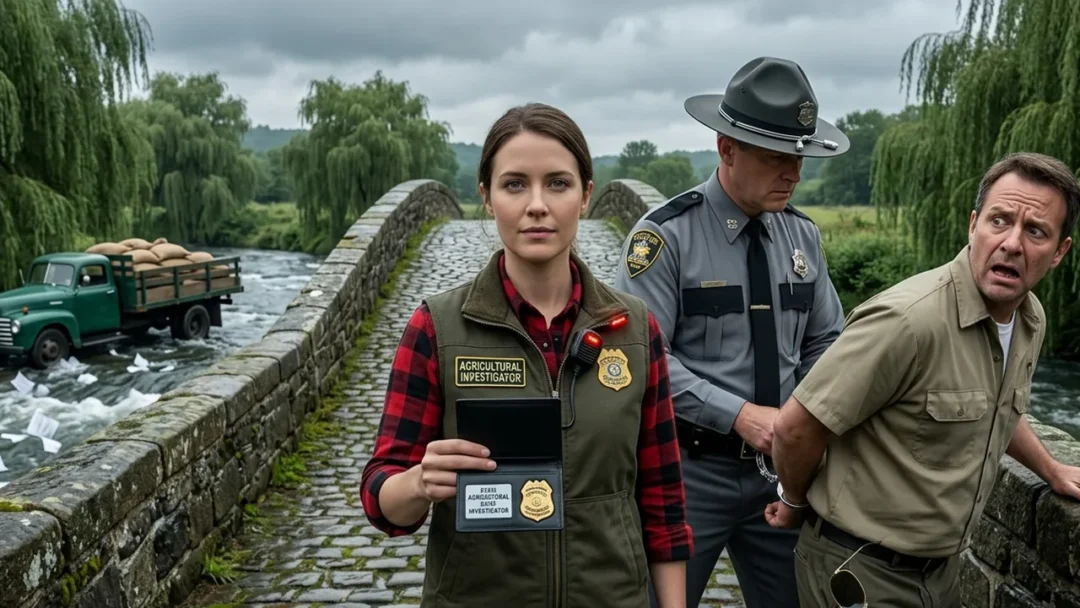
The morning mist hung low over the South Fork of the Shenandoah River, curling like frayed white fleece through the weeping willows that clustered along the limestone bluffs. Where the county road narrowed to squeeze between two moss-covered rock ledges stood Cedar Run Bridge, an antique three-arch span constructed of rough-cut Virginia dolomite in eighteen-eighty-two. The river below rushed with cold mountain runoff, churning into green-white foam around the stone piers before sliding under the dark shadow of the center arch.
A vintage forest-green International Harvester flatbed truck rumbled down the steep approach grade, its six-cylinder diesel engine clattering with heavy, rhythmic precision. In the truck bed, secured beneath heavy canvas tarpaulins and yellow ratchet straps, sat eighty fifty-pound burlap sacks of heritage Red May winter wheat, freshly milled at an independent water-powered gristmill three miles up the valley.
Behind the wheel sat Maya Sterling. She was thirty-two years old, with weathered, watchful dark eyes, her dark brown hair braided and tucked beneath a faded navy agricultural cooperative ball cap. She wore a washed-out flannel work shirt, a heavy canvas utility vest with brass snap closures, and muddy leather work boots resting against the worn steel floor pedals. On the passenger seat beside her lay a scarred aluminum clipboard holding a certified Virginia Department of Agriculture transit manifest and a small brass weight ticket.
As the truck’s front tires hit the damp limestone cobbles of the bridge deck, a yellow strobe light flashed violently from the far bank.
Blocking the single-lane bridge exit was a white township pickup truck bearing the decal CEDAR RUN TRANSIT & WEIGHT ENFORCEMENT. Leaning against the driver’s side fender was Lyle Higgins, the township’s chief agricultural inspector. Higgins was forty-eight, thick-necked and barrel-chested, wearing a sweat-stained khaki uniform shirt with an unauthorized silver badge pinned over his pocket, dark mirrored aviator sunglasses, and a heavy leather ticket pouch swinging from his brass-buckled belt.
Higgins stepped directly into the center of the narrow stone bridge, raising a red-painted wooden paddle marked STOP.
Maya eased the truck to a halt ten feet from his boots, setting the mechanical parking brake with a sharp, ratcheting clank. She rolled down the crank window, resting her left arm on the steel door sill as the damp, mineral scent of river mist drifted into the cab.
“Morning, Inspector,” Maya said evenly.
Higgins didn’t reply immediately. He took a slow, theatrical lap around the green flatbed, rapping his knuckles against the wooden side-rails and squinting at the burlap sacks. When he returned to the driver’s window, his mouth was twisted in an arrogant, mocking sneer.
“Engine off, farm girl,” Higgins barked, propping one dusty boot on the truck’s steel running board. “Let’s see your commercial weigh slip, your transport manifest, and your township bridge clearance endorsement.”
Maya reached over, picked up her clipboard, and handed it through the window. “Weight slip is from the certified scales at the cooperative elevator in Luray. Tare weight is eight thousand four hundred; gross is twelve thousand four hundred. Four thousand pounds under the posted bridge limit of eight tons.”
Higgins took the clipboard, glancing at the crisp white papers for less than two seconds. He tapped the laminated county seal with a dirty thumbnail. “This weigh slip is signed by a county scale master. But Cedar Run Bridge is an independent township structure under municipal jurisdiction. My town council passed an ordinance three weeks ago: no agricultural vehicle carrying bulk grain crosses this stone without a Cedar Run Bridge Weight Endorsement.”
“I checked the State Department of Transportation register before dispatching from Luray, Inspector,” Maya said calmly. Her voice was quiet, steady, and devoid of fear. “Cedar Run Bridge is classified as a Secondary State Highway connector under Commonwealth code. Municipal townships have no statutory authority to levy independent transit fees on agricultural food products.”
Higgins leaned closer, his face inches from the window, breathing the stale smell of cheap tobacco and black coffee into the cab. “You want to quote state law to me out here on the river, girl? Let me tell you how law works in this township. The bridge belongs to the township. The badge on my chest says I decide what rolls across it. And my clearance fee is two hundred dollars. Cash. Right now. Or you turn that green heap around and drive thirty miles south through the mountain gap.”
“I don’t carry two hundred dollars in cash,” Maya said. “And the Commonwealth prohibits off-the-books cash transactions at transport checkpoints.”
Higgins chuckled, a dry, grating sound that bounced off the stone parapet. “Is that right? Well, let’s see how much your high-and-mighty Commonwealth helps you get this flour to the bakeries in Front Royal before the morning bids close.”
With a sudden, violent twist of his thick forearms, Higgins snatched the transit manifest and the certified weight slip off the aluminum clipboard. He clamped his hands together and ripped the heavy bond paper cleanly in half with a sharp, dry tearing sound that echoed across the water.
Before Maya could speak, Higgins stepped to the edge of the stone parapet, held his hands over the twenty-foot drop, and let the torn white pieces go.
The paper fragments fluttered through the river mist like broken white moths, hit the churning green current beneath the stone arch, and were swallowed instantly by the roaring mountain water.
“Oops,” Higgins laughed, resting his hands smugly on his leather duty belt. “Looks like you don’t have a valid transport manifest anymore. That makes this load an undocumented, uncertified agricultural hazard under township code. Step out of the truck, girl. I’m impounding this vehicle and selling that wheat at the county auction.”
Maya did not panic. She did not yell. Her breath remained slow and rhythmic. Slowly, she reached down to the hem of her canvas vest, unbuttoning the left breast pocket.
From the northern riverbank behind Higgins, the deep, thunderous wail of an electronic siren split the morning silence. A sharp grey Ford Interceptor sedan bearing the blue and gold insignia of the Virginia State Police tore onto the bridge deck, its blue LED strobes flashing with blinding intensity against the damp limestone walls.