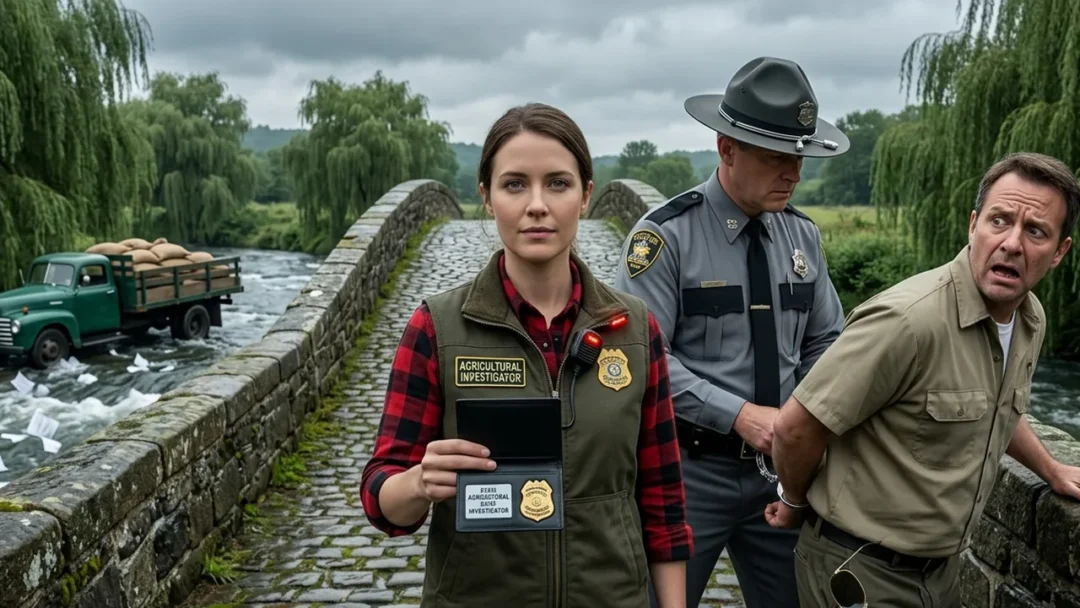
The Stone River Bridge Toll And The State Investigator Shield
CHAPTER 7: THE FREEDOM OF THE RIVER
Maya didn’t wait for the courtroom to clear. She sprinted down the marble steps of the courthouse, jumped into Trooper Ross’s cruiser, and grabbed the radio mic.
“Convoy Lead, this is Agent Sterling! Hold all trucks at the southern bridge approach! Repeat, hold all vehicles until structural integrity is verified!”
“Maya, this is Thomas!” her father’s voice came crackling back through the speaker. “We’re already at the river! The state highway engineers are down in the gorge right now with ultrasound sensors!”
Ten minutes later, the cruiser slid to a halt at the southern approach of Cedar Run Bridge.
The late afternoon sun was beginning to slant across the Shenandoah River in brilliant shafts of amber and gold, painting the white water around the limestone piers in shades of molten bronze. Lined up along the approach road for nearly two miles were forty independent farm trucks: vintage green flatbeds, polished tandem haulers, and family grain wagons, their engines purring in patient, disciplined rows.
At the center of the stone bridge, Chief Structural Engineer Marcus Vance—Arthur Vance’s estranged cousin who had refused to sign fraudulent inspection reports ten years earlier—climbed up the iron ladder from the river pier, wiping limestone dust from his hard hat.
Maya ran onto the cobblestone deck. “Marcus! Did Arthur sabotage the keystones? Can the bridge support the harvest?”
Marcus wiped his brow with a bandana, a broad, triumphant grin spreading across his sun-weathered face. “Arthur didn’t sabotage the bridge, Maya. He lied about the bridge to keep the farmers from knowing the truth. The keystones were reinforced with solid granite core pillars during the WPA restoration in 1936! This bridge wasn’t failing—it was rated for eighty thousand pounds gross vehicle weight! Arthur Vance fabricated the five-ton weight limit out of whole cloth so he could force every farmer to either pay his extortion toll or sell their harvest to Blue Ridge Milling at ten cents on the dollar!”
A collective gasp swept through the hundreds of farmers and valley residents gathered along the riverbanks, followed instantly by a deafening, euphoric roar of cheers.
“The bridge is rock-solid, Maya,” Marcus said, handing her a certified green Commonwealth Bridge Safety Certificate stamped with the state seal. “She can take anything the Shenandoah can throw at her.”
Maya took the certificate, feeling the weight of three generations of struggle lift from her shoulders. She turned and walked down the bridge approach toward the head of the convoy, where her father’s vintage green International Harvester sat rumbling at the front of the line.
Thomas Sterling leaned out the cab window, his weathered eyes shining with tears of fierce pride. “Is she clear, Maya?”
“She’s clear, Dad,” Maya said, climbing up onto the passenger running board and swinging open the heavy metal door. “And she belongs to the Commonwealth forever.”
Maya sat in the passenger seat beside her father. Thomas shifted into first gear, eased his work boot off the clutch, and pressed down on the throttle.
The heavy flatbed rolled forward, its wide tires humming smoothly as they met the historic cobblestones of Cedar Run Bridge.
Behind them, one by one, forty trucks followed in single file. The thunderous, joyful blast of forty air horns erupted simultaneously, rolling down the river gorge and reverberating off the Blue Ridge bluffs like a hymn of absolute liberation.
Standing along the parapets where Lyle Higgins had set up his extortion checkpoint that morning, children and families waved flags and tossed wildflowers onto the hoods of the passing trucks. Two state highway department workers with heavy pneumatic wrenches were unbolting the crooked municipal weight sign and hauling it into the bed of a state utility truck to be melted for scrap. In its place, bolted permanently into the granite parapet, was a gleaming bronze historical plaque:
THE CEDAR RUN AGRICULTURAL CORRIDOR
ERECTED 1882 – FREED BY THE PEOPLE 2026
DEDICATED IN PERPETUITY TO THE INDEPENDENT FARMERS OF VIRGINIA
WHERE NO ARBITRARY TOLL SHALL EVER BAR THE FRUITS OF HONEST LABOR
As the green International Harvester reached the exact center of the stone span, Maya looked out the open window into the rushing water twenty feet below. In the clean mountain current, there was no sign of the ripped manifests or fraudulent citations of the past. The Shenandoah was running crystal-clear over the riverbed, rushing forward to the sea—unstoppable, untamable, and free.
Thomas reached up and pulled the air horn cord in the cab ceiling, letting out one last long, triumphant blast that echoed across the valley into the golden dusk, announcing to the entire Commonwealth that the road was finally open.