The Broken Hive Beside Briarwood’s Perfect White Fences
CHAPTER 1: THE CLUB AGAINST THE HIVE
The morning breeze across the rolling limestone hollows of Maryland’s Piedmont smelled of damp white clover, sweet nectar, and wet granite. At the edge of Cloverlight Farm, sixty-six-year-old Arthur Bell stood in his white cotton apiary veil and goatskin gauntlets, quietly lifting a cedar frame from the brood chamber of Hive Number Seven. Beside him, his sixteen-year-old granddaughter, Maya Bell, held a smoldering brass smoker tin, sending gentle puffs of cool white pine-needle smoke across the hive entrance to calm the forty thousand Italian honeybees humming inside.
Arthur had kept bees on this twenty-acre heritage meadow for forty years. His late wife, Eleanor, had planted the sweet clover, wild bergamot, and heritage orchard that made Cloverlight Farm a state-certified pollinator sanctuary. But fifty yards across the eastern survey ditch, the peaceful pasture ended abruptly at a line of gleaming, pressure-treated vinyl fencing. Beyond it sat Briarwood—a ninety-acre luxury subdivision of five-thousand-square-foot brick colonials, manicured rye-grass lawns, and artificial ornamental ponds.
A sudden, sharp slamming of a golf cart door broke the meadow’s humming quiet.
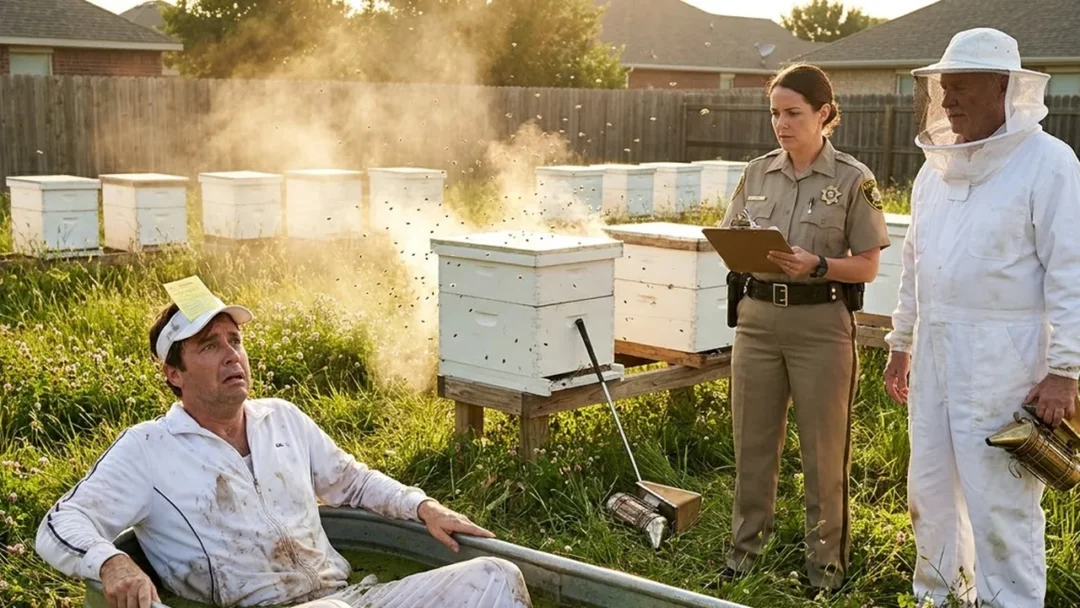
Nolan Price, the forty-five-year-old president of the Briarwood Homeowners Association, came marching through the waist-high sweet clover toward the apiary fence. He wore an immaculate white designer tracksuit, reflective tennis visor, and spiked golf shoes that tore through the wildflower roots. In his right hand, he gripped a titanium-headed driving iron like a combat baton.
“Get these filthy insects off my property line, old man!” Nolan yelled, his voice shrill, breathless, and shrill with theatrical rage. He stopped five feet from the hive row, waving his golf club wildly through the air, clipping the heads off purple clover blossoms. “I have two private landscape crews spraying my fairways, and your bug boxes are swarming across my perimeter! I don’t pay six thousand dollars a year in HOA dues to have venomous pests terrorizing my family pool!”
Arthur did not rush. At sixty-six, his hands had the steady, patient rhythm of a man who worked with living colonies that lived by the pulse of the sun. He slid the wooden brood frame back into its cedar groove with microscopic gentleness, turned slowly, and looked at Nolan through the black wire mesh of his veil.
“The bees aren’t swarming, Mr. Price,” Arthur said, his voice calm, low, and quiet. “They’re foraging on sweet clover. Cloverlight Farm has been a registered agricultural apiary with the Maryland Department of Agriculture since 1984. My bees have a legal right to fly the state pollinator corridor.”
“I don’t give a damn about your agricultural paperwork!” Nolan roared, his face flushing crimson against his white visor. “I called Animal Control forty minutes ago! I told them you have a vicious, uncontained swarm threatening residential human life! When the county gets here, they’re going to exterminate every wooden crate in this field!”
Nolan lunged forward across the low drainage furrow. Ignoring Arthur’s raised hand, he planted his spiked shoe against Maya’s brass smoker tin resting on the turf and kicked it hard into the tallgrass. Sparks and smoldering pine needles scattered into the dirt.
“And to make sure your inspector sees how dangerous this is,” Nolan barked, “let’s see how friendly your bugs are when someone knocks on their door!”
With a vicious, two-handed baseball swing, Nolan brought the heavy titanium golf club down against the front wooden corner of Hive Number Seven.
The sharp, explosive crack of splitting pine timber echoed across the meadow. The impact sheered the wooden foundation runner, tilting the top brood box thirty degrees askew. The inner cover cracked open, breaking the bees’ airtight propolis seal in a single violent shockwave.
Arthur froze, his hand snapping out to pull Maya behind his back. “Stand still, Maya. Do not move a muscle.”
For half a second, there was silence. Then, a sudden, terrifying rising hum filled the air—not the gentle, harmonic drone of foragers, but the high-pitched, furious electric buzz of thousands of guard bees defending their queen. A dark cloud of agitated bees poured from the ruptured seam, spiraling into a tight, defensive funnel directly above the shifted lid.
Nolan took one look at the dark, buzzing cloud hovering two feet from his face, and his smug arrogance evaporated into blind, animal panic. He dropped the titanium club, threw both arms over his unvested head, and let out a blood-curdling shriek.
“They’re attacking me! They’re stinging me!” Nolan screamed, flailing his arms like a windmill, which only drew the guard bees closer.
He spun on his spiked shoes and bolted blindly across the meadow toward the safety of his subdivision fence. But in his terror, Nolan didn’t watch his footing. Ten yards from the ditch stood a heavy, eight-foot galvanized steel cattle water trough, filled to the brim with three feet of stagnant, murky rainwater and green duckweed.
Nolan hit the muddy bank, his spiked shoes slid on the slick clover sod, and he launched forward headfirst into the open trough with a massive, thundering belly flop.
A geyser of brown, muddy swamp-water, rotting weeds, and duckweed exploded over the meadow, drenching his pristine white tracksuit in foul-smelling mire. Nolan plunged under the water, sputtering, gasping, and surfacing with thick green slime dripping from his nose, his white visor floating upside down like a dead lily pad.
From the gravel farm drive, a green state truck had just pulled to a stop.
Officer Kayla Brooks, a thirty-seven-year-old agricultural protection officer with the state enforcement division, stepped out of her vehicle carrying an official citation clipboard and wearing her duty body camera. She walked calmly to the edge of the galvanized trough, looked down at Nolan wallowing in the brown muck, and tilted her head.
“Sir,” Officer Brooks said, her voice dry, crisp, and deadpan. “Honeybees are protected agricultural pollinators under Section 9 of the Maryland Agricultural Code. Damaging a registered, state-inspected apiary without protective equipment is a mandatory fifteen-hundred-dollar citation.”
Officer Brooks unclipped a yellow carbon-copy summons from her clipboard, leaned over the water, and tucked the wet ticket under the strap of Nolan’s floating visor.
Arthur adjusted his veil, walking slowly over to the trough with Maya. “Stay under for another ten minutes, neighbor,” Arthur said with a faint, polite smile. “They’re still looking for the man who brought the golf club.”
Nolan whimpered from the bottom of the trough, pulling duckweed from his chin as the guard bees slowly returned to their damaged hive.
Maya knelt by the ruptured hive stand to inspect the foundation. But as she lifted the displaced bottom board, she noticed something that made her breath catch in her throat.
Scattered across the grass beneath the tilted entrance were hundreds of worker bees. They had not been killed by Nolan’s golf club. Their wings were locked in tight, rigid tremors, their tongues extended in fatal convulsions, and a faint chemical odor smelling of industrial almonds drifted from the brood comb.