The Broken Hive Beside Briarwood’s Perfect White Fences
CHAPTER 3: WIND FROM BRIARWOOD
The sun sank behind the Catoctin Mountains, casting long, bruised shadows across Cloverlight Farm. In the quiet honey house, Maya Bell sat at her laptop, surrounded by printouts of weather telemetry and micro-meteorological sensor logs.
“I pulled the sonic anemometer data from our weather station on the barn roof,” Maya said, pointing her pencil at a colorful velocity vector graph. “At 6:30 AM yesterday—when the white tanker trucks were idling on the Briarwood fairway—the prevailing wind wasn’t blowing from the west. We had a ten-knot thermal inversion blowing directly from the northeast, straight across their manicured turf toward our hives.”
Arthur adjusted the wick on the kerosene lamp, the warm amber light reflecting off his reading glasses. “Pesticide drift. If they sprayed turf drenches during an inversion, the aerosol droplets wouldn’t settle on the grass. The cold air layer would carry the chemical cloud three hundred yards down into our hollow, right into the flight path of our morning foragers.”
“It’s worse than drift,” Dr. Simone Reed said, walking in from the gravel drive holding a printout from the university mass spectrometer. “The lab results just came back from College Park.”
Arthur and Maya leaned in close.
“The compound recovered from Hive Seven is Bifenthrin-Pro Ultra,” Dr. Reed said, tapping the peak analysis on the graph. “Concentration: eight hundred parts per billion. That is forty times the lethal threshold for honeybees. And look at the carrier additive: an industrial sticking agent formulated exclusively for commercial drainage swales to prevent wash-out during heavy rain.”
“Why would someone spray drainage-grade sticking agent on a residential golf lawn?” Maya asked.
“Because they weren’t trying to green their grass,” Arthur said quietly, his voice heavy with revelation. “They were spraying the culvert that empties into our meadow.”
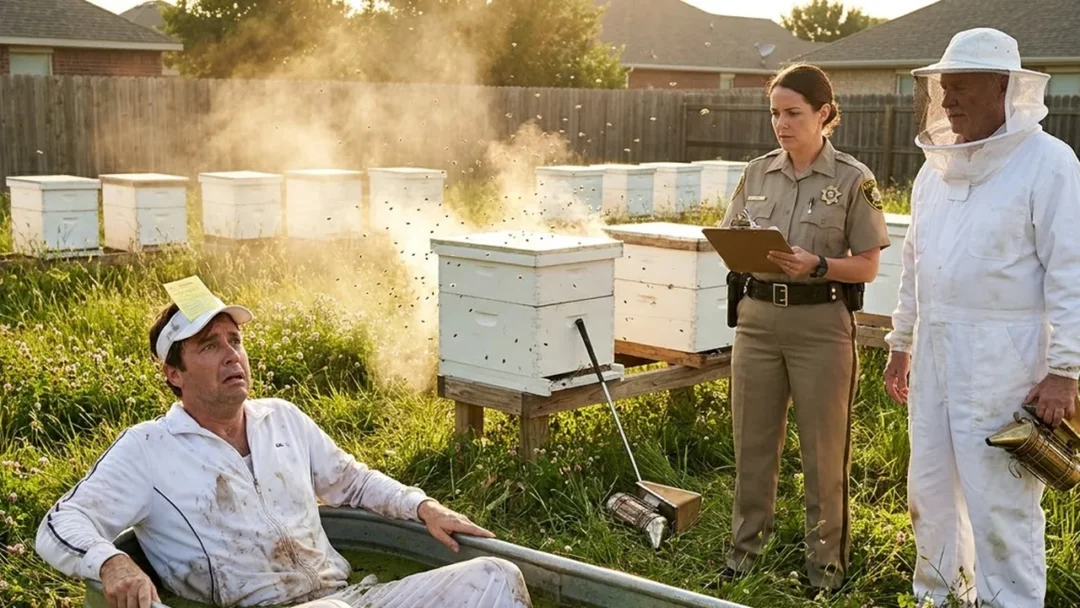
Officer Kayla Brooks stepped through the door, her uniform jacket damp with night mist. “I just did a drive-by of Briarwood’s maintenance yard. Both white tanker trucks are gone. But I checked the county land records office before it closed.”
Brooks spread a large blueprint map across the honey extraction table. It was the master civil engineering plat for the Briarwood Phase Three expansion.
“Look at the drainage calculations,” Brooks explained, tracing a blue line from the center of the subdivision toward the property line. “Briarwood was permitted for two hundred homes on the condition that they construct an eight-acre retention basin to handle stormwater runoff. Without that basin, the county stormwater division won’t sign off on their final occupancy permits for Phase Three. That’s thirty million dollars worth of luxury homes sitting unsold.”
“Where is the eight-acre basin supposed to go?” Maya asked.
Brooks pointed her finger squarely at the center of the map.
The blue line crossed the property fence and terminated in the heart of Cloverlight Farm’s twenty-acre sweet clover meadow.
“Celia Ward’s engineers drew the retention basin right over our hives,” Arthur whispered.
“Ward applied to the county commissioners two months ago for an agricultural condemnation,” Brooks said. “She claimed the meadow was an underutilized flood plain necessary for regional public safety. But the State Department of Agriculture rejected her application because Cloverlight Farm is a certified, active pollinator sanctuary protected under the Maryland Heritage Farmland Act.”
“So if the sanctuary is destroyed,” Maya realized, her voice trembling with anger, “if the bees are declared an aggressive public health hazard and eradicated by the health department, the sanctuary status is automatically revoked!”
“And Celia Ward gets her retention basin for free through municipal eminent domain,” Dr. Reed finished.
A sudden, low metallic rumble vibrated through the floorboards of the honey house.
Arthur extinguished the kerosene lamp with a quick turn of his fingers. In the darkness, they moved to the screened window overlooking the eastern boundary.
Across the drainage ditch, in the pitch-black shadows of the subdivision tree line, two sets of halogen headlights switched on. A heavy flatbed commercial truck with a hydraulic crane had pulled onto the grass behind Nolan Price’s vinyl fence.
In the headlights’ glare, Nolan Price stood on the grass, pointing toward Hive Number Seven, while two men in heavy industrial respirators began unrolling a thick yellow hose from a high-pressure pump.