The Magnetic Sweeper And The Blue Chalk Footprint Trail
CHAPTER 1: THE SHADOW ON THE CURB
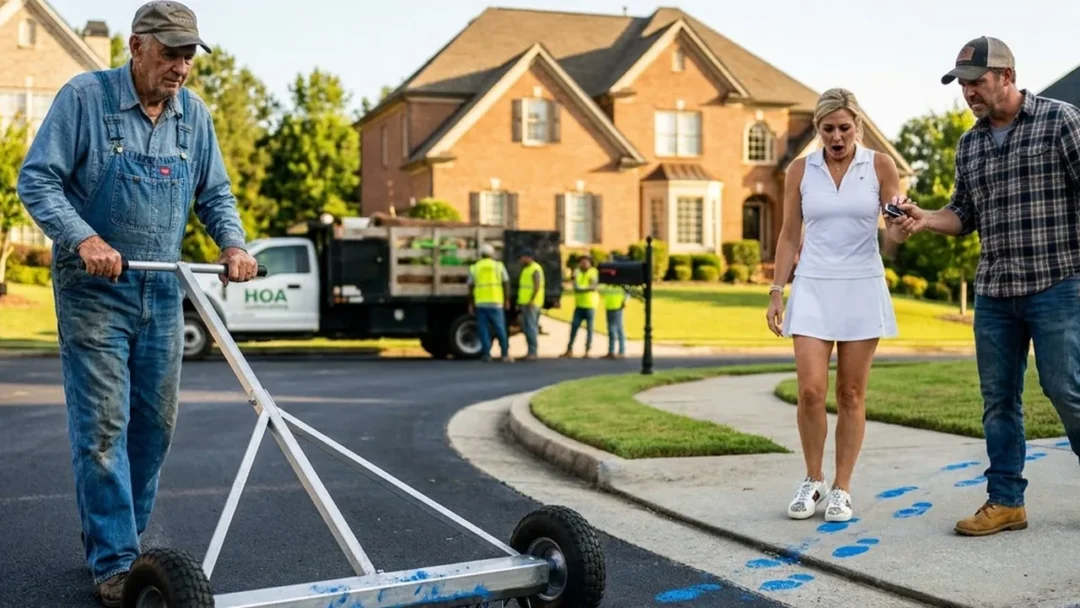
The gentle Georgia morning sun filtered through the spreading, moss-draped branches of mature live oaks, casting dappled emerald shadows across the perfectly manicured bermuda turf of Magnolia Glen Estates. At seventy-five years old, Arthur Pendelton found his greatest peace in the quiet discipline of his front garden. To a man who had spent four decades inside the hum of climate-controlled defense plant cleanrooms, the tactile simplicity of moist loam, earthworms, and sun-warmed cedar bark was a sanctuary. In machine shops, a single vibration in a lathe headstock could ruin a titanium wing spar worth thirty thousand dollars; here among his perennials, nature grew according to patient, organic blueprints that required nothing more than gentle water and steady stewardship. Dressed in faded denim overalls, heavy split-cowhide work gloves, and a soft twill field cap, he knelt on a closed-cell foam kneeling pad, carefully pruning the spent blooms from his prized heirloom blue hydrangeas.
For forty-four years, Arthur had worked as a precision machinist and tool-and-die maker for Lockheed Martin in Marietta, fabricating components for heavy transport aircraft where tolerances were measured in ten-thousandths of an inch. That lifelong training in mechanical observation had never left him. He noticed the minute details of his surroundings: the steady, low-frequency vibration of the municipal transformer down the street, the slight oil sheen on the asphalt from a passing delivery van, and the sharp, rhythmic rustle of the ornamental pampas grass dividing his driveway from the property next door.
Across that property line lived Brenda Holloway.
At forty-nine, Brenda was the self-appointed moral and aesthetic arbiter of Magnolia Glen. Married to Greg Holloway, a successful commercial roofing contractor whose work vans were constantly in transit across the Atlanta metroplex, Brenda spent her days monitoring the cul-de-sac from behind plantation shutters. Her life was a rigid ledger of perceived slights, social grievances, and neighborhood violations. She kept a leather-bound binder filled with dates, times, and unauthorized paint swatches, measuring grass blades with a clear plastic ruler when she suspected a neighbor had let their turf exceed the mandatory three-inch HOA ceiling. Her obsession with absolute control was not merely a hobby; it was an aggressive campaign to dominate the cul-de-sac through intimidation. She was a woman driven by a corrosive, all-consuming resentment. Two weeks earlier, Arthur had politely declined her demand to remove his antique copper rain gauge from his front porch railing—a refusal that Brenda had treated as a personal act of insurrection against her social authority.
Down the gentle curve of the cul-de-sac, the low, mechanical rumble of a commercial diesel engine announced the arrival of the Magnolia Glen HOA grounds maintenance crew. A heavy white Ford F-450 flatbed truck, hauling a twenty-foot tandem-axle trailer loaded with commercial zero-turn lawnmowers, heavy gas weed-trimmers, and steel edgers, pulled to a stop along the curb directly opposite Arthur’s driveway.
The driver’s door opened, and Carl Jenkins, the overworked grounds supervisor, climbed out with a clipboard in hand, motioning to his two crewmen to begin unloading the heavy mowers.
Arthur smiled, nodding politely across the street. “Morning, Carl. Warm one coming today.” Arthur appreciated Carl’s steady, uncomplaining demeanor. Carl was a former Marine who had served two tours in the Helmand Province before returning home to Cobb County to build his business; he was a man of few words who valued punctuality, disciplined execution, and fair dealing. In an upscale suburban enclave where homeowners routinely called the police over stray leaves or misplaced trash cans, Carl and Arthur shared an unspoken mutual respect rooted in their common background of manual discipline.
“Always is in August, Mr. Pendelton,” Jenkins replied, wiping his brow with a blue bandanna before walking toward the rear trailer ramp. Jenkins was thirty-two years old, carrying the crushing weight of a family landscaping business that had recently secured the master contract for the Magnolia Glen community. Every month, he balanced razor-thin profit margins against equipment depreciation, rising two-stroke oil prices, and the relentless demands of the HOA board. A single catastrophic equipment failure on a commercial zero-turn mower or a blown set of trailer tires could wipe out an entire week’s operating margin, leaving him struggling to meet payroll for his crew.
Arthur returned his attention to his hydrangeas, his pruning shears making clean, crisp snips. He did not look up, but his peripheral vision caught a sudden, darting movement from the adjacent driveway.
Brenda Holloway was emerging from the side door of her three-car garage. She was dressed in an expensive, tennis-club outfit: a sleeveless white pleated tennis dress, a matching white visor, and pristine, chalk-white designer running sneakers with thick athletic soles. In her arms, she cradled a heavy, rectangular cardboard carton with both hands, clutching it close to her chest like a stolen prize.
She did not walk along the public concrete sidewalk. Instead, she slipped along the shadow of her privacy hedge, her eyes darting nervously toward the landscaping truck, then toward Arthur’s bent back.
Curiosity Lock: As Brenda reached the curb directly behind the rear dual tires of the maintenance truck, Arthur noticed that the bottom of the cardboard box in her hands was leaking a fine, electric-blue powder that puffed across her white shoes with every nervous step she took.