The Quarantined Orange Grove And The Battalion Of Golden Wasps
CHAPTER 1: THE RED MARK ON VALENCIA
The morning sun climbing over the Topatopa Mountains cast a harsh, amber glare across the terraced orchards of the Ojai Valley, illuminating a scene of quiet devastation. Beneath the towering stands of fifty-year-old eucalyptus windbreaks, five thousand ancient Valencia orange trees stood in thirty-foot-wide rows, their broad emerald leaves drooping under the relentless summer heat. But it was not drought that threatened the grove. Across the lower canopy of every single tree, the waxy green leaves and ripening golden citrus fruits were coated in an unsightly, calcified crust of reddish-brown bumps—millions of California red scale insects, Aonidiella aurantii, encrusting the bark like an infectious leprosy.
Leo Alvarez stood in row twelve, his calloused hands trembling slightly as he held a pruning shear he had carried for forty years. Leo was sixty-two years old, with deeply lined, sun-bronzed skin, thick silver hair, and shoulders shaped by decades of hoisting eighty-pound field boxes of citrus fruit. The citrus micro-climate of the Ojai Valley was one of the most celebrated horticultural anomalies in North America. Tucked into an east-west trending transverse basin where coastal fog from the Pacific mingled with dry, baking desert winds funneled through the Sespe wilderness, the temperature differentials created fruits with an exceptionally high sugar-to-acid ratio. For nearly a century, the Alvarez groves had operated as a model of dry-farmed organic viticulture and citrus production. The elder trees had developed thirty-foot root systems that reached down into ancient subterranean gravel aquifers, requiring only minimal supplemental irrigation during peak summer months. To see these magnificent living monuments marked for commercial cremation was an unspeakable tragedy for the entire valley.
These particular Valencia trees were budded onto sour orange rootstocks imported from Spain in the late nineteenth century, providing exceptional resistance to soil-borne Phytophthora root rot and high calcium carbonate tolerance. Their deep taproots anchored the fragile hillside soils against winter erosion, serving as a vital environmental buffer for the entire valley watershed.
His family had cultivated these sixty acres since his grandfather had arrived from Jalisco in nineteen-twenty-six, hand-digging the stone irrigation channels that still channeled snowmelt down from the mountain flumes.
A sharp, abrasive hiss echoed down the orchard lane.
Vance Sterling, senior agricultural quarantine officer for Ventura County, stepped around the front fender of his official white state pickup truck. Sterling was fifty-one, with thinning gray hair combed flat with pomade, small, calculating eyes behind gold-rimmed aviator glasses, and a clipboard clutched tightly in his left hand. In his right hand, Sterling held a commercial can of high-visibility scarlet spray paint.
Sterling walked up to the trunk of a magnificent, seventy-year-old Valencia tree whose branches were laden with hundreds of plump, sweet oranges. Without a word of warning or sympathy, Sterling pressed the nozzle. With a loud, sputtering hiss, he sprayed a massive, three-foot-tall scarlet “X” across the rough gray bark of the living tree.
“Stop it, Vance!” Leo yelled, stepping forward, his voice cracking with anguish. “That tree was planted by my father in nineteen-forty-eight! You don’t paint a condemned mark on a living tree while the fruit is still hanging!”
Sterling turned slowly, releasing the aerosol nozzle with an indifferent flick of his thumb. He looked past Leo toward the farmhouse, his mouth curling into a thin, bureaucratic sneer.
“I can paint whatever I want on an active quarantine vector, Alvarez,” Sterling said, tapping the manila folder on his clipboard. “The state entomology board confirmed the infestation on Tuesday afternoon. Red armored scale. It’s a class-A regulated agricultural pathogen under the California Food and Agricultural Code. Every chemical spray your contractor tried bounced straight off their shells. The wax armor is two hundred microns thick. The pest has colonized eighty percent of your south parcel.”
Sterling reached into his pocket and pulled out a formal legal document stamped with the gold seal of the State Department of Food and Agriculture. He thrust the paper into Leo’s chest.
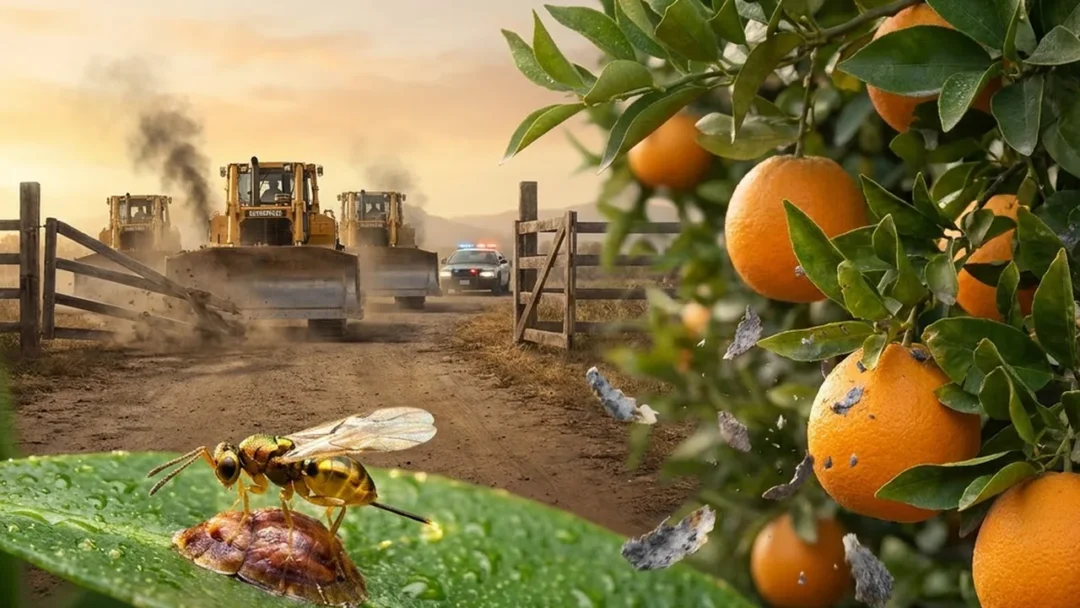
“Emergency Quarantine and Mandatory Abatement Order,” Sterling declared, his voice echoing across the quiet rows. “You have until Friday morning at eight o’clock to clear the premises. At eight-fifteen, three state-contracted D9 bulldozers will roll down this driveway. Every single one of these five thousand trees will be pushed into the center drainage wash, covered in diesel fuel, and incinerated in an open burn pit. If you interfere, county deputies will place you under arrest for obstructing emergency agricultural containment.”
For Leo, the orchard was far more than an agricultural enterprise; it was the sacred archive of his family’s history. Every single terraced row told a story. Here stood the block of blood oranges his older brother had bud-grafted before shipping out to Vietnam; there stood the sweet Lisbon lemons his mother had nurtured with goat manure and river compost during the great drought of seventy-seven. The stone packing barn, with its hand-chiseled sandstone lintels and heavy redwood rafters, had hosted three generations of family weddings, quinceañeras, and harvest celebrations. To think of heavy diesel tracks grinding these historic stones into dust was like watching his ancestors’ graves get desecrated.
Leo looked at the document. The demolition order was signed, sealed, and binding. If the trees were bulldozed, the Alvarez homestead was ruined. The family owed seventy thousand dollars in seasonal operating credit to the agricultural bank in Santa Barbara; without the harvest proceeds, the bank would foreclose on the underlying real estate before the ashes were cold.
“There has to be another way, Vance,” Leo pleaded, his throat tightening. “Let me bring in organic paraffin oil washes. Let me prune the lower canopy. Give me two weeks to flush the channels.”
“Paraffin oil is useless against a mature population,” Sterling scoffed, checking his gold wristwatch. “Sprays can’t penetrate their wax shields. My bulldozers arrive Friday at eight AM. Start packing your house, Leo.”
Before Sterling could turn back to his truck, the low, steady hum of an approaching electric vehicle broke the tense silence. A dusty gray Toyota Prius crested the gravel washboard of the driveway, pulling to a halt behind Sterling’s state cruiser.
The driver’s door swung open, and Dr. Sofia Alvarez stepped out onto the dusty soil. Sofia was twenty-eight years old, with sharp dark eyes, her hair gathered into a neat, practical bun beneath a canvas sun hat. She wore a pair of sturdy field khakis, scuffed hiking boots, and a lightweight white lab coat over an organic chemistry conference shirt. In her gloved right hand, she carried an insulated white Styrofoam laboratory cooler sealed with biological transport tape.
“Step away from that tree, Inspector Sterling,” Sofia said, her voice clear, sharp, and commanding as she walked toward the men.
Sterling turned, looking down his nose at her with a dismissive chuckle. “And who might you be, young lady? The family attorney?”
“Dr. Sofia Alvarez,” she answered, unbuttoning her lab coat to display her faculty credentials from the Department of Entomology at the University of California, Riverside. “Postdoctoral research fellow in insect biological control and parasitoid dynamics. And I’m Leo’s niece.”
Sofia set the Styrofoam cooler down on the tailgate of her uncle’s farm truck. She pulled off her sunglasses, looking Sterling dead in the eye.
“You have until Friday at eight o’clock to execute that abatement order under Section 5403 of the agricultural code,” Sofia said, her tone razor-sharp. “The statute explicitly mandates that a grower has the legal right to present an alternative non-chemical biological suppression protocol if certified by a state-accredited academic research institution. Give me until Friday at seven o’clock AM. My soldiers don’t need chemical sprays, and they don’t bounce off wax.”
Sterling stared at her, then glanced at the small Styrofoam cooler on the tailgate. A burst of contemptuous laughter erupted from his chest.
“You’re going to clear five thousand heavily infested trees with whatever is in that little picnic cooler?” Sterling scoffed. “You academics live in a fantasy world. What do you have in there, kid? Magic dust?”
Sofia did not smile. She rested her hand on the sealed lid of the cooler. “Ten thousand female Aphytis melinus wasps, Inspector. And they consider your armored scale bugs a four-star banquet.”