The Twenty Five Kilogram Chainsaw And The Walnut Timber Poachers
CHAPTER 1: THE IRON GUIDE-BAR
The deep afternoon shadows were lengthening across the Boston Mountain ridges of the Ozark National Forest, turning the dense canopy of ancient white oak, sugar maple, and shortleaf pine into a cathedral of dappled emerald light. In a secluded, limestone-terraced hollow five miles off the nearest paved county road in Newton County, Arkansas, stood a grove of old-growth American black walnut trees—Juglans nigra—that had rooted into the mineral-rich mountain soil before the Louisiana Purchase. Their dark, deeply furrowed trunks rose eighty feet into the sky, their crowns heavy with green-husked nuts, their basal root crowns swollen with the dense, swirling flame-grain burls that were prized above raw gold by international luxury veneer buyers.
Standing in the center of the clearing, beside the massive five-foot-diameter trunk of the matriarch walnut tree, was Silas Thorne. At seventy-five years old, Silas was a legendary Ozark high-lead timber cruiser, master sawyer, and retired state forestry warden who had spent fifty-eight years felling, bucking, and preserving the hardwood timber of the southern highlands. He stood six feet two inches tall, broad-shouldered and straight as a structural column, wearing heavy tin-cloth logger pants suspendered over a faded red-and-black wool logging shirt, a grease-stained canvas field cap, and ten-inch corked work boots that gripped the mossy mountain rocks with immovable stability.
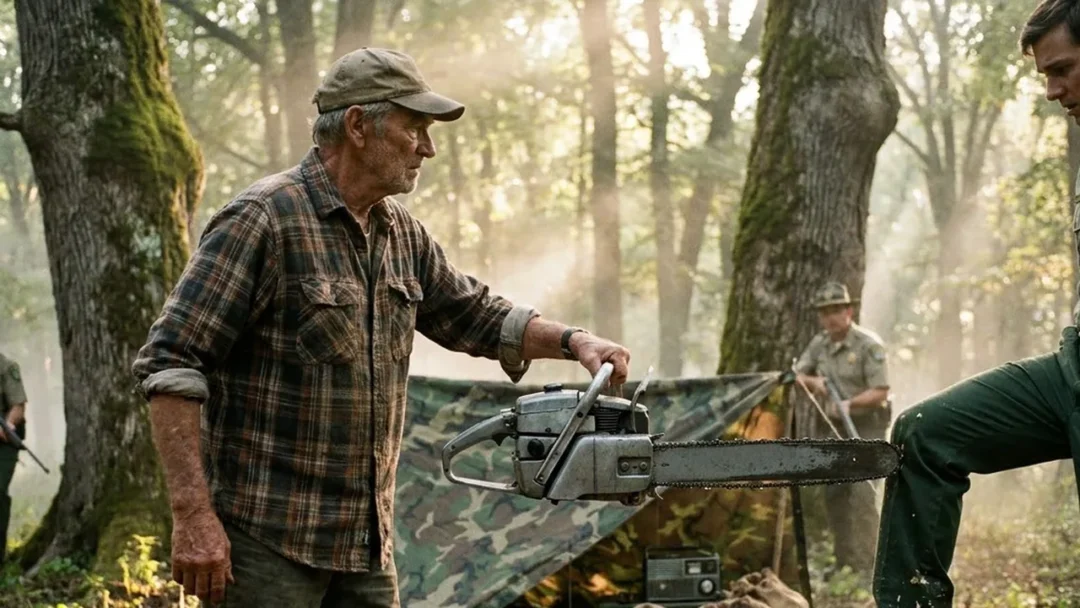
In his right hand, Silas held an extraordinary mechanical artifact of early American industrial logging: a vintage nineteen-forty-eight Mall Model 7 two-man commercial timber chainsaw. Fabricated from thick, cast aluminum-magnesium alloy, powered by a massive one-hundred-and-forty-cubic-centimeter two-stroke gasoline engine, and fitted with a solid four-foot carbon-steel guide-bar carrying a heavy three-quarter-inch pitch scratcher chain, the machine was a deadweight monster that weighed precisely twenty-five kilograms—fifty-five pounds—when dry. In modern forestry, such a saw required two burly lumberjacks to operate, one holding the throttle handle and the second guiding the idler grip at the tip of the bar.
Yet Silas was holding this twenty-five-kilogram machine with just one bare right hand.
He was not resting it against his thigh or balancing it on a stump. His right arm was extended straight out horizontally from his shoulder at chest height, parallel to the forest floor, holding the massive cast-aluminum motor and the four-foot steel guide-bar locked in mid-air like an oversized target pistol.
The biomechanical leverage required for such a hold was staggering. Suspending twenty-five kilograms thirty inches forward from the shoulder joint generated over two hundred foot-pounds of rotational torque across the anterior deltoid, pectoralis major, and serratus anterior muscles, while demanding an unyielding isometric grip from the extensor and flexor muscles of the forearm to prevent the heavy steel bar tip from dipping a single degree. For Silas, whose shoulders had carried heavy steel logging chokers, crosscut saws, and hydraulic jacks up forty-degree mountain ravines for six decades, his arm was as steady and immovable as a cantilevered crane boom.
Standing eight feet in front of him on the leaf-strewn clearing, holding an aluminum clipboard and wearing a crisp, brand-new olive-drab tactical uniform, was Clayton Vance.
Clayton was thirty-four, sporting a manicured beard, dark polarized sunglasses, and a United States Forest Service patch stitched to his left shoulder. Under his arm he clutched a legal-sized binder filled with laminated maps. At his hip hung a heavy tactical holster carrying a nine-millimeter semi-automatic sidearm.
“Look, old-timer, I’m ordering you to step away from that tree and clear the area immediately,” Clayton said, his voice flat, abrasive, and laced with rehearsed bureaucratic authority. “I am Special Agent Vance with the Department of Agriculture Forestry Inspection Division. This entire ridge has been placed under an emergency biological quarantine due to a sudden outbreak of Thousand Cankers Disease and the walnut twig beetle. All unauthorized civilians must evacuate this sector immediately. We are bringing in heavy commercial extraction equipment to clear and incinerate this entire timber stand for forest biosecurity.”
Silas did not blink. His pale blue eyes remained fixed on Clayton’s face, as calm and unhurried as the deep mountain pools of the Buffalo River. He did not lower the twenty-five-kilogram saw an inch.
“Thousand Cankers Disease, you say, son?” Silas asked softly, his voice carrying the deep, quiet resonance of the Ozark timber.
“That’s right, old man,” Clayton snapped, stepping forward and tapping his clipboard with a pen. “It’s a federal quarantine under Title Seven of the United States Code. If you don’t drop that obsolete museum piece and clear this hollow in sixty seconds, I’m placing you under federal arrest for interfering with an agricultural containment order!”
Silas smiled faintly, the weathered creases around his eyes deepening. “That’s a very fancy story, son. But when the state forestry department sets a quarantine line, they bring portable chemical sprayers and sterile sample bags. You brought four logging binder chains and a hydraulic wedge jack strapped to your four-wheeler down in the creek.”
Clayton’s jaw clenched, his hand drifting instinctively toward his holstered sidearm. “I don’t have to explain federal protocol to a trespassing hillbilly. Put the saw down!”
Silas did not lower the saw. Instead, with a microscopic, razor-sharp flick of his single right wrist, he guided the rounded tip of the four-foot solid steel guide-bar forward through the air.
SWISH.
The heavy steel bar tip stopped precisely one inch above the toe of Clayton’s left boot. Then, with the delicate, surgical touch of an old master craftsman who could skin a squirrel with an axe, Silas tilted his wrist upward by two degrees.
The steel tip caught the hem of Clayton’s crisp green uniform trousers, lifting the cuff three inches up his shin.
Exposed to the late afternoon sunlight, strapped tightly around Clayton’s lower leg over heavy leather pads, was a pair of heavy, forged-steel tree-climbing gaffs—vicious, razor-sharp three-inch steel spikes designed for vertical timber climbing. And stuck to the barbed steel tip of the spur were fresh, oily shavings of rich, purple-black wood—the unmistakable, aromatic heartwood of fresh black walnut.
“Real forestry rangers wear fire-resistant Vibram lug soles, son,” Silas said softly, the guide-bar tip holding the pant leg aloft without touching the man’s skin. “They don’t wear timber-poacher climbing spurs strapped to their shins. And they don’t have fresh black walnut bark stuck to their spikes.”
Clayton froze, his face draining of color as his eyes locked onto the massive four-foot saw blade hovering inches from his chest.
Silas did not wait for a reply. Still holding the twenty-five-kilogram saw steady with his right hand, he reached out with his left arm, grabbed the corner of a heavy digital-camouflage tarp draped over a dense blackberry thicket ten feet behind Clayton, and gave one violent, sweeping yank.
WHOOOOOOSH!
The tarp tore free from the thorns, fluttering to the forest floor.
Revealed beneath the branches was an illegal timber staging depot: a portable gas-powered Alaskan chainsaw lumber mill, three stolen United States Forest Service commercial tactical radios, four heavy hydraulic timber jacks, and three burlap sacks overflowing with freshly harvested black walnut root burls—their swirling, feathered fiddle-back grain gleaming in the late afternoon sun, representing fifty thousand dollars in black-market veneer timber stolen from the national forest.
From the dark hemlock trees along the ravine crest, the metallic clatter of rifle bolts echoed through the clearing.
Stepping out from the brush with tactical carbines leveled was Senior Game Warden Hannah Cross and two uniformed tactical officers of the Arkansas Game and Fish Commission.
Silas lowered the heavy vintage chainsaw to his hip, nodding calmly toward the hemlocks.
“Found your walnut thief, Hannah,” Silas said. “He had his spikes on before the sun even went down.”
The physiological and mechanical forces exerted during a unilateral horizontal hold of a twenty-five-kilogram timber chainsaw represent an extreme manifestation of human musculoskeletal lever mechanics. In athletic kinesiology, suspending a fifty-five-pound mass at the extremity of a four-foot moment arm places an intense rotational torque upon the glenohumeral joint, demanding sustained isometric co-contraction of the anterior deltoid, the clavicular head of the pectoralis major, and the serratus anterior to lock the scapula against the thoracic ribcage. Concurrently, the carpal joint must resist severe ulnar deviation and downward flexion, requiring the radial wrist extensors—the extensor carpi radialis longus and brevis—to generate continuous tensile force exceeding four hundred pounds per square inch along the lateral epicondyle. For Silas Thorne, whose neuromuscular pathways had been forged through nearly six decades of manually wielding two-man crosscut saws and swinging five-pound falling axes across thirty-degree mountain slopes, his shoulder and forearm tendons possessed a dense, fibrous thickness comparable to seasoned mountain hickory. His respiratory cadence remained deep, rhythmic, and diaphragmatic, his core muscles providing an unyielding kinetic platform that transferred the gravitational load directly down through his spine and pelvis into the bedrock of the Boston Mountains.
The botanical uniqueness of American black walnut (Juglans nigra) root burls represents one of the most lucrative and fiercely contested resources in the global hardwood trade. Unlike ordinary straight-grained stem wood, a walnut burl forms as a result of abnormal cellular division triggered by microscopic environmental stressors, cambial injury, or localized viral agrobacterium infection occurring over decades. The xylem vessels, rather than ascending vertically in uniform vascular bundles, become contorted into tight, swirling, highly dense spherical nodes known as ‘bird’s eyes’ and ‘feathered flame’ figure. When sliced on specialized industrial rotary veneer slicers to a thickness of one-fortieth of an inch, walnut burl yields an exquisite, iridescent Chatoyancy that reflects light with an amber, holographic three-dimensional depth prized by luxury automotive manufacturers, bespoke yacht builders, and high-end gunstock artisans. Because an intact root burl from a mature two-hundred-year-old tree can weigh upwards of three thousand pounds and command twenty to fifty thousand dollars on international spot markets, organized poaching cartels have increasingly targeted old-growth national parks, using heavy four-wheel-drive equipment and silent climbing gaffs to sever the root crowns under the protective cover of dense mountain weather.
The engineering history of the Mall Model 7 chainsaw occupies a legendary place in the technological transition of mid-twentieth-century American logging. Introduced in nineteen-forty-seven by the Mall Tool Company of Chicago, the Model 7 was among the first commercially viable two-man gasoline-powered chainsaws deployed across the heavy hardwood and old-growth timber reserves of North America. Prior to its arrival, falling crews relied exclusively on six-foot manual crosscut saws—affectionately known as ‘misery whips’—and double-bitted felling axes. The Model 7, engineered with a massive, single-cylinder two-stroke engine displacing over eight cubic inches, produced five horsepower at three thousand revolutions per minute, transmitting torque through a heavy cast-iron reduction gearbox to a specialized scratcher chain running around a four-foot solid carbon-steel bar. Because the cutting assembly utilized a swiveling transmission that allowed the bar to be indexed ninety degrees for felling or bucking while the carburetor remained level, the machine was an awkward, front-heavy mechanical beast that punished any operator who lacked perfect anatomical leverage. To hoist and manipulate such an industrial relic with a single arm was not merely an athletic curiosity; it was an incontrovertible demonstration that the operator possessed the complete, unyielding mechanical mastery of an era when human strength stood toe-to-toe with primeval wilderness.