The Twenty Five Kilogram Chainsaw And The Walnut Timber Poachers
CHAPTER 2: THE AMBUSH AT THE HOLLOW
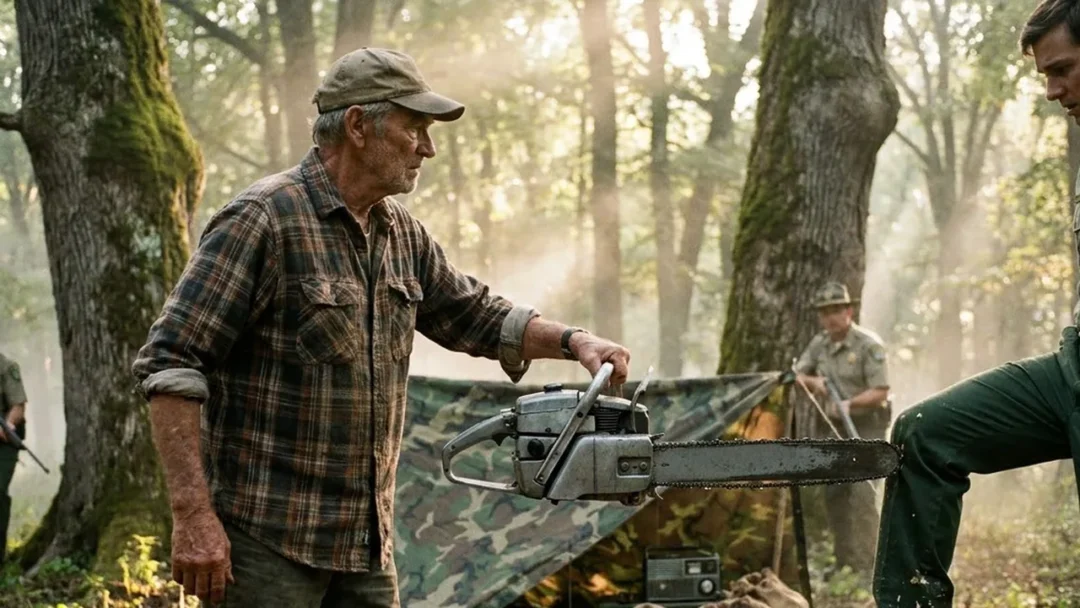
The clearing beneath the ancient walnut grove fell into absolute, breathless stillness. The late afternoon mist was beginning to swirl off the damp limestone bluffs, mingling with the rich, unmistakable scent of crushed pine needles, damp loam, and the spicy, tannic aroma of freshly severed black walnut heartwood.
Clayton Vance stood paralyzed between the hovering steel tip of Silas Thorne’s chainsaw and the three tactical rifles held by Senior Warden Hannah Cross and her team.
“Clayton Vance,” Hannah Cross’s voice cut through the mountain air like a cold blade. “Keep your hands away from your belt. Step three paces to your left, interlock your fingers behind your head, and drop to your knees.”
Clayton’s eyes darted frantically toward the shadowed ridge of the ravine to the north. His chest heaved with ragged breaths, his arrogance completely shattered.
“You don’t understand, Warden!” Clayton stammered, backing slowly away from the walnut tree. “I’m an independent contractor! I have a state salvaging permit issued by the county commissioners!”
“Your salvaging permit was forged in a print shop in Fort Smith, Clayton,” Hannah said, advancing across the clearing with her sidearm at low ready. “We have surveillance footage of your trucks unloading stolen timber in Missouri three nights ago. Drop to your knees right now.”
Suddenly, from the dense laurel thicket twenty yards up the northern ravine trail, the silence was shattered by the sharp, terrifying crack of a dry branch snapping under heavy boots.
“Look out, Hannah!” Silas roared.
Two armed timber poachers—clad in full camouflage ghillie jackets and muddy logging chaps—burst from the laurel cover. The lead poacher, a burly man with wild eyes, raised a short-barreled twelve-gauge pump shotgun, racking the action with an unmistakable metallic clack-clack, aiming directly at Hannah Cross’s unprotected flank.
The second poacher raised a heavy steel logging peavey, preparing to rush the state officers from the blind side.
Hannah began to pivot, but the sudden angle of the ambush gave the poachers a deadly tactical advantage. In that fraction of a second, before the game wardens could acquire a clear sight picture through the thick brush, Silas Thorne moved.
He did not pull a firearm. In fifty-eight years of timber work, Silas had learned that twelve pounds of unyielding American steel moved by human muscle was faster and more lethal than any mechanical trigger.
With an explosive extension of his legs and hips, Silas surged forward. He swung the massive twenty-five-kilogram Mall Model 7 chainsaw through a horizontal defensive sweep, using the four-foot solid carbon-steel guide-bar as an impenetrable physical barrier.
CLAAANG!
The hardened steel edge of the four-foot guide-bar struck the barrel of the poacher’s shotgun with the concussive force of an iron railroad rail. The impact tore the firearm violently from the poacher’s hands, shattering the man’s trigger finger and sending the weapon spinning twenty feet into the muddy ravine.
Without pausing to reset, Silas cycled his hips and drove the heavy, cast-aluminum motor casing of the chainsaw directly into the second poacher’s chest.
THUD!
The twenty-five-kilogram engine housing struck the man like a charging mountain steer, knocking the breath from his lungs with a sickening gasp and sending him tumbling backward down the rocky bank into a tangle of briars.
“Federal officers! Don’t move!” Hannah Cross shouted, stepping across the clearing and pinning the disarmed lead poacher to the earth with her knee, clicking stainless steel handcuffs around his wrists in three seconds flat.
Her tactical partner dropped into the ravine, disarming the second man and securing him with plastic flex-cuffs.
In the chaos of the sudden firefight, however, Clayton Vance had made his move.
He had sprinted through the dense brush on the southern perimeter, diving down an old abandoned logging skid trail that dropped steeply toward the rushing white waters of the Little Buffalo River.
Silas set the heavy Mall chainsaw on the ground beside the matriarch walnut tree, his breath steady, his pulse calm as the mountain bedrock.
“He’s heading for the old limestone caves at Blue Hole, Hannah,” Silas said, pointing with his calloused hand toward a narrow gap in the bluffs where the river vanished into a subterranean karst canyon. “He has an amphibious timber skidder stashed in the lower cavern.”
The tactical dynamics of close-quarters confrontation in dense mountain laurel thickets are dictated by terrain density and weapon clearance. In heavy Ozark underbrush, where mountain laurel (Kalmia latifolia) and wild rhododendron form dense, intertwined vegetative walls exceeding eight feet in height, a long-barreled firearm is severely compromised by foliage deflection and restricted pivoting angles. When the poacher raised his short-barreled twelve-gauge shotgun, he failed to account for the spatial arc required to acquire a clean sightline through the brush. By swinging the massive four-foot carbon-steel guide-bar of the Mall Model 7 chainsaw through a horizontal sweep, Silas utilized the fifty-five-pound mass of the industrial tool as an impenetrable ballistic deflection shield and kinetic lever. The flat steel surface of the guide-bar, fabricated from hardened high-carbon alloy steel heat-treated to fifty-eight Rockwell C, intercepted the shotgun barrel with sufficient concentrated kinetic energy to deform the barrel axis and strip the weapon from the poacher’s grip before the mechanical trigger sear could be engaged.