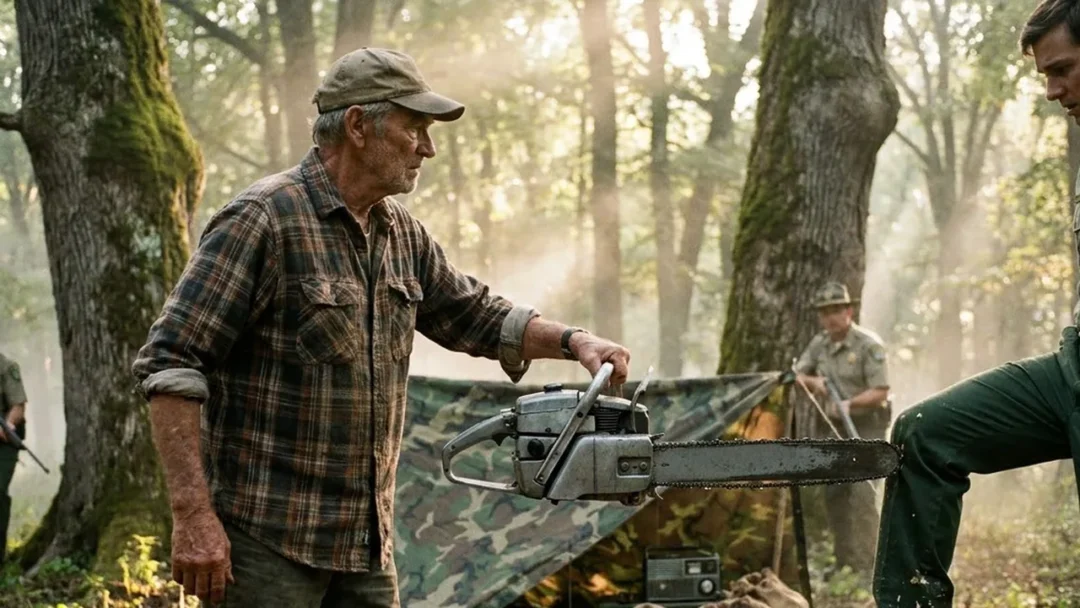
The Twenty Five Kilogram Chainsaw And The Walnut Timber Poachers
CHAPTER 5: THE RIVER STAND
The roar of the Little Buffalo River grew thunderous as Silas Thorne and Senior Warden Hannah Cross emerged from the lower mouth of the Blue Hole cavern onto the gravel bars of the main river valley. The sun had dipped completely behind the western rim of the Boston Mountains, casting the rugged Ozark gorge in an eerie, deep blue twilight.
Half a mile downstream, where the river flattened into a wide, boulder-strewn gravel ford used by logging trucks to access the state highway, a scene of desperate mechanical fury was underway.
Clayton Vance had reached his primary getaway vehicle: a massive, eight-wheel-drive articulated timber forwarder powered by a five-hundred-horsepower turbo-diesel engine. The enormous machine—its steel cage reinforced with heavy steel logging screens, its front grapple lowered like an iron claw—was churning through the three-foot-deep river current, sending massive sheets of white water spraying thirty feet into the twilight air.
Clayton was attempting to cross the ford and reach a commercial gravel quarry where an unmarked flatbed tractor-trailer was waiting to load the stolen timber burls and smuggle them across the state line into Missouri.
Standing on the rocky gravel bar on the far bank of the river, having navigated an old timber skidder shortcut along the ridge, Silas Thorne was already waiting.
Beside Silas stood his vintage nineteen-forty-eight flatbed Ford truck, parked horizontally across the gravel boat ramp. Tied to the truck’s heavy-duty rear pintle hook was a one-inch-thick, braided steel logging winch cable, its opposite end carrying a heavy, forged-alloy steel logging choker hook weighing forty pounds.
As Clayton’s massive timber forwarder surged out of the deep current, its eight massive tires grinding against the river gravel, Clayton spotted Silas standing in the road.
Clayton floored the diesel accelerator, revving the massive engine until black smoke bellowed from the vertical exhaust stack. He aimed the forwarder’s sharp hydraulic grapple straight at Silas’s truck, screaming hysterically over the roar of the diesel: “Get out of the way, old man! I’ll grind your truck into scrap metal!”
Silas did not flinch, nor did he run for cover.
In his right hand, Silas held the heavy, one-inch braided steel cable. Moving with the fluid, calculated precision of a veteran high-lead rigger who had thrown cable across mountain ravines for forty years, Silas stepped forward into the spray of the river.
As the forwarder reached within fifteen feet of the gravel bar, Silas whipped his right arm in an explosive, circular underhand swing.
WHIIIIISH!
The forty-pound forged steel choker hook flew through the air, snaking straight through the forwarder’s front wheel carriage. The heavy steel cable wrapped two tight loops around the main front drive axle and the steering tie-rod, locking the heavy steel hook into the vehicle’s planetary hub with an unyielding metallic snap.
CLANK-LOCK!
Clayton had no time to hit the brakes. The massive forwarder surged forward another six feet, instantly taking up the slack in the one-inch braided steel cable.
KA-CHUUUNK!
The reaction was catastrophic.
The one-inch high-test steel cable, anchored to the bedrock deadman that Silas had secured behind his flatbed, snapped drum-tight with a high-pitched acoustic whine. The immense forward momentum of the five-ton forwarder was brought to an immediate, violent halt.
The machine’s front drive axle seized instantly, the planetary steering knuckles snapping under the unyielding tensile resistance of the cable. The rear of the forwarder lifted three feet out of the water before crashing back down into the river with a deafening splash, its engine stalling in a boiling cloud of white steam.
Clayton was hurled forward against the steel protective cage, his forehead striking the wire mesh with a sickening crack. He collapsed onto the floorboards of the cab, dazed, bleeding, and completely defeated.
Silas walked calmly through the knee-deep river water, his corked boots gripping the slippery river stones with effortless balance. He reached up, opened the forwarder’s heavy steel door, and reached inside with one hand, hauling Clayton Vance out of the cab by his tactical vest and setting him flat on the wet gravel bar.
From the quarry road above, the flashing blue lights of six state police cruisers and federal game warden trucks illuminated the river in brilliant, triumphant hues.
Silas looked down at Clayton, his pale blue eyes reflecting the cold, unyielding dignity of the Ozark mountains.
“You can buy a uniform in a surplus store, Clayton,” Silas said softly. “You can buy a diesel truck and forged papers. But you can’t out-rig an old logger who knows every rock in this river.”
The mechanical physics of braided high-tensile steel wire rope deployed in industrial logging operations is governed by the principles of multi-strand rotational tension and catastrophic kinetic arrest. The one-inch wire rope utilized by Silas Thorne was a standard 6×19 IWRC (Independent Wire Rope Core) improved plow steel cable, engineered with six outer strands of nineteen individual cold-drawn wires wrapped around a central steel wire core, possessing an ultimate breaking strength exceeding eighty-four thousand pounds. When Silas whipped the forty-pound forged alloy choker hook into the articulated wheel carriage of the charging five-ton forwarder, the cable looped around the planetary hub, instantly transforming the vehicle’s own five-hundred-horsepower kinetic drive into a self-destructive torsional vise. Because the cable was anchored to a buried bedrock deadman—a four-foot structural oak timber wedged into a granite rock fissure—the tensile shockwave did not dissipate into the gravel bar. It reflected directly back through the machine’s drive-line, shattering the cast-steel steering knuckles and planetary gear teeth in less than one-tenth of a second.