The Midnight Camera In The Cedar Screen And The Dumped Bag
CHAPTER 1: THE CEDAR LATTICE ON THE DRIVEWAY APRON
The humid October breeze sweeping across Whispering Willows carried the sharp, sweet scent of crushed autumn leaves and damp pine needles, but fifty-eight-year-old David Miller was focused entirely on the grain of the wood. Standing at the western shoulder of his concrete driveway, David ran a calloused thumb across the smooth, chamfered corner of the cedar lattice screen he had installed three weeks earlier. The screen was built from three-quarter-inch clear Western red cedar, joined with waterproof polyurethane glue and tight mortise-and-tenon joints, framed by four-by-four posts anchored deep into galvanized steel ground sleeves. Tucked neatly behind the honey-colored lattice stood two standard sixty-four-gallon green municipal recycling and refuse bins, their lids closed tight, completely invisible from any angle along the public roadway.
David was a retired Navy shipwright who had spent twenty-four years repairing hull bulkheads and dry-dock rigging before opening an independent architectural joinery shop on the edge of Lower Merion Township. He lived alone in the stone colonial his grandfather had built in 1948, long before the surrounding farm pastures were subdivided into the sprawling, manicured cul-de-sacs of Whispering Willows. David understood building codes, structural loads, and township ordinances. What he did not understand was why anyone with two eyes and an ounce of sense could look at a piece of cabinet-grade exterior cedar joinery and call it a criminal public eyesore.
“Cite him right now, Maria! Don’t just stand there staring at your clipboard—write the maximum three-hundred-dollar per-day penalty and issue the formal mandatory removal order!”
The voice sliced through the quiet neighborhood like a rusty bandsaw. Striding down the center of the asphalt street was Evelyn Vance. At fifty-one, Evelyn was the vice president of the Whispering Willows Homeowners Association and the self-appointed guardian of neighborhood aesthetic purity. She wore designer tennis clothes, oversized tortoise-shell sunglasses, and carried her smartphone held high at chest level, its camera lens pointing directly at David’s property like a loaded weapon. Her lips were pressed into a thin, bloodless line, and her heels clicked sharply against the pavement.
Beside her, walking with a noticeably slower, exhausted gait, was Maria Gonzalez. Maria was a municipal compliance officer for the Montgomery County Waste Management and Environmental Protection Division, dressed in a sensible navy blue uniform polo shirt, cargo trousers, and steel-toed work boots. Maria carried a heavy aluminum citation clipboard tucked beneath her left arm, her dark eyes reflecting the weary patience of an official who spent forty hours a week mediating petty disputes between wealthy neighbors who had far too much free time.
David stood his ground beside his mailbox, his hands resting easily in the pockets of his faded canvas work jacket. He didn’t raise his voice, nor did he shift his weight. “Morning, Officer Gonzalez,” he said calmly, nodding toward the inspector. “Hope Evelyn didn’t drag you away from actual county business this morning.”
“Actual county business is preserving the luxury property values of this enclave, David!” Evelyn snapped, stopping two feet from the driveway apron and jabbing a manicured finger toward the cedar screen. “Section Eight, Paragraph Four of the association covenant clearly states that no waste receptacle, whether municipal or private, may be visible from the primary residential street. Those repulsive green plastic barrels are an absolute blight. Every single morning I am forced to look at this construction. It’s an unauthorized, unpermitted monstrosity.”
Officer Maria Gonzalez adjusted her glasses, stepped onto the driveway apron, and peered closely at the wooden structure. She reached out and touched an embossed brass medallion affixed to the upper corner post of the cedar screen. The medallion bore the seal of Lower Merion Township and the signature stamp of the chief building inspector.
“Mrs. Vance, we went over this two months ago when Mr. Miller pulled his zoning permit,” Maria said in an even, measured tone that brooked no argument. “The township municipal code requires curbside bins to be screened from direct street view by a physical enclosure of at least four feet in height. Mr. Miller’s screen is four feet six inches. It sits three feet behind the legal road easement, utilizes approved natural materials, and possesses an active township compliance seal. As far as the county and the township are concerned, these bins are completely legal.”
“I don’t care what the township rubber-stamped!” Evelyn’s voice rose an octave, sharp and grating enough to make a neighborhood labrador bark two houses down. “The association architectural rules supersede municipal minimums! We have an architectural review board, and David never submitted a design packet! He is in open, defiant violation, and I demand you cite him for maintaining an illegal waste eyesore!”
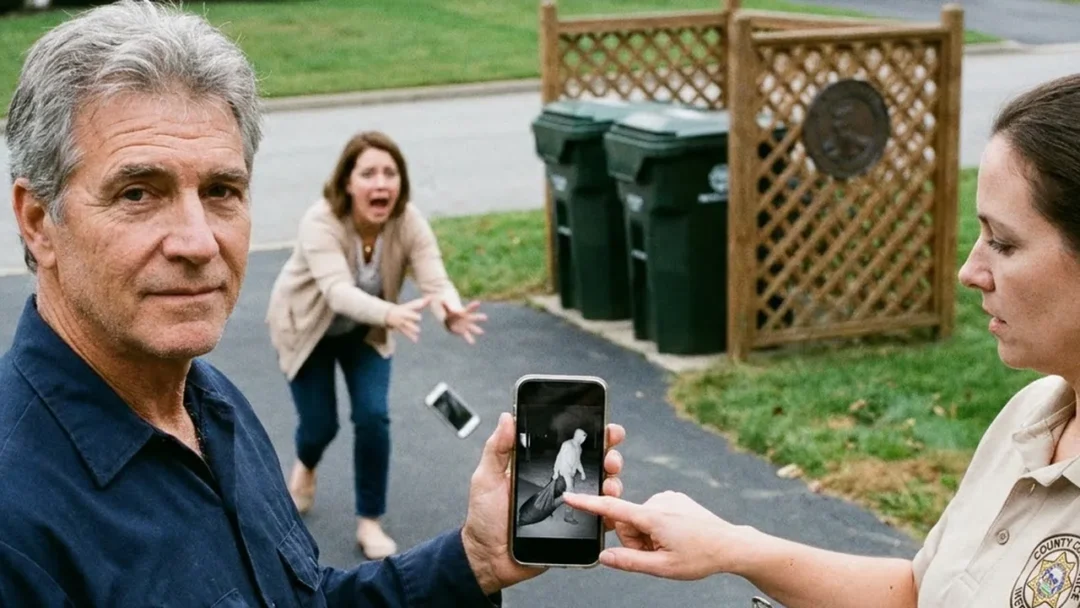
David pulled his right hand from his jacket pocket. He wasn’t holding a lawyer’s letter, nor was he holding a copy of the deed restrictions. He was holding his personal smartphone, its screen unlocked and resting on the playback screen of his home security application.
“I didn’t bring Maria out here to argue about cedar lattice, Evelyn,” David said quietly, his voice dropping into the steady register of a man who had already laid his trap and watched the quarry step into the center of the snare. “I called Maria out here because someone has been trespassing on my property under the cover of darkness. And I think you know exactly what they’ve been doing.”
Evelyn’s face hardened, her chin jutting outward. “What ridiculous nonsense are you babbling about now? If you’re having prowlers, call the township police and stop wasting county compliance hours!”
“It isn’t a prowler,” David said. He tapped the glass screen twice. “Take a look at this, Maria.”
Officer Gonzalez leaned forward, her brow furrowing as she looked down at the bright screen. The display was playing a crystal-clear, high-definition monochrome night-vision video stream. In the upper right corner of the frame, the green digital timecode read 11:47:12 PM from the previous evening. The camera angle was positioned four feet off the ground, peering through a concealed one-inch gap in the cedar lattice slats, pointing straight down David’s driveway toward the street.
On the screen, the quiet darkness of the cul-de-sac was suddenly broken by the silhouette of a woman emerging from the shadows of the large brick colonial across the street. She was dressed in an unmistakable lavender silk floral nightgown, pink rubber garden clogs, and wore her blonde hair pinned up in a wide plastic claw clip. She was bent low, dragging a massive, bulging black commercial contractor bag across the asphalt. The bag was clearly heavy, sagging against the pavement and leaving a wet, shiny trail behind it.
The video showed the woman slip quietly behind David’s cedar lattice screen, lift the heavy plastic lid of his green municipal recycling bin, and heave the bulging black contractor bag inside with a visible grunt of exertion. She let the heavy lid drop with a muffled thud, wiped her hands on the skirt of her nightgown, and scurried back across the dark street into her own front entrance.
As the woman in the video hoisted the bag, the infrared camera caught her face in stark, unforgiving detail: the arched eyebrows, the sharp nose, and the tight, petulant mouth were completely unmistakable.
Maria Gonzalez let out a slow, sharp whistle through her teeth. She looked up from the glowing phone screen, her gaze shifting from the video directly to Evelyn Vance’s face.
Evelyn had frozen. The color drained from her cheeks with terrifying speed, leaving her complexion the shade of curdled milk. Her fingers began to tremble against the plastic edge of her clipboard.
“That’s night-vision footage recorded last night at eleven-forty-seven,” David said, his voice entirely devoid of anger, which made the words ten times more devastating. “I got video of you dragging your commercial trash across the street and dumping it into my private bin.”
Maria reached out her hand. “Pass me the device, Mr. Miller.”
David handed his smartphone to the compliance officer. Maria scrubbed the video back ten seconds, paused on the high-resolution frame of Evelyn’s illuminated face as she hoisted the contractor bag, and nodded once with professional finality. She tapped the share icon, opened the Montgomery County Environmental Compliance Portal, and uploaded the raw video file directly to the county board’s evidentiary registry.
A quiet chime sounded from the phone speaker. A green checkmark popped up on the display: Upload Confirmed – File Registered as Exhibit A.
“That’s certified digital evidence,” Maria said, her voice dropping into icy official authority. “Already submitted to the county environmental docket and the township zoning board.”
Evelyn let out a choked, panicked shriek. Her eyes flared wide with wild, unhinged fury. Dropping her own phone onto the grass, she lunged forward with both hands clawed, reaching straight for Maria’s arms to snatch the phone from her grip. “Give me that phone! You have no right to record me on private property! Delete that right now!”
Before her fingers could touch the phone, David stepped forward with the lightning-fast reflexes of a seasoned shipbuilder, his broad shoulder sliding between Evelyn and the inspector like an oak timber, blocking her path and forcing her back onto the edge of the lawn. Maria held the phone high over her head, her face stern and unyielding.
“You did what?!” Evelyn screamed, clutching her chest as her voice cracked into hysteria. “You sent that to the board?!”
“Have a seat on the curb if you need to catch your breath, Mrs. Vance,” Maria said, tapping her body-worn camera to ensure it was active. “Because illegal dumping of unverified waste into a municipal residential receptacle is a first-class township violation. And before I write this citation, we’re going to open that bin and see exactly what you were so desperate to hide.”
David walked around the cedar screen, his expression dark. “You might want to put on heavy gloves, Maria,” he said quietly. “Because whatever was leaking from that bag last night ate straight through the polyurethane sealant on my concrete within ten minutes of hitting the ground.”