The Locket They Tried to Bury
Part I — The Girl at the Glass
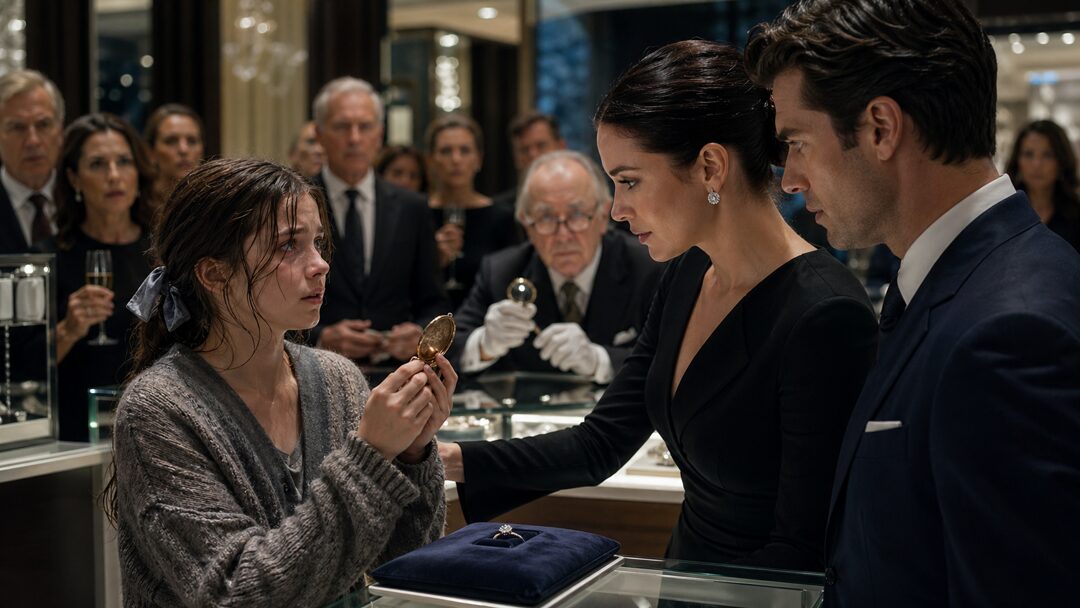
The girl came into Bellamy & Vale dripping rain on marble, wearing a gray cardigan too thin for April, and pointed straight past the velvet rope.
“That one,” she said. “Please. I need the man who made that one.”
Every head in the boutique turned.
Not fully. Not rudely. People like Bellamy & Vale’s clients did not stare. They paused with champagne near their mouths. They lowered their voices. They let their eyes travel from the child’s scuffed Mary Janes to the puddle forming beneath her feet, then away again, as if poverty were something contagious only when acknowledged.
Claire Vale moved before anyone else could.
She crossed the showroom in three silent steps, black dress smooth as ink, diamond studs cold against her neck. Her smile appeared with professional speed.
“Sweetheart,” she said, soft enough for the room to hear kindness, firm enough for the girl to feel warning. “You can’t be back here.”
The girl did not look at Claire. Her gaze stayed locked on the far display case, where a row of antique lockets rested under museum lighting.
“I need the old man,” she said. “The one with the glass eye.”
Claire’s fingers closed around the girl’s wrist.
Not hard. Not enough for anyone to call it cruel.
Enough for the girl to look down.
In the private salon behind the showroom, a photographer adjusted a light. A waiter passed silver trays of champagne. Beyond the glass partition, two families had gathered around a velvet presentation table where the engagement ring of the season waited beneath a small dome.
The Bellamy heir was choosing a diamond for the woman he loved.
No one had scheduled a wet child with shaking hands.
Claire bent lower. Her red lipstick did not move from its polite shape.
“What’s your name?”
“Nora.”
“Nora, this is a private appointment. If you need help, I can call someone.”
“I don’t need someone.” The girl swallowed. “My mother said to come here.”
A woman near the salon entrance whispered, “Is she lost?”
Claire heard it. Of course she heard it. She heard everything in rooms like this: judgment, boredom, threat, appetite. She had built her career on hearing things before they became problems.
She guided Nora two steps toward the door.
Nora resisted.
It was small, just the tightening of a child’s shoulders, but the resistance traveled through Claire’s hand like a current.
“I’m not stealing,” Nora said.
The sentence did what panic could not. It made the silence sharper.
Claire’s smile almost broke.
“No one said you were.”
The girl pulled something from inside her sleeve.
At first it looked like trash against the showroom lights: a scratched gold locket on a tarnished chain, its oval body dented near the hinge. Nora held it in both hands, carefully, as if the cheapest thing in the room were the only thing that could not be replaced.
“My mother said if anything happened to her, I had to bring this to Bellamy & Vale.”
Claire looked at the locket, then at the glass door, then at the salon where Adrian Bellamy stood with his back to them in a navy suit, laughing politely at something his future mother-in-law had said.
This was not the day.
Not this hour.
Not with press arriving in twenty minutes and Adrian’s ring waiting under velvet and the Bellamy name glowing in gold letters above the door.
Claire lowered her voice.
“We don’t buy walk-in pieces during private appointments.”
“I’m not selling it.”
“Then what do you want?”
Nora’s thumb rubbed the damaged hinge.
“It won’t open.”
One of the younger sales associates, Daniel, had drifted closer, curiosity overcoming training. Claire stopped him with one glance.
Nora saw that too.
Her chin trembled once, then steadied.
“My mother said only the old man with the glass eye would know how.”
The phrase landed strangely.
Claire felt it before she understood why. The air shifted behind her. A glass clicked against a tray. And from the private salon, Adrian Bellamy turned.
His eyes dropped to the locket.
For one second, his face emptied.
Then he smiled.
It was the kind of smile rich men learned young: charming, painless, and locked from the inside.
“Claire,” he said, walking toward them. “Everything all right?”
Nora stared at him.
Adrian stared at the locket.
Claire felt the girl’s wrist go still beneath her fingers.
And for the first time that afternoon, Claire wondered whether the problem had not walked into Bellamy & Vale.
Maybe it had been waiting there for years.
Part II — The Old Man with the Glass Eye
Claire took a folded hundred-dollar bill from the small emergency envelope behind the counter.
She did it cleanly. Quietly. With no visible panic.
“Nora,” she said, placing the bill beside the child’s hand instead of pushing it into her palm, “take a cab home. Come back tomorrow morning, and someone can look at it properly.”
Nora did not touch the money.
“It has to be today.”
“Tomorrow.”
“My mother died three days ago.”
The showroom went silent in that awful way polite rooms did when grief arrived underdressed.
Claire felt the sentence strike the room and leave a mark. The guests in the salon heard it. Adrian heard it. Daniel heard it. Even the photographer, who had been fussing with his lens, stopped moving.
Nora placed the locket on the glass counter.
A small wet mark spread beneath it.
Claire looked at it and thought, absurdly, of all the things she had been taught never to leave on glass: fingerprints, breath, doubt.
Adrian stepped closer.
“Let August look at it,” he said.
Too fast.
Claire turned her head. “Your father is preparing for the announcement.”
“It’ll be faster,” Adrian said.
His voice was gentle. That made it worse.
Nora looked at him as if trying to remember a face from a dream.
“Do you know it?” she asked.
Adrian’s smile did not change.
“No.”
The lie was small. Perfectly shaped. Almost invisible.
Claire saw it anyway.
Before she could answer, a door opened behind the west display wall.
August Bellamy came out of the workshop wearing a white shirt with the sleeves rolled to his forearms. His silver hair was combed back. A jeweler’s visor rested above one eye, the magnifying lens catching the light like a second, colder pupil.
The old man with the glass eye.
Nora’s breath caught.
August looked first at Claire, then Adrian, then the child.
Only then did he look at the locket.
His face did not change.
That was how Claire knew he recognized it.
“What is this?” August asked.
Nora pushed the locket toward him. “My mother said you made it.”
August did not pick it up immediately.
His hands, famous in three generations of jewelry magazines, hovered over the glass. Hands that had set diamonds for actresses, duchesses, first ladies. Hands that could repair a nineteenth-century clasp without disturbing a single engraved hairline.
At last, he lifted the locket.
The chain dangled from his fingers.
Cheap under the lights, Claire thought.
Then August turned it over, and the thought died.
There was a mark on the back. Not the Bellamy & Vale commercial seal, the one stamped on boxes and insurance documents. This was smaller. Almost hidden inside a curve of scratched gold.
August’s private mark.
The one Claire had seen only once, on the signet ring he had made for Adrian when Adrian became president of the company.
Adrian stepped back half an inch.
No one else noticed.
Claire did.
August closed his fingers around the locket. “Where did you get this?”
Nora’s eyes sharpened.
“It was my mother’s.”
“Her name?”
Nora hesitated, as if names had weight and hers were the last coins she had.
“Mara Bell.”
August looked at Adrian.
Adrian looked away.
Claire heard the salon whisper again.
Mara Bell meant nothing to most of the room. But another name had already begun forming behind August’s eyes, one he did not want spoken under chandeliers.
Nora said it anyway.
“My father was Elliot.”
Someone in the salon made a small sound. Not shock exactly. Recognition sharpened by discomfort.
Elliot Bellamy was not a name people used at Bellamy & Vale.
He existed in old society-page photographs and careful family obituaries: August’s brilliant eldest son, troubled, estranged, dead too young. If anyone asked, the family said addiction had taken him. If anyone pressed, the family said grief was private.
Claire knew only the version Adrian had given her in bed one winter night, his hand resting on her hip, his voice tired.
Elliot never wanted the family. He burned every bridge we built.
Now a child stood beneath Bellamy’s chandeliers with Elliot’s name in her mouth.
August’s voice lowered.
“This should not be discussed here.”
Nora’s hands curled around the counter edge. “Then open it.”
“Nora,” Claire said, instinctively reaching for control again.
The girl turned to her.
Not pleading now.
Accusing.
“If he didn’t make it, he can say that.”
August’s jaw moved once.
He took the locket to the small examination table near the private display. Daniel brought tools without being asked. Claire watched August set the locket beneath the lamp.
The old man lowered his visor.
The room leaned toward him.
Even Adrian.
Especially Adrian.
August touched the damaged hinge with a thin blade. The metal resisted. He adjusted, pressed, waited. His hands were steady, almost tender.
Then he stopped.
“What?” Claire asked.
August did not look up.
“There is a second plate.”
Nora’s lips parted.
Adrian whispered, “No.”
Claire heard him.
This time, so did August.
Part III — What the Locket Knew
August asked everyone to step back.
No one did.
He asked again, and this time there was authority in it. The salon guests returned to pretending they were not watching. The photographer checked his camera. The waiter resumed his path with champagne that nobody wanted.
But the room had changed.
Before, Nora had been a disruption.
Now she was a question with wet shoes.
August carried the locket into the narrow corridor outside the workshop. Claire followed. Adrian followed Claire. Nora followed the locket.
No one invited her.
No one stopped her.
Under the harsher workroom light, the locket looked worse. Its scratches deepened. Its dent cast a shadow. The gold had thinned at the edges where fingers had held it for years.
Claire thought of Mara Bell, whoever she had been, wearing it under a blouse, under a coat, under a life that had taught her to hide valuable things.
August placed the locket in a clamp lined with felt.
“Who sent you?” he asked.
“My mother.”
“Who sent your mother?”
Nora looked confused. “No one.”
“Did she tell you what to say?”
“She told me the truth.”
Adrian closed his eyes briefly.
Claire saw it and felt something inside her begin to loosen from him.
August worked the blade beneath the inner rim. There was a soft click.
The hidden plate lifted.
Nora rose onto her toes.
Claire saw the inscription first because she was standing closest.
For Mara and the child.
If they deny you, bring this home.
—E.
No one spoke.
The silence was no longer polite. It was alive.
Nora read the words slowly, lips moving.
“The child,” she whispered.
August removed his visor.
For the first time since Claire had known him, the old man looked his age.
Adrian reached for the workbench, then stopped himself before his hand touched it.
Claire turned to him.
“You knew,” she said.
It was not a question.
Adrian’s face tightened. “Not this.”
“What did you know?”
He looked toward the showroom, toward the salon, toward everything waiting to crown him.
“Claire.”
“What did you know?”
Nora stood between them, small and rigid, but her eyes stayed on Adrian now.
“My mother wrote letters,” she said. “She said no one answered.”
Adrian flinched.
Claire felt it like a slap.
August spoke first. “Mara Bell wanted money.”
Nora’s head snapped toward him. “She wanted my father.”
“She wanted access to a family she had no claim on.”
The cruelty was quiet. It entered the room dressed as fact.
Claire looked at Nora’s cardigan, pilled at the cuffs. The faded ribbon in her hair. The way she held herself with both pride and exhaustion.
Then she looked at August, who had engraved the words himself.
“If she had no claim,” Claire said, “why did Elliot write that?”
August’s eyes sharpened.
“You are not family yet.”
The sentence struck exactly where he aimed.
Claire felt Adrian move beside her.
“Dad,” he said.
Not because August had insulted Claire.
Because he had done it in front of witnesses.
That difference mattered.
Claire looked at the engagement ring still waiting in the salon. The diamond chosen from a private tray. The Bellamy name about to close around hers like a clasp.
She had wanted that name.
She hated that she had wanted it so badly.
When her own father’s small jewelry shop failed, men like August had shaken his hand and called it unfortunate. Then they had bought his tools at auction. Claire had been twenty-four, standing beside a folding table while strangers bid on the benches where she had done homework as a child.
August hired her six months later.
You have discipline, he had said.
She had mistaken that for rescue.
Adrian touched her elbow. “Can we talk?”
Claire pulled away.
“No. Here.”
His eyes flicked to Nora.
That was answer enough.
He lowered his voice. “I found letters when I was nineteen. Mara’s letters. My father said she was trying to exploit Elliot. He said Elliot was sick and she would destroy what was left of him.”
“So you destroyed them,” Claire said.
Adrian’s mouth opened.
Nora whispered, “You burned them?”
He looked at the girl then. Really looked.
His face broke for half a second.
“I didn’t know about you.”
Nora’s expression did not change. “But you knew about my mother.”
Adrian said nothing.
That silence had a shape.
It was the shape of a door closing.
August reached for the locket. “This will be handled privately.”
Nora snatched it back.
“No.”
“Nora,” Claire said, softer this time.
But Nora did not look at her. She looked at August.
“My mother said you would try that.”
The old man stilled.
Nora reached into the locket’s lifted plate and pulled at something Claire had not seen—a tiny folded strip tucked beneath the metal lip. Her fingers shook so badly she almost dropped it.
Claire caught it before it fell.
It was a receipt.
Bellamy & Vale. Custom family locket. Paid in full. Commissioned by Elliot Bellamy.
Signed: August Bellamy.
On the back, in faded handwriting, was a date.
Claire read it once.
Then again.
It was the same year Adrian said Elliot had cut all ties with the family.
The same month.
The same week.
Nora said, “My mother told me not to ask for money.”
Her voice was small now, but it carried.
“She said, ‘Make him say your father’s name in a room full of people.’”
August’s face hardened.
Adrian looked at Claire, and in his eyes she saw the plea before he gave it words.
Please don’t make this worse.
But some things were only called worse by people who had survived the lie.
Part IV — The Price of Quiet
August offered the trust in the workshop.
He did it with a chair pulled out for Nora, a glass of water placed beside her, and his voice lowered into something almost kind.
“A child should not be made into a scandal,” he said.
Nora stared at the water.
She had not taken off her cardigan. The damp wool clung to her shoulders.
August continued. “Your mother should have come to me directly.”
“She did,” Nora said.
The old man’s fingers curled once against the table.
Claire caught it.
Adrian did too.
“That was years ago,” August said. “There were complications.”
“My mother called them lies.”
Adrian flinched again.
Claire wished he would stop flinching and start speaking.
August leaned back. “I can arrange an account for you. Schooling. Housing. Proper care.”
Nora finally looked up.
“If I leave?”
“If we handle this with dignity.”
The word dignity landed wrong in the room.
Claire had heard that word used by the wealthy all her professional life. It usually meant silence from someone poorer.
Nora’s eyes went to Claire, not for help exactly, but to see whether another adult would translate the insult honestly.
Claire looked away first.
Cowardice could be quiet too.
From the showroom came the sound of arriving guests. More voices. The press. The engagement announcement had drawn people who wanted champagne, diamonds, photographs, a story about American craftsmanship and romantic legacy.
Legacy.
Claire almost laughed.
Adrian caught her at the corridor.
“Claire, listen to me.”
“No.”
“Please.”
That word, from him, still had power. She hated that too.
He stepped closer. He smelled like cedar and expensive soap, like the apartment they had almost chosen together, like mornings when he made coffee badly and kissed her shoulder as if love could exist outside consequence.
“I love you,” he said.
“You keep saying that like it answers things.”
“It answers us.”
“There is no us outside this.”
His face tightened. “Public exposure will destroy everyone. Nora included.”
“Do not use her as your excuse.”
“I’m trying to protect her.”
Claire looked through the glass wall at Nora, sitting alone at the workshop table while August stood nearby like a judge considering a sentence.
“No,” Claire said. “You’re trying to protect the version of yourself who didn’t open the door.”
Adrian’s eyes went wet, but he did not cry. Men like Adrian had been trained to make pain beautiful, not messy.
“I saw her once,” he said.
Claire went still.
He looked down. “Outside St. Vincent’s. After Elliot died. Mara was there with a child. I didn’t know her name.”
Claire could not breathe.
“She had his eyes,” Adrian said. “I knew that much.”
“You saw her.”
“I was twenty-four. My father said Mara was dangerous. He said if we acknowledged anything, she would take everything Elliot had left.”
“And you believed him?”
“I wanted to.”
There it was.
Not innocence.
Not ignorance.
Choice.
Claire’s ring finger felt suddenly cold though the engagement ring had not yet touched it.
Adrian reached for her hand. “I was afraid.”
“So was she.”
He looked toward Nora.
Claire did not let him look away from her for long.
“She was a child,” she said. “You were afraid of losing money.”
“That’s not fair.”
“No,” Claire said. “It isn’t.”
He understood then that she did not mean the accusation.
She meant the world.
A bell chimed in the showroom. Daniel appeared at the corridor entrance, pale.
“They’re ready,” he said. “Mr. Bellamy wants you both.”
Claire looked past him.
In the private salon, chandeliers burned bright over the velvet tray. The ring waited beneath its glass dome. Cameras angled toward the small stage of Bellamy history.
August came from the workshop carrying himself like nothing had happened.
“Nora will remain here,” he said. “Daniel, see that she has anything she needs.”
“I need my locket,” Nora said.
August paused.
Claire saw his calculation. The old man did not want the locket near the announcement. He also did not want a child screaming for it.
He handed it back.
Nora held it to her chest.
August turned to Claire.
“You will stand with Adrian.”
It was not a request.
Adrian looked at her with all the love and fear he had confused for the same thing.
“Afterward,” he whispered, “we can fix this.”
Claire looked at the locket in Nora’s hands.
The hinge was open now, but bent.
Some truths survived only by breaking the thing that held them shut.
Claire walked toward the salon.
Adrian exhaled in relief.
That was his mistake.
Part V — The Ring Tray
August Bellamy knew how to command a room without raising his voice.
He stood beneath the chandelier, one hand resting lightly on the velvet presentation table, and spoke of legacy. Of craft. Of fathers and sons. Of the Bellamy name, passed carefully from one generation to the next.
Claire stood beside Adrian.
She felt every eye on her dress, her diamonds, her left hand.
She had spent years learning how to look like she belonged in rooms like this. How to stand without fidgeting. How to smile without asking for approval. How not to reveal hunger.
Now all that training held her upright while something inside her quietly came apart.
August gestured toward Adrian.
“My son has carried this house forward with honor.”
Adrian’s shoulder brushed Claire’s.
A private apology.
A public claim.
“And today,” August continued, “we welcome Claire Vale, whose grace and discipline have already become part of Bellamy & Vale.”
Grace and discipline.
Claire almost heard her father’s auctioneer calling lot numbers over the benches of his ruined shop.
The room applauded.
Then Nora stepped into the doorway.
She had not meant to. Claire saw that immediately. The child had followed the sound of Elliot’s name not being spoken. She stood half in shadow, cardigan still damp, locket gripped in both hands.
The applause thinned.
A woman near the front gave a small laugh, startled and sharp.
Nora froze.
That laugh did what August’s money had not.
It made her look twelve.
Her face flushed red, then white. Her shoulders folded inward. For one terrible second, she seemed ready to apologize for existing.
Claire moved.
Adrian caught her wrist.
“Claire,” he whispered.
Not a plea now.
A warning.
She looked down at his hand.
He let go.
Claire crossed the salon.
The guests watched her approach the girl. She felt them writing the story already: gracious fiancée handles disturbance, poor child removed, elegance restored.
Nora looked up at her, braced for betrayal.
Claire held out her hand.
“May I?”
Nora hesitated.
Then she placed the locket in Claire’s palm.
It was warm from the child’s grip.
Claire turned and walked back to the velvet table.
August’s face changed by a fraction.
Only a fraction.
But Claire had worked for him long enough to know terror when he dressed it as patience.
She lifted the glass dome from the engagement ring.
The diamond flashed, large and flawless, a stone cut to catch every light in the room and give none of it back.
Claire removed the ring from the tray.
A murmur passed through the guests.
She placed Nora’s scratched locket where the ring had been.
The sound it made was small.
Metal on velvet.
Still, it seemed to reach every corner of the boutique.
August’s voice was very soft.
“Claire.”
She looked at him.
“Read it,” she said.
The room held still.
August did not move.
“You engraved it,” Claire said. “Read it.”
Adrian stepped closer. “This isn’t the way.”
Claire turned to him.
“There was a way before. You chose this one.”
A camera clicked.
The sound made Adrian flinch.
August’s mouth tightened. “This is a private family matter.”
Nora stood near the doorway, her hands empty now.
Claire looked at her.
“No,” she said. “That’s what made it cruel.”
She opened the locket.
For a moment, her hands trembled. Not from fear exactly. From the knowledge that once some words entered a room, they could not be made private again.
She read clearly.
“For Mara and the child. If they deny you, bring this home.”
No one breathed.
Then Nora took one step forward.
Her voice was not loud. It did not need to be.
“My father’s name was Elliot Bellamy.”
The room changed.
Not dramatically. No one screamed. No glass shattered.
But everyone knew they had just witnessed the collapse of a story rich people had paid dearly to maintain.
August stared at the locket.
Adrian stared at Claire.
Claire stared at Nora.
The child’s chin lifted, though tears had gathered in her eyes.
A journalist lowered her recorder toward the table.
August saw it and aged another year.
Adrian reached for the engagement ring.
Maybe he thought the ritual could still save them. Maybe he thought if he placed the diamond on Claire’s finger, the room would remember what it had come to celebrate.
He took Claire’s hand.
She let him.
For one heartbeat, his face filled with hope.
Then she gently closed his fingers around the ring and pushed it back toward him.
His eyes broke.
“Claire.”
She kept her voice low, but the front row heard.
“You knew how it felt to be loved in secret,” she said. “You let her inherit it.”
Adrian’s hand fell.
The ring remained in his palm, useless and bright.
Nora began to cry silently then, not like a child throwing pain outward, but like someone whose body had finally received permission to stop holding itself together.
August looked at her through the magnifying lens still pushed above one eye.
The old man who could see flaws invisible to everyone else.
The father who had refused to see his own son’s child.
“Elliot,” he said.
It was barely audible.
But it was the first time he had spoken the name without turning it into a warning.
Nora heard it.
So did Claire.
So did the room.
And that was the point.
Part VI — The Scar in the Hinge
By the time the last guest left, the champagne had gone warm.
The photographer packed his equipment without meeting anyone’s eyes. The wealthy clients slipped out in pairs, carrying scandal beneath their coats. Daniel locked the front doors with hands that shook so badly the key scraped twice before turning.
The boutique looked different empty.
Without voices, without music, without performance, the glass cases seemed less like displays and more like cages.
August sat alone at the workbench with Nora’s locket under the lamp.
No one had asked him to repair it.
He did it anyway.
Nora stood near Claire, watching from the corridor. Her eyes were swollen, her cardigan drying in stiff patches. She had not asked for water again. She had not asked about the trust. She had not asked what would happen next.
Children learned quickly when adults made every answer dangerous.
Adrian stood across the showroom, still holding the engagement ring.
He had not put it away.
He had not approached.
Claire could feel him looking at her, but she did not turn.
August worked carefully. The room filled with tiny sounds: metal nudged into place, tool against hinge, breath through an old man’s nose.
Finally, he lifted the locket.
“It will open now,” he said.
Nora did not move.
Claire walked with her to the bench.
August held out the locket.
For a second, the three of them stood under the workshop light: the patriarch, the almost-daughter-in-law, the granddaughter no one had wanted in the room.
Nora took the locket.
Her thumb found the hinge.
It opened.
Not smoothly. Not perfectly. The repair had left a visible scar where the gold had bent.
Nora touched it.
“Is it ruined?”
August’s face changed.
“No,” he said. “It survived.”
The answer was too small for what he owed her.
Maybe he knew that.
He looked at Nora, and when he spoke again, his voice carried no authority.
“Elliot was my son.”
Nora waited.
August swallowed.
“And you are his child.”
The words entered her slowly.
Recognition, Claire thought, watching Nora’s face, was not the same as comfort. Sometimes it was only a door opening onto a room already emptied.
Nora closed the locket.
“Does that mean I’m a Bellamy?”
No one answered at first.
August looked down.
Adrian closed his eyes.
Claire felt the old habit rise in her: soften it, manage it, make the wound sound smaller than it is.
She refused it.
She knelt slightly so Nora did not have to look up so far.
“It means they don’t get to pretend you aren’t.”
Nora held that answer like she had held the locket—carefully, because it was not enough, but it was hers.
Claire stood.
Adrian stepped forward at last.
“Claire.”
His voice stopped her near the showroom door.
She turned.
He looked younger than he had that morning. Not innocent. Just stripped of the shine that had made cowardice resemble charm.
“I love you,” he said.
“I know.”
That hurt him more than anger would have.
He looked at the ring in his hand. “Is that all?”
Claire glanced at Nora, then at August, then at the glass cases filled with flawless stones.
“No,” she said. “That’s the trouble.”
For a moment, she wanted to go to him. The wanting did not vanish just because truth had arrived. Love was not a switch. It was a room you sometimes had to leave while your heart still recognized the furniture.
Adrian took one more step.
Claire shook her head.
He stopped.
Behind him, August sat with both hands flat on the workbench, as if holding himself upright.
Claire opened the boutique door.
Cold evening air entered, carrying the smell of rain and taxis and the city continuing without permission from any of them.
Nora stepped outside first.
Then she turned back.
Not to August.
Not to Adrian.
To the gold letters above the door.
Bellamy & Vale.
She looked at them for a long moment, as if measuring the distance between a name and a home.
Claire waited beside her, ringless.
There would be lawyers. There would be statements. There would be arguments about money, inheritance, reputation, intent. There would be people who called Nora a scandal because calling her a child would make them responsible.
But not tonight.
Tonight, the locket was open.
Tonight, Elliot Bellamy’s name had been spoken in the room built to survive him.
Nora slipped the chain over her neck. The scarred locket rested against her cardigan, small and dull beneath the city lights.
Claire held out her hand.
Nora looked at it.
Then took it.
Behind them, through the glass, Adrian remained inside the boutique with the diamond still in his palm, bright enough to blind, not strong enough to bring anyone back.
Claire did not look again.
She walked into the rain with the girl whose proof had finally opened, carrying no ring, no promise, and no clean victory.
Only the truth.
And the ache of what it had cost to say it out loud.