What She Kept Still
Part I — Where They Could Hear
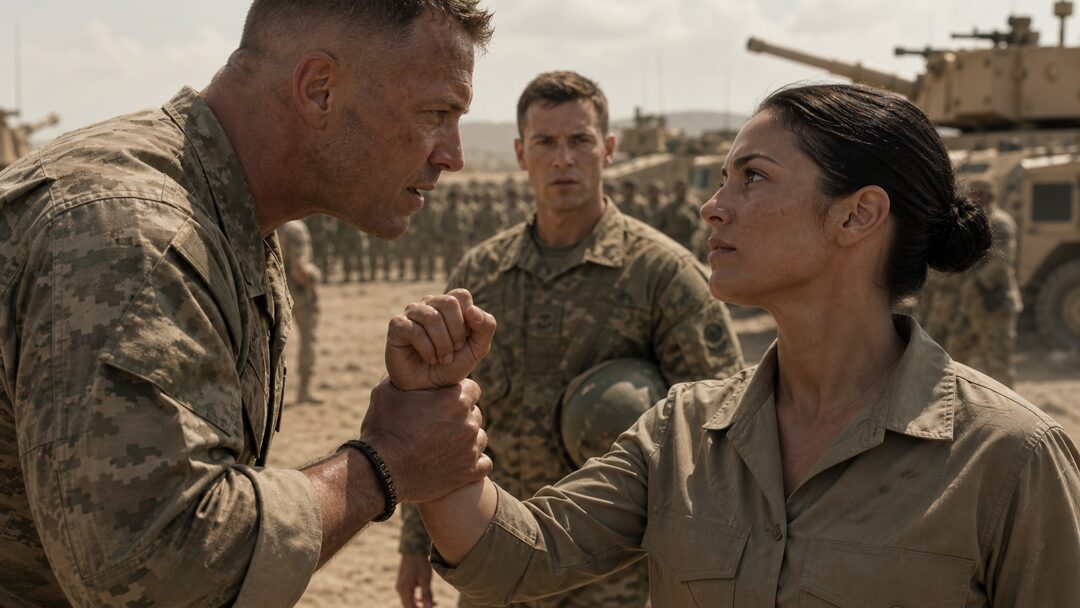
Major Robert Hayes caught Captain Emily Carter by the wrist in front of two platoons, three armored vehicles, and every senior observer who had come to Camp Black Mesa to pretend the inspection was routine.
The laughter died first.
It had been low and loose a moment before, the kind soldiers used when the desert was too hot and the day was too long and someone in authority looked ready to make an example of someone else. Then Hayes’s hand closed around Emily’s wrist, hard enough to stop her mid-step, and the sound dropped out of the formation like someone had cut a wire.
Dust crossed the parade ground in a thin brown sheet.
Emily did not pull away.
That was what everyone noticed second.
She was a small woman, compact and exact, her khaki field shirt tucked flat, her dark hair pinned so tight it looked painful. Hayes stood nearly a head taller, broad through the shoulders, his sleeves sun-faded, his boots planted as if the ground owed him permission.
He leaned down until only she could have heard him if he had chosen to whisper.
He did not.
“Say it where they can hear you.”
Emily looked at his hand around her wrist, then at his face.
“Release me, Major.”
A few soldiers shifted in formation. Someone’s boot scraped gravel. The sound carried too far.
Hayes did not move his hand.
“No,” he said. “Not today.”
Behind him, Lieutenant Daniel Price stood in the front rank with his helmet clipped under one arm and his jaw tight enough to hurt. Emily saw him without turning her head. She saw the way his eyes flicked to Hayes’s grip, then away.
Daniel had served under Hayes.
Most of them had.
To them, Hayes was not simply a major. He was the man who had walked convoys through bad roads, dragged wounded men behind cover, written letters home when no one else could find words that didn’t sound cheap.
Emily was intelligence.
That meant she worked behind screens. It meant doors closed when she entered rooms. It meant people lowered their voices around her and then accused her of hiding things when she left.
Hayes tightened his fingers.
“You hid behind classification for six months,” he said. “You hid behind stamps and locked files while my men were put in the ground by your mistake.”
Emily’s pulse moved once beneath his thumb.
Only once.
Colonel Susan Mitchell had not yet crossed the yard from the review stand, but Emily knew she was watching. Everyone was watching. That was the danger. That was also, finally, the point.
Hayes dragged a folded paper from his cargo pocket with his free hand and held it up beside her face.
“Operation Dry Lantern,” he said.
The name moved through the formation without a voice. Men who had been smiling stopped breathing like ordinary men and became statues.
Dry Lantern was not supposed to be spoken on inspection days.
Dry Lantern was the reason Camp Black Mesa had gone quiet every time a convoy rolled out after dusk. It was the reason Hayes wore a black bracelet on his right wrist, the one now pressing into Emily’s skin.
Three names were engraved on it.
Emily did not have to read them.
She knew all three.
Hayes held the paper higher.
“Tell them what you sent,” he said. “Tell them when you sent it.”
Emily’s eyes stayed on his.
“I sent what the evidence supported.”
“That isn’t an answer.”
“It is the only one I can give you in public.”
His mouth twitched, almost a smile, except there was nothing amused in it.
“In public is exactly where you’re going to give it.”
Part II — The Name on His Wrist
Six months earlier, Emily had heard Sergeant Mark Ellis die through a headset that smelled faintly of old plastic and coffee.
Not the moment itself.
Not the final breath.
Just the last transmission before the channel dissolved into static and men started shouting over one another.
She had been in the intelligence trailer at 0200, the monitors painting everyone’s faces blue. A route map glowed on the center screen. A thin red line crawled toward a dry riverbed the convoy was never supposed to use.
Emily had already sent the warning.
Route compromised. Delay movement. Possible hostile relay activity east of Marker Seven. Recommend alternate extraction.
She had sent it once through the automated channel, once through operations, and once by direct call to the duty officer when the automated receipt did not return fast enough.
Then she had watched the warning sit in the queue while command argued about timing.
A visiting general was inbound at dawn.
A convoy still outside the perimeter made the base look unready.
Readiness mattered. Optics mattered. Schedules mattered.
Men mattered too, but often in language written after the damage.
Now Hayes stood in front of her with the old report in his hand as if paper could absolve him.
“You delayed the warning,” he said. “You sent it after my unit was already committed.”
Emily’s throat tightened.
She kept her voice level.
“That is not what happened.”
Hayes laughed once. It was worse than shouting.
“You hear that?” he called to the formation. “That is what six months of hiding sounds like.”
The soldiers did not laugh this time.
Emily saw their faces. Young, sunburned, tired. Some angry. Some curious. Some ashamed to be curious. They had all inherited pieces of Dry Lantern without being trusted with the whole shape of it.
Hayes turned back to her.
“You know what Ellis asked me for before we lost him?”
Emily’s gaze dropped before she could stop it.
Not to the paper.
To the bracelet.
Mark Ellis.
The letters were small, engraved in silver against black metal. Hayes wore the bracelet tight, like he needed the names close enough to punish him.
Emily remembered Ellis’s voice, distorted by distance.
Did the captain get the warning through?
Not bitter. Not blaming.
Afraid, yes. In pain, probably. But still asking the practical question. Still believing someone outside the dust and noise had tried to reach them.
Emily had replayed that line more times than she had admitted on any official form.
Hayes saw her look at the bracelet and mistook it for guilt.
“There it is,” he said softly. “You do remember him.”
“I remember all of them.”
“Don’t.”
The word cracked through the air.
Daniel’s head lifted.
Hayes stepped closer. Emily could smell heat, sweat, sun-baked fabric.
“Don’t you stand here with that calm face and borrow grief you didn’t earn.”
Something in the front rank moved. A soldier’s fingers flexed against his pant seam. Nobody spoke.
Emily wanted to say Ellis’s name. Not as evidence. Not as a shield. Just as a name. But the recording was sealed, and sealed things had a way of making honest people sound like liars.
So she said nothing.
Hayes smiled without warmth.
“That’s what I thought.”
He dropped the folded paper at her feet.
It opened as it hit the dust.
A timestamp faced up.
Emily saw it.
For the first time since Hayes grabbed her, her expression changed.
Not fear.
Recognition.
The report in the dirt carried her header, her classification line, her exact phrasing.
But the timestamp was wrong.
Forty-two minutes wrong.
Part III — The Copy in the Dust
The formation saw Emily look down.
That was enough for some of them.
A murmur passed through the ranks, small and ugly. Hayes heard it too. His shoulders squared as if the sound fed him.
“Pick it up,” he said.
Emily did not.
Hayes bent, snatched the report from the dirt, and shoved it close to her chest.
“Read the time.”
“Major.”
“Read it.”
Her wrist hurt now.
He had not meant to make it gentle. He had meant to make it public. There was an old logic in that, one men like Hayes trusted without naming: if everyone saw you controlled, maybe the truth would look controlled too.
Emily took one breath.
The page trembled, not in her hand, because she refused to take it, but in his.
“Where did you get that copy?” she asked.
Hayes’s eyes narrowed.
“From the file.”
“Which file?”
“The one your office sealed.”
“My office did not seal that version.”
That landed.
Not loudly. Not cleanly. But the air changed.
Daniel looked up again.
Emily saw memory move through his face before he could hide it.
He remembered something.
Good, she thought.
Then hated herself for thinking it, because Daniel Price was not a lever. He was a young officer who had been trained to trust the man now standing in front of him, and trust was hardest to break when it had once saved your life.
Hayes turned toward him.
“Lieutenant.”
Daniel’s face went still.
“Sir.”
“You were in operations that night.”
“Yes, sir.”
“You saw when the warning came through.”
Daniel’s eyes flicked to Emily.
Hayes’s voice sharpened.
“Answer me.”
The formation seemed to lean without moving.
Daniel swallowed.
“I saw an alert, sir.”
“What time?”
Daniel’s mouth opened.
Nothing came out.
Hayes stepped toward him, dragging Emily half an inch with him before stopping himself. She did not stumble. She let his grip remain visible.
That mattered.
Everything visible mattered now.
“What time, Lieutenant?”
Daniel looked at the paper.
At Hayes.
At Emily’s wrist.
“I don’t remember the exact time, sir.”
Hayes’s face hardened with disappointment so personal it looked almost intimate.
“You don’t remember?”
Daniel took the blow without flinching.
“No, sir.”
Hayes turned back to Emily, and anger filled the space where Daniel had refused to place certainty.
“There,” Hayes said. “That is what you people do. You blur everything until no one can be held responsible.”
Emily’s voice stayed quiet.
“Someone is responsible.”
His grip tightened.
“Then say who.”
She looked toward the review stand.
Colonel Mitchell had begun walking toward them.
Not fast. Mitchell never moved fast in front of soldiers. She believed speed was a confession that something had escaped control.
Her uniform looked impossibly clean against the dust. Silver hair tucked under her cap. Face composed. Eyes already measuring damage.
Emily watched Hayes notice her.
Watched him misunderstand.
He thought Mitchell was coming to rescue discipline from Emily.
Emily knew better.
The colonel stopped ten paces away.
“Major Hayes,” Mitchell said. “Release Captain Carter and return to formation.”
Hayes did not release her.
“With respect, ma’am, this concerns Dry Lantern.”
“I am aware of what this concerns.”
That made Daniel look at her.
Small things reveal large lies. A pause too long. A sentence too prepared. A commander who knows the name of a fire before anyone reports smoke.
Emily let the silence stretch one second more than Mitchell wanted.
Then she said, “Colonel, would you like the formation dismissed before or after the original transmission log is read?”
Mitchell froze.
Not much.
Just enough.
But the soldiers saw it.
Hayes saw it too.
For the first time, his hand loosened without letting go.
“What did you say?” he asked.
Emily did not answer him.
She kept her eyes on Mitchell.
“Before,” she said, “or after?”
Part IV — The Still Point
Nobody moved for three full seconds.
That was the longest silence Emily had ever heard outside a briefing room where everyone already knew someone had died.
Mitchell recovered first.
“This is not the place.”
Hayes gave a short, bitter laugh.
“Now it’s not the place?”
Mitchell’s eyes cut to him.
“Major.”
But Hayes was watching Emily.
The anger had not left his face. It had changed shape. Suspicion had entered it. Worse than suspicion—fear. The kind a man feels when the door he has leaned against for months begins to open inward.
Emily almost pitied him.
Almost.
Then his thumb pressed into the tender part of her wrist again, and the pity moved aside.
“You have the log?” he asked.
“I have a copy of the original archive.”
“Impossible.”
“Not for intelligence.”
That stirred a few uneasy breaths from the formation.
Mitchell stepped closer.
“Captain Carter, you will surrender any restricted material in your possession immediately.”
Emily turned her head slightly.
“Restricted from whom, ma’am?”
Mitchell’s face did not change. That was her gift. Also her flaw.
“Do not make this worse.”
Emily thought of the intelligence trailer. The red line on the map. The warning sitting too long in a queue. The duty officer saying, We’re waiting on command guidance. The convoy moving anyway. The channel filling with voices.
She thought of Ellis asking whether the captain got the warning through.
For six months, Emily had told herself silence was discipline.
She had told herself there would be an inquiry.
There was one.
It asked the questions it had already learned how to survive.
Then the report became sealed. The original timestamp disappeared into a restricted archive. Hayes received a version that made Emily late and command merely unlucky.
And Emily kept showing up to briefings where men who had never read the original file looked at her as if her calmness was proof of rot.
Hayes held up the altered paper.
“This says you sent the warning at 0247.”
Emily looked at Daniel.
He looked miserable.
She made her voice softer, not gentler.
“Lieutenant Price.”
Daniel stiffened.
“Yes, ma’am.”
“You saw the convoy board before the correction.”
Hayes snapped, “Do not lead him.”
Emily ignored him.
“You saw the alert pinned in yellow. Route compromised. Delay movement.”
Daniel’s eyes closed for half a second.
He was back there now.
They all were, though only two of them knew it.
Hayes turned on him.
“Daniel.”
The use of his first name did what rank could not. It hurt him.
Daniel opened his eyes.
Hayes said, “Tell her she’s wrong.”
Daniel’s lips parted.
Emily could see the war inside him. Not the one outside the wire. The one that happens when a decent person realizes neutrality has been serving the wrong side.
He looked down at the page in Hayes’s hand.
Then at the colonel.
Then at the soldiers behind him, men who would remember whatever he did next longer than they remembered any safety brief.
His voice came out barely above the wind.
“Sir, that isn’t the copy we saw.”
The words did not echo.
They did something worse.
They stayed.
Hayes stared at him as if Daniel had stepped out from behind his own face wearing someone else’s.
“What?”
Daniel’s breathing changed.
“That night. On the board. The warning was already there before the movement order came through.”
A rustle passed through the ranks.
Mitchell said, “Lieutenant Price, stop speaking.”
But Daniel had already crossed the line. Once crossed, it is sometimes easier to keep walking than to crawl back.
“I watched it disappear after the first casualty report,” he said.
Hayes’s hand went slack for one dangerous second, then tightened again, as if gripping Emily was the only way to keep the world from rearranging.
“You’re confused,” he said.
Daniel looked at him with open pain.
“I wanted to be.”
Part V — What the Record Kept
Emily had one choice left that still belonged to her.
Not whether the truth would hurt. That had been decided months ago.
Only where it would land.
She turned her left side slightly toward Daniel.
“Lieutenant,” she said, “left cargo pocket. Sealed drive.”
Mitchell stepped forward.
“Captain Carter.”
Emily did not look at her.
Hayes still held her right wrist. Daniel hesitated, then reached carefully into Emily’s left pocket and withdrew a small evidence drive sealed in a clear sleeve.
The label was printed in black.
DRY LANTERN ARCHIVE — ORIGINAL TRANSMISSION RECORD
Hayes stared at it.
His face emptied.
Not softened. Not yet.
Emptied.
Mitchell’s voice lowered.
“That material is not authorized for public review.”
Emily finally looked at her.
“Neither was the altered copy.”
That line moved through the formation like a match touching dry paper.
Mitchell’s eyes hardened.
“You are making an accusation you may not survive professionally.”
Emily almost smiled then, but not enough for anyone to see.
“I know.”
Hayes’s voice came rough.
“What’s on it?”
Emily turned back to him.
“The original timestamp. The warning sent at 0205. Receipt confirmation at 0208. Movement order issued at 0247.”
His jaw worked once.
“No.”
“The convoy received the order forty-two minutes after the warning cleared operations.”
“No.”
This time the word had no authority in it.
Only refusal.
Emily looked at the bracelet on his wrist.
“And Sergeant Ellis’s final transmission.”
Hayes went utterly still.
The desert did not.
Dust moved around them. A vehicle engine ticked as it cooled. Somewhere behind the formation, a loose strap tapped metal in the wind.
Hayes’s voice dropped.
“You had his transmission?”
“Yes.”
“All this time?”
“Yes.”
His fingers dug into her wrist again, but the strength had gone strange, less like command than balance.
“And you never told me?”
Emily held his gaze.
This was the part she had feared.
Not Mitchell. Not the investigation. Not the end of her career.
This.
The moment grief lost the wrong target and looked for somewhere else to go.
Hayes leaned closer. His eyes were red now, though no tears had fallen.
“Why?”
Emily could have said classification.
She could have said procedure.
She could have said she filed three requests to reopen the archive and all three had vanished into offices where truth was handled with gloves until it stopped moving.
All of that was true.
None of it was the truth he had asked for.
So she gave him the one that would hurt.
“Because you needed someone alive to hate.”
The words struck him harder than Daniel’s had.
His grip remained.
His face changed.
Emily saw the instant he understood that she was not only accusing him. She was naming the thing that had kept him upright.
Anger had fed him. Blame had dressed itself as loyalty. Emily had been useful because she breathed, because she stood where he could point, because the dead could not answer and command would not.
Hayes looked at the drive in Daniel’s hand.
Then at Mitchell.
Then at the soldiers.
His voice was low enough that only the first rows heard it.
“Ellis asked for me?”
Emily shook her head once.
“No.”
That was crueler, and kinder, than a lie.
Hayes flinched.
Emily said, “He asked whether the warning got through.”
Hayes closed his eyes.
For a moment, he was not the man gripping her in front of everyone. He was a commander standing in a place only he could see, hearing a man under his protection ask whether someone had tried to save him.
Daniel’s hand trembled around the drive.
Mitchell said, “Lieutenant, give that to me.”
Daniel looked down at the sealed sleeve.
Then up.
“No, ma’am.”
The formation inhaled.
Mitchell’s face sharpened.
“Excuse me?”
Daniel stepped half a pace forward, not enough to threaten, enough to choose.
“It’s already copied to Inspector General intake.”
Mitchell did not blink.
But her silence changed temperature.
Hayes opened his eyes.
The first thing he did was look at Emily’s wrist.
As if he had forgotten he was holding it.
As if seeing his own hand there told him something about himself he could not put back.
Slowly, he let go.
Part VI — After the Release
The marks stayed.
Four red bands across Emily’s wrist, one deeper crescent where Hayes’s thumb had pressed too long.
Everyone saw them.
Emily did not rub them.
That was what they noticed last.
Not the drive. Not Mitchell’s silence. Not Daniel standing too straight beside her with fear still written across his face.
They noticed that Emily let her hand fall naturally to her side, as if pain did not deserve performance simply because it had witnesses.
No one cheered.
No one should have.
The truth had arrived too late to be clean.
Hayes stood in front of her with the altered report hanging from his hand. The paper that had looked so powerful minutes earlier now seemed thin enough for the wind to take.
Mitchell’s voice returned, colder than before.
“This formation is dismissed.”
Nobody moved.
Not because they were disobeying.
Because they were waiting to see whether authority still meant what it had meant five minutes ago.
Mitchell looked at Hayes.
“Major.”
Hayes did not respond.
His eyes were on the bracelet.
Emily wondered if he was reading the names or avoiding them.
Daniel still held the drive.
He looked younger than he had at dawn and older than he had a minute before.
Emily touched his elbow lightly as she passed him.
Not gratitude. Not forgiveness. Just acknowledgment.
Sometimes that is all courage earns at first.
Hayes spoke when she was nearly past him.
“Captain.”
She stopped.
The whole yard waited again.
He did not apologize.
Maybe he could not yet. Maybe apology would have been too small a word for what had just collapsed. Maybe the first honest thing he could do was not ask her to make his grief easier.
He looked at her wrist.
Then at her face.
“What did he sound like?”
Emily knew which he meant.
For once, no regulation rose to stop her.
“Tired,” she said. “Scared. Still doing his job.”
Hayes’s mouth tightened.
Emily added, “He wasn’t blaming you.”
That almost broke him.
It would have been easier if he had shouted. Easier if he had denied it, cursed her, turned his anger back into armor. Instead he stood there with the sun on his face and the dust around his boots, and all the strength people had admired in him looked suddenly like something that had been holding a door shut from the wrong side.
Mitchell said nothing.
Daniel said nothing.
The soldiers said nothing.
The base, for once, did not know what story to tell about itself.
Emily gave Hayes the smallest smile.
It was not victory. It was not mercy. It was not forgiveness.
It was the expression of someone who had carried a locked thing until her hands went numb, and had finally set it down where everyone could see its shape.
Then she walked past the formation.
The soldiers made room without being ordered.
Behind her, Hayes remained in the dust, the altered report in one hand, the bracelet on the other, unable to salute and unable to look away from the place where she had stood.
Emily kept walking.
Her wrist burned.
She did not touch it.