The Bedrock Iron Boundary Post And The Torn Chrome Bumper
CHAPTER 4: THE UNBROKEN MONUMENT ON THE LINE
Chad sat in the driver’s seat for ten long seconds, his chest heaving, his hands trembling violently against the steering wheel. The cabin was filled with the bitter smell of fried wiring, hot transmission fluid, and electrical ozone. Across the digital instrument cluster, a dozen warning lights flashed in frantic synchronization: TRACTION CONTROL FAULT. REAR RADAR DISABLED. TRAILER WIRING DISCONNECTED. BLIND SPOT SYSTEM FAILURE. SERVICE AIRBAG IMMEDIATELY.
Coughing on the tire smoke that drifted into the cab, Chad pushed the driver’s door open and stepped down onto the sidewalk on shaky legs.
He walked around to the rear of his truck, and what he saw made the blood drain completely from his face.
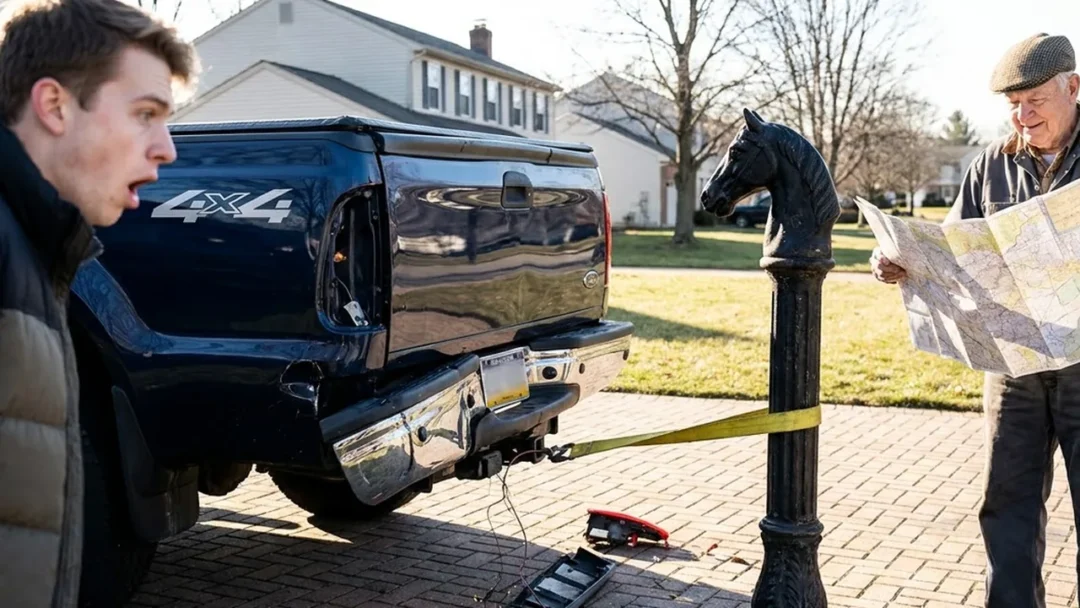
The back of his seventy-thousand-dollar luxury Denali looked as if it had been struck by an express freight train. The entire rear bumper was gone, leaving a gaping, jagged cavity of torn frame rails and dangling, sparking wire bundles. The rear fenders were bent outward like twisted wings, the black paint cracked and spiderwebbed, exposing bare metal. The tailgate was warped on its hinges, permanently jammed shut, and both rear quarter panels were crushed beyond recognition.
Thirty feet behind the truck, lying dead center in the brick carriageway, was the detached chrome bumper. It lay upside down on the cobblestones, the yellow kinetic tow strap still cinched securely around its center step plate, while the other end of the strap remained tied around the cast-iron horse head.
And sitting untouched between the two cottages, perfectly upright, perfectly plumb, and utterly unmoved, stood the antique boundary monument.
The dark gunmetal patina on the cast-iron horse head was completely unmarked. The bronze medallion on its base gleamed in the morning sun, its stamped 1928 lettering sharp, clean, and pristine. There was not a single loose brick around its foundation, not a single cracked mortar joint, and not a single degree of deflection in its vertical axis.
Beside the untouched monument, Walter Krause calmly leaned his broom against the limestone wall of his cottage.
With slow, deliberate movements, Walter reached into his chore coat, pulled out the aged blue linen surveyor’s map, and unfolded the large parchment across the hood of the post.
“Chad,” Walter said, his voice echoing across the quiet neighborhood with the calm, devastating certainty of an ancient prophet. “Your truck moved. It didn’t.”
Chad stared from the mangled wreckage of his vehicle to the pristine iron post, his mouth hanging open in paralyzed, wordless horror.
At that moment, the low, rhythmic purr of a municipal police cruiser broke through the silence. A white-and-blue cruiser from the Columbus Division of Police turned onto Jaeger Street, its amber and blue roof lights flashing softly as it pulled to a stop behind the ruined truck.
The physical contrast between the two objects on Jaeger Street was a living parable of modern consumerism versus classical craftsmanship. Modern automotive engineering prioritizes planned obsolescence, lightweight synthetic composites, and rapid assembly-line manufacturing, resulting in vehicles that look imposing in sales brochures but disintegrate when subjected to severe structural stress. In contrast, nineteenth-century industrial ironwork was engineered under the principles of absolute permanence. Cast from dense gray iron poured in charcoal-fired cupola furnaces, the Victorian horse post possessed high compressive strength, exceptional damping capacity, and natural resistance to atmospheric corrosion.
The foundation beneath the post was a masterwork of nineteenth-century civil infrastructure. During the street renovations of 1928, the Columbus Department of Public Service had excavated a five-foot-deep trench to the underlying Columbus limestone shelf, setting a heavy cast-iron foundation plate secured with three-inch solid forged steel drift pins driven directly into the living rock. The trench was then backfilled with high-strength hydraulic Portland cement mixed with crushed river gravel, forming a four-ton monolithic subterranean anchor. To an experienced stonemason like Walter Krause, watching a pickup truck attempt to yank that anchor out of the earth was like watching a rowboat attempt to tow an ocean liner.
The gathering crowd of neighbors along Jaeger Street watched the unfolding drama in breathless, stunned silence. Mrs. Clara Becker, who had lived on the corner for eighty-one years, stood behind her wrought-iron gate, clutching her wool shawl against the chill. She had watched Chad Bradford harass delivery drivers, park across wheelchair ramps, and threaten elderly homeowners with spurious lawsuits. Now, seeing his brand-new truck sitting mangled on the sidewalk while Walter Krause stood serene beside his unbroken iron horse, a quiet, knowing smile touched her weathered face.