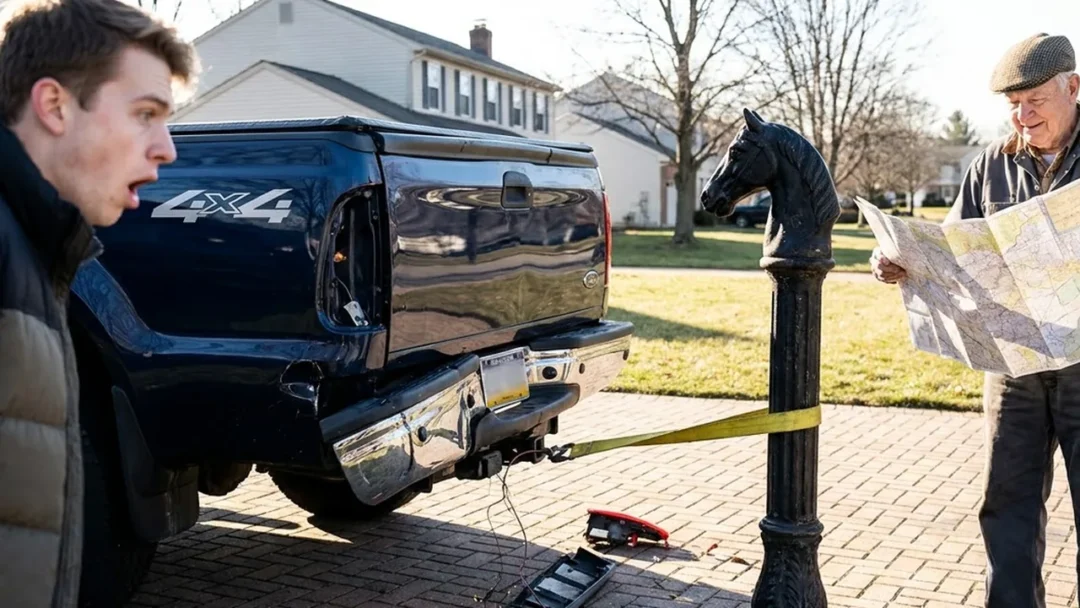
The Bedrock Iron Boundary Post And The Torn Chrome Bumper
CHAPTER 2: THE TENSION ON THE HITCH
“Chad, leave that strap in your truck bed,” Walter said, his voice dropping into a tone of quiet, solemn warning. “You do not understand how that post was built, nor do you understand the forces you are dealing with. That casting was not poured into a post hole with a bag of pre-mix concrete. My grandfather helped set that monument ninety-six years ago. It is anchored into the underlying Columbus limestone bedrock.”
Chad didn’t even look up from his work. He walked the free end of the thirty-foot nylon strap to the back of his brand-new truck. Bending down beneath the tailgate, he bypassed the Class IV frame receiver hitch—which would have required digging out an auxiliary hitch pin from under his back seat—and instead looped the heavy steel safety hook directly around the center step-plate opening of his factory hydroformed chrome rear bumper.
The chrome bumper on the modern truck was a sculpted work of aesthetic automotive styling, manufactured from thin-gauge high-strength stamped sheet steel and fastened to the vehicle’s hydroformed frame rails with four small, pre-torqued shear bolts designed to crumple under rear-end highway collisions to protect passenger safety. It was engineered to absorb impact, not to act as a twenty-ton industrial anchor pulling against geological bedrock.
Chad stood up, dusted his palms on his track pants, and sneered at Walter. “Your grandfather used shovels and wheelbarrows, old man. I have a four-hundred-and-twenty-horsepower Duramax turbo-diesel with four-wheel drive and ten-speed automatic torque management. Watch how fast seventy thousand dollars of modern horsepower rips your little iron pony out of the dirt.”
Walter did not move to physically stop him. In fifty years of master stonemasonry, he had watched dozens of impatient men attempt to outmuscle the basic laws of physics, geology, and material engineering. He reached into his coat pocket, retrieved his phone, and tapped the camera icon, holding the screen steady to record the entire carriageway from a safe fifteen-foot distance.
Chad climbed into the air-conditioned leather cab of the Denali, slammed the heavy door, and engaged the four-wheel-drive rotary selector on the dashboard, switching the transfer case into Four-Low. A heavy mechanical clunk echoed beneath the floorboards as the planetary gear reduction locked all four wheels into synchronized low-speed torque delivery.
He rolled down his driver’s side window, stuck his head out into the morning air, and yelled back toward Walter:
“Last chance to dig it up yourself, Krause! Once I pull this trigger, it’s going into the scrap bin!”
Walter stood motionless beside his brick cottage, his phone recording, his expression as calm and still as a winter pond. “Proceed at your own peril, Mr. Bradford. Just remember that physics doesn’t care about your financing terms.”
Chad laughed, dropped the heavy column shifter into drive, and stomped his right foot down on the throttle.
The engineering principles governing kinetic energy recovery straps are fundamentally misunderstood by amateur off-roaders. Unlike static transport chains or steel winch cables, which possess almost zero elasticity and transmit tensile loads instantaneously, kinetic snatch-straps are manufactured from braided polyamide nylon that stretches up to twenty-five percent under maximum working load. In deep mud or soft sand, this elasticity allows a towing vehicle to build forward momentum, using the kinetic energy stored within the stretched nylon fibers to yank a stuck vehicle out of a mire. But when a kinetic strap is hitched to an immovable, unyielding geological object, the stored energy has nowhere to go; it multiplies the shock load exponentially, returning all thirty thousand pounds of stored kinetic force directly to the hitch attachment point.
Modern automotive manufacturing has increasingly moved toward lightweight hydroformed steel structures to reduce vehicle curb weight and improve federal fuel efficiency ratings. While traditional pickup trucks from the twentieth century featured heavy C-channel steel bumpers bolted directly to solid boxed frame rails with thick cast-iron brackets, contemporary luxury trucks utilize stamped sheet-metal bumper covers supported by thin sacrificial crush cans designed to deform under five-mile-an-hour parking lot impacts. By looping a thirty-five-thousand-pound kinetic strap around the decorative step plate of an unreinforced cosmetic bumper, Chad was committing an engineering error of catastrophic proportions—placing tens of thousands of pounds of dynamic shear load on four small grade-five factory bolts designed only to hold the weight of a spare tire.
Chad Bradford tapped the steering wheel with impatient knuckles, checking his reflection in the rearview mirror. In his mind, he had already envisioned the Monday transformation of this driveway: black petroleum asphalt covering the old bricks, bright yellow painted lines marking numbered tenant stalls, and an automated keypad gate blocking Walter from accessing his own carriage barn. He had already pre-sold parking permits to his tenants for one hundred and fifty dollars a month each. He didn’t see history or engineering; he saw only thirty-six hundred dollars in annual recurring passive income.