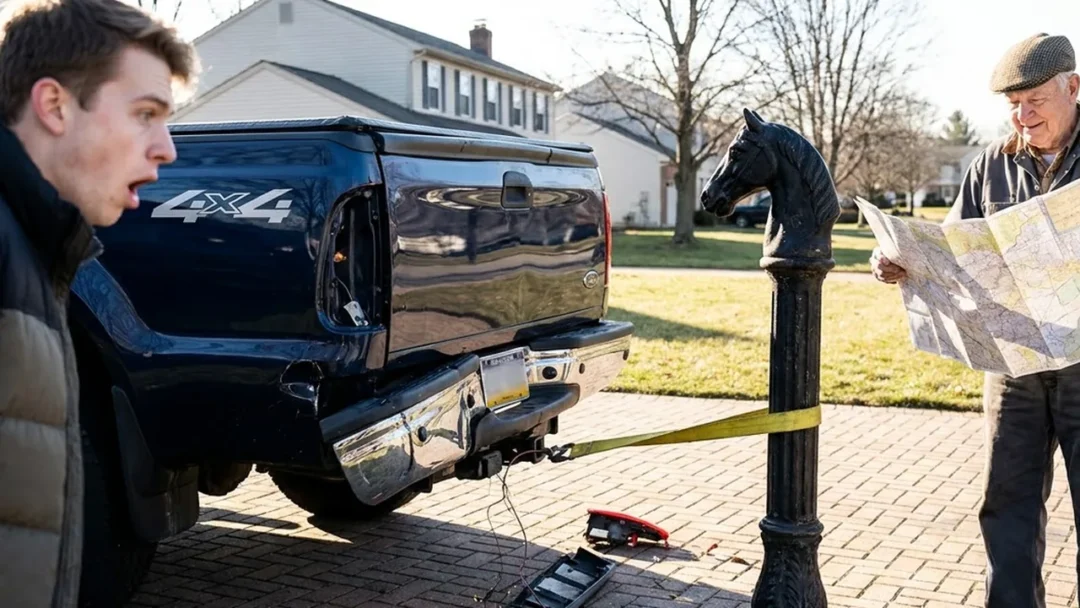
The Bedrock Iron Boundary Post And The Torn Chrome Bumper
CHAPTER 5: THE LEDGER OF THE HISTORIC COMMISSION
The cruiser door opened, and Officer Derek Miller stepped out onto the brick pavement. At forty-two, Miller was an eighteen-year veteran of the Columbus police force, assigned specifically as the liaison officer for the city’s historic preservation districts. Walking beside him was Dr. Eleanor Vance, the chief archivist and senior surveyor for the City of Columbus Landmark Preservation Board.
Dr. Vance was fifty-six, dressed in a sharp tweed field blazer, carrying an aluminum clipboard and an electronic laser surveying transit. She had spent thirty years mapping every historic monument, stone milestone, and iron benchmark in Franklin County, and she possessed statutory authority under Ohio preservation law to issue immediate civil stop-work orders and criminal citations.
“Officer Miller, look at this debris field,” Dr. Vance said, her voice filled with cold, professional outrage as she adjusted her glasses. “This is unmitigated vandalism.”
Chad Bradford rushed toward the officer, waving his hands in a frantic, hysterical attempt to control the narrative. “Officer! Thank God you’re here! This man—this neighbor—set a mechanical trap on our shared driveway! He refused to remove an illegal iron obstruction, and when I attempted to clear my deeded access, my truck was catastrophically damaged! Look at my vehicle! It’s a total loss! I want him arrested for reckless endangerment and civil destruction of property!”
Officer Miller held up a flat, commanding palm, stopping Chad six feet away. He took in the yellow kinetic strap tied to the iron post, the sheared frame mounting bolts scattered across the bricks, the trail of transmission fluid, and the calm elderly stonemason standing beside the monument.
“Mr. Bradford, step back to the sidewalk and keep your hands at your sides,” Officer Miller instructed firmly. “I can read a physical scene without your commentary.”
Dr. Vance walked deliberately up the brick carriageway, kneeling beside the cast-iron post. She took out a brass caliper and a digital magnifying glass, carefully inspecting the bronze medallion on the base.
“Monument Number Eighty-Two,” Dr. Vance read aloud, her voice carrying clear and sharp across the alley. “Established by City Ordinance 412 in October of 1928 to mark the primary civil triangulation baseline between Jaeger Street and City Park Avenue. Fully cataloged in the National Register of Historic Places under the German Village Historic District inventory.”
Dr. Vance stood up, turned around, and looked directly into Chad Bradford’s pale face.
“Mr. Bradford, this monument is not a private obstacle. It is an active municipal property benchmark owned by the citizens of Columbus,” Dr. Vance said with razor-sharp legal clarity. “Under Ohio Revised Code Section twenty-nine-oh-nine-oh-five, the intentional tampering with, defacing, or attempted removal of an established government boundary survey monument is a fifth-degree felony, punishable by up to twelve months in state custody and mandatory restitution for structural re-verification.”
Dr. Vance pulled a bright yellow carbon-copy summons pad from her clipboard, rapidly writing out three separate administrative violations. “Furthermore, under Columbus City Code Title Thirty-One, unauthorized heavy mechanical excavation or demolition within a designated historic preservation district carries an immediate civil penalty of ten thousand dollars per occurrence.”
Chad’s knees buckled slightly, his face turning an ashen gray. “Ten thousand dollars? Felony? Over an iron post?”
“Over an irreplaceable cultural landmark that you tried to rip out with thirty thousand pounds of kinetic force,” Dr. Vance replied coldly.
Dr. Eleanor Vance’s authority under the Columbus City Code was backed by decades of municipal statutory reform. In 1960, the City of Columbus had created the German Village Commission—one of the earliest architectural review boards in the nation—empowering it with legislative authority to protect the district’s streetscapes, historic carriageways, and original civil infrastructure. Under Title Thirty-One of the municipal code, any individual who alters, damages, or removes a designated historic monument or public landmark without a Certificate of Appropriateness is guilty of a strict-liability civil violation carrying mandatory daily fines and full financial liability for historical restoration.
Dr. Vance pulled out her archival file folder, displaying a high-resolution scanned blueprint of the 1928 street survey signed by City Engineer Walter W. Graf. The blueprint clearly identified the iron horse-head post at Jaeger Street as Civil Monument 82, established as a permanent benchmark to resolve property boundary disputes between adjacent lot subdivisions. Stamped on the blueprint was an explicit legal warning: “THIS MONUMENT IS THE PERMANENT PROPERTY OF THE CITY OF COLUMBUS. REMOVAL, DEFACEMENT, OR ALTERATION STRICTLY PROHIBITED BY LAW.” Chad Bradford had not merely trespassed on his neighbor’s property; he had attacked a sovereign municipal benchmark.
Officer Miller walked the perimeter of the carriageway, measuring the skid marks on the vitrified paving bricks with a precision rolling wheel. “Seventeen feet of continuous locked-wheel acceleration scrub, Mr. Bradford,” Officer Miller noted into his handheld dictaphone. “The tires generated sufficient friction to scorch the historic clay pavers. Under municipal preservation codes, restoring those damaged pavers requires hand-cleaning with specialized non-acidic chemical poultices under the supervision of a licensed historic masonry conservator. That invoice alone will run several thousand dollars.”