The Bedrock Iron Boundary Post And The Torn Chrome Bumper
CHAPTER 3: THE SHEAR OF THE HYDROFORMED STEEL
The big eight-cylinder engine spooled with a high-pitched, predatory whistle from its variable-geometry turbocharger. The heavy GMC pickup lurched forward down the brick carriageway, taking up the slack in the yellow recovery strap.
The strap lifted from the red bricks, hovering three feet above the ground like a vibrating violin string.
When the kinetic nylon reached its zero-slack threshold, the mechanical dynamics became instantly violent. Kinetic recovery straps are engineered with twenty percent internal elasticity, designed to stretch under load and transfer stored kinetic energy in a massive forward snap. But for a kinetic strap to function, the anchored object must have some degree of compliance, or the vehicle must maintain traction.
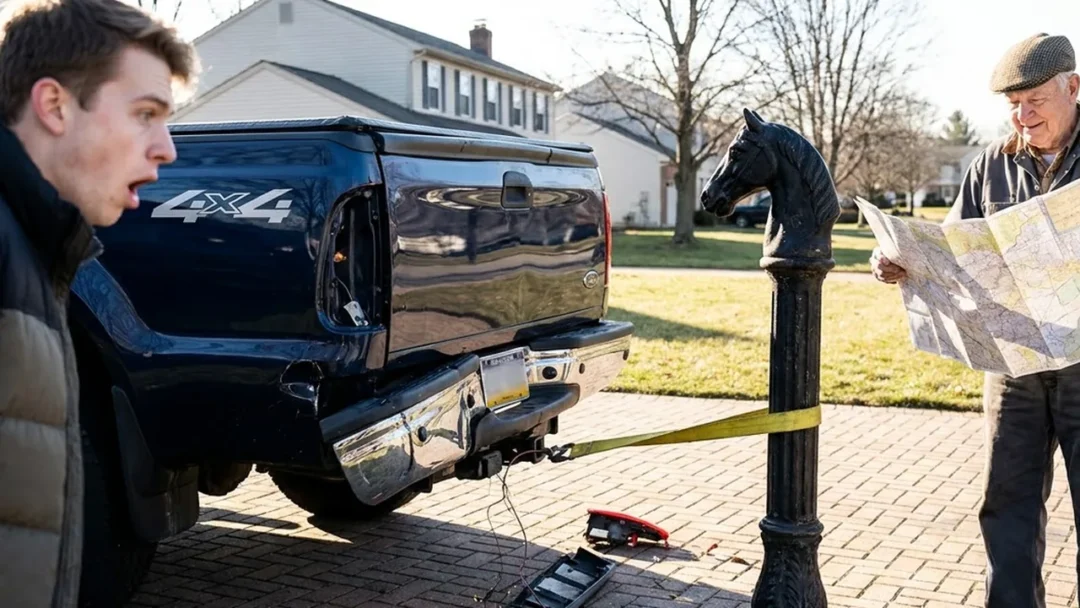
The cast-iron horse-head post did not comply. It did not budge a thousandth of an inch.
Inside the deep foundation pit beneath the red-brick pavers, the iron post extended four feet into the earth, culminating in a three-foot-wide flared cast-iron footing secured with three-inch solid forged steel drift pins driven directly into a ten-foot shelf of solid Columbus limestone bedrock. The subterranean assembly weighed over four tons. To pull that post from the ground would have required a heavy commercial railroad crane anchored on steel outriggers.
The Denali’s rear suspension squatted violently, the leaf springs compressing flat against the rear axle bump stops.
All four massive Goodyear tires broke traction against the damp paving bricks, screaming in mechanical agony and spinning at twenty miles per hour while the truck remained pinned in place. Dense, acrid clouds of blue rubber smoke poured from all four wheel wells, filling the narrow carriageway with the stench of burning petroleum and pulverized vulcanized rubber. The bricks beneath the spinning tires were scrubbed clean of ninety years of moss, throwing sparks as the tire sipes bit into the vitrified clay.
Chad looked in his side mirror, his eyes widening in furious disbelief as he saw the yellow strap drawn as tight as an iron bar, while the small horse head sat centered in his mirror, completely motionless.
“Pull, you piece of junk!” Chad roared, leaning forward and flooring the accelerator pedal flat against the firewall.
The engine screamed at four thousand RPM, delivering eight hundred foot-pounds of torque through the locked drivetrain.
The failure occurred in a fraction of a second.
The decorative chrome rear bumper, constructed from stamped one-eighth-inch hydroformed sheet steel, reached its ultimate shear tensile limit. The four three-eighths-inch factory mounting bolts holding the bumper brackets to the hydroformed frame horns sheared cleanly in two with an explosive BANG that sounded like a fragmentation grenade detonating beneath the truck.
The entire chrome rear bumper assembly ripped violently free from the pickup’s frame.
With a horrifying screech of tearing metal, the bumper was hurled backward across the brick driveway by the contracting kinetic strap, crashing onto the pavement with a brutal metallic roar. The attached ultrasonic sonar wiring harnesses, trailer-brake electrical connectors, and rear camera conduits were violently ripped from the vehicle’s main wiring loom, throwing a blinding shower of electrical sparks and severed copper wires across the bricks.
The rear quarter panels of the new truck, deprived of their structural bumper support, buckled outward, creasing the glossy black sheet metal into jagged, crumpled accordions. Both rear taillight housings shattered into hundreds of pieces of ruby-red plastic that showered across the driveway like bloody hail.
Deprived of its thirty-thousand-pound kinetic anchor, the four-hundred-horsepower pickup truck surged forward violently. Chad’s head snapped backward into the leather headrest as the truck rocketed down the carriageway, careening across the sidewalk and slamming its front wheels into the curb on Jaeger Street before Chad could stomp on the brake pedal.
In metallurgy, the failure mode of stamped sheet steel under sudden lateral shear load is accompanied by severe acoustic and vibrational resonance. When the four bumper mounting bolts sheared simultaneously, the sudden release of energy created a mechanical shockwave that rippled through the entire length of the Denali’s hydroformed ladder frame. The frame rails, which were manufactured from high-strength low-alloy steel with pre-engineered crumple zones behind the rear axle, twisted inward under the uneven torque of the kinetic strap. The structural box sections buckled, kinking the metal like an aluminum soda can crushed in a vise.
The electrical destruction was equally devastating. Modern vehicle architectures utilize high-speed Controller Area Network (CAN-bus) wiring backbones to coordinate radar sensors, blind-spot cameras, and electronic trailer brake modules. When the bumper was violently torn from the frame, the main wiring loom was stretched beyond its elastic limit, ripping the delicate copper data conductors from their weather-sealed multi-pin plugs and causing high-voltage short circuits that flashed through the central body control module. The sudden voltage spike fried the vehicle’s central gateway computer, disabling the digital dashboard and locking the electronic transmission into safe-mode limp operation.
The mechanical energy released during the fracture of the hydroformed frame was equivalent to dropping a two-ton safe from a second-story window. As the four factory mounting bolts snapped, the kinetic tow strap whipped like a snapped steel cable, carving a deep, ragged gouge into the black clear coat of the tailgate. The shattered pieces of the ultrasonic radar sensors dangled from their copper wiring like broken beads on a string, their internal piezoelectric crystals pulverized by the concussive shockwave. The Denali had been reduced from a showpiece of modern status into a crippled piece of industrial wreckage.