The Hydrant Line That Broke Calder’s Glass Empire
CHAPTER 4: THE VOICE BEHIND THE FREEZER
Price sealed the key in an evidence bag while Calder’s lawyer protested contamination from water, glass, and firefighters. The objection did not change the stamped tag or the vehicle log. A judge authorized seizure of Calder’s phone and cloud records before the lawyer finished speaking.
The judge’s order also covered Calder’s building-access system. Logs showed Mara’s rear door had opened with a master credential at 4:03 a.m. The credential was assigned to an executive override kept in Calder’s office. At 4:18, the restaurant hood controller went offline. At 11:39, Denny’s maintenance badge opened the service passage, although witnesses had seen Voss carrying Denny’s ring of keys earlier that morning.
Price arranged the events on the hood of his cruiser using waterproof note cards. The timeline did not yet prove who lit the flame, but it stripped coincidence away one layer at a time. Calder watched from twenty yards off. Each time Price placed another card, the developer’s lawyer leaned closer and spoke more urgently.
Eli focused on Denny. The maintenance man was sixty-one, diabetic, and unlikely to survive smoke exposure in a confined passage. Ortiz assigned a rescue team from the exterior hatch and another from the kitchen. The ductwork between them had warped into a trap of razor edges and hot grease.
Eli crawled behind the exterior crew with oxygen and trauma gear. The concrete passage narrowed to shoulder width. Water ran beneath his knees. Every foot forward required cutting wire, levering sheet metal, and checking the ceiling for collapse. The air tasted of burned oil even through his mask.
They reached Denny’s flashlight forty feet in. A faint tapping came from beyond the duct.
“Fire department,” Ortiz shouted. “Denny, tap twice if you hear me.”
Two weak strikes answered.
Outside, Price opened Calder’s phone under the warrant. Deleted messages recovered from a synced tablet showed a thread with Nolan Voss, Calder’s security chief. One message ordered Voss to “make the archive problem disappear before inspection.” Another warned that the hydrant had to remain “decorative until noon.” Calder insisted the words referred to landscaping.
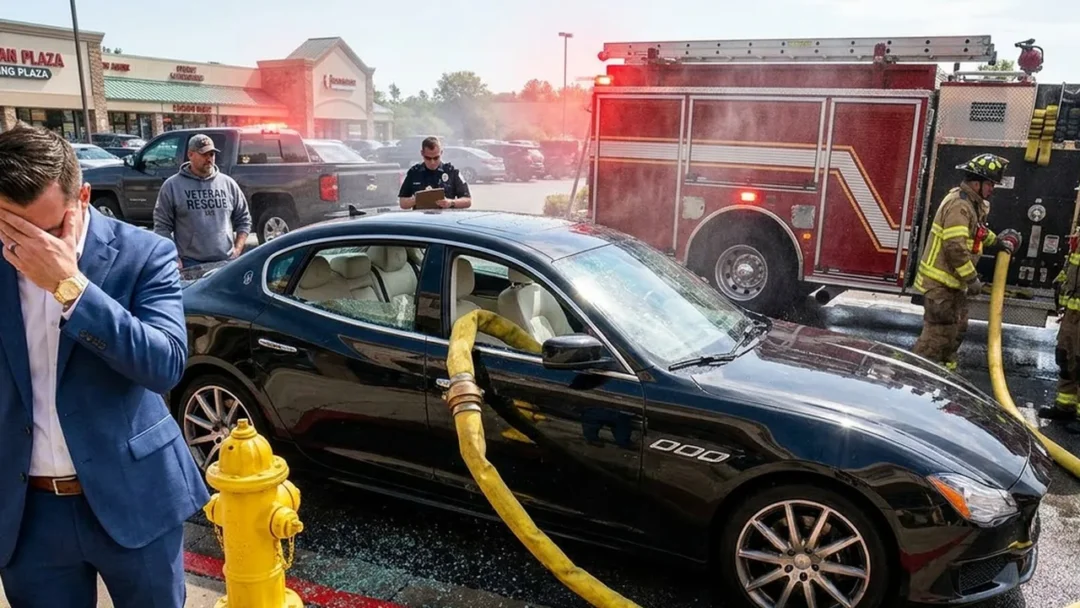
Vehicle telemetry added a harder fact. The sedan had arrived at the service entrance before dawn, left for three hours, then returned to the hydrant at 11:36. Calder had not chosen the illegal space from convenience. He had positioned the car there five minutes before smoke appeared.
Price read the timestamps aloud. Calder’s face drained, but he recovered. “Coincidence is not conspiracy.”
Mara held Toby against her side and watched the rescue entrance. “Where is Nolan Voss?”
No one knew. His company truck had left the plaza as the first siren arrived.
Inside the passage, Ortiz and Eli used a battery spreader to peel the duct upward. Hot metal fought every inch. Denny lay on his side beyond it, wrists bound with plastic ties, soot pulsing from his mouth. A waterproof document pouch had been shoved under his jacket.
The spreader’s battery indicator flashed red. Ortiz wedged a halligan beneath the lifted duct while a firefighter crawled back for a replacement pack. Eli reached through the opening and felt Denny’s carotid pulse with two gloved fingers. Slow, present. He called the rhythm aloud so Ortiz could track any change. Denny’s skin was cool despite the heat, a sign that shock had already begun.
They cut away a belt loop snagged on sheet metal, padded the sharp edge with a folded salvage cover, and moved him inches at a time. Nothing about rescue resembled the clean speed of television. It was leverage, breath, cramped muscle, and repeated checks that the cure was not worsening the injury.
Eli cut the ties and fitted an oxygen mask. Denny’s pulse fluttered. The passage was too tight for a rigid litter, so the crew slid him onto a flexible rescue sheet and passed him backward hand by hand. Eli stayed at his head, keeping the airway open while metal screamed above them.
Halfway out, Denny caught Eli’s sleeve. “Voss,” he rasped through the mask. “Valve pit.”
Then his eyes rolled closed.
Paramedics intubated him on the pavement. The pouch contained copied tenant affidavits and a flash drive. Denny had preserved what Voss tried to burn. Mara recognized his handwriting on the envelope: IF THEY TAKE THE RED BOX.
Fire investigators recovered the original box after suppressing the secondary fire. Its exterior had charred, but the stacked paper within was only wet at the edges. Laboratory techs found a narrow accelerant trail from the towels to the box and a separate ignition device made from a kitchen timer.
Price’s phone sounded. A traffic camera had caught Voss’s truck heading toward the old municipal valve yard beside the Monongahela canal. That yard contained obsolete maps, maintenance logs, and the manual bypass controlling pressure to the redevelopment district.
Ortiz checked the fireground. The kitchen fire was contained. Mutual-aid crews could handle overhaul. She looked at Eli. “You heard Denny.”
“Valve pit.”
Price sent patrol units ahead, but the first reported the yard gate chained from inside. Security video showed Voss descending into the concrete pit with fuel cans. Calder’s seized smartwatch then lit with an incoming message mirrored from a hidden account.
Voss had written only six words: TEN MINUTES. THEN THE RECORDS BURN.
Ortiz checked the remaining air cylinders and assigned the freshest crew to the pit. Price requested the bomb squad, but the nearest team was forty minutes away. Waiting would surrender both the archive and anyone Voss had trapped below. They would have to recognize the device, isolate its energy, and act without specialists.
Eli replaced his empty bottle and called the hospital for Denny’s status. The nurse reported severe inhalation injury but a stable pulse after intubation. Alive was not safe, yet it was enough to carry into the next decision. He told Mara, who closed her eyes once and then asked what Denny’s wife needed.
At the police tape, Calder’s lawyer quietly stepped away from his client. Calder noticed and began issuing orders to people who no longer answered him.