The Hydrant Line That Broke Calder’s Glass Empire
CHAPTER 5: TEN MINUTES UNDERGROUND
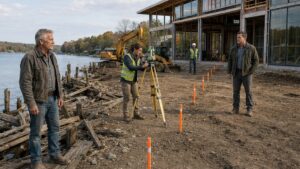
The valve yard occupied a wedge of land between the canal and an abandoned rolling mill. Rain began as Ortiz’s command truck arrived, tapping on steel pipes stacked behind the fence. Smoke curled from a vent in the concrete pit.
Price requested utility schematics, but three generations of drawings contradicted one another. A 1958 linen plan showed a gravity drain where a 1987 renovation showed an electrical trench. Calder’s recent submission omitted the chamber entirely. Eli spread the pages across the command-truck wall and traced pipe diameters with a finger. The oldest drawing matched the vibrations underfoot. Someone had designed later work to make the past unreadable.
Ortiz established air monitoring around the vent. Gasoline vapor climbed toward its explosive range, forcing officers to kill radios within the hot zone and use hand signals. Firefighters laid a foam line but kept it dry; premature discharge could spread floating fuel into the archive alcove. The technical choices narrowed with every inch of rising water.
Price ordered Calder transported separately and secured the perimeter. Eli followed Ortiz through a cut section of fence with air packs, a thermal camera, and a foam extinguisher. The old plans showed two stair exits, but redevelopment fill had buried one. Voss had chosen a place with a single throat.
“Police,” Price called down. “Nolan, come up empty-handed.”
Voss answered by opening a bypass. Water hammered through the chamber, shaking the grating. He had coupled a fuel bladder to the record-room drain and rigged a flare above it. If the level rose high enough, the floating fuel would meet flame and carry fire across every paper shelf.
Ortiz shut the accessible feed valve. Nothing changed. The illegal work had reversed the controls.
Eli studied the vibration under his boots. Navy damage-control drills returned in fragments: isolate, brace, cool boundaries, never trust a label after sabotage. A smaller handwheel on the canal side trembled against its stop. Fresh wrench scars marked it.
“That’s the live branch,” he said. “Close it and the pit stops filling.”
The wheel would not turn. Ortiz fixed a chain wrench around its rim while Eli added a pipe extension. Together they drove it a quarter turn, then another. The hammering eased. Below, Voss fired a nail gun through the stair opening. A steel fastener rang off the railing beside Price.
Price pulled back. “He’s armed.”
“With a tool,” Ortiz said, “but it’ll kill the same.”
The clock on Calder’s message had less than six minutes. Eli descended behind a ballistic shield carried by a tactical officer. Smoke flattened visibility. Water reached his calves. The flare’s red glow moved on the surface while shelves of inspection ledgers absorbed spray.
Each stair tread had become slick with algae and fuel. Eli clipped a search line to the rail and counted his descent, announcing depth to Ortiz. At the landing, he found fishing line stretched ankle-high toward a shelf of glass jars. A rushed responder would have pulled them into the water. He cut the line and passed the improvised alarm upward in an evidence tub.
Voss laughed somewhere beyond the pump. “All this for paper nobody read.”
“Denny read it,” Eli answered.
“And look where that got him.”
The words clarified what the smoke concealed. Voss believed Denny dead and had not checked the hospital. He had no outside information, which meant Calder was still directing him through the hidden account. Price signaled that the admission had been captured on a hard-wired recorder at the stair mouth.
Voss crouched behind a pump housing. He fired twice. Nails punched the shield and stopped. When he shifted to reload, Ortiz swept his legs with a hose stream from the yard’s auxiliary line. He struck the concrete, lost the gun, and lunged toward the flare cord.
Eli reached him first. They crashed into the water. Voss drove an elbow into Eli’s ribs and grabbed for a utility knife. Eli trapped the wrist, rolled his weight through Voss’s shoulder, and pinned him until the tactical officer cuffed both hands.
Ortiz snatched the flare from its bracket with insulated tongs. Thirty seconds remained on the kitchen timer wired to the igniter. She submerged the electrical lead in a dry chemical bucket and cut power at the battery.
The pit went quiet except for water draining through the grates.
On the record shelves, Price found original pressure tests, valve diagrams, and inspection photographs. They showed that Calder’s planned tower exceeded the old district main’s fire-flow capacity. Approval would have required ten million dollars in utility upgrades. Instead, an engineer’s rejection letter had vanished from the city file, and Calder had begun buying out tenants whose safety complaints could reopen review.
Voss asked for a deal before they reached daylight. He said Calder ordered him to close the district valve, stage a small kitchen fire, move Mara’s records, and leave Denny unconscious in the passage. Calder would blame the pressure failure on the city and use the casualty clause to void leases.
“He said nobody would get hurt,” Voss muttered.
Eli looked at the blood dried on Denny’s cap in an evidence bag. “You tied a man behind a burning kitchen.”
At the top of the stairs, Price received an alert. Calder’s transport had never left the plaza. During the confusion, the developer had slipped a second key from his briefcase, opened the cruiser door, and run through the stormwater culvert toward the valve yard.
Ortiz swept her light across the canal bank. A figure in a soaked blue suit climbed toward a yellow excavator parked above the buried bypass line. Calder hauled himself into the cab and started the engine.
The machine’s bucket rose over the exposed pipe and the evidence pit beneath it.
Rain silvered its teeth as the boom began to fall.
Below, Ortiz shouted the last firefighter clear.
Eli heard the warning and climbed anyway because the machine could bury Ortiz’s crew before officers reached the cab. He checked the stable track, chose three fixed handholds, and kept his body inside the counterweight line. It was not impulse. It was a rapid risk calculation made visible.