The One Arm Weighted Pull Up And The Fake Welder Fraud
CHAPTER 7: THE MASTER WELDER’S FORGE
Saturday afternoon was a festival of quiet, joyous celebration across the farming hollows of Lancaster County.
A convoy of four flatbed farm trucks, led by Sam Stoltzfus and six elders of the local agricultural community, drove slowly down the lane toward Elihu Miller’s bank-barn. In the bed of the lead truck, cleaned and polished until its green paint gleamed in the sun, was Sam’s twenty-kilowatt John Deere generator, successfully reinstalled and running like a clock.
Sam Stoltzfus—a tall, bearded man of sixty-eight with gentle blue eyes and a handshake that could crush a walnut—stepped onto Elihu’s porch, carrying a hand-carved cedar chest filled with homemade strawberry preserves, smoked bacon, and fresh apple butter prepared by his family.
“Elihu,” Sam said, his voice thick with deep, unadorned reverence. “Words are small things on the ridge. You saved forty thousand dollars of milk from souring, and you protected twenty neighbors from being robbed in their beds. We thank the Almighty for your hands and your watchful heart.”
Elihu smiled, accepting the cedar chest with a gentle nod. “Neighbors look out for neighbors, Sam. That’s the only law that matters.”
Once the neighbors had departed, Elihu did not sit in an easy chair to rest.
He walked out to his personal forge shop behind the barn. He fired up his own industrial Lincoln electric TIG welding machine—a precision high-frequency unit capable of producing radiographic-quality structural joints in aerospace alloys. He selected a ten-foot section of six-inch wide-flange structural steel I-beam, four high-tensile three-quarter-inch A325 structural bolts, and two heavy triangular gusset plates sheared from three-quarter-inch carbon steel plate.
Working with the calm, methodical mastery of a lifelong craftsman, Elihu prepared the joints with a pneumatic beveling tool, pre-heated the thick steel with an oxy-acetylene rosebud torch to four hundred degrees, and ran three continuous, immaculate passes of E7018 low-hydrogen weld metal.
The arc hissed with the clean, smooth, frying-bacon hum of a perfect electric weld. The molten slag peeled away from the glowing metal in long, curling ribbons of golden glass, revealing a structural bead that was flawless, uniform, and fused five-eighths of an inch deep into the parent steel.
By sundown, the new hoist beam was bolted through the twelve-inch white-oak post, anchored with heavy backing plates that distributed the load across the entire timber frame.
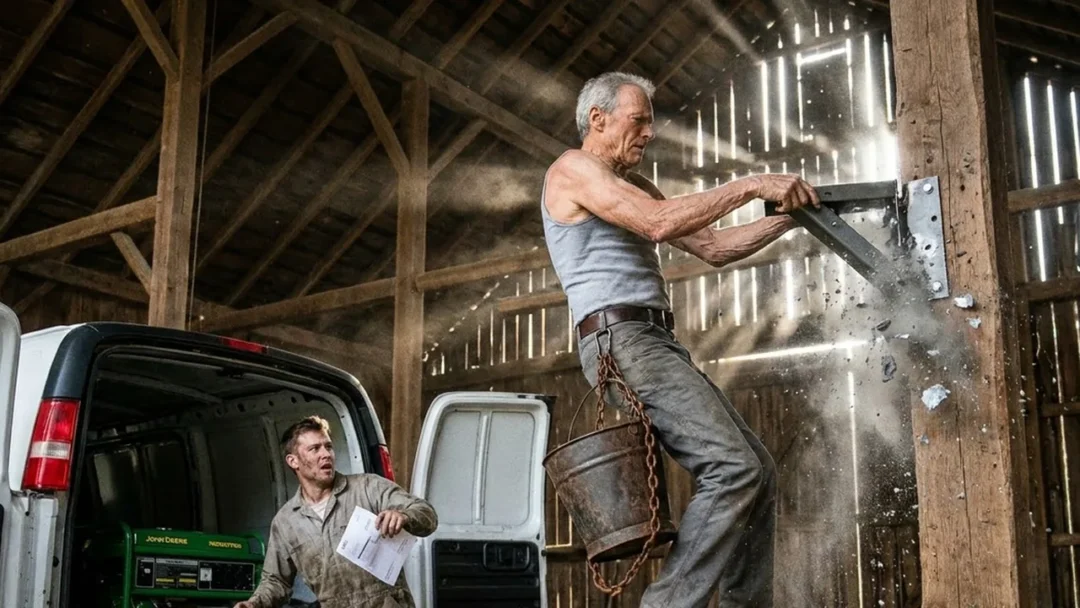
Elihu mounted his five-ton mechanical chain hoist to the trolley, hooked the lift ring to his four-wheel-drive farm tractor, and lifted the front axle three feet into the air.
The heavy steel beam did not bend. The oak timber did not groan. The weld did not flinch. It was an unbreakable monument to honest American craftsmanship—built to hold ten tons, built to last a century, and built by hands that never cut a corner.
The technical precision demonstrated in Elihu’s installation of the new structural hoist beam was an exhibition of textbook industrial welding practice. Before laying a single bead, Elihu utilized an ultrasonic flaw detector to verify the internal lamination integrity of the three-quarter-inch gusset plates, ensuring there were no sub-surface inclusions or voids within the rolled plate. He ground the root faces to a sixty-degree included angle, established a precise three-thirty-seconds-inch root opening with copper spacers, and executed an immaculate root pass using E6010 cellulosic electrodes for deep, complete penetration into the root face. Following the root pass, he ground out the stop-starts with a narrow pneumatic stone, deslagged the joint with a needle scaler, and capped the weld with three weave passes of low-hydrogen E7018, creating a structural joint with an ultimate tensile strength exceeding seventy-two thousand pounds per square inch.