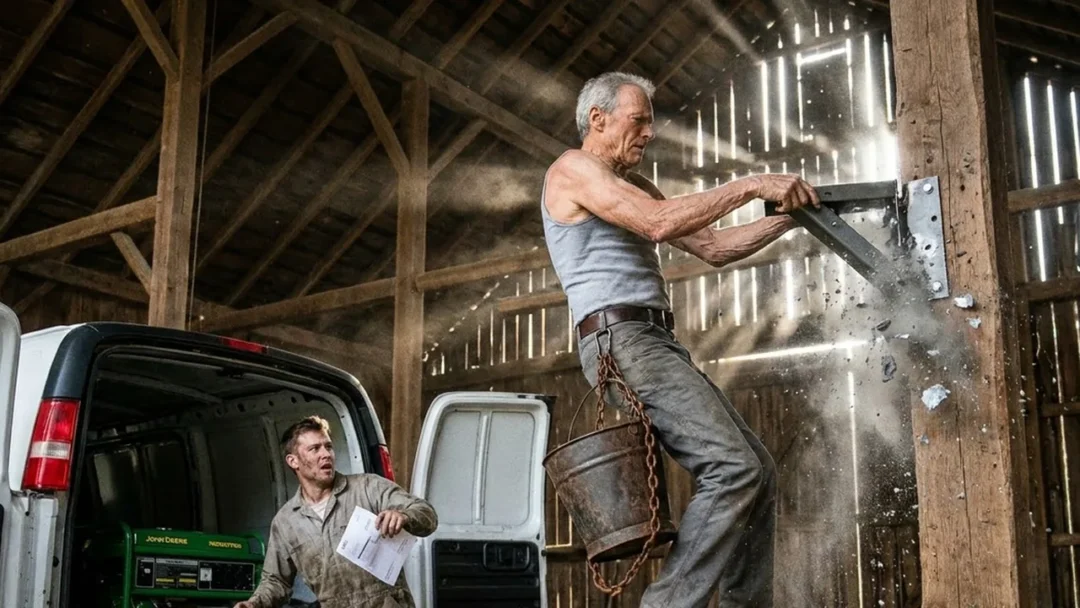
The One Arm Weighted Pull Up And The Fake Welder Fraud
CHAPTER 2: THE POROUS SEAM
To an ordinary farmer, the installation looked professional. The bracket was constructed of heavy three-eighths-inch structural steel angle, bolted to the vertical oak timber with two lag screws and welded to a horizontal cantilever arm designed to mount a rolling trolley. The entire joint had been freshly coated in a thick, uniform layer of bright silver-colored metallic enamel that gleamed in the barn light.
Elihu Miller, however, had spent forty-five years inspecting high-pressure steam boiler drums for the United States Navy and commercial nuclear power facilities. He had held ASME Section IX welding certifications in shielded metal arc welding, gas tungsten arc welding, and radiographic non-destructive testing since nineteen-seventy-five. To Elihu, a weld was not merely an adhesive joint; it was a microscopic crystalline fusion zone where molecular grain boundaries determined the boundary between human life and catastrophic structural failure.
Elihu drew back his scarred right knuckles and delivered two sharp taps against the horizontal steel arm.
Tock. Tock.
The acoustic resonance was dead, hollow, and muffled—not the high, clear, ringing tone of high-carbon steel fused to structural iron, but the dull, absorptive thud of an organic polymer.
Elihu leaned closer, his nose two inches from the bright silver seam.
Beneath the wet, pungent odor of fresh aerosol enamel paint, there was zero trace of the ozone-and-flux scorch that characterizes legitimate electric arc welding. Furthermore, the surface texture of the weld bead was completely wrong. A true low-hydrogen E7018 structural fillet weld displays a tight, uniform pattern of overlapping crescent-shaped ripples formed by the surface tension of the molten puddle as the slag freezes.
This bead was smooth, rounded, and riddled with microscopic pinholes and gas bubbles—the unmistakable signature of polyester resin out-gassing as it cures.
Elihu glanced down toward Tyler’s open tool tote resting on the floorboards beside the van’s front tire.
Tucked half-underneath a dirty rag was an empty, newly punctured tube of commercial cream hardener, a plastic body-filler spreader smeared with grey residue, and an open cardboard box of Bondo Professional Heavy-Duty Auto Body Filler. Resting beside the filler was a freshly used aerosol spray can of Krylon Industrial Bright Silver Metallic Enamel, its nozzle still wet with silver paint.
The entire fraudulent scheme was laid bare before Elihu’s eyes:
Tyler Riggs had not executed a structural multi-pass arc weld. He had merely thrown two tiny, one-eighth-inch surface tack welds at the outer corners to hold the steel in place, packed the deep four-inch structural gap with cheap, eighty-cent polyester auto-body putty, smoothed the contour with a plastic spatula, and sprayed the entire mess with five dollars worth of silver enamel to mimic a continuous industrial bead.
Had Elihu mounted an electric hoist to that bracket and lifted an eight-hundred-pound tractor engine, the brittle polyester putty would have sheared instantly under the first dynamic load, dropping the engine and crushing anyone standing on the threshing floor.
Elihu looked up at Tyler Riggs, who was leaning against his van, checking his gold-plated watch with an arrogant smirk.
“You’re a certified structural welder, Tyler?” Elihu asked quietly, his voice dangerously calm.
“Top of my trade, pops,” Tyler bragged, blowing dust off his clipboard. “Certified by the American Welding Society. That joint is rated for ten thousand pounds. You could hang an elephant from that bracket.”
Elihu stepped directly beneath the steel cantilever arm, his grey eyes turning to freezing winter ice.
“Let’s see if it holds a boilermaker.”
The metallurgy of structural arc welding is governed by the American Welding Society D1.1 Structural Welding Code, which mandates precise pre-heat temperatures, electrode storage protocols, and interpass temperature controls. In heavy structural applications, high-tensile carbon steel requires low-hydrogen electrodes such as E7018, which must be stored in heated rod ovens at two hundred and fifty degrees Fahrenheit to prevent atmospheric moisture from contaminating the flux coating. When moisture penetrates the weld puddle, the intense thermal arc dissociates water molecules into hydrogen and oxygen; the atomic hydrogen becomes trapped within the cooling crystalline lattice of the steel, creating microscopic interstitial stress points known to metallurgists as ‘underbead hydrogen cracking’ or delayed cold-cracking. To substitute such rigorous thermodynamic metallurgical fusion with polyester auto-body filler—an unsaturated resin blended with talc and styrene—is an act of criminal negligence that invites catastrophic shear failure under minimal static load.