The One Arm Weighted Pull Up And The Fake Welder Fraud
CHAPTER 3: THE POWDER ON THE BOOTS
Tyler Riggs’s arrogant smirk froze on his face. “Hey, old man, don’t touch that! The paint is barely dry! What the hell are you doing?”
Elihu Miller did not answer.
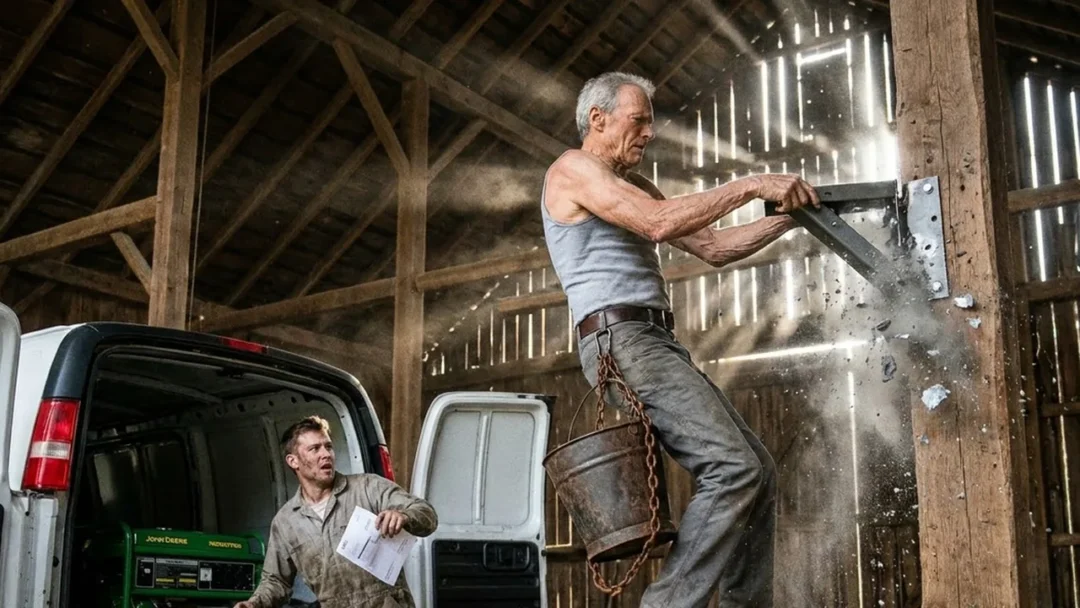
With the explosive, fluid athleticism that defied his seventy-three years, Elihu leaped straight up from the floorboards.
His bare, calloused hands shot toward the horizontal steel arm of the hoist bracket. His fingers—hardened by decades of handling heavy steam pipe and gripping industrial pneumatic riveting guns—clamped around the three-inch steel channel with the unyielding, mechanical bite of a forged bench vice.
He did not merely hang his one-hundred-and-sixty-eight-pound body weight.
The moment his fingers locked onto the steel, Elihu engaged his entire posterior kinetic chain. In an explosive, violent downward surge of dynamic latissimus dorsi torque, Elihu drove his elbows downward and arched his back, generating a dynamic shock load exceeding four hundred and fifty pounds of downward shear directly onto the welded seam.
The response of the fraudulent joint was instantaneous and catastrophic.
CRACK!
The brittle polyester auto-body filler had zero tensile strength and zero shear elasticity. Under Elihu’s explosive human lat-pull, the plastic filler sheared clean through its resin matrix like a stale cracker. The two tiny, superficial tack welds at the corners snapped with a sharp, high-pitched metallic crack.
The entire five-foot structural steel hoist bracket tore clean off the vertical oak post.
As the steel bracket ripped free, an enormous, choking cloud of chalky grey polyester dust and wet silver enamel paint flakes burst into the humid barn air. Elihu landed lightly on his boots, carrying the sixty-pound steel bracket safely down to his side, completely uninjured.
A heavy shower of brittle grey putty chunks, white dust, and silver paint flakes rained directly down across the polished leather work boots, embroidered coveralls, and clipboard of Tyler Riggs.
Tyler scrambled backward in sheer terror, his face draining of all color, his eyes wide as dinner plates as he stared at the bare oak post where the bracket had been. On the timber wall, there was no melted steel, no heat-affected zone, and no penetration into the base metal—only two smeared lines of grey plastic glue and two charred pinpricks where the electrode had barely touched the wood.
Elihu walked forward three slow, deliberate paces, his boots crunching on the fallen grey putty.
With a dull, heavy clang that rattled the floorboards, Elihu dropped the broken steel bracket directly onto the sawdust at Tyler’s feet.
“Two spots of glue and silver paint,” Elihu said, his voice dropping like an anvil onto the concrete. “You charged three thousand dollars for eighty cents worth of car-fender putty. You would have killed a man with this bracket, boy.”
Tyler Bradley was hyperventilating, his hands shaking so violently that the paper invoice fluttered to the floor. “You… you tore that down with your bare hands? That was structural steel! You’re out of your mind!”
Backing away in blind, frantic panic toward his van, Tyler’s heavy elbow slammed hard against the vehicle’s rear exterior door handle.
CLACK-CREAK.
The worn commercial latch mechanism popped open. The van’s heavy double rear cargo doors swung wide open in the afternoon breeze, revealing the dark, shadowed interior of the cargo bay.
The physics of dynamic human latissimus dorsi contraction can generate peak impulse forces that far exceed static body weight. When an athlete or laborer drops from an overhead elevation and abruptly arrests his momentum, or executes an explosive concentric pull against an immovable structural beam, the impulse-momentum theorem (J = F * Δt) dictates that the force applied is inversely proportional to the duration of deceleration. By locking his fingers into an unyielding hook grip and driving his entire posterior kinetic chain downward in less than two-tenths of a second, Elihu concentrated an instantaneous shock load of nearly five hundred pounds directly across the narrow three-inch weld seam. While legitimate welded steel possesses a shear yield strength of over forty thousand pounds per square inch, brittle polyester body filler fails in brittle tension at less than eight hundred pounds per square inch, disintegrating instantly into powdery particulate.
The acoustic dynamics of the timber barn during the collapse of the fraudulent bracket amplified the physical shock of the failure throughout the entire fifty-foot structure. The sudden, violent release of four hundred and fifty pounds of downward shear sent high-frequency vibrational waves rippling through the vertical grain of the twelve-inch white-oak post, resonating like a massive wooden tuning fork. The swallows nesting in the high purlins took flight in a frantic whir of wings, disturbed by the unfamiliar crack of brittle polyester and sheared steel. The chalky grey particulate that rained from the sheared joint settled into the sawdust with the soft, dead hiss of falling ash, a physical testament to the utter absence of metallic fusion within the joint.