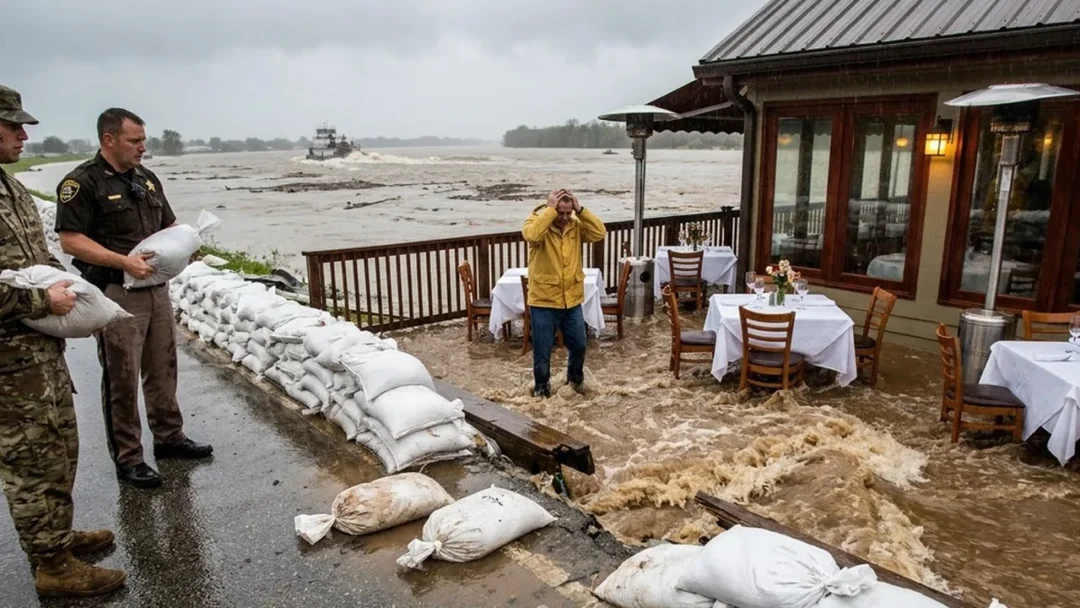
The River View That Swallowed Rourke’s Last Lie
CHAPTER 7: WHAT THE RIVER RETURNED
The tunnel entrance stood behind a rusted steel hatch inside the pump station. Naomi took Greene and a county utility diver, each tethered to a surface team. Dunn wanted her to command from outside. She answered that she could read Daniel’s map and knew the gate sequence; sending someone else without that knowledge would add risk, not remove it.
They entered waist-deep water. The tunnel amplified the river into a continuous roar. Daniel’s diagram showed three wheels, but only two remained visible. The third hid behind a concrete patch installed during Rourke’s renovation.
The utility diver tested the atmosphere above the water. Oxygen remained safe, but the meter detected methane released from flooded soil. Surface ventilation pushed clean air through a flexible duct while the entry officer logged each worker’s cylinder pressure and tether mark. Naomi kept one glove on the wall because visibility collapsed whenever muddy spray struck her face shield.
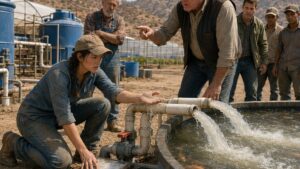
At the first wheel, a bent stem blocked movement. Greene fitted a chain wrench while Naomi cleared gravel from the gear teeth with a screwdriver. They advanced it one notch at a time, pausing when the tunnel ceiling shed pebbles. The work demanded controlled force. Too little would leave the gate open; too much could shear a stem that had no replacement.
Dunn relayed conditions from the berm. Residents had formed a supply line, but only trained crews entered moving water. Earl used his towboat spotlight from upstream to illuminate drifting debris without adding engine thrust. The community’s help was strongest when organized around limits.
Naomi found Daniel’s initials scratched behind the second wheel with an arrow toward the patch. He had left guidance in the one place altered maps could not erase. She felt grief press close, then set it aside until both hands were free. Memory could wait. Hydraulic pressure would not.
Greene broke the patch with a sledge while the diver cleared debris from the drain. Behind it, the wheel was chained open. Bolt cutters snapped the chain. Naomi and Greene leaned into the spokes. The gate moved one inch, stopped, then moved again as surface crews reduced pump suction in the correct order.
Mud rained from the ceiling. Dunn called that they had six minutes before the outer culvert failed. Naomi counted turns from Daniel’s note: fourteen to isolate the farm branch, six back to relieve the road foundation. At fourteen, water dropped around their knees. She reversed six. The roar shifted away from the damaged berm and into the restored public floodway beside the restaurant.
“Gate set,” she radioed.
They cleared the tunnel as the culvert collapsed behind them. The temporary bags settled but held because pressure had moved to the legal channel. At the Santos and Moseley farms, gauges fell. The pump station remained on its foundation.
Dawn revealed what the night had rearranged. Rourke’s lower deck was gone. The public road remained open for ambulances and utility crews. Mud covered the restaurant lawn, tracing the drainage path that maps had tried to erase.
State police returned Rourke in dry jail clothes for identification before taking him to the county facility. Dunn read charges including reckless endangerment, flood-control sabotage, evidence tampering, fraud, and violation of release conditions. Rourke stared at the ruined view and said the town would collapse without his payroll.
June stood with twenty restaurant employees behind the tape. “A job is not permission to drown our neighbors.”
The evidence converged over the next months. Tessa’s archived lidar proved the four-foot substitution. Creel testified about Halpern’s threat and Rourke’s data package. Remote gate logs documented five deliberate diversions. Dunn’s body camera showed Rourke kicking the bags and later threatening the monument. River recordings tied his escape wake to the auxiliary breach. Daniel’s microfilm preserved original surveys and construction photographs.
Prosecutors reconstructed the scheme parcel by parcel. After each engineered flood, a shell company bought damaged land below market value and pledged it as collateral. The river had served as an enforcer until measurements gave its path a record. Defense attorneys blamed extraordinary rain, but Tessa’s paired gauges showed local spikes beginning within minutes of Rourke’s commands. Separate disciplines reached the same conclusion.
Rourke was convicted on the principal fraud, sabotage, and endangerment counts. The judge cited his return to the monument while on release as proof that lesser restrictions could not protect the public. Halpern pleaded guilty before trial. Creel received a reduced sentence contingent on restitution and permanent loss of professional credentials.
Mrs. Santos addressed the court without exaggeration. She described lifting two children above water that had been sent toward her home so another business could keep a scenic deck. The plain scale of the choice silenced the room.
Halpern was indicted for bribery, records fraud, and conspiracy. Creel accepted responsibility for falsifying the certificate and cooperated. Rourke’s shell companies entered receivership. Courts returned foreclosed farm parcels to their former owners and created a restitution fund from the restaurant and undeveloped holdings.
The waterfront building survived above its lower floor. Instead of demolishing it, the town converted the upper level into a cooperative market and emergency shelter managed by former employees. The illegal deck was removed. Its pilings became material for benches placed well outside the floodway.
Engineers restored the public swale and installed visible gauge posts showing real elevations. No landscaped mound concealed the control vault. Its gates received mechanical locks held jointly by the county, levee district, and farm association, so no single owner could redirect water in secret.
Naomi attended the hearing that cleared Daniel’s professional record. The board did not make him flawless. Its report said he should have disclosed his evidence sooner, but confirmed that he rejected the permit, documented the fraud, and preserved proof under credible threats. Truth gave him accountability and vindication together.
At his grave, Naomi brought no grand speech. She set a rubbing of the brass monument beside the stone. “You should have trusted us,” she said. “I should have asked one more question.” Wind moved through wet grass. The admission hurt cleanly, without the old poison of uncertainty.
The following spring, the river rose again. Guard engineers built a shorter temporary wall along the surveyed road. Farmers checked gauges through a shared network. Children watched from the safe side while volunteers passed bags hand to hand.
Earl guided a tow around Morrow Bend at idle speed. Its wake reached the restored floodway and spread harmlessly through cottonwoods planted where the restaurant deck had stood. Water covered the brass disk, then withdrew without moving it.
Dunn joined Naomi on the road crown. “Still blocks the view,” he said, nodding at the sandbags.
Naomi looked across protected farms, the cooperative market, and the honest line of water on the gauge posts. “Depends what you came to see.”
The river swallowed Rourke’s last lie and returned boundaries beneath it: public ground, shared duty, and no private view worth another family’s home.