The River View That Swallowed Rourke’s Last Lie
CHAPTER 3: THE DEAD SENSOR
State emergency management joined the call within minutes. Tessa sent them the forged sensor file, her original submission, and live measurements. Until investigators arrived, Naomi’s mission remained simple: protect the evacuation road through the crest. Yet the false elevation had changed how water moved across three miles of floodplain. She could not hold one wall while hidden channels broke another.
Dunn located Miles Creel at a retirement community thirty miles inland. Creel first denied remembering the permit. When Dunn mentioned the dead sensor, he asked whether Rourke was present. Hearing that Rourke could not listen, Creel agreed to speak by secure video.
His face appeared on Tessa’s tablet, pale beneath fluorescent light. He said Rourke brought a corrected data package and a letter bearing Daniel Bell’s signature. Creel entered the number after a county commissioner warned that delaying the restaurant would cost Morrow Bend two hundred jobs.
Creel described the meeting in detail. Rourke had placed two envelopes on his desk: the corrected certificate and a brochure for a lake condominium. After Creel approved the filing, a title company linked to Rourke transferred the condominium to Creel’s sister for one dollar. Creel sold it within a year and reported the proceeds as an inheritance. Dunn asked whether he would surrender bank and title records. Creel said yes, then requested counsel.
Tessa searched the county archive for the sensor serial number. It belonged to a pressure transducer crushed by ice in 2014 and removed from service. Yet the false file contained hourly readings through 2017, all following a smooth mathematical curve. Real rivers jittered with wind, locks, rainfall, and boat traffic. The invented line was too perfect.
Naomi had her soldiers place additional staff gauges upstream and downstream of the restaurant. Each was photographed against a known benchmark every ten minutes. The redundant record ensured no one could later claim a single defective instrument. Young troops learned why documentation belonged beside shovels and pumps in flood work.
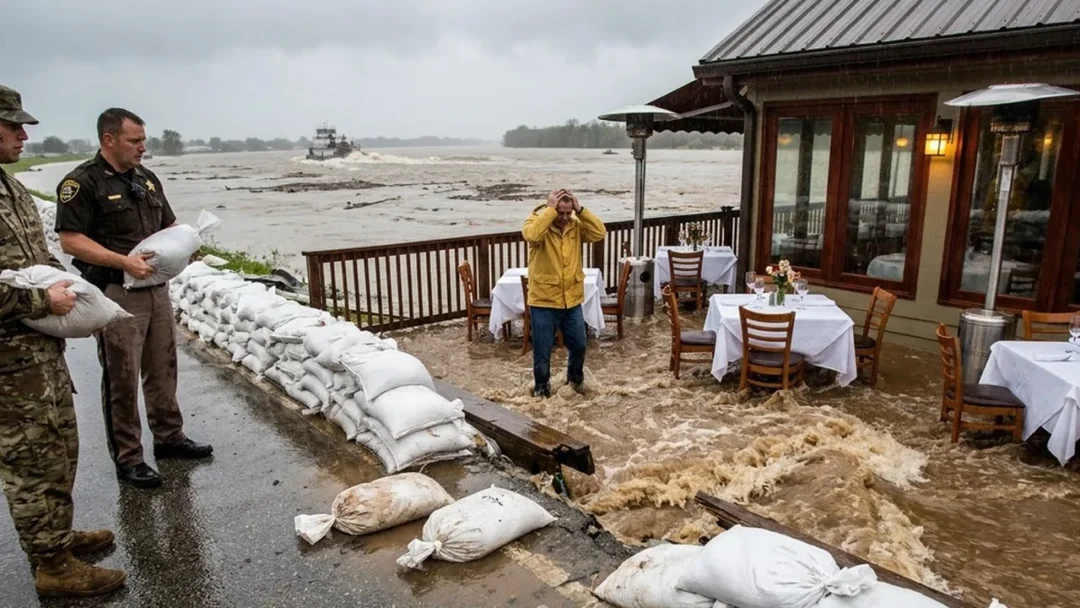
Rourke phoned a local councilman, who called the command post demanding that the restaurant remain accessible. Naomi routed him to the county emergency manager and kept building the wall. Rank, wealth, and friendship did not alter the river’s cross-section.
“Did Daniel verify the correction?” Naomi asked.
Creel looked down. “He came to my office afterward. Said the signature was copied. Said he’d prove it.”
“And did he?”
“Not where anybody could find it.”
Daniel had died six months later when his county truck left a rain-slick bridge. The crash was ruled accidental. Naomi had been twenty-four and furious that his final public record looked compromised. Her mother packed his field notebooks into a steel trunk that Naomi had never opened.
Rourke watched her from the restaurant steps. “Your father approved my project. Don’t turn family embarrassment into an emergency.”
Naomi felt every soldier waiting to see whether she would answer as a daughter or a sergeant. “Specialist Greene, report wall saturation.”
The soldier gave percentages and seepage locations. Naomi assigned relief pumps and moved on. Discipline was not silence. It was choosing the ground where truth could stand.
Tessa compared live upstream gauges. Water entering the reach matched the forecast, yet gauges beside three farms climbed twice as fast. A broad volume was being diverted away from Rourke’s frontage.
They launched a county drone between rain bands. Its thermal camera traced warmer runoff through buried pipes beneath the valet lot. The lines converged at a concrete control vault concealed inside a landscaping mound. From there, twin culverts discharged toward low fields occupied by the Moseley, Ward, and Santos families.
“Those farms should drain into the river,” Tessa said. “This reverses the grade.”
Rourke claimed the pipes were agricultural improvements. Dunn reminded him that altering a regulated floodway required state and federal permits. No permits appeared in the database.
The warrant for Rourke’s office arrived. Deputies found invoices for oversized culvert gates labeled as kitchen equipment, payments routed through a shell company, and annual maintenance schedules timed before spring floods. A map marked the neighboring farms as “sacrifice acreage.”
June identified the handwriting as Rourke’s. She had processed bills without understanding what the coded equipment meant. Dunn copied drives and sealed paper records above the flood line.
Naomi’s crew opened the landscaping mound. Beneath wet topsoil lay a reinforced hatch with fresh machine scratches. Water thundered below. The control vault contained motorized gates directing flow away from the restaurant’s legal drainage channel and toward the farms.
Shutting them too quickly could send a pressure surge against the road wall. Tessa calculated volumes while engineers installed temporary gauges. They planned a staged reversal: ten percent every three minutes, with pumps ready at the restaurant swale.
Before Naomi gave the order, emergency dispatch broke over the radio. Mrs. Santos and two grandchildren had refused evacuation because their access road was dry an hour earlier. It now lay under three feet of moving water.
The gauge beside their farmhouse rose another six inches while Naomi watched.
She marked the time, ordered the rescue channel kept clear, and assigned a second crew to protect the culvert vault. Solving the diversion would mean nothing if the people at its far end drowned first. On the drone feed, water had already reached the Santos porch steps and severed the shortest road from town.
Dunn checked the boat kit himself: spare inhaler spacer, thermal blankets, bolt cutters, throw bags, and two child-size flotation vests. The careful inventory used another minute, but entering without it could waste twenty. Naomi gave the launch order only after every rescuer repeated the downstream recovery point.