The Sixty Kilogram Mortar Buckets And The Stolen Cement Wall
CHAPTER 2: THE STANDOFF ON THE TERRACE
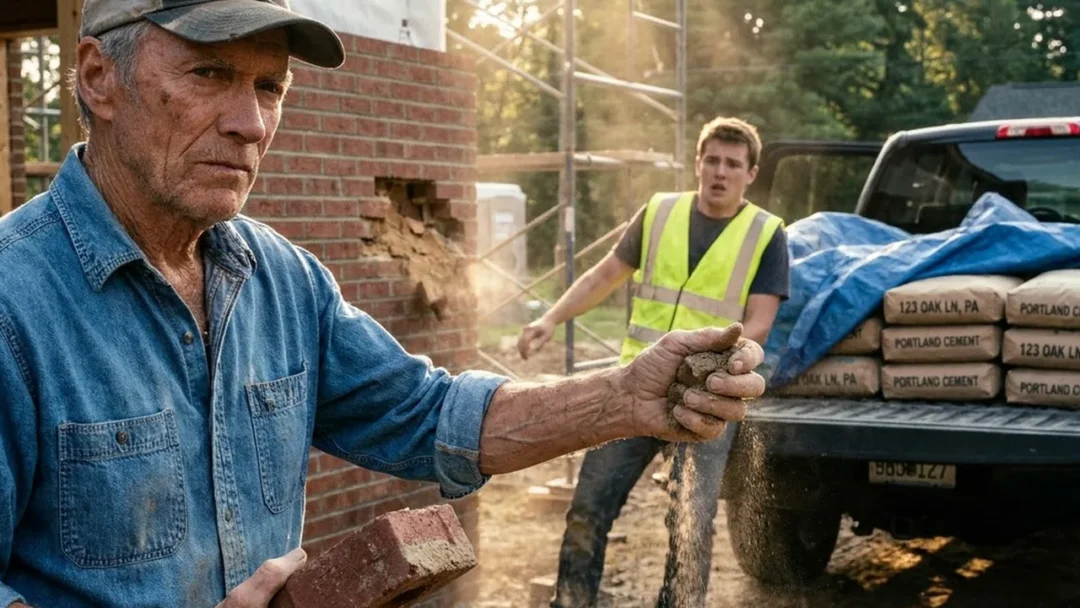
The sun climbed higher over the Brandywine hills, casting the limestone terrace of the manor in sharp, unforgiving contrast. On the gravel driveway, Greg Sterling stood pinned against the tailgate of his truck, his chest heaving, his hands clutching the loose red brick against his ribs as he stared at the exposed bags of stolen Portland cement.
The air was silent save for the distant cawing of crows over the river bottom and the steady, dripping hum of Frank’s newly delivered mortar buckets.
“Frank, please… listen to me for one second!” Greg pleaded, his voice trembling with frantic, desperate energy as he dropped the brick onto the gravel. “This was a logistical oversight! My supply runner loaded the wrong pallets at the distributor this morning! I was going to bring these twelve bags back to the site on Monday for the terrace steps!”
Frank DeLuca did not blink. He stood immovable beside the truck, his arms crossed over his leather apron, his presence carrying the quiet, crushing authority of sixty years of union leadership.
“You’ve been in the trade for six years, Greg,” Frank said, his voice low and cold as a winter quarry. “A true mason knows every ounce of sand and every pound of cement that goes into his trough. You didn’t load these bags by mistake. You loaded them at seven o’clock this morning while the estate caretaker was at breakfast. You intended to bill this family twelve thousand dollars for a wall made of sand, then sell twelve bags of my cement to the housing tract over in West Chester for cash.”
Greg’s expression hardened, the desperate pleading vanishing, replaced by the cornered, venomous arrogance of a criminal who realized his scam had been completely unmasked.
Greg reached his right hand down to the heavy leather tool belt strapped around his hips.
He drew a heavy, twenty-two-ounce solid-steel masonry hammer—a lethal tool featuring an axe-like chiseled blade on one end and a square waffle-faced striking head on the other. He stepped forward off the bumper, his knuckles whitening around the rubber grip.
“You think you’re going to ruin my business over twelve bags of gray powder, old man?” Greg snarled, stepping within three feet of Frank’s chest, the steel chisel blade raised in a menacing arc. “You sign that completion voucher right now! You sign the invoice and let me drive out of this gate, or I’ll bury this hammer in your collarbone and claim you fell off the scaffold!”
Frank did not step back. In fifty-two years of working high iron and stone scaffoldings alongside rough quarrymen and hard-drinking tunnel workers, Frank had stood down men twice Greg’s size without flinching.
In his right hand, resting loosely beside his thigh, Frank held his primary trade tool: an eleven-inch solid-forged high-carbon steel London-pattern masonry trowel—a heavy, tempered blade polished to a mirror finish, its balance so precise that Frank could flip a half-pound of wet mortar ten feet into a ceiling joint without dropping a grain.
As Greg lunged forward with the hammer raised to strike, Frank moved.
He didn’t swing for Greg’s head. Moving with the blinding, fluid economy of an old fencing master, Frank took a single half-step inside Greg’s swinging arc. His left hand caught Greg’s forearm at the wrist, deflecting the downward momentum outward, while his right hand brought the flat, tempered steel face of the masonry trowel against the side of the hammer head.
CLAAANG!
The ringing metallic chime echoed across the flagstone courtyard like an anvil strike. The flat steel blade met the descending hammer head with absolute structural leverage, arresting the blow in mid-air.
Before Greg could recoil, Frank rotated his right wrist forward in a sharp, circular sweeping motion. The beveled heel of the heavy steel trowel hooked under the hammer’s iron claw, and with a single, effortless twist of Frank’s scarred forearm, the twenty-two-ounce steel hammer was ripped cleanly from Greg’s grip, spinning through the air and landing ten feet away in the wet mortar trough with a soft, muddy splash.
Frank took half a step forward, his boot pinning Greg’s right foot to the gravel, his cold blue eyes boring into the young contractor’s face.
“A tool is for building, Greg,” Frank said softly. “The day you raise a tool against another man is the day you forfeit the right to call yourself a craftsman.”
Suddenly, the crunch of gravel echoed from the main entrance drive.
A county government sedan with official municipal markings rolled through the stone gateposts, pulling to a halt behind Greg’s truck.
Stepping out from the vehicle, holding an electronic inspection tablet and wearing an official Chester County building code enforcement jacket, was Senior Building Inspector Sarah Hayes.
Sarah walked onto the terrace, her sharp eyes taking in the scene in an instant: the missing brick on the crumbling wall, the exposed bags of stolen cement in the truck, and the contractor pinned against his bumper.
“Good morning, Frank,” Sarah said, her voice brisk, professional, and carrying the authority of the law. “I received your message at seven-thirty this morning regarding uncertified mortar ratios.”
She turned her gaze upon Greg Sterling, her expression hardening with severe disdain.
“Greg Sterling, step away from that truck and place your hands on the hood,” Inspector Hayes commanded. “We just pulled the structural permits for your other two projects in the township. Your three-hundred-foot retaining wall at the West Bradford Elementary School has begun to buckle under yesterday’s rain. The school is forty minutes away from an emergency structural evacuation.”
The tensile and shear bond strength between extruded kiln-fired clay bricks and masonry mortar is governed by capillary suction and micro-mechanical keying. When a dry modular clay brick—manufactured from dense alluvial shale and fired at nearly two thousand degrees Fahrenheit—is laid onto a fresh mortar bed, its microscopic pore structure exerts an initial rate of absorption (IRA) that draws water and microscopic cement particles into the outer millimeter of the brick surface. As the cementitious gel hydrates within these porous ceramic capillaries, it forms an unbreakable mechanical lock that can withstand hundreds of pounds of direct tensile pull. However, when the mortar is contaminated by excessive un-washed river sand, the high concentration of organic silts and rounded quartz particles clogs the brick’s surface capillaries without forming crystalline bonds. When Frank clamped his fingers onto the newly laid corner brick, the absence of crystalline cross-linking allowed the joint to shear under simple manual torque, crumbling the un-bound sand into powder without requiring the concussive impact of an iron hammer.
The structural bonding patterns of architectural brick masonry govern the distribution of lateral and vertical stresses throughout the wall plane. In traditional structural brickwork, masons utilized English bond or Flemish bond, patterns that integrated alternating courses of stretchers—bricks laid horizontally along the face—and headers—bricks laid perpendicular to the face that tied the outer wythe directly into the backing wall. In modern commercial subcontracting, however, builders frequently defaulted to running bond, a pattern consisting entirely of stretchers that lacked transverse mechanical ties between wythes. Without continuous metallic corrugated wall ties anchored into a solid structural backing, an eight-foot brick wall laid in running bond behaves as a series of independent vertical cantilevers, relying entirely upon the tensile bond strength of the mortar beds to resist horizontal earth pressure. When Greg Sterling omitted both the structural headers and the Portland cement binder, he created a wall that possessed zero lateral shear resistance, converting what should have been a monolithic retaining barrier into an unstable stack of loose bricks awaiting the first vibration of heavy machinery.