The Sixty Kilogram Mortar Buckets And The Stolen Cement Wall
CHAPTER 5: THE POLE BARN STASH
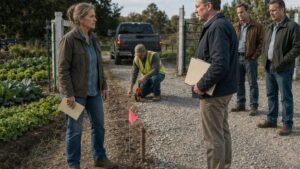
By four o’clock that afternoon, the West Bradford Elementary School had been secured by the Pennsylvania Department of Environmental Protection and the state police hazardous materials division. The shored retaining wall remained standing, held firm by Frank’s timber rakers, while environmental specialists contained the rusted chemical drums buried beneath the footer.
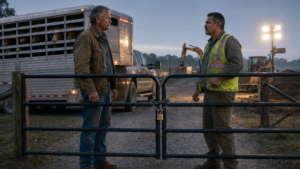
Across the county, in a remote agricultural hollow outside Coatesville, four state police cruisers and two tactical forensics vans were executing an emergency search warrant on an un-marked, two-hundred-foot commercial steel pole barn leased by North Ridge Construction.
Standing inside the illuminated cavern of the pole barn, surrounded by the smell of diesel exhaust and dry mineral dust, were Detective Mark O’Reilly, Inspector Sarah Hayes, and master mason Frank DeLuca.
The interior of the warehouse was a monument to industrial-scale commercial fraud.
Stacked forty feet high on heavy industrial pallet racking were over four hundred unopened, fifty-pound bags of high-grade Lehigh Type S Portland cement, all bearing stenciled delivery markings from half a dozen prominent residential estates, public library projects, and township municipal facilities across Chester and Montgomery counties.
Beside the stolen cement sat two massive horizontal industrial dry-mixing augers and forty tons of cheap, un-washed river silt—the low-grade filler that Greg Sterling had been using to dilute his mortar mixes down to a ten-to-one sand ratio before shipping the adulterated material to his job sites.
Detective O’Reilly walked over to an open metal desk in the warehouse office, holding a stack of subpoenaed commercial shipping ledgers.
“It’s an organized interstate material fencing ring, Frank,” Detective O’Reilly announced, his face tight with professional outrage. “Greg Sterling wasn’t just working alone. He was operating in partnership with an un-licensed commercial industrial disposal firm based out of northern New Jersey. The disposal syndicate paid Greg ten thousand dollars in cash per drum to bury toxic industrial cleaning solvents beneath the footers of large retaining walls and foundation trenches, knowing that the concrete would conceal the chemical containers for twenty years.”
Sarah Hayes slammed her inspection tablet onto the desk, her eyes blazing with fury. “And while he was taking cash to bury toxic waste beneath school playgrounds, he was skimming the cement from the walls to sell back to crooked commercial contractors in Philadelphia for eighty cents on the dollar!”
Just then, two state troopers escorted Greg Sterling into the warehouse in handcuffs. Greg’s face was bruised from his stumble, his clothes covered in dry yellow sand, his arrogant smirk replaced by the hollow, vacant stare of a man facing decades in state penitentiary confinement.
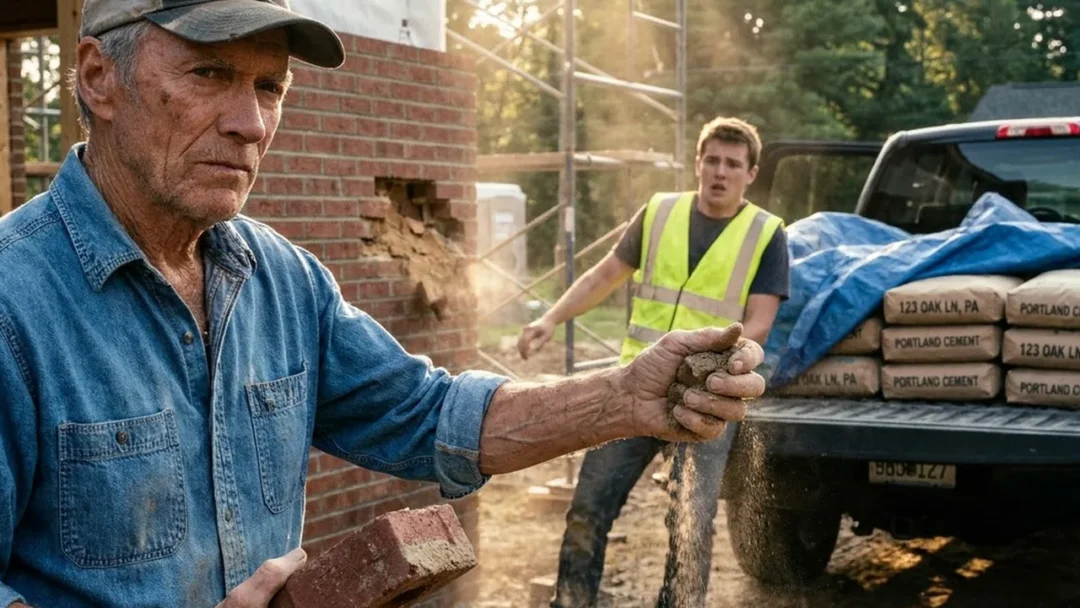
Frank DeLuca walked over to Greg, stopping two feet away. He reached into his pocket and pulled out a small, dried chunk of the fraudulent mortar he had crumbled on the terrace that morning.
Frank opened his hand, letting the yellow dust fall at Greg’s feet.
“A wall is supposed to protect people, Greg,” Frank said, his voice quiet, steady, and devastating as a judge’s sentence. “You used our trade—the oldest, most honorable trade in human history—to hide poison under the feet of children. You aren’t a builder. You’re just a disease.”
Greg hung his head, unable to look into the old master mason’s eyes, as the troopers led him away toward the transport cruiser.
The federal environmental statutes governing the unauthorized disposal of hazardous industrial waste are anchored in the Comprehensive Environmental Response, Compensation, and Liability Act (CERCLA) of nineteen-eighty, commonly known as the federal Superfund statute. Under federal law, the intentional concealment and underground burial of chlorinated hydrocarbons, benzene derivatives, and industrial degreasers without a certified Resource Conservation and Recovery Act (RCRA) Part B disposal permit constitutes an aggravated felony punishable by severe statutory penalties and mandatory corporate remediation. In the forensic investigation conducted by Detective Mark O’Reilly and state environmental officers, chemical analysis of the buried drums revealed high concentrations of trichloroethylene and perchloroethylene—volatile organic compounds that migrate rapidly through groundwater plumes and penetrate concrete foundations as toxic vapors. By burying these volatile chemical vessels directly beneath an elementary school retaining wall footer, the contractor had created an environmental catastrophe that violated both federal toxic containment laws and state building manslaughter statutes.