The Sixty Kilogram Mortar Buckets And The Stolen Cement Wall
CHAPTER 4: THE TIMBER SHORING
The work that unfolded across the muddy kindergarten playground over the next fifteen minutes was an extraordinary demonstration of emergency timber engineering and master craftsmanship under pressure.
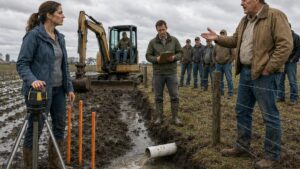
While county sheriff deputies cordoned off the school perimeter and evacuated two hundred students from the southern classrooms, Frank DeLuca and his six veteran union bricklayers worked with the synchronized, rhythmic speed of a ship’s damage-control crew.
The physics of structural shoring required neutralizing the outward horizontal overturning moment of the wall by establishing a forty-five-degree diagonal timber raker system anchored into the bedrock below.
“Bring the twenty-foot white oak balks!” Frank shouted, his boots sinking two inches into the rain-soaked sod as he positioned the first massive six-by-six hardwood timber against the bulging center of the brick wall.
Between the wood and the compromised brickwork, Frank placed a three-foot by eight-inch solid steel spreader plate to distribute the concentrated compressive force across twenty square feet of masonry, preventing the timber from punching through the brittle, sand-filled joints.
At the base of the timber raker, forty feet back on the playground, Frank’s men used twelve-pound sledgehammers to drive four-foot solid steel pickets deep into the underlying shale bedrock, setting heavy oak timber footing grillage behind the stakes to act as an immovable thrust block.
Between the timber raker and the footing block, Frank inserted a twenty-ton commercial hydraulic bottle jack.
“Line up on the jacks, boys!” Frank called out, his voice cutting through the wind. “Pump in sequence! Two strokes on my count! We don’t want to shock the masonry! We just want to pick up the load!”
Frank took the operating lever of the central hydraulic jack himself. His heavy, calloused hands pumped the steel handle with smooth, measured cadence.
HISS-CLANK. HISS-CLANK.
The hydraulic piston rose, taking up the slack. The twenty-foot oak timber bowed slightly under the sudden, immense compressive stress, its wood fibers groaning with a deep, resonant pitch that resonated through the playground.
Around them, four other jacks pumped in perfect synchronization.
Slowly, terrifyingly, the forward momentum of the eighty-ton brick retaining wall was arrested.
The outward bowing halted. The pressurized jets of water weeping through the fractured joints slowed to a steady trickle as the heavy steel spreader plates locked the bulging brick face into an unyielding mechanical brace.
Just as the final timber was secured, the sound of tearing metal and collapsing earth erupted from the western edge of the wall, where the un-braced footer gave way. A twenty-foot section of the corner collapsed into the drainage ditch, exposing the subterranean foundation trench to the rain.
Frank walked over to the open trench, wiping the mud and sweat from his forehead.
As he looked down into the exposed foundation excavation, his eyes narrowed with sudden, chilling intensity.
Beneath the four-inch un-reinforced concrete footer that Greg Sterling had poured, half-buried in the wet clay fill dirt, were six fifty-five-gallon steel industrial chemical drums, their rusted steel barrels dented and crushed beneath the weight of the wall. Painted across the corroded yellow metal were black skull-and-crossbones hazard warnings and the stencil: HIGHLY TOXIC INDUSTRIAL HYDROCARBONS — DISPOSAL PROHIBITED.
Sarah Hayes ran to the edge of the trench, her flashlight beam illuminating the toxic drums, her hand flying to her mouth in horrified shock.
“My God, Frank,” Sarah whispered, her face completely pale. “He didn’t just skim cement. He was using the playground retaining wall foundation as an illegal commercial toxic waste dump!”
The structural principles of emergency timber shoring are rooted in the classical mechanics of vector force redirection through diagonal raker assemblies. In structural collapse rescue, a diagonal raker functions as an artificial inclined compression strut that intercepts the overturning moment of a failing vertical wall and transfers the horizontal thrust directly into the earth. To achieve maximum mechanical efficiency, the raker angle must be maintained between forty-five and sixty degrees relative to the horizontal grade, ensuring that the downward vertical component increases the frictional resistance of the thrust block while the horizontal component counteracts the lateral earth pressure. By positioning heavy three-foot steel spreader plates across multiple horizontal mortar courses, Frank prevented localized crushing of the compromised brickwork, allowing the twenty-ton hydraulic bottle jacks to build controlled, counteracting thrust that stabilized sixty thousand pounds of saturated hillside without inducing shock fractures along the compromised foundation lines.