The Torn Hospital Photograph And The Brass Key To Greenhouse Seven
CHAPTER 2: THE ONE HUNDRED AND EIGHTY-FOUR SIGNATURES
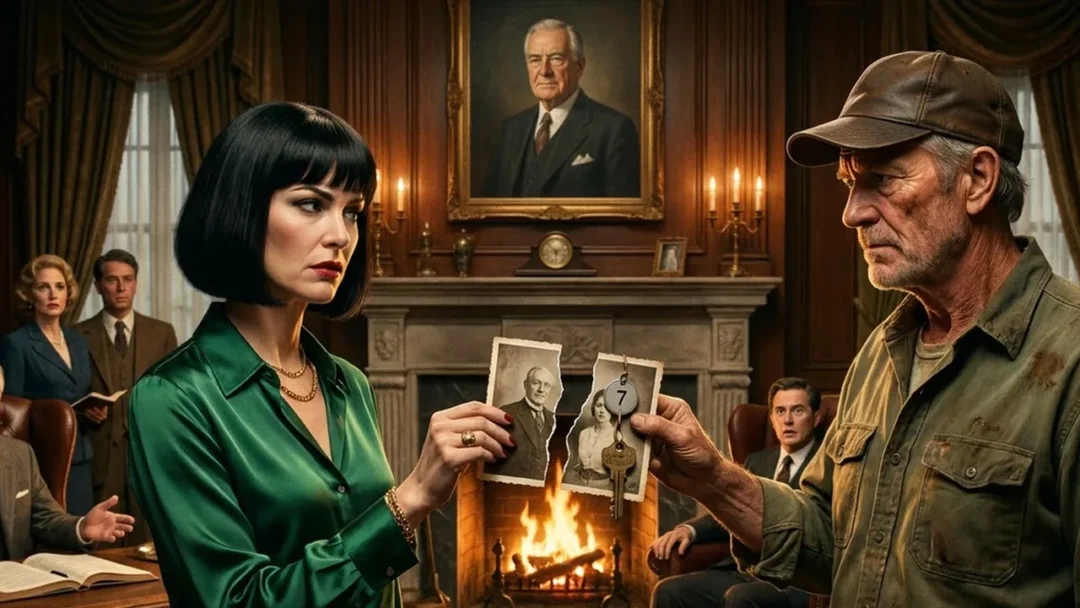
The charred remains of the left half of the photograph drifted up the chimney in thin wisps of gray smoke, vanishing into the rainy gloom of the Hudson Valley. Sloane Bellamy turned her back on the fireplace, smoothing the front of her ivory silk blouse with triumphant satisfaction as she walked toward the central mahogany library table.
“Now that the domestic staff has been put in their place,” Sloane announced, taking her seat in the high-backed executive chair directly across from the attorney, “let us proceed with the reading. My attorneys have already prepared the probate distribution schedules for the real estate trust.”
Sitting at the center of the massive library table was Attorney Marcus Whitfield. At fifty-six, the senior partner of Whitfield, Sterling & Vance was a towering, dignified Black American attorney with a neatly trimmed salt-and-pepper goatee, rimless titanium spectacles, and an immaculate charcoal three-piece suit accented by a gold silk tie. He had served as Arthur Bellamy’s personal legal counsel, corporate trustee, and primary executor for twenty-eight years.
Whitfield did not open the probate binder Sloane had set out. He did not look at her corporate schedules. Instead, he adjusted his glasses, picked up a heavy red leather binder bearing the gold-embossed seal of the Dutchess County Surrogate’s Court, and looked toward the back of the room.
“Thomas,” Attorney Whitfield said, his deep, resonant voice echoing through the quiet library with immense, quiet respect. “Please step forward and take a seat at the counsel table.”
Sloane’s head snapped around, her face tightening with instant outrage. “Attorney Whitfield! I just made it abundantly clear that this man is a hired laborer! He has no legal standing in this room!”
“Miss Bellamy,” Whitfield replied, his tone icy, calm, and utterly immovable, “this proceeding is governed by the express testamentary instructions of your grandfather, Arthur Bellamy. Not by you. Thomas was personally named as an essential party to this session in a codicil executed thirty days before Mr. Bellamy’s death. If you disrupt this court-supervised proceeding again, I will have Deputy Ward remove you from the premises.”
At the rear double doors, Deputy Sheriff Caleb Ward, a broad-shouldered forty-four-year-old lawman wearing a tan Dutchess County uniform, stepped forward, his hand resting casually on his duty belt, his eyes fixed firmly on Sloane.
Sloane bit her lip, her knuckles whitening as she gripped her champagne flute, sinking back into her leather chair with a venomous glare.
Thomas walked slowly across the Persian carpet. He did not sit in the executive chairs; he stood with quiet dignity beside the table, his weathered fingers gently holding the surviving half of the photograph, feeling the cool weight of the brass key hidden against the paper in his pocket.
Attorney Whitfield opened the red leather binder. From within, he extracted a single laminated document containing a high-resolution color printout of a digital administrative spreadsheet.
Whitfield turned to a large, sixty-inch television monitor mounted on the cherrywood wall behind him, tapping a wireless remote.
The screen illuminated, displaying the official electronic visitor log of the palliative care wing at St. Luke’s Hospice in Rhinebeck, covering the period from May first through October thirty-first of the current year.
“Before we review the primary distribution of the four hundred acres of the Bellamy estate and the two hundred million dollars in commercial real estate trusts,” Whitfield said, his voice cutting through the room like a judicial summons, “I am required by Article Four of the decedent’s last will to review the hospice attendance ledger.”
Whitfield pointed a laser pointer at the glowing screen.
“Under Clause 4B,” Whitfield read, “Arthur Bellamy established an extraordinary conditional bequest. He directed that a cash endowment of five million dollars be distributed in equal shares to any direct biological relative who visited his hospice suite at least three times per month over the course of his six-month terminal illness, without requesting financial assistance, loans, or early inheritance distributions.”
A ripple of eager, greedy whispers passed through the twelve relatives seated in the wingback chairs. Sloane leaned forward, her eyes bright with predatory anticipation. “Grandfather knew we were managing his commercial developments in Manhattan! We were in constant communication with his administrative office!”
“Let us examine the official biometric sign-in log, Miss Bellamy,” Whitfield said coldly.
He zoomed in on the first column of the screen.
NAME: SLOANE BELLAMY. VISITS RECORDED: 0.
NAME: JULIAN BELLAMY (COUSIN). VISITS RECORDED: 0.
NAME: BEATRICE BELLAMY-CRAWFORD (AUNT). VISITS RECORDED: 0.
NAME: GREGORY BELLAMY (NEPHEW). VISITS RECORDED: 1 (VISIT DURATION: 8 MINUTES — INVOICE PRESENTED).
Every single relative on the family tree was listed with zero visits, save for Gregory, whose lone appearance had been to request a bridge loan for his luxury yacht dealership.
A dead, suffocating hush descended upon the library. Sloane’s champagne glass trembled in her grip, the pale wine shivering against the rim.
Whitfield scrolled down to the final entry at the bottom of the ledger:
NAME: THOMAS BELLAMY (REGISTERED GUEST / ADVANCE HEALTHCARE PROXY).
TOTAL SIGNED VISITS: 184.
CONSECUTIVE VISITS: 184 CONSECUTIVE EVENINGS.
FINANCIAL REQUESTS PRESENTED: NONE.
The room froze. Sloane leaped to her feet, her chair flying backward and slamming against the cherrywood bookcase with a violent crash.
“This is a fraudulent conspiracy!” Sloane screamed, her face flushed crimson, pointing an accusing finger at Whitfield. “You falsified that digital log! My grandfather was surrounded by hired staff! He was senile! He had no right to punish his own flesh and blood because we had real corporate responsibilities!”
“Your grandfather was entirely lucid when he signed this instrument, Miss Bellamy,” Whitfield said, his voice dropping into a register of thunderous authority that made Sloane flinch. “And he left a specific video record to explain why your name appears nowhere in the inheritance.”
The grandfather clock in the corner of the library chimed three solemn, metallic strokes. The mahogany wainscoting seemed to absorb the sound, holding the room in an ancient, ancestral grip. Every painting on the wall—the Dutch landscapes, the equestrian portraits of Hudson Valley squires, the maritime scenes of clipper ships entering New York Harbor—represented an empire built on the fiction of an unbroken aristocratic lineage. Charles Bellamy had spent millions of dollars whitewashing municipal archives, bribing county clerks, and buying up colonial deeds to ensure that no common blood could be traced to the family crest. But a dying man in a hospice bed cared nothing for colonial deeds. In the presence of death, all the gold in Manhattan could not buy one breath of true human love.