The Torn Hospital Photograph And The Brass Key To Greenhouse Seven
CHAPTER 3: THE SIGNET RING BENEATH THE WORK GLOVE
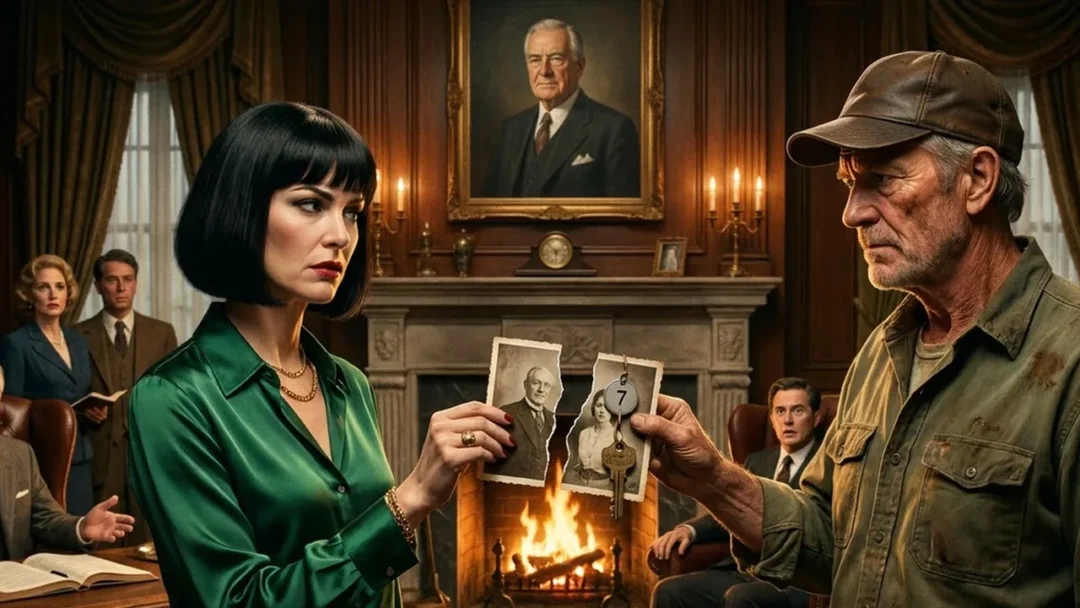
The tension inside the library of Bellamy Hall was now so thick that the smell of burning oak in the fireplace seemed to carry the scent of an impending execution. Sloane Bellamy stood panting beside her overturned leather armchair, her chest heaving beneath her silk blouse, her diamond bracelets catching the harsh blue light of the hospice monitor.
“I will take this to the Surrogate’s Court in Poughkeepsie tomorrow morning!” Sloane shrieked, her voice cracking with hysterical rage. “My attorneys will have this will thrown out on grounds of undue influence! A senile old man manipulated by a crooked lawyer and a manipulative gardener who spent forty years clipping hedges!”
Attorney Whitfield did not blink. He picked up his wireless remote and aimed it at the large television screen mounted on the cherrywood wall.
The hospice visitor spreadsheet vanished. The screen flashed black, then dissolved into an intimate, high-definition video recording captured six weeks earlier in a sunlit corner room of St. Luke’s Hospice.
On the screen appeared Arthur Bellamy.
He was propped against four soft pillows, wearing his burgundy fleece robe, looking frail and gaunt, his silver hair neatly combed back. His gray eyes, clear and blazing with an unshakeable moral lucidity, looked directly into the camera lens. His voice, though thinned by respiratory illness, carried the deep, resonant authority of a man who had built half the skyline of the Hudson Valley.
“If you are watching this recording,” Arthur spoke from the screen, his gaze seeming to bore straight into Sloane’s eyes, “it means I have finally laid down the burden of this life, and Marcus Whitfield is reading my final testament in the library of Bellamy Hall.”
Arthur paused, taking a slow, shallow breath, before a faint, sorrowful smile touched his cracked lips.
“Sloane, my dear granddaughter. You are standing there right now, furious that your inheritance is in question. You are wondering why the grandfather who paid for your private Swiss boarding schools, your Manhattan penthouses, and your sports cars didn’t leave you the keys to this estate. Let me answer you: for six months, I lay in this room, watching the seasons turn from spring to autumn. I watched the sun rise over the river, and I watched it set. And in all those one hundred and eighty-four days, you never once came to hold my hand. You never once asked if I was in pain. You only called my attorneys to ask if my power of attorney had transferred.”
Sloane took an involuntary step back from the screen, her lips parting in stunned, breathless disbelief.
Arthur turned his gaze toward the right side of the camera frame, his expression softening into an expression of profound, tender reverence.
“And then there is Thomas,” Arthur continued, his voice thick with tears. “Thomas, who came every single evening at six o’clock after twelve hours of manual labor in the heat and the rain. Thomas, who sat beside my bed, brought me fresh peaches from the orchard, read the daily papers aloud to me, and held my hand while the treatments made me sick. Thomas never asked me for a single dollar. He never asked for a contract. He only asked me to let him be my brother.”
A collective, horrified gasp broke out across the library. Two of Sloane’s aunts gripped their armrests, their eyes wide as they stared at the screen.
“Yes,” Arthur said, his voice rising in clear, unmistakable defiance. “Thomas is my biological younger brother. Born to our father, Charles Bellamy, and his second lawful wife, Sarah Miller, in 1952. When our father died, the family trustees forced me to conceal the marriage to protect the single-bloodline land charter. They told me that if the truth came out, our credit lines would collapse. For fifty years, I allowed my own flesh and blood to live in the carriage cottage, tending the flowers on his own ancestral land, while I lived as the master.”
Arthur’s eyes on the screen locked onto the camera with ferocious, terminal conviction. “I spent my life in cowardice, Thomas. But I will not die a coward. Everything belongs to you. Every stone, every tree, and every share of the Bellamy empire. You are the master of Bellamy Hall.”
The video screen clicked black.
In the dead, suffocating quiet that followed, all eyes turned to the elderly gardener standing at the edge of the table.
Slowly, deliberately, Thomas reached up to his left hand. With steady, unhurried fingers, he peeled off his heavy leather gardening work glove, laying the soiled cowhide gently onto the polished cherrywood table.
There, resting upon the fourth finger of his weathered, scarred hand, gleaming brightly in the firelight, was a heavy, eighteen-karat gold signet ring.
Engraved upon the oval crest was the ancient Bellamy family heraldry: a nesting falcon clutching an olive branch, encircled by three five-pointed stars.
It was the identical signet ring that Arthur Bellamy had worn on his hand in every corporate portrait and oil painting in the estate.
Sloane backed against the limestone fireplace, her champagne flute slipping from her fingers, shattering on the hearthstone into a thousand glittering pieces that sprayed Dom Pérignon across her designer trousers.
“No…” Sloane whimpered, her face gray as ash. “No… this is a nightmare… you can’t do this… you’re a servant…”
Attorney Whitfield stood up to his full six-foot-two height, opening the final red-sealed parchment of the will.
“Under Clause Nine of the Bellamy Master Trust,” Whitfield announced, his baritone booming through the room like thunder, “any biological beneficiary who initiates a legal challenge or contests this distribution triggers an immediate, irrevocable forfeiture of all trust funds, stipends, and voting shares. Miss Sloane Bellamy, your inheritance is officially zero.”
Thomas stood motionless as the video concluded, feeling the weight of sixty years of subterranean family history settling upon his shoulders. He remembered the cold winter of 1968, when their father Charles had lay dying in this very room, summoning seventeen-year-old Thomas to the bedside only to warn him that if he ever spoke his mother’s name aloud in the village of Rhinebeck, he would be sent to a state workhouse. Arthur had stood by the window that night, weeping in silence, powerless against the tyrannical patriarch. For five decades, Arthur had carried the guilt of that silence like an iron collar around his throat. Today, the collar was broken, and the truth stood unassailable in the candlelight.