The Day He Asked Them To Listen Before Choosing Too Quickly
Part I — The Man on the Green Mat
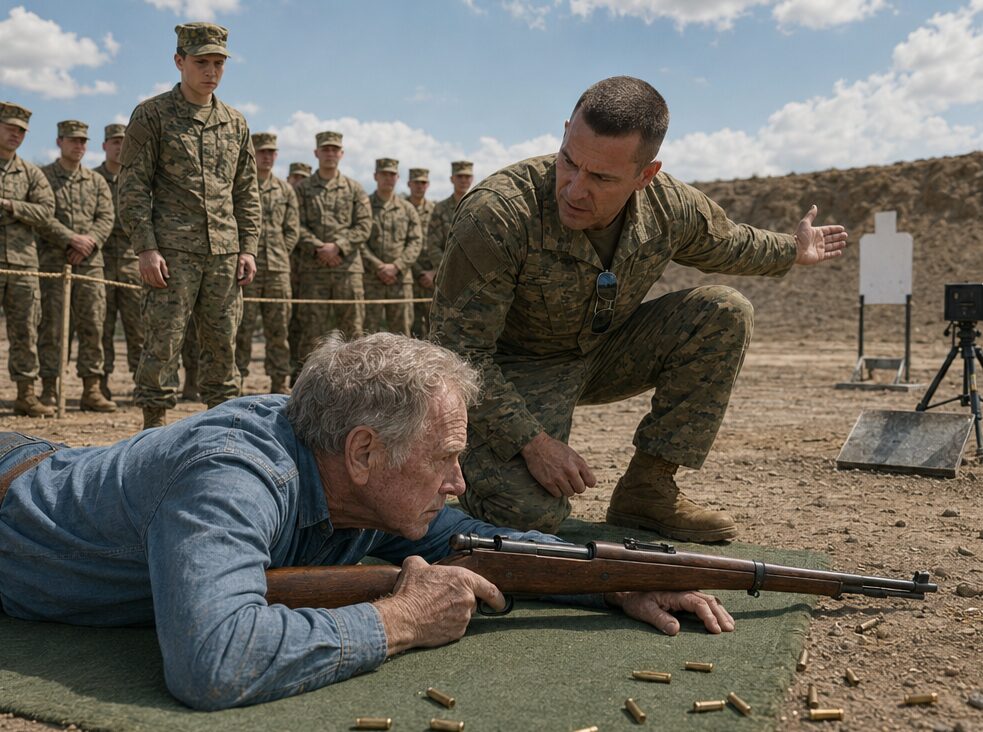
Dennis Mason lay flat on the green shooting mat while twenty young soldiers watched him like he was a dare someone had accepted by mistake.
He wore a faded blue button-up shirt, jeans, and old brown work boots that had no business being on an Army range. Brass casings glittered in the dust around him. His cheek rested against the wooden stock of a rifle older than most of the men behind him. His hands trembled.
A few feet away, Sergeant Patrick Brooks dropped to one knee with a smile that was almost polite.
“All right, Mr. Mason,” he said, loud enough for the line to hear. “Show us how they did it back when dinosaurs had rifles.”
A ripple of laughter moved through the soldiers.
Dennis did not lift his head.
His right hand settled on the stock. His left adjusted the sling with slow, economical care. Not fast. Not showy. His fingers shook just enough for the closest soldiers to notice.
Behind the safety rope, someone whispered, “Somebody should take that thing away before Grandpa hurts himself.”
Dennis heard it.
So did his grandson.
Private Benjamin Mason stood at the edge of the group with his jaw tight and his face burning under his cap. He looked at the dirt, then at the line of soldiers, then at his grandfather on the mat.
He said nothing.
That silence hurt Dennis more than the joke.
Patrick glanced back once, caught the laughter, and turned to Dennis with the easy confidence of a man still in control of his own room.
“Whenever you’re ready.”
Dennis closed one eye.
Downrange, the white targets waited.
At the far side of the lane, a black sensor box stood on a tripod beside a loose metal plate. It looked incidental, like range clutter. Nobody else seemed to notice that the plate was moving with the wind.
Dennis noticed.
He noticed the angle of the sun. The dry twitch of the grass beyond the lane. The dust drifting right to left, then settling. He noticed the way the young soldiers shifted their weight when they were impatient, as if the ground itself had offended them by staying still.
Most of all, he noticed Benjamin’s silence.
A week earlier, Benjamin had sat at Dennis’s kitchen table with a grin he was trying to hide, holding the folded letter Dennis had mailed to the company office.
“Grandpa,” he had said, “you really sent this?”
Dennis had looked up from his coffee.
“Did they read it?”
“They read it,” Benjamin said. “That’s kind of the problem.”
The letter was three pages, handwritten in block capitals because Dennis’s fingers cramped if he wrote cursive too long. It objected to a new pressure qualification drill Benjamin’s unit had been practicing before deployment. The drill rewarded speed. It rewarded aggression. It rewarded hitting the obvious target before the clock punished you.
Dennis had written one sentence twice.
You are teaching them to finish before they understand what has started.
Benjamin had laughed at that part. Not meanly. Nervously.
Then he had taken a picture of the letter.
By the next morning, half his platoon had seen it.
By Friday, they were calling Dennis “General Grandpa.”
By Saturday, family day at the range, Dennis arrived with a canvas rifle case in his hand.
Benjamin had seen him walking across the gravel lot and gone pale.
“Grandpa, what are you doing here?”
Dennis had looked past him toward the range.
“Came to ask if they read the second page.”
“Please don’t do this,” Benjamin said.
“Did you show it to Sergeant Brooks?”
Benjamin’s mouth opened, then closed.
Dennis knew the answer from the shame on his face.
Now, on the mat, Patrick tapped one gloved finger against his own wristwatch.
“Mr. Mason, this is a timed demonstration. Modern conditions don’t wait for memories to warm up.”
Dennis finally lifted his head.
His eyes were pale, tired, and clear.
“Do they teach you what to do after?”
Patrick’s smile thinned. “After what?”
Dennis looked at Benjamin.
Benjamin looked away.
Dennis lowered his cheek back to the stock.
“After you’re right.”
No one laughed that time.
Not because they understood him.
Because something in the old man’s voice made understanding feel like a risk.
Part II — General Grandpa
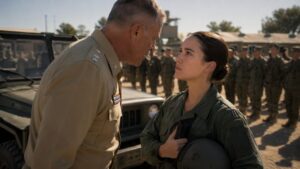
When Dennis had first asked to speak to the range officer that morning, Patrick Brooks had tried to be decent about it.
Family day was already noisy. Parents were taking pictures. Younger siblings were staring at armored vehicles. Spouses were pretending not to be frightened by the word deployment. The range schedule was tight, the sun was high, and Patrick had no patience for a civilian carrying an old rifle case and a complaint folded in his shirt pocket.
“Sir, I appreciate your concern,” Patrick had said, standing between Dennis and the firing line. “But this is a controlled training environment.”
Dennis looked past him at the targets.
“Controlled is not the same as understood.”
Benjamin stepped in quickly. “Grandpa, stop.”
Patrick looked from the young private to the old man. Then he understood.
“Oh,” he said. “This is the letter.”
A couple of soldiers nearby heard him and turned.
One of them grinned. “General Grandpa?”
Benjamin’s ears went red.
Dennis did not look at the soldier. He looked at Patrick.
“You’re rewarding them for shooting before they see.”
Patrick’s jaw flexed, but his voice stayed level. “We reward them for responding under pressure.”
“No,” Dennis said. “You reward them for believing the first thing that moves.”
That drew a sharper laugh.
Patrick’s eyes cooled.
“Mr. Mason, with respect, this isn’t 1968. We have updated doctrine, updated simulations, updated performance metrics. Your grandson’s unit is doing exactly what it needs to do.”
Dennis nodded once, as if Patrick had confirmed something.
“Then let me ask them one question.”
“No.”
“Let me ask you.”
Patrick’s patience was thinning in front of witnesses. Dennis could see it. He had spent a lifetime noticing when men began choosing pride over judgment.
“The valley where I served,” Dennis said, “had updated plans too.”
That was when Patrick stiffened.
Not because he believed Dennis.
Because men in uniform understood certain phrases even when they didn’t want to.
A small crowd had formed now. Benjamin stood inside it, trapped between blood and belonging.
Patrick saw the crowd and made the decision a proud man makes when he thinks public pressure can be turned into public victory.
“All right,” he said. “You want to make a point? Make it.”
Benjamin’s head snapped up.
“Sergeant—”
Patrick held up a hand.
“One controlled demonstration. You show us what our drill misses, and I’ll give you five minutes with the unit. You don’t, you leave this range, and you stop interfering with Private Mason’s training.”
Dennis studied him.
“Target unannounced.”
Patrick laughed. “You want special rules?”
Dennis’s face did not change.
“No. I want the real rule.”
That was how he ended up on the green mat with the rifle case open beside him.
The rifle had a dark wooden stock rubbed smooth by decades of hands. It looked wrong among the clean modern equipment around it. Too old. Too personal. Too quiet.
Patrick crouched near him, performing patience for the soldiers.
“Safety on until command. Finger off the trigger until ready. Sight picture, breathing, all the usual basics. You good, Mr. Mason? Need me to explain the optic?”
“It doesn’t have an optic,” Dennis said.
More laughter.
Patrick smiled. “That was the joke.”
Dennis turned his face just enough to look at him.
“I know.”
The smile faded.
Benjamin stepped closer to the rope. “Grandpa, you don’t have to prove anything.”
Dennis looked at him then.
For a moment Benjamin saw not the stubborn old man who saved coffee cans full of screws in his garage, not the grandfather who forgot birthdays but remembered the sound of every engine he had repaired, not the widower who ate soup over the sink because setting the table for one made him angry.
He saw a man who had walked into ridicule on purpose.
Dennis said, “I’m not proving.”
“What are you doing?”
Dennis turned back toward the targets.
“Trying to leave you something better than my silence.”
Benjamin had no answer for that.
Patrick stood and addressed the range.
“First marker. Standard timing. On my command.”
Dennis settled in.
The line quieted.
A mechanical whine traveled downrange. A white target rose cleanly into view.
Patrick called, “Threat!”
Dennis did not fire.
The first second passed.
Then the second.
Then the third.
The young soldiers shifted. Someone coughed. Someone muttered, “Come on.”
Patrick said, “Mr. Mason.”
Dennis stayed still.
The target remained up, bright and obvious, waiting to be hit.
Patrick’s voice sharpened. “That is your target.”
Dennis did not blink.
The timer buzzed.
The target dropped.
Laughter broke behind him, bigger this time, relieved and cruel.
Patrick exhaled through his nose.
“Demonstration over.”
Dennis spoke without lifting his cheek from the stock.
“That one wasn’t the threat.”
The laughter thinned.
Patrick looked down at him. “Excuse me?”
Dennis’s eye stayed downrange.
The wind shifted.
The loose metal plate beside the neighboring lane trembled once. Not much. Just enough.
Dennis inhaled, held, and fired.
The sound cracked across the range.
The announced target remained untouched.
But the small plate near the black tripod snapped sideways and spun so hard the tripod legs jittered in the dust.
For one second, nobody moved.
The plate kept spinning.
Its thin metallic rattle filled the silence where laughter had been.
Part III — The Wrong Kind of Waiting
Patrick’s face changed before his posture did.
His shoulders stayed squared. His chin stayed up. His uniform stayed perfect. But something behind his eyes jerked hard, like a door slammed inside him.
“That wasn’t part of the drill,” he said.
Dennis rolled onto his side slowly, the movement costing him. Benjamin started forward, then stopped himself at the rope.
“No,” Dennis said, still breathing through the recoil. “It wasn’t part of your score.”
A young soldier near the back leaned to see downrange.
“Sergeant,” he said carefully, “he hit the lane marker.”
Patrick turned on him. “I can see that.”
The soldier shut up.
Dennis pushed himself up on one elbow. His right hand trembled worse now, but not from weakness. Not only that. His face had gone gray around the mouth.
Benjamin saw it.
For the first time all morning, his embarrassment loosened its grip.
“Grandpa?”
Dennis did not answer.
The spinning plate slowed. Its rattle became uneven. Then it stopped.
That small final silence did something to Dennis. He looked at the stopped metal like it had said a name no one else could hear.
“Water,” he said.
Benjamin ducked under the rope before anyone could stop him. He brought a bottle from the cooler and crouched beside him.
Patrick did not like that. He did not like the soldiers watching Benjamin kneel beside the old man. He did not like the fact that his range had gone from demonstration to uncertainty.
He liked least of all that Dennis had been right in a way Patrick could not immediately explain away.
Benjamin held out the water. Dennis took it, but his hand shook so badly that Benjamin had to steady the bottle.
Dennis noticed.
So did everybody else.
Patrick used the moment.
“Mr. Mason,” he said, voice clipped, “hitting range hardware is not a tactical lesson. It’s a trick. A good trick, sure. But still a trick.”
Dennis drank once, then lowered the bottle.
“The trick,” he said, “is telling them a clean hit means the story is over.”
Patrick’s mouth tightened. “You don’t know what we tell them.”
“I heard enough.”
“You heard jokes.”
“I heard speed.”
Patrick stepped closer.
“Speed saves lives.”
Dennis looked up at him.
“Sometimes.”
The word landed harder than a disagreement.
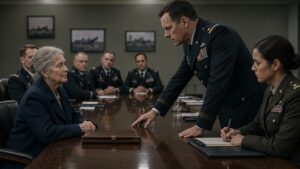
Patrick seemed ready to answer, but Captain Angela Mitchell’s voice cut through from behind the line.
“Sergeant Brooks.”
Everyone turned.
She had come from the command trailer without hurry. She was in uniform, dark hair pulled tight, expression controlled in a way that made silence gather around her. She had been watching longer than anyone realized.
Patrick straightened. “Ma’am.”
“Let him finish.”
Patrick’s jaw shifted. “Ma’am, he fired outside the declared target—”
“I saw what he fired at.”
“That doesn’t validate the drill.”
“No,” Angela said. “That may be the point.”
Dennis looked at her with wary eyes. He knew command voices. He knew when they were offering a bridge and when they were building a cage.
Angela stepped closer to him.
“Mr. Mason, are you able to continue?”
Benjamin answered before Dennis could. “He shouldn’t have to.”
Dennis looked at him.
It was not anger. That would have been easier.
It was disappointment sharpened by love.
Benjamin swallowed and stepped back.
Dennis capped the water.
“I can finish.”
Patrick’s face hardened at the word finish. He was losing the day, and everyone could see it.
Angela turned to him.
“Run the pressure sequence.”
Patrick glanced at the soldiers. “Full sequence?”
“Modified. Multiple targets. No announced priority.”
Dennis gave her a brief look.
Not gratitude.
Recognition.
Patrick walked back to the control station and made the changes with short, angry movements. The soldiers behind the rope had stopped smirking. Some looked curious now. Some looked annoyed. One or two looked afraid of being curious.
Benjamin stayed near the mat.
“Grandpa,” he whispered, “what happened to you?”
Dennis looked downrange.
“Wrong question.”
“What’s the right one?”
Dennis’s hand settled on the rifle again.
“What happens if it happens to you?”
Benjamin felt the words go cold in his chest.
Downrange, three targets rose at once.
Patrick’s voice barked from the side. “Threat sequence active.”
Noise burst from the speakers. Metal clanged. A recorded shout cracked through static. The timer began its hard electronic pulse.
Dennis did not fire.
One target stood square in the center lane.
Obvious.
Bright.
Waiting.
“Grandpa,” Benjamin said, panic slipping out before respect could catch it. “Just shoot.”
Dennis lifted his head.
His face had changed. He was not on that range for a second. Or not only there. His eyes had gone somewhere green, wet, and far away.
“That’s what I did,” he said.
The timer kept beeping.
Patrick said sharply, “Engage, Mr. Mason.”
Dennis did not move.
“That’s what I did,” he repeated, softer.
Benjamin stared at him.
The center target dropped. The second target swung. The third stayed half-hidden.
Dennis let all of them go.
Patrick slapped the control panel and killed the sequence.
“That’s enough.”
But no one laughed.
Not even the ones who wanted to.
Part IV — The Sentence in the Report
Captain Angela Mitchell did not offer Dennis a hand when he sat up.
That was the first thing he respected about her.
She waited until he had done it himself, waited until Benjamin had taken the rifle safely, waited until the old man had breathed through the pain in his knees without pretending there was none.
Then she said, “Dennis Mason.”
Dennis looked at her.
“You know my name.”
“I know a sentence with your name in it.”
His face closed.
Angela saw it and continued anyway. “It’s in an old leadership packet. I read it as a lieutenant.”
Patrick, still standing near the control station, looked between them.
Angela spoke the sentence carefully.
“Mason engaged hostile movement and enabled withdrawal.”
The range went very still.
For a moment, Dennis looked less like an old man than a door someone had opened without permission.
Benjamin turned to him. “Grandpa?”
Dennis’s fingers tightened around the water bottle until the plastic crackled.
“That all it says?”
Angela’s expression did not change, but her voice lowered.
“Yes.”
Dennis laughed once. It was not humor. It was the sound of something dry breaking.
“Efficient.”
Patrick’s anger shifted into confusion. “Sir, that’s a commendation.”
Dennis looked at him.
“That’s a receipt.”
No one moved.
Angela understood enough not to speak.
Dennis looked down at his hands, then at the rifle Benjamin held. The old wood caught the sunlight along the stock. For decades he had kept it wrapped in cloth above the garage rafters. Not hidden. Not displayed. Just kept where he could avoid looking at it and still know it had not disappeared.
Benjamin had never asked why.
Maybe because families learn the borders of silence early.
Maybe because old men are easy to reduce into habits. Coffee at five. Garage open at seven. Same blue shirts. Same chair at Thanksgiving. Same refusal to talk when the room got soft.
Benjamin had thought silence meant there was nothing to say.
He hated himself for that now.
Angela took one step closer.
“Mr. Mason, I can close this here,” she said. “I can thank you for coming. I can make it clear to the unit that your experience deserves respect.”
Dennis looked at her for a long moment.
“That would make everybody feel better.”
“It might.”
“It wouldn’t make them better.”
Patrick shifted.
Angela did not defend herself.
Dennis turned his head toward the young soldiers behind the rope. Their faces were different now. The old joke had soured in their mouths. They were waiting, but not like before.
Before, they had waited for failure.
Now they were waiting for permission to understand.
Dennis hated that too.
Understanding should not require an old man to bleed memory in public.
But Benjamin stood among them.
Benjamin, who had laughed because it was safer.
Benjamin, who would soon be sent into places where obvious things got people killed.
Dennis looked back at Angela.
“Honor that comes before truth,” he said, “is just another way to keep everyone comfortable.”
Angela absorbed that like an order she had not expected from a civilian.
Then she nodded once.
“What do you need?”
Dennis pointed toward the green mat.
“My grandson beside me.”
Benjamin blinked.
“What?”
“Not behind me,” Dennis said. “Beside me.”
Patrick started forward. “Ma’am, I don’t recommend—”
Angela held up a hand.
Benjamin crossed under the rope again.
This time the soldiers made room without joking.
He knelt beside Dennis, awkward in his uniform, suddenly young in a way that had nothing to do with age. Dennis looked at him, and for the first time that day, his voice softened.
“You don’t touch the rifle.”
“Okay.”
“You watch what I watch.”
Benjamin nodded.
Dennis lowered himself back down. It took longer this time. His breath caught once, and Benjamin reached to help.
Dennis almost refused.
Then he let Benjamin steady his elbow.
The small surrender passed between them without a word.
Patrick reset the range.
The speakers hissed.
The wind dragged dust sideways.
The black tripod stood downrange near the loose plate, still as if nothing had happened.
Dennis settled behind the rifle.
His tremor remained.
So did his aim.
Part V — What Came After Being Right
The final sequence began without announcement.
Three targets rose. Then two more. A recorded shout burst from the speakers, followed by metallic noise and the hard pulse of the timer.
Benjamin’s heart jumped toward the center target.
Dennis did not move.
“Don’t chase what asks loudest,” Dennis said.
His voice was low enough that only Benjamin heard clearly, but the nearest soldiers leaned in.
The center target rocked in the wind.
“The bright one,” Dennis said, “is there to make you proud of seeing it.”
A second target lifted halfway behind a screen.
“The hidden one is there to make you proud of finding it.”
Something shifted near the far right marker. Benjamin barely noticed it. A shadow passed wrong against the dirt.
Dennis breathed.
“The real question,” he said, “is what happens when you choose.”
The timer screamed.
Patrick watched from the control panel, arms folded tight.
Angela watched Dennis.
Benjamin watched the range until his eyes watered.
A loose stand near the side lane trembled. The same metal plate as before moved with it, but this time Benjamin saw the delay. Sound first. Movement second. Wind after.
He would have missed it.
He knew he would have missed it.
Dennis waited one more second.
Then he fired.
The black device on the tripod snapped sideways. The small plate whipped around, spinning hard, flashing sun with every turn.
No one spoke.
Not even Patrick.
The spinning slowed but did not stop right away. Its thin rattle filled the range, strange and small and impossible to ignore.
A couple of soldiers began to cheer.
Dennis lifted his head.
“No.”
The sound died immediately.
He kept his cheek near the stock, eyes still downrange.
“Don’t clap for that.”
Benjamin stared at him.
Dennis’s mouth tightened, and for a moment it looked as if he would swallow the rest and carry it home again. Carry it back to the garage, back above the rafters, back into coffee at five and silence at Thanksgiving.
Instead, he sat up.
Benjamin helped him. This time Dennis did not pretend he didn’t need it.
The whole unit watched him rise.
Dennis looked at them, not as a crowd, not as uniforms, but as faces young enough to still believe survival would explain itself later.
“There was a man named Jason,” he said.
No one moved.
“He was nineteen. He hated coffee. Said it tasted like boiled dirt. Sang when he was scared, which was often, and badly.”
Benjamin’s throat tightened.
Dennis looked at the ground.
“We were told movement meant threat. We were told delay cost lives. We were told the first man to see clearly should act.”
His fingers flexed once at his side.
“I saw movement. I acted. Clean. Correct. The report liked that part.”
Patrick lowered his eyes.
Dennis looked downrange toward the spinning plate, now almost still.
“What the report didn’t say was what came after. Noise. Return fire. Men running to the wrong cover because I gave away where we were. Jason turning back because someone called his name. Me trying to tell him not to.”
His voice stayed steady.
That made it worse.
“I was praised for the part they could measure.”
The plate stopped.
Dennis looked at Benjamin.
“I have lived fifty-six years with the part they couldn’t.”
The range seemed to hold its breath.
Dennis turned back to the soldiers.
“I’m not telling you to be slow. Slow can get people hurt too. I’m not telling you old ways are better. Some old ways were stupid, and some old men remember themselves kinder than they were.”
A few faces shifted at that.
Dennis did not let them off.
“I’m telling you that after you choose, the world keeps moving. A target is not the end of a decision. It’s the beginning of consequence.”
Benjamin looked at his grandfather’s trembling hands.
He had been ashamed of those hands an hour ago.
Now he could not stop looking at everything they had carried.
Patrick walked toward Dennis.
Every step seemed to cost him something different from pride. Pride had been easy. This was harder.
He stopped in front of the old man.
“Mr. Mason,” he said, then paused.
The soldiers waited.
Patrick removed his cap.
“I owe you an apology.”
Dennis watched him without expression.
Patrick did not make it big. He did not turn to the unit for approval. He did not try to rescue himself with a speech.
He held out a clipboard.
“Would you mark the correction yourself?”
Dennis looked at it.
At the top of the page, in bold letters, was the training phrase Patrick had used all morning.
SPEED UNDER PRESSURE.
Dennis took the pen.
His hand trembled so badly that the first line he drew through the phrase wavered.
Nobody laughed.
He crossed it out again.
Then he wrote beneath it in block capitals, slow and uneven.
JUDGMENT UNDER CONSEQUENCE.
Angela stepped beside him. She took the clipboard, read the words, and signed her name below them.
No ceremony.
No applause.
Just ink.
Somehow, that mattered more.
Part VI — The Name They Had Not Been Given
When the range shut down, the soldiers moved differently.
They did not scatter. They did not joke too loudly. They cleared equipment in careful silence, stepping around the brass on the ground instead of kicking through it.
Dennis noticed that.
He noticed everything.
Benjamin carried the old rifle case now. He did not ask if he could. He simply picked it up with both hands, like it deserved weight.
Dennis stood near the edge of the mat, exhausted in a way he had not planned to show anyone. His blue shirt clung to his back. Dust marked one knee. His hand still shook.
Benjamin came to his side.
For a second, he hovered there, unsure whether help would insult him.
Dennis solved it by holding out his arm.
Benjamin took it.
Not to rescue him.
To walk with him.
They moved slowly toward the gravel lot. Behind them, Patrick spoke quietly to two soldiers at the control station. Angela stood with the clipboard tucked under her arm, watching the range as if it had become a different place without moving an inch.
Benjamin stopped before they reached the cars.
“Grandpa.”
Dennis kept looking ahead. “What?”
“Who was Jason?”
Dennis closed his eyes.
The question should have come years ago. Maybe Dennis should have invited it. Maybe both things were true, and truth rarely cared who was late.
When he opened his eyes, the range was bright and ordinary again.
“He was from Ohio,” Dennis said. “Had a sister named Anna. Wanted to open a little engine shop when he got home. Could fix anything if you gave him enough wire and a reason.”
Benjamin listened.
Dennis swallowed.
“He sang ‘You Are My Sunshine’ when he got scared. Drove us crazy.”
A faint sound came from Benjamin, almost a laugh and almost not.
Dennis looked at him then.
“He was better than the sentence they gave him.”
Benjamin’s face tightened.
“I’m sorry I laughed.”
Dennis watched his grandson fight to keep his eyes steady.
“You wanted them to like you.”
“That’s not an excuse.”
“No,” Dennis said. “But it’s a reason. Learn the difference.”
Benjamin nodded once, hard.
Across the range, Patrick called the unit together. Not loudly. Not theatrically. He held up the revised clipboard and began speaking. Dennis could not hear the words from where he stood, and he did not need to.
Angela walked over a minute later.
She stopped a respectful distance away.
“Mr. Mason.”
Dennis turned.
“I’ll update the training packet,” she said.
He gave a small, tired smile.
“That sentence too?”
Angela did not answer too quickly.
“Yes,” she said. “That sentence too.”
Dennis looked down at the rifle case in Benjamin’s hand.
For decades, he had thought dignity would feel like being cleared.
It did not.
It felt smaller.
Heavier.
It felt like a name being returned to the air.
Benjamin opened the passenger door of Dennis’s old truck, then paused.
“Do you want the rifle in the back?”
Dennis looked at the case.
Then at his grandson.
“No,” he said. “Put it between us.”
Benjamin did.
They climbed in slowly. The cab smelled like dust, old vinyl, and the peppermint candies Dennis kept in the cupholder because his wife used to complain his coffee breath could peel paint.
Benjamin buckled himself in but did not start the truck.
Dennis looked through the windshield at the green mat still lying on the range.
From here, it looked smaller.
At the start of the day, he had been a spectacle on that mat. An old man in the wrong place. A joke with shaking hands.
By the end, the mat had become something else.
Not a stage.
Not a memorial.
A place where silence had finally run out of room.
Benjamin’s voice was quiet.
“Will you tell me more about him sometime?”
Dennis looked at the rifle case between them.
Then he looked at his grandson.
“Not all at once.”
“Okay.”
“And not so you can make a hero out of me.”
Benjamin shook his head.
“I don’t think that’s what you are.”
Dennis waited.
Benjamin’s hands tightened on the steering wheel.
“I think you’re someone who remembered what everyone else made smaller.”
Dennis turned toward the window before the boy could see too much of his face.
On the range, the black tripod still stood near the lane, still and ordinary now. The plate beside it no longer spun.
But Dennis could still hear it.
Not as a trick.
Not as proof.
As a small metal sound that had made a group of young men stop laughing long enough to listen.
He reached into his shirt pocket and touched the folded copy of the letter they had mocked.
For the first time in years, he did not feel foolish for having written it.
Benjamin started the truck.
They pulled away slowly, the old rifle resting between them, the range shrinking behind them, and one forgotten name riding home in the cab like it had finally been invited.