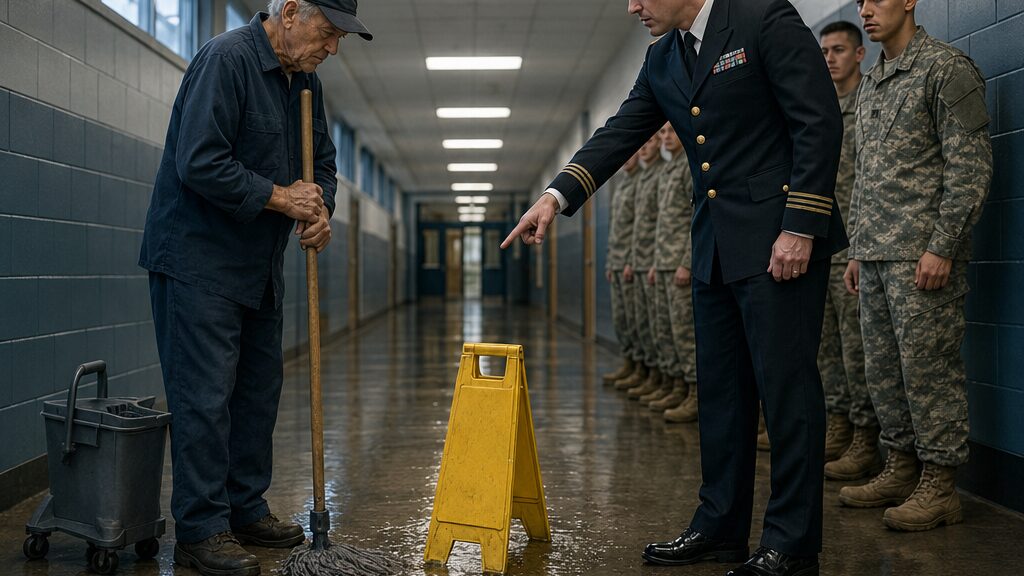
The Officer Kicked Over His Wet-Floor Sign, Not Knowing Why the Old Veteran Kept Guard
Chapter 1: The Sign in the Middle of the Hall
Ryan Campbell’s polished black shoe stopped less than an inch from the puddle, close enough that the water trembled around its edge.
Gregory Thomas saw the shoe first, then the crease of the dress trousers above it, then the ribbons on the officer’s chest catching the pale morning light from the high hallway windows. Behind Ryan, a file of trainees in camouflage had gone still, their boots lined against the wall, their young faces turned toward the old man with the mop.
Gregory kept both hands around the mop handle. The wood was worn smooth where his palms rested. He had been leaning on it more than using it for the last ten minutes, waiting for the slow leak above the west stairwell to finish its morning drip. He had placed the yellow sign in the exact center of the wet patch, legs open, black letters facing both directions.
CAUTION.
The word was scuffed nearly white at one corner.
Ryan looked from the sign to Gregory.
“Why is this still here?”
Gregory shifted his weight off his right knee. “Floor’s wet, sir.”
“I can see the floor.”
“Yes, sir.”
“Then clean it.”
Gregory glanced up toward the ceiling seam, where a brown line had spread through the tile like an old bruise. Another drop formed, fattened, then fell into the puddle with a small sound that only Gregory seemed to hear.
“I did,” he said. “Leak’s still active.”
A trainee at the back swallowed a laugh too quickly. Not because it was funny, Gregory thought. Because boys that young did not know what to do with silence when a grown man was being measured inside it.
Ryan turned his head slightly. The laugh died.
The hallway smelled of floor wax, rainwater, and laundry soap from the barracks wing. Inspection week had made the whole academy shine in strange places. Brass plates had been polished twice. Trophy cases were spotless. The command photographs had been straightened until every old face looked ready to judge the living.
But this hall, the main hall, still had a leak.
Gregory had written it up six times.
Ryan took one step around the sign. “This corridor will be used by the visiting inspection officer on Monday. It should not look like a bus station bathroom.”
Gregory lowered the mop head into the bucket. Gray water twisted around the wringer.
“It won’t look better if someone falls.”
“It will look better when you stop leaving equipment in the middle of the passage.”
Gregory’s hands tightened once on the mop handle. He let them loosen before anyone could notice. That was a habit older than his knees. Grip, release. Breathe before answering.
“The sign stays until the floor is dry.”
Ryan’s jaw moved. He was a man built out of sharp edges that morning: clean shave, pressed uniform, hard eyes. He was not old, not young. Old enough to have authority, young enough to believe authority should never have to repeat itself.
“Are you refusing a direct instruction?”
The trainees watched from beside the wall. Gregory could feel their attention more than see it. A dozen young soldiers learning, in real time, which kind of person could be pressed flat in public.
“No, sir,” Gregory said.
Ryan’s eyebrows lifted. “Then move it.”
Gregory did not move.
A drop struck the puddle.
The sound was small.
Ryan looked down at the yellow sign as if it had insulted him. Then his boot moved, fast and careless. The sign snapped sideways. One folding leg clipped the slick floor and skidded through the puddle. Water fanned out across Ryan’s shoe and spattered the base of the wall.
The sign landed on its side with a hollow plastic slap.
For a moment no one spoke.
Gregory looked at the fallen sign. It lay half in the water, the word CAUTION tilted toward the trainees now, as though warning them from the ground.
Ryan wiped a fleck of water from his shoe with the edge of his other sole.
“Now it’s not in the way.”
Gregory felt something rise in his chest, not anger exactly. Anger was hot and bright. This was older, heavier. It had no place to go because he had spent too many years teaching it to stand still.
The mop handle creaked under his hand.
One of the trainees looked down. Another stared straight ahead. A third, a young man near the front with a narrow face and dark eyes, watched Gregory with an expression that had not yet decided whether it was pity or shame.
Gregory set the mop gently against the bucket. His right knee complained before he bent, then his hip followed, then the old pull along his back. He lowered himself slowly, not because he wanted them to see the effort, but because the body only gave him so much. His fingers reached the wet plastic edge.
The hallway seemed to hold its breath around him.
The sign was heavier wet. Gregory lifted it, shook once, and set it back where it belonged. He adjusted the legs until they locked. He turned it so both directions of the corridor could read it.
Then he stood.
It took him longer than he liked.
Ryan watched with a look that said the old man had chosen embarrassment as his hill to die on.
Gregory picked up the mop handle again.
Ryan stepped closer. “Do you understand how this looks?”
Gregory looked at the sign, then at the line of trainees. “Yes, sir.”
“Then explain it to me.”
Gregory’s thumb moved over a groove in the mop handle, a worn place no wider than a shoelace. “It’s not for the floor.”
Ryan’s mouth tightened. “What?”
Gregory met his eyes. “It’s for the person who hasn’t reached it yet.”
The words did not rise. They did not cut. They simply stood there, like the sign, in the middle of the hall.
A trainee shifted his boots.
Ryan’s face changed just enough to show the sentence had landed somewhere he had not prepared to defend. Then the change vanished.
“You have until noon to clear this corridor. If that sign is still obstructing the main hall, I’ll file it as insubordination and unsafe placement of equipment.”
Gregory nodded once. “Understood.”
Ryan turned sharply. “Move out.”
The trainees began walking again, but not the way they had before. Their steps split around the sign. Some gave the puddle too much space. Some stared at Gregory’s hands. The young man with dark eyes passed last. His name strip read FLORES.
Gregory noticed because noticing was part of the work. Wet soles. Loose tiles. Frayed laces. A tired recruit favoring one ankle. The details people missed until they became consequences.
Anthony Flores slowed near the sign. His gaze dropped to the place where Gregory’s wet fingers still rested on the top edge.
Gregory did not know what the boy saw there. A janitor’s hand. An old man’s stubbornness. Skin thin over knuckles. A tremor he hoped was not visible.
He lifted his hand away.
Anthony looked from the sign to Gregory’s face, then lowered his eyes and stepped carefully around the puddle.
Gregory waited until the hallway cleared before he reached down again. This time he did not move the sign. He only pressed two fingers against the top, a touch so brief that anyone watching might have missed it.
But Anthony had turned back once at the end of the corridor.
And he saw.
Chapter 2: The Report That Called Him a Hazard
“The word he used was hazard,” Linda Smith said, and she did not look at Gregory when she said it.
The complaint lay on her desk between a stack of work orders and a cracked mug full of pens. Someone had circled the word in blue ink. Not the leak. Not the puddle. Not the ceiling tile brown with old water. The hazard, according to the report, was Gregory’s placement of academy equipment in a main corridor during inspection preparation.
Gregory stood in front of the desk with his cap in both hands.
The facilities office had no windows, only fluorescent light and the low hum of the vending machine outside the door. In the corner, the yellow sign leaned against a filing cabinet, dried now but streaked with gray where the morning water had run down its sides.
Linda tapped the paper once. “Ryan Campbell filed this directly with command admin.”
“Did he.”
“Gregory.”
He looked up because her voice had changed.
Linda was in her fifties, with reading glasses hanging from a chain and the tired patience of someone who had spent too many years translating reality into forms command staff would accept. She was not unkind. She was not brave by nature either. Gregory had learned there was a difference.
“He wrote that you refused to comply in front of trainees,” she said. “That you created a tripping risk.”
Gregory’s gaze moved to the sign in the corner.
Linda followed it. “Don’t look at it like it can answer for you.”
“It was doing its job.”
“And now it’s in a report.”
Gregory folded his cap once, stopped himself, and smoothed the brim with his thumb. He had carried a rifle once with less care than he carried that old cap now. Not because the cap deserved it. Because his hands needed a task.
Linda pulled another sheet from beneath the first. “Charles wants to see you in the maintenance closet. Before that, I need to ask you something.” She lowered her voice. “Did you tell Officer Campbell you would not move it?”
“I told him the floor was wet.”
“That’s not what I asked.”
Gregory did not answer.
Linda sighed through her nose. “You can’t keep making people guess the part you leave out.”
There it was again. The part you leave out.
He had left out plenty in his life and found that the world kept moving. Most people did not need the whole story. Most people wanted enough to finish their own sentence about you.
Old. Slow. Proud. Difficult.
Or if they saw one old file in his personnel folder: veteran.
That word made people stand differently for half a minute, then ask for proof with their eyes. What branch? What years? What did you do? Did you see anything? Did you lose anyone? They wanted a shape for the pain so they could put it somewhere clean.
Gregory had no interest in giving it to them.
Linda opened a drawer and pulled out a thin folder. “Your service paperwork is still in your hiring file.”
His eyes sharpened.
“I’m not waving it around,” she said. “I’m saying command knows. Or could know, if they bothered.”
“They hired a custodian.”
“They hired a man.”
Gregory looked away first.
The maintenance closet was at the end of a narrower hall behind the laundry room. It smelled of bleach, rubber gloves, and old coffee. Charles Wright was waiting with both hands on his hips, staring at a whiteboard filled with weekend assignments.
“You trying to get fired before the big inspection?” Charles asked.
Gregory hung his cap on a hook. “Afternoon to you too.”
“I’m serious.”
“I noticed.”
Charles turned, and the hard line of his mouth softened against his will. He was younger than Gregory by more than a decade but had the posture of a man who had lifted too many boxes with too few people. He pointed toward the office. “That complaint goes in your file. One more and they can say you’re creating repeated disruption.”
“The leak’s repeated.”
“The leak doesn’t have a pension, bad knees, and a supervisor trying to keep him employed.”
Gregory reached for the mop bucket log clipped to the shelf. He checked the tag out of habit: west stairwell, main corridor, morning hazard. His own block letters filled the last six entries.
Charles watched him read. “You wrote it up?”
“Every Monday. Twice last month when the rain came hard.”
“Send copies to Linda?”
Gregory nodded.
“Command admin?”
“When the ceiling stain spread.”
Charles rubbed both hands over his face. “And you didn’t tell Campbell that?”
“He didn’t ask.”
“Don’t do that.”
Gregory closed the log.
“Don’t stand there like words cost money,” Charles said. “A man writes you up as a hazard, you answer.”
Gregory’s voice stayed quiet. “I answered by putting the sign back.”
“That’s not an answer to them. That’s an excuse to push harder.”
The door opened before Gregory could reply. Linda stepped in, holding several papers in one hand. Her glasses had slid low on her nose.
“I found the leak reports,” she said.
Charles reached for them. “How many?”
“Six formal. Three maintenance notes. One request for ceiling access above the old west stairwell.”
Gregory’s jaw tightened at the last phrase, almost too slightly to see.
Linda noticed. “You remember that one?”
“It’s the same line.”
“What same line?”
Gregory took the papers from her. His own handwriting stood there in black pen, plain and square. Water intrusion above west stairwell approach. Recurring slick surface. Warning signage required until repair complete.
His thumb stopped on the date.
Four months ago.
Linda pulled one more sheet from the folder. It was stamped across the top with a routing note. Deferred until after inspection cycle. Cosmetic priorities active.
Charles swore under his breath.
Linda looked toward the hallway as if someone might hear the paper from two rooms away. “This wasn’t denied because they thought it was safe. It was delayed because opening the ceiling would make a mess before inspection.”
Gregory handed the paper back carefully.
“Gregory,” she said, “did you know they marked it deferred?”
“No.”
“You want me to attach this to your response?”
He looked at the old sign leaning beside the door now. Someone had dragged it there after lunch, clearing the main corridor for the buffing crew. Its plastic hinge was slightly bent from Ryan’s boot.
If Linda attached the paper, the matter would become larger. A leak was one thing. A delayed repair, during inspection preparation, with a complaint blaming the man who warned people about it—that was something command staff would not like appearing in daylight.
Charles lowered his voice. “Let her attach it.”
Gregory kept looking at the bent hinge.
“It won’t bring anything good to have them digging,” he said.
Linda stared at him. “It already isn’t bringing anything good.”
“They’ll fix the leak faster if it stays about the leak.”
“No,” Charles said. “They’ll fix the blame faster if you let them.”
Gregory put his cap back on. His fingers were stiff now, and he had to work the brim open twice. “I need to check the hall.”
Linda stepped into his path. “You need to answer the report.”
He met her eyes. She was angry, but not only at him. That made it harder.
“I will,” he said.
“With what?”
“The truth.”
But he did not say which part of it.
As Gregory left, Linda looked again at the routing note. Deferred until after inspection cycle. Cosmetic priorities active.
Below the stamp, in smaller print, another line had been added by someone in admin.
Remove visible warning equipment from main corridor during visitor walk-through.
Linda went still.
Then she turned the page over and saw the date.
It had been approved before Ryan ever kicked the sign.
Chapter 3: The Trainee Who Looked Away
“Standards,” Ryan Campbell said, “are what remain when excuses become convenient.”
Anthony Flores stood in the second row of the drill classroom, shoulders back, hands at his sides, eyes fixed on the whiteboard behind Ryan’s head. He had learned early that staring straight ahead could look like attention even when your thoughts had moved somewhere else.
On the board, Ryan had written three words in block letters.
DISCIPLINE. APPEARANCE. RESPONSE.
The class had been called before breakfast. Nobody said it was because of the hallway. Nobody had to. The story had already moved through the barracks in pieces: the old janitor, the wet sign, Campbell’s shoe, the way the sign went skidding. Some trainees told it like a joke until they reached the part where Gregory bent down. Then the jokes thinned.
Ryan paced once in front of them. “You will be tired. You will be inconvenienced. You will encounter people who slow the mission because they are attached to routine. Your job is not to stop for every obstacle placed in your path.”
Anthony felt the back of his neck warm.
He saw the sign again, yellow against gray water, knocked sideways like a thing with no right to stand.
Ryan turned. “Flores.”
Anthony’s spine tightened. “Sir.”
“What do we do when a nonessential obstacle compromises presentation during inspection prep?”
The room waited.
Anthony heard the correct answer before he gave it. Remove it. Report it. Maintain standard. There were several ways to say the same thing.
His mouth opened. “We assess whether it marks an actual hazard, sir.”
A small silence followed.
Ryan’s eyes settled on him. Not angry, not yet. Curious in the most dangerous way.
“Do we.”
“Yes, sir.”
“And who taught you that?”
Anthony kept his gaze steady. “The floor, sir.”
Someone behind him made a soft sound, quickly swallowed.
Ryan stepped closer. “Explain.”
Anthony wished he had not spoken. His heartbeat was in his throat. He had joined to become steadier, not to stand in classrooms challenging officers over janitorial signs. He thought of his mother’s hands pressing his duffel closed, of his younger brother asking whether the academy yelled at everyone or just the slow ones.
He also thought of Gregory’s fingers touching the top of the sign after everyone else had walked away.
“There was water under it,” Anthony said. “Yesterday.”
Ryan held him there for another second. Then he smiled without warmth. “Outstanding observation. Next time, observe without editorializing.”
“Yes, sir.”
The class moved on. Ryan spoke of visitor routes, barracks inspections, boot lines, polished brass. Anthony answered nothing else. When they were dismissed, the trainees poured into the corridor with the relief of people released from a room where the air had gotten too thin.
At the main hallway, the yellow sign was not in the center anymore.
It stood near the wall, angled half toward the puddle, half toward no one. The leak had slowed but not stopped. A thin shine spread across the floor, nearly invisible under the overhead lights.
Anthony saw it too late.
His right boot slid.
His arm shot out, striking the wall hard enough to sting his palm. For half a second his balance went backward and his stomach lifted with the sudden helplessness of falling in public.
A hand caught his sleeve.
Not hard. Not dramatic. Just enough.
Gregory Thomas stood beside him with the mop in his other hand, face unreadable beneath his dark cap.
Anthony pulled himself upright. “Thank you.”
Gregory released him. “Floor’s wet.”
The words should have sounded like correction. They did not. They sounded like a fact offered before a consequence could arrive.
Anthony looked down. The sign was too far from the slick patch.
“Did someone move it?” he asked.
Gregory dipped the mop into the bucket. “People move things.”
“You didn’t put it there?”
“No.”
Anthony waited for more. None came.
Around them, trainees stepped wide now, some because they had seen Anthony slip, some because fear traveled faster than instruction. Gregory placed the mop across the water and drew it back slowly, leaving a dark clean path that began filling again with beads from above.
Anthony glanced at the ceiling. “They know about the leak?”
Gregory wrung the mop. “Yes.”
“How long?”
Gregory looked at him then. The old man’s eyes were clear in a way that made Anthony uncomfortable, not because they were sharp, but because they did not ask to be believed.
“Long enough,” Gregory said.
A group of trainees approached, laughing too loudly from the barracks side. Anthony moved aside. One of them nudged the sign with his boot to make space.
Anthony’s hand shot out before he thought. He set it back.
The trainee gave him a look. “What are you, sign detail now?”
Anthony felt heat climb his face. “Just walk around it.”
Gregory’s mop paused.
The trainee shrugged and stepped around.
It was nothing. A tiny thing. Not courage, not really. Anthony knew that. He had not said anything yesterday when Ryan kicked it. He had watched an old man bend in front of them and done what most of them did: measured the safest place for his own eyes to land.
But Gregory resumed mopping, and the hallway seemed different to Anthony because of that pause.
Later, after lunch, Anthony was sent with two others to move supply boxes from the training hall. On the return, he took the main corridor alone. The floor had been mopped dry for the moment. The yellow sign stood folded beside Gregory’s bucket, not open, not warning anyone. Gregory crouched near it with his back to the hall.
Anthony slowed before the old man heard him.
Gregory took something from inside his shirt pocket. A small folded card, softened at the edges, sealed once with tape and opened too many times. He unfolded it only partway. Anthony saw no full words from where he stood, only a dark line of handwriting and a small stain at the corner.
Gregory slid the card into the narrow space behind the sign’s upper hinge, hidden but not lost. Then he pressed the hinge closed with his thumb.
The gesture was careful. Familiar. Almost private enough that seeing it felt like taking something.
Anthony shifted his boot.
Gregory turned at the sound.
For a moment neither of them spoke.
Anthony looked at the sign, then at the pocket where the card had come from.
Gregory’s face did not harden. It closed, which was worse.
“I didn’t mean to—” Anthony began.
Gregory picked up the folded sign. “Then don’t.”
Anthony stepped back.
Gregory carried the sign toward the main hall, moving slower than he had yesterday, one hand on the plastic handle and the other on the mop. At the corner, he stopped where the ceiling stain widened over the west stairwell approach.
He opened the sign and set it down.
Anthony remained where he was, staring at the hinge.
Whatever was inside that folded card, Gregory had not put it there for paperwork.
He had put it there like a man leaving a name where no one else would.
Chapter 4: Inspection Standards and Old Water
“Remove all unsightly safety clutter before the visitor walk-through,” the command staff member said, and Linda Smith felt every person in the admin wing pretend not to hear the word safety.
The checklist landed on her desk with a soft slap. It was only one page, but it carried the weight of a week’s worth of panic: buff floors, polish brass, repaint east stairwell rail, replace faded bulletin board trim, conceal temporary repair equipment from main route.
Conceal.
Linda read the line twice.
The command staff member stood over her desk with a tablet tucked under one arm. “The visiting inspection officer enters through the main doors at 0800 Monday. He’ll pass the trophy cases, continue through the central corridor, then head to the training hall. That corridor needs to look clean.”
“It’s wet,” Linda said.
He blinked. “Then it needs to be dry.”
“There’s an active leak above the west stairwell approach.”
“Put in a work order.”
“I did.”
“Then follow up.”
“I did that too.”
His expression tightened in the polite way people used when they had no intention of changing direction. “Linda, I’m not asking for a facilities debate. I’m asking you to make sure nothing in that corridor suggests neglect.”
She looked down at the checklist.
Nothing in that corridor suggests neglect.
The yellow sign did not suggest neglect. It suggested someone had noticed it.
“Understood,” she said.
He left before she finished the word.
Linda sat still for a moment, listening to the office noises around her: printer warming, phones ringing low, someone laughing near the copier like nothing on paper ever harmed a person. Then she opened the maintenance database and typed west stairwell leak into the search bar.
The screen filled with entries.
Gregory Thomas had not submitted six reports.
He had submitted nine.
Three had been categorized differently: “ceiling discoloration,” “recurring moisture,” “floor slickness after precipitation.” Linda had missed them because Gregory wrote like a man trained to describe a problem from every angle until someone could no longer pretend it was one thing.
She opened the oldest.
Water intrusion observed after overnight rain. Main corridor foot traffic includes trainees during morning movement. Temporary warning sign placed. Recommend ceiling access before next inspection cycle.
Date: four months ago.
She opened the next.
Surface slick after mopping due to continued drip from overhead seam. Warning sign remains necessary. Recommend repair before visitor route use.
Date: three months ago.
The third had a note from admin: Lower priority. No injury reported.
Linda’s jaw tightened.
She printed the entries and took them with her to the maintenance closet. The buffing crew had already begun working the east end of the academy. Their machine groaned across the floor, leaving a shine so bright it reflected the overhead lights in long white streaks.
At the main corridor, Gregory was kneeling beside the mop bucket, tightening the bent hinge of the yellow sign with a small screwdriver. His cap was pulled low. The sign lay open across his knees like something injured.
Linda stopped before he saw her.
A younger custodian might have replaced it. A faster worker might have tossed it into the broken equipment bin and signed out a new one. Gregory had chosen to repair the bent hinge by hand, patiently aligning the plastic until the legs opened square again.
That was the problem with him, Linda thought. He made small things matter until the room had to answer for treating them as small.
“Gregory.”
He did not startle. “Ms. Smith.”
“You know you can call me Linda.”
“On paper, you’re Ms. Smith.”
“That’s exactly the kind of thing that makes people think you’re arguing when you’re not.”
The corner of his mouth moved, almost a smile, then disappeared. He tightened the screw another quarter turn.
Linda held out the printed reports. “You filed nine entries on that leak.”
He looked up then.
“Six formal, three categorized under related conditions,” she said. “That’s not counting the handwritten notes in the bucket log.”
He took the pages, scanned the top one, and handed them back. “Seems right.”
“Seems right?”
“You asked how many. That seems right.”
“Why didn’t you tell me yesterday?”
“I thought you knew.”
“I knew the formal ones.”
“Then now you know the rest.”
She wanted to snap at him. Instead she crouched so they were nearly eye level. Her knees complained, and she imagined his did too, though he gave no sign.
“Command wants the corridor cleared of warning equipment during the walk-through.”
His hand stilled on the screwdriver.
“Ryan Campbell’s name isn’t on the checklist,” Linda said. “But the instruction was approved through his inspection route notes.”
Gregory looked toward the corridor. The leak had slowed to one drop every half minute, just enough to keep the floor treacherous after mopping. A trainee carrying a box stepped wide around the darker patch without looking at the ceiling.
“They’ll move someone through there,” Gregory said.
“They’ll move everyone through there if it’s the cleanest route.”
He closed the screwdriver and slipped it into his pocket. “Then the sign stays.”
Linda lowered her voice. “That is exactly what they’re waiting for. They already have one complaint. If you put that sign out after a written instruction says not to, they’ll call it defiance.”
Gregory stood slowly. He lifted the sign and tested its legs. They locked with a clean plastic click.
“Defiance would be letting a man walk into what I know is there.”
“You cannot carry the whole academy on your back.”
“No.”
“Then stop acting like you can.”
The words came out sharper than Linda intended. Gregory’s face did not change, but she saw his thumb move along the top of the sign, searching for a worn place.
A long silence passed before he said, “I don’t need the whole academy. Just this stretch of floor.”
Linda looked down at the printed reports in her hand. She had spent years making compromises and calling them practical. A sign moved for an inspection. A repair delayed for a budget cycle. A worker warned privately instead of defended publicly. Each compromise was small enough to survive. Together they formed a hallway where the old man became the problem.
She stood. “I can attach the reports to your response.”
“Not yet.”
“Gregory.”
“If you attach them now, they’ll look for who delayed it. Someone under you will take the blame before anyone above you does.”
Linda glanced toward the admin wing. He was right, and she hated that he had thought of it before she had.
“You’re protecting people who won’t protect you.”
His eyes went to the puddle. “That’s not new.”
The sentence closed a door between them.
By late afternoon, Linda was called into a route review with command staff. Ryan Campbell stood beside a projected map of the academy, pointer in hand, uniform immaculate, expression calm. On the screen, the main corridor was highlighted in blue.
“This is the intended visitor path,” he said. “No equipment, no carts, no temporary signage unless cleared through command.”
Linda raised a hand before she could decide not to. “Temporary signage is required if the surface is wet.”
Ryan did not look surprised. “Then facilities will ensure it is not wet.”
“We cannot ensure that until the leak is repaired.”
“Then station someone out of sight with a mop.”
Several heads turned toward her, not because Ryan’s suggestion was good, but because it sounded clean enough to end the discussion.
Linda looked at the highlighted corridor. “Out of sight does not warn anyone walking through.”
Ryan’s smile was thin. “This is not a legal seminar, Ms. Smith. It is a walk-through.”
“And if someone slips?”
“Then I suggest facilities do its job.”
The meeting moved on.
That evening, Linda returned to the corridor with the updated checklist folded in her pocket. The buffing crew had stacked equipment near the side doors. The floor shone like still water even where it was dry. Near the west stairwell approach, the ceiling released a single drop.
The yellow sign was gone.
For one brief second, Linda thought Gregory had listened.
Then she heard the maintenance closet door open.
Gregory stepped out, carrying the folded sign under one arm. He had no cart, no bucket, no visible excuse. Only the sign.
He did not see Linda at first. He walked toward the wet patch with the slow, deliberate pace of a man who had already accepted the cost of arriving.
Linda did not stop him.
At the center of the corridor, Gregory opened the sign and set it down.
Chapter 5: The Promise Under the Mop Handle
Gregory stood alone with the sign hidden under his arm, and the empty hallway seemed louder than it had been all day.
The academy after hours was never truly quiet. Pipes ticked behind walls. Floor machines hummed somewhere distant. A door closed two corridors away and sent a soft thud through the building. But the main hall itself had emptied, leaving only the polished floor, the old ceiling stain, and the slow fall of water from above.
He could still put the sign back in storage.
He could let the night pass, let the inspection happen, let younger men with sharper shoes and cleaner papers decide what counted as danger. He could keep his job a little longer by pretending the puddle would wait for permission to matter.
A drop struck the floor.
Gregory opened the sign.
The legs snapped into place with a sound that moved through his chest. He set it over the wet patch and checked both directions, the way he always did. Then he took the mop handle and rested one hand on top of it, not leaning, not exactly standing guard, though the difference had become hard to name.
In the reflection on the floor, the yellow sign wavered.
He took the folded card from his shirt pocket.
The tape along its crease had yellowed long ago. The paper was not official. Not a record. Not something command could file or stamp. It was only a training safety card, the kind handed out by the dozen, with a handwritten note on the back in a young man’s blocky script.
Gregory did not open it all the way.
He knew the words.
Watch your step, Mr. Thomas. You always watch ours.
He had been Sergeant Thomas then to some, Mr. Thomas to the young ones who thought anyone over forty belonged to another century. The boy who wrote it had been nineteen, maybe twenty, with a laugh too loud for narrow halls and a habit of running down stairs even after being warned.
Gregory pressed the folded card against the sign’s hinge, then tucked it into the little gap where the plastic folded over. Hidden, but near the warning. Near where it belonged.
“Still doing that?”
Charles Wright’s voice came from the maintenance hall.
Gregory closed his eyes once, then opened them. “You walk quiet for a man with bad ankles.”
“You hear what you want to hear.”
Charles stepped into the light, jacket half zipped, face drawn with irritation and worry. He looked at the sign, then at the card Gregory had tried to hide.
“I figured I’d find you here.”
“Then you saved yourself a search.”
“Don’t be clever with me.”
Gregory adjusted the sign a fraction of an inch.
Charles came closer, lowering his voice though there was no one nearby. “Command gave a written instruction. Linda told me.”
“I know.”
“And you put it back anyway.”
“Floor’s wet.”
“Don’t say that to me like I’m Campbell.”
Gregory’s hand tightened around the mop handle.
Charles saw it. “I know the floor’s wet. I know the sign belongs there. I also know they’re looking for one more reason to make you the problem instead of fixing what’s above your head.”
Gregory looked toward the ceiling seam. “That’s been true before.”
“Not like this. You’ve got a complaint in your file. You put this sign out during a no-sign order, they’ll call it public defiance.”
“Better than private negligence.”
Charles stepped around the puddle and stood in front of him. “You cannot save the dead by losing your job.”
The words struck harder than Ryan’s boot had.
Gregory did not move.
Charles’s face changed as soon as he said it, as if he had meant to press on a bruise and found bone beneath it. “Gregory—”
“No.”
“I’m sorry.”
“No.”
The old word filled the hallway with more than refusal. It was a barrier, a warning, a door closed before memory could walk through.
But memory had already entered.
The west stairwell had not looked like this back then. Different paint, dimmer lights, a runner of brown rubber matting worn thin in the middle. Rainwater had come in through an upper seam and gathered near the approach. Command had been preparing for a ceremony that week. Visitors. Families. Photographs. Clean halls.
A warning cone had stood near the stairwell at 0600.
By 0730, it had been moved behind a storage cart.
By 0745, a young trainee with too much speed and too much trust in the floor came around the corner carrying a tray of training binders. Gregory had heard the slip before he saw the fall. The sick sound of heel losing surface. The crash. The sharp intake of every person nearby.
The injury had not killed the boy. Not then. Not on that floor. But it had taken him out of training, led to complications, sent him home changed in ways Gregory never fully learned because after the reports, after the questions, after the blame was softened into phrases like contributing conditions, the boy’s family stopped answering letters.
Gregory had kept the safety card because the boy had given it to him two days before the accident.
Watch your step, Mr. Thomas. You always watch ours.
Charles’s voice came through the memory. “That card from him?”
Gregory opened his eyes. He had not realized he was touching the hinge again.
“I said I’m sorry,” Charles said. “I shouldn’t have said it that way.”
Gregory looked at his old friend, and for a moment he was angry with him for being kind. Kindness asked questions. Cruelty was easier to stand in front of.
“He was walking where he was told to walk,” Gregory said.
Charles said nothing.
“The sign had been moved.”
“By you?”
Gregory’s face tightened. “No.”
“Then why do you carry it like you did it?”
Gregory looked down at the mop handle. There was a narrow band of dark tape around it, placed where his right hand naturally rested. Beneath the tape, hidden from sight, the handle was cracked. He had repaired it because it still held.
“I saw it moved,” he said.
Charles waited.
“I thought they had a reason.”
The words cost more than he expected. He had never spoken them plainly. Not to Linda. Not to Charles. Not to himself in any way that did not immediately break apart.
“I saw the cone behind the cart,” Gregory said. “I thought maybe someone was coming back. I thought I had other work. I thought…” He stopped. The hallway offered no mercy, only the next drop of water. “I thought too long.”
Charles’s shoulders lowered.
Gregory looked at the sign. “Afterward, there were reports. Everyone had language. Unfortunate. Contributing. Miscommunication. I had language too. But none of it changed that I saw a warning out of place and didn’t put it back.”
Charles spoke carefully. “So you made yourself the warning.”
Gregory gave the smallest shake of his head. “I made myself remember.”
The side door at the end of the hall opened.
Both men turned.
A night-shift worker stood there with a trash liner in one hand and a phone in the other. His eyes went from Gregory to Charles to the sign in the center of the corridor.
“Nobody’s supposed to have signs out tonight,” he said.
Charles took a step forward. “We’ve got it handled.”
The worker looked uncomfortable. “Officer Campbell told night staff to report anything left in the main route. He said directly.”
Gregory did not move.
Charles said, “Go on, then. I’ll talk to him.”
The worker’s thumb hovered over the phone screen.
Gregory looked at the young man’s shoes. They were slick-soled and nearly on the edge of the wet patch.
“Step left,” Gregory said.
The worker glanced down and shifted before he understood why. His face colored. “I’m sorry.”
“Don’t be,” Gregory said. “Just step left.”
The worker backed away, still holding the phone.
Charles turned on Gregory. “Now it’s official.”
“It was official when they wrote it down wrong.”
The hallway doors opened again ten minutes later, harder this time.
Ryan Campbell entered in dress trousers and a training jacket, phone in hand, expression already set. He stopped at the edge of the light and saw the yellow sign standing in the center of the corridor.
His gaze moved to Gregory.
Then to the mop.
Then to the small folded card tucked behind the sign’s hinge.
“What,” Ryan said quietly, “do you think you’re doing?”
Chapter 6: The Officer Who Feared Weakness
Ryan Campbell’s phone rang before dawn, and for three seconds he hated the sound more than he hated any person.
He knew who it was before he looked. The care facility never called early with good news. Good news came on scheduled calls with cheerful voices and careful phrases. Early calls began with his father’s name and ended with forms, follow-ups, or decisions no son wanted to make in uniform.
He answered on the second ring.
“Yes.”
The nurse on the other end spoke gently, which made it worse. His father had fallen trying to get from the bed to the chair without assistance. No broken bones. A bruise along the hip. Increased confusion. They recommended a mobility alarm at night. They recommended he come by if he could.
Ryan stood in his office, shirt sleeves half buttoned, inspection jacket hanging from the back of his chair. On his desk lay the visitor route packet, the complaint against Gregory Thomas, and the night-shift report: unauthorized warning sign placed in main corridor after written route-preparation instruction.
“Was he hurt?” Ryan asked.
The nurse repeated that there were no broken bones.
That was not an answer.
After the call ended, Ryan remained still with the phone in his hand. Through the office window, the academy grounds were turning gray with morning. The flag outside was a dark shape against the pale sky. In an hour, trainees would move through the corridors. In two, the visiting inspection officer would arrive. In less than three, Ryan’s route would either look disciplined or look like an institution unable to manage its own ceiling.
He set the phone facedown.
His father had once stood straight as a fence post and believed every problem could be corrected by rising earlier than the next man. Now he forgot where the bathroom was. He argued with nurses. He called Ryan by his brother’s name, though Ryan had no brother.
Weakness did not ask permission before entering a room.
Ryan put on his jacket.
The main corridor smelled freshly waxed when he reached it, but wax could not hide water. The yellow sign stood in the same forbidden place as the night before. Gregory Thomas stood beside it with a mop, dark cap low, one hand braced at the top of the handle.
For one irrational second, Ryan saw his father.
Not the face. Not the body exactly. The angle of stubbornness. The refusal to sit when sitting was sensible. The old-man insistence that a small thing mattered because he said so.
Ryan felt something in himself recoil.
Gregory looked up. “Morning, sir.”
Ryan stopped short of the puddle. His reflection appeared in the wet floor beside the yellow sign, broken by a falling drop from the ceiling.
“You were instructed to remove this.”
“Yes, sir.”
“And you chose not to.”
“Yes, sir.”
The admission should have satisfied him. It did not. There was no defiance in Gregory’s voice, no challenge Ryan could push against. Only the maddening calm of a man who would not help make the conflict clean.
“This corridor will be used by visitors in two hours.”
“Then it should be marked.”
“It should be dry.”
“It isn’t.”
Ryan stepped closer, then stopped himself when the edge of his shoe touched the shine of water. Gregory’s eyes flicked down. Not mockery. Warning.
That was somehow worse.
“You think this is about your sign,” Ryan said.
“No, sir.”
“What is it about, then?”
Gregory’s hand moved to the hinge. Ryan noticed the folded card tucked there, small and worn, hidden badly enough to suggest it had not been meant for him but close enough that he could not ignore it.
Before Gregory could answer, Linda Smith came from the admin side carrying a folder. She slowed when she saw them.
“Officer Campbell,” she said.
“Ms. Smith, remove this equipment from the visitor route.”
“The floor is wet.”
“I am aware.”
“Then I can station staff here and reroute visitors through the east corridor.”
“No.”
Linda held the folder tighter. “There are multiple repair reports documenting the leak.”
Ryan looked at her. “And there is now a documented refusal to follow route-preparation orders.”
Gregory said nothing.
Ryan turned back to him. “You understand what happens next?”
“I expect you’ll tell me.”
“A disciplinary safety board this afternoon. Training hall. You will answer for public defiance and unsafe placement of equipment.”
Linda’s face went pale with anger. “Unsafe placement? The sign is warning people.”
“The sign is in a main route after removal was ordered.”
“Because removal was unsafe.”
Ryan heard his own voice harden before he chose it. “That will be for the board to determine.”
Gregory dipped the mop into the bucket, wrung it once, and drew it across the edge of the puddle. The slow movement irritated Ryan more than argument would have. He wanted Gregory to protest, to raise his voice, to make himself the problem everyone could name.
Instead the old man worked.
Ryan looked at his bent shoulders, the careful way he shifted weight off one knee, the cap that made him look smaller than he was. The irritation flared into something closer to disgust, and beneath that, fear.
He did not want men like this in the center of his corridor. He did not want frailty made visible where the institution was supposed to shine. He did not want to think of his father reaching for a chair and missing.
“You don’t get to hold the academy hostage because you’re attached to a routine,” Ryan said.
Gregory paused.
Linda drew in a breath.
Ryan knew he had gone too far, and the knowledge did not stop him. Pride hated witnesses almost as much as failure did.
Gregory looked at him. “No, sir.”
“No?”
“No one’s hostage.”
“Then move it.”
Gregory set the mop back into the bucket. “I’ll answer the board.”
The answer gave Ryan what he needed and not what he wanted.
By 0800, the visitor route had been changed without calling it changed. Linda posted a staff member near the corridor and directed movement through the east side “for efficiency.” Ryan hated the adjustment because it solved the immediate risk while leaving the argument alive.
During the inspection, he performed well. He always did. He spoke clearly. He anticipated questions. He showed the training hall, the barracks wing, the updated classroom technology. The visiting inspection officer nodded at the right times, asked about retention numbers, and complimented the orderliness of the facility.
But Ryan’s thoughts kept returning to the main corridor.
At one point, passing a trophy case, he saw his reflection beside a row of academy honors. For half a heartbeat, the glass placed his decorated chest over the memory of the yellow sign reflected in water.
It made him look divided.
After the visitors left, Ryan returned to his office and shut the door. The voicemail light blinked on his phone. He pressed play.
The nurse again. His father had become agitated. He kept insisting he needed to report for duty. He had tried to stand. They had calmed him. Could Ryan come by that evening?
Ryan deleted the message before it finished.
Then he opened the complaint file and added the board notice.
At 1315, the safety board clerk carried the printed notice to the maintenance office. Gregory was there with Charles, cleaning mop heads in the utility sink. The clerk looked uncomfortable as he handed the paper over.
Gregory dried his hands before taking it.
Charles read over his shoulder and went still.
Public defiance.
Unsafe placement of equipment.
Failure to comply with inspection preparation order.
Gregory folded the notice once and placed it in his shirt pocket, beside the card.
Charles said, “You need representation.”
Gregory looked toward the corridor, where the yellow sign stood folded against the wall under temporary watch.
“No,” he said. “I need to decide what I’m done keeping quiet.”
Chapter 7: The Man Behind the Warning
Ryan placed the yellow sign on the table as if it were evidence from a crime.
It stood folded between them, wet scuffs still visible along one plastic edge, the hinge slightly crooked despite Gregory’s repair. In the training hall, folding chairs had been set in two rows for trainees ordered to observe “procedure and accountability.” At the front table sat the safety board clerk, a command staff member, Ryan Campbell, Linda Smith, and Charles Wright. Gregory stood alone on the polished floor with his cap in his hands.
The sign looked smaller under the fluorescent lights.
Gregory looked at it anyway.
The safety board clerk cleared his throat. “This hearing concerns repeated failure to comply with inspection preparation orders, unsafe placement of equipment in a main corridor, and public defiance of an officer’s instruction.”
A few trainees shifted in their seats.
Gregory heard the words without taking them in. They sounded clean. Clean words could carry dirty things if spoken in the right order.
The command staff member glanced at Ryan. “Officer Campbell, begin with your statement.”
Ryan stood. His uniform was exact, his face controlled. “During inspection preparation, Mr. Thomas repeatedly placed a warning sign in the central corridor after being instructed that the corridor needed to remain clear. His action created visual disorder during a high-priority inspection cycle and introduced a tripping hazard into a main route. When corrected, he refused to comply.”
Gregory held his cap by the brim.
Linda looked down at her folder.
Charles sat with both hands locked together.
Ryan continued. “This is not about one sign. It is about whether support personnel can disregard route preparation instructions during academy operations.”
Gregory almost smiled at that. Not because it was funny. Because Ryan had finally said something true.
It was not about one sign.
The clerk turned to Gregory. “Mr. Thomas, you may respond.”
Gregory opened his mouth.
Nothing came out.
The room waited. He felt every young face behind him, every person at the table deciding whether his silence was guilt, stubbornness, confusion, or age. He had told Charles he needed to decide what he was done keeping quiet. He had not known quiet would fight him so hard when the moment arrived.
He looked at the sign.
There was a faint gap behind the hinge where the folded card rested. Still there. Still hidden.
“I placed the sign because the floor was wet,” Gregory said.
The clerk made a note. “Were you aware of the instruction to remove visible warning equipment from the corridor?”
“Yes.”
“Then why did you violate it?”
Gregory’s thumb pressed into the cap brim. “Because the floor was wet.”
A faint sound passed through the trainees. Not laughter. Frustration, maybe. The room wanted more from him. So did Linda. So did Charles. Maybe even Ryan.
The command staff member leaned forward. “Mr. Thomas, repeating the same statement will not help you.”
Gregory nodded. “I understand.”
“Then help us understand.”
Gregory looked toward the back row. Anthony Flores sat near the aisle, jaw tight, hands flat on his knees. Their eyes met for less than a second before Anthony looked away.
Gregory could let the moment pass. He could keep the old card in the hinge and the old boy in the past and let the board call him difficult. It would be simpler. Pain kept private had weight, but it did not require witnesses.
Linda opened her folder. “Before Mr. Thomas continues, I need the board to see the maintenance records.”
Ryan’s gaze sharpened. “This hearing concerns conduct.”
“It concerns a warning sign placed over a documented hazard,” Linda said. “The hazard was reported nine times.”
The clerk paused. “Nine?”
Linda slid copies across the table. “Six formal reports, three related entries, plus bucket logs. The oldest report is four months old. The repair was deferred until after inspection due to cosmetic priorities.”
The words changed the air.
The command staff member took the top sheet. Ryan did not reach for his copy.
Gregory looked down. Linda had done what he had avoided.
The board clerk read silently. His lips tightened at the routing note. “Deferred until after inspection cycle.”
Ryan said, “Facilities had responsibility for mitigation.”
“Yes,” Linda replied. “And the mitigation was the sign.”
Ryan turned toward her. “Unless the sign itself obstructed the corridor.”
Charles let out a short breath. “It was marking the obstruction.”
The command staff member raised a hand. “One at a time.”
A chair scraped behind Gregory.
Anthony stood.
Gregory closed his eyes briefly.
“Sir,” Anthony said, voice stiff. “I saw the sign get moved.”
Ryan turned slowly.
The clerk looked over his glasses. “State your relevance.”
“I was present in the corridor when Officer Campbell confronted Mr. Thomas.”
Ryan’s face remained still, but something closed behind his eyes.
Anthony swallowed. “The sign was standing over water. Officer Campbell kicked it aside. It fell into the puddle. Mr. Thomas picked it up and put it back.”
The room went very quiet.
A trainee in the back row stared at the floor. Another looked at Ryan, then quickly away.
The command staff member’s pen stopped moving.
Ryan said, “Trainee Flores, choose your next words carefully.”
Anthony’s face flushed, but he did not sit. “Yes, sir.”
Gregory turned toward him. “Sit down, son.”
Anthony blinked.
Gregory’s voice stayed gentle. “That’s enough.”
“But—”
“That’s enough.”
Anthony sat, slowly, confused and almost hurt.
Ryan looked at Gregory then, and for the first time that day, Gregory saw uncertainty in him. Not regret. Not yet. But uncertainty.
The clerk adjusted his papers. “Mr. Thomas, you do not wish to pursue that point?”
Gregory looked at the sign on the table. The room was ready to make Ryan the center. It would have been easy. A kicked sign, a young witness, a clean reversal. Gregory could stand back and let the officer feel the eyes he had once placed on him.
He could not do it.
“No,” Gregory said. “I don’t need this room to punish a man for moving plastic.”
Ryan’s mouth tightened.
Gregory stepped closer to the table. “I need this room to stop moving warnings out of sight.”
The folded sign stood between them.
Gregory set his cap beside it. His hands looked older without something to hold.
“A long time ago,” he said, “I saw a warning moved from a wet stairwell.”
Charles lowered his head.
Linda went still.
Gregory kept his eyes on the sign, not the room. “It was inspection week then too. Different building. Different command. Same kind of thinking. Somebody wanted the hall clear. Somebody figured the wet spot could be watched. Somebody figured a warning looked worse than the thing it warned about.”
He touched the top edge of the sign.
“A trainee came through carrying binders. He slipped. He was young, fast, trusted the floor. I was close enough to hear it happen.”
No one moved.
“I had seen the warning moved before he came through,” Gregory said. “I thought someone had a reason. I thought maybe they were coming back. I thought I had other work.”
His throat tightened, and he stopped until it let him continue.
“The reports after that used careful language. Contributing condition. Miscommunication. Temporary hazard. I signed one of those reports. I let the language be enough because it was easier than saying what I knew.”
The command staff member looked down at the papers in front of him.
Gregory reached behind the sign hinge and pulled out the folded card.
The movement was small, but every eye followed it.
He opened the card only enough for the handwriting to show. He did not pass it around.
“This was given to me before that accident,” he said. “It says, ‘Watch your step, Mr. Thomas. You always watch ours.’”
A sound came from Linda, nearly hidden.
Gregory folded the card again. “That boy did not need me to be decorated. He did not need me to be important. He needed me to put back what I knew belonged there.”
Ryan looked at the card, and the sharpness in his face faltered.
Gregory turned toward him. “Officer Campbell moved the sign. That was wrong.” He raised a hand before anyone spoke. “But I have done wrong too. I have stayed quiet so long that people learned to call safety clutter and call silence agreement.”
The words entered him as he said them.
He had thought his silence protected the dead from being used. Maybe sometimes it had. But it had also protected living men from hearing what they had repeated.
He looked at the command staff member. “I placed the sign after the order because the order was unsafe. If that is defiance, write it that way. But write the rest too.”
The board clerk’s pen hovered. “The rest?”
“The leak was known. The warnings were ordered out of sight. The corridor was kept pretty before it was kept safe.”
Linda pushed the printed reports forward. “The records support that.”
Charles finally spoke. “So do the maintenance logs.”
The command staff member looked at Ryan. “Officer Campbell.”
Ryan’s eyes were still on the folded card.
“Officer Campbell,” the command staff member repeated. “Did you issue or support the instruction to remove warning signs from the main corridor during visitor movement?”
Ryan looked up.
The room waited for him.
Gregory saw the struggle pass across the younger man’s face: career, pride, fear, the need to remain sharp and unbent in front of trainees who had seen too much already.
The yellow sign stood between them, no longer warning about the floor.
Warning about what a man would step into next.
Chapter 8: Watch Your Step
Gregory arrived one week later to find the hallway dry and the sign still standing.
For a moment he stopped so completely that the mop bucket rolled forward without him and bumped softly against his shin. The ceiling tile above the west stairwell approach had been replaced. The brown stain was gone. A square of fresh paint marked the repair, slightly brighter than the rest of the ceiling. The floor beneath it held no shine of water, no spreading slick patch, no quiet drip measuring time.
But the yellow sign stood in the center of the corridor anyway.
Not open wide enough to block. Not folded away against a wall. It stood beside a small strip of blue painter’s tape marking the last edge of the repair area. Someone had turned it so the words faced the morning traffic.
Gregory set one hand on the mop handle.
Trainees moved through the hall in pairs, stepping around the sign without complaint. One of them nodded to him. Gregory nodded back because not answering would have turned kindness into ceremony, and he wanted no ceremony.
The safety board had ended without applause, without apology, without one clean sentence that could be framed and hung on a wall. Ryan had answered the question after a long silence.
“Yes,” he had said. “I supported the removal instruction.”
Then he had added, lower, “I should not have.”
That was all.
The board had suspended the complaint pending review, then removed it from Gregory’s file two days later. The leak repair was ordered before the end of the afternoon. Linda filed the maintenance records with a new routing note that did not hide behind cosmetic priorities. Charles told Gregory he was still a stubborn old fool and then stood beside him for ten minutes without speaking.
The academy did not transform overnight. No place did. People still hurried. Command staff still liked clean lines and quiet problems. But on Friday afternoon, a new safety memo appeared in every office: temporary warning equipment related to active hazards was not to be removed for visitor presentation, photography, route preparation, or cosmetic concerns without equivalent safety control in place.
Gregory read it once.
Then he went back to work.
Now, on the repaired Monday morning, the sign stood where it no longer needed to stand.
That unsettled him more than the leak had.
He pushed the mop bucket closer and reached for the sign.
Before he could fold it, Ryan Campbell came out of the side corridor.
Gregory’s hand stopped.
Ryan was not in dress uniform today. Training jacket, pressed trousers, no ribbons. His face looked tired in a way polish could not correct. He walked toward the sign, looked at Gregory once, then bent down and adjusted the left leg so it stood straighter.
It was a small thing. Almost nothing.
A week ago, he had kicked that same sign into water.
Today, he aligned it.
Gregory watched without helping.
Ryan stood. “The repair crew left tape residue near the edge.”
Gregory looked down. There was indeed a faint strip of adhesive dulling the shine.
“Could catch dirt,” Ryan said.
“Could.”
Ryan’s eyes moved to the mop handle, then to Gregory’s face. “I wanted it visible until you cleared it.”
The words were plain. No performance. No witnesses called closer to hear them.
Gregory nodded. “I’ll clear it.”
Ryan did not leave.
A group of trainees passed. Anthony Flores was among them. He saw the two men near the sign and slowed only slightly, then kept moving when Gregory gave him a look that said not now.
Ryan waited until they passed.
“My father fell again,” he said.
Gregory did not answer.
“He’s in a care facility. Some days he thinks he’s still reporting for duty.” Ryan looked toward the repaired ceiling. “I don’t like seeing men become… less than they were.”
Gregory rested both hands on the mop handle. “Men don’t become less because they need help.”
Ryan’s jaw worked.
“No,” he said. “They don’t.”
The hallway continued around them. Boots, voices, doors, morning movement. The sign stood between them, but not like an accusation now. More like a witness neither man needed to touch.
Ryan looked at it. “I was wrong.”
Gregory waited.
“Not because you had a card. Not because you served.” Ryan’s voice tightened slightly. “Because the floor was wet.”
Gregory felt the words settle somewhere deeper than an apology that named him as special would have. The floor had been wet. The warning had belonged there. That should have been enough.
“Yes,” Gregory said.
Ryan turned to leave, then stopped. “There was talk of a recognition ceremony. Command thought it would be appropriate.”
Gregory’s eyes narrowed.
“I told them to ask you first.”
“They didn’t.”
“No.”
“Good.”
Ryan almost smiled, but not enough to make it easy. “I thought you’d say that.”
“I don’t need a room.”
“What do you need?”
Gregory looked down the corridor. A new trainee, too fresh to know the patterns of the building, came through the main doors carrying a duffel too large for his shoulder. He walked fast, eyes on the numbers above the classroom doors, not on the floor.
Anthony stepped out from the side of the hall before Gregory could speak.
“Watch your step,” Anthony told the new trainee.
The young man slowed. “Thanks.”
Anthony moved the yellow sign a few inches into clearer view, then looked toward Gregory.
Gregory felt the old folded card in his shirt pocket. He had taken it out of the sign after the board and put it back where it belonged, close to his heart but no longer hidden in plastic. He had not stopped remembering. He had only stopped making the sign carry all of it alone.
“What do I need?” Gregory repeated.
Ryan waited.
Gregory lifted the mop from the bucket and squeezed gray water through the wringer. “People to watch where they’re sending each other.”
Ryan looked toward Anthony, who had returned to his place with the trainees, then back at Gregory. “That can be arranged.”
“No,” Gregory said. “It can be practiced.”
The distinction held Ryan there for a moment.
Then he nodded once and walked down the corridor. Near the corner, he paused beside a trainee whose bootlace had come loose. He did not bark. He did not embarrass him. He pointed down, waited while the young man fixed it, then continued on.
Gregory saw Anthony notice.
That was how things changed, if they changed at all. Not in speeches. Not in polished rooms. In small interruptions. A sign left standing. A warning heard. A man with authority choosing not to make someone smaller.
Later that morning, Linda came by with a clipboard and found Gregory removing the blue tape from the floor.
“You heard about the ceremony?” she asked.
“Heard enough.”
“I told them you’d refuse.”
“Then why ask?”
“Because I wanted the pleasure of being right.”
He gave her the almost-smile.
She looked at the repaired ceiling. “The new safety memo has your language in it.”
“My language?”
“‘Equivalent safety control.’ ‘Visitor presentation does not supersede hazard warning.’ Very dry. Very you.”
“Sounds like you.”
“It can be both.”
Charles appeared at the far end pushing a cart of replacement bulbs. “If everyone’s done admiring the absence of water, I’ve got actual work.”
Gregory folded the yellow sign and tucked it under his arm.
Not discarded. Not hidden. Ready.
At the maintenance closet, he set the old sign in its usual place by the door. Beside it stood a new one, bright yellow, letters sharp, hinge unbent. Linda had ordered six.
Gregory ran a thumb over the old sign’s worn top edge. The plastic was scratched where years of hands had lifted it, kicked it, moved it, restored it.
He took the folded card from his pocket and opened it fully for the first time in months.
Watch your step, Mr. Thomas. You always watch ours.
For years, he had read the sentence as a debt. Today, it looked a little more like permission.
He folded it once, not along the old crease but a new one, and placed it inside the top pocket of his work shirt.
From the hallway came Anthony’s voice again, firmer this time, carrying just enough to reach the closet.
“Watch your step.”
Gregory picked up his mop handle and went back toward the sound.
The story has ended.