They Restrained the Old Man Beside the Fighter He Once Ordered Home
Chapter 1: The Old Card at the Painted Line
“The Air Force stopped issuing this card before I was born.”
The young security specialist held the plastic rectangle toward the morning light as though expecting the sun to expose a counterfeit. Its edges had gone cloudy with age. Beneath the scratches, a gray aircraft silhouette crossed a field of faded blue.
George Campbell rested both hands on the handle of his wooden cane.
“That does not make it false,” he said.
“It makes it invalid.”
The specialist’s name strip read MOORE. He was young enough that his uniform still looked assembled rather than lived in, every seam straight, every pocket flat. Behind him, the visitor-processing booth hummed with printers, radios, and the impatient voices of people being directed toward the memorial hangar.
George wore a brown plaid shirt with the sleeves buttoned at his wrists, loose trousers, and black shoes polished long ago and maintained since by habit. He had left his jacket in Rebecca’s car before telling her he could manage the rest alone.
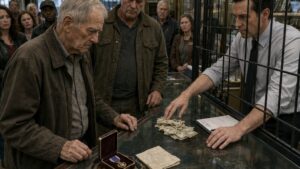
On the counter between him and Tyler Moore lay a folded invitation.
Tyler tapped it with one finger. “This is a photocopy.”
“The original was mailed to my daughter’s house.”
“Your name isn’t on today’s public guest list.”
“I asked for that.”
Tyler looked up. “You asked to be removed?”
“Yes.”
“And you still expect restricted access?”
“I was told I could see the aircraft before the ceremony.”
“By whom?”
George watched a shuttle pass through the inner gate. Gold-lettered signs in its windows identified it as FAMILY TRANSPORT. An elderly woman inside held a framed photograph against her chest.
“The memorial coordinator,” he said.
“Name?”
“I don’t recall.”
Tyler’s expression hardened by a degree. “Sir, you expect me to believe someone invited you onto an active flight line, removed your name from the list, sent you a photocopy, and told you to arrive alone with a credential that expired decades ago?”
George looked at the card in Tyler’s hand. Once, it had opened doors before he reached them. Men had straightened when they saw it clipped to his flight suit. The insignia beneath the laminate had been changed twice, then retired entirely.
Now Tyler held it between two fingers as if it might stain him.
“You can call the wing office,” George said.
“We already have a verification process.”
“Then use it.”
“I am using it.”
The line behind George shifted. A man in a dark blazer checked his watch. Someone whispered that boarding for the hangar would begin in ten minutes.
Tyler placed the old card on the counter. “Step aside while we process the guests with valid documentation.”
George did not move.
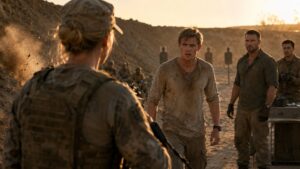
Through the booth’s glass wall, he could see a strip of runway and, beyond it, the upper edge of a gray vertical tail. The aircraft itself remained hidden behind a maintenance shelter, but its auxiliary power unit had begun to turn. The low mechanical whine climbed by degrees, thin at first, then fuller.
His fingers tightened around the cane.
Thirty-two years fell out from beneath the sound.
A voice saying fuel state.
Another asking for confirmation.
A burst of static that George still heard more clearly than many living voices.
Tyler was speaking. “Sir?”
“That unit is running rough.”
Tyler followed his gaze. “What?”
“The auxiliary power unit. Third bearing, most likely. The pitch wanders under load.”
The specialist stared at him.
George regretted the words as soon as they were out. He had not meant to show recognition. He had come before the families, before the speeches, before anyone could place a title in front of his name. Five minutes by the aircraft. That was all he had asked for.
Tyler picked up the invitation again. “You haven’t even seen the aircraft.”
“I don’t need to see it to hear that.”
A radio on Tyler’s shoulder crackled. He turned slightly to answer, one hand resting near his belt. The reply mentioned a recent perimeter breach and reminded the security team that the wing commander expected zero exceptions during the ceremony.
When Tyler faced George again, caution had become suspicion.
“Wait by the wall.”
George stepped aside. The cane clicked once on the tile, louder than it should have been.
A clerk behind the counter made two calls. The first went unanswered. The second transferred her twice. Tyler processed three families while George waited beneath a sign instructing visitors to have current identification ready.
His phone vibrated in his shirt pocket.
Rebecca.
He let it stop.
It rang again.
Tyler glanced toward him. “Answer it.”
George did.
“Dad, where are you?” Rebecca asked without greeting.
“At the visitor center.”
“You’ve been there twenty-five minutes. I told them you were coming.”
“There is a question about the list.”
“I’m turning around.”
“No.”
“Give the phone to whoever is there.”
“No.”
Her silence carried more anger than shouting would have.
“Dad,” she said, “this is exactly why I wanted to stay.”
“I can resolve it.”
“You always say that when you mean you intend to stand there and suffer until someone else feels guilty.”
Tyler looked away, but not far enough to pretend he could not hear.
George lowered his voice. “Please call the memorial office. Ask them to recheck the private-access note.”
“I can tell them who you are in ten seconds.”
“I did not ask you to do that.”
“You never ask.”
He closed his eyes briefly. “Recheck the note, Rebecca.”
The call ended before she answered.
The clerk received another transfer. “Yes, ma’am. Elderly male, George Campbell. No, not on the public list. He says there was a private-access authorization.”
Tyler’s gaze settled on George’s cane. Near the handle, almost erased by years of use, a set of numbers had been burned into the wood.
He pointed. “What does that marking mean?”
“An old unit number.”
“Were you assigned here?”
“Once.”
“In what capacity?”
George said nothing.
Tyler stepped closer. “You see the problem?”
“Yes.”
“You won’t say who authorized you. You won’t explain what you did here. You have a copied invitation and obsolete credentials.”
“The card is genuine.”
“It is not access.”
“I understand the difference.”
“Then why bring it?”
George looked past him toward the flight line.
Because the men who had made the cane had also made the card’s aircraft fly when no parts catalog said it should. Because he had thought an old piece of plastic might be enough to show he belonged without forcing anyone to remember why. Because asking to be recognized felt too close to asking to be forgiven.
He answered only, “It was what I had.”
A maintenance tractor emerged from behind the shelter, towing the restored fighter at walking speed. Its gray nose came into view first, then the dark mouth of the intake, then the canopy shining above a fuselage polished for ceremony.
George’s breath stopped.
The aircraft wore its old tail markings. Beneath the paint, he could still see differences no restoration team could erase: a slightly uneven panel line, a row of fasteners placed closer together than regulation allowed, the intake skin shaped by hands working through a desert night.
The tractor turned toward the memorial hangar.
Too sharply.
George saw the tug’s rear corner moving toward the intake. The driver could not see the clearance. A spotter watched the opposite wing.
He lifted his cane and pointed. “Stop the tug.”
Tyler turned. “Stay behind the line.”
“The intake panel cannot take that contact.”
“What panel?”
“Stop them.”
The tug continued. Four feet. Three.
George stepped toward the door.
Tyler blocked him. “Sir, you are not cleared beyond this point.”
“Then call them.”
“I said step back.”
George looked through the glass. The tug’s metal corner was now level with the intake. The turn tightened.
He pushed the door open.
A red line crossed the pavement beyond it.
Tyler caught his sleeve. “Do not cross that boundary.”
George pulled free, planted the cane beyond the painted line, and stepped after it.
“Move the tug six inches left!” he shouted.
Every head near the aircraft turned.
Behind him, Tyler’s boots struck the pavement at a run.
Chapter 2: The Chain Beneath the Fighter’s Wing
The tug’s rear corner passed close enough to the intake that Tyler expected the scrape before it came.
“Stop!” the old man shouted.
The driver braked.
The tow bar jolted. The fighter rocked once on its landing gear, gray metal flashing beneath the sun.
Tyler seized George’s upper arm and pulled him back from the moving equipment. “Hands where I can see them.”
George did not resist. That should have reduced Tyler’s anger. Instead, the old man’s calm felt deliberate, almost insulting.
“I told you not to cross the boundary.”
“The tug needs to move left.”
“You entered a restricted flight line.”
“The panel behind that intake was never load-bearing after the desert repair. Move the tug six inches left before you crease it.”
Tyler looked toward the aircraft. The intake appeared solid. Fresh paint covered every seam. Nothing marked the section George indicated as weak.
The maintenance chief strode over from the far side of the fighter. “What happened?”
“This individual crossed the line after repeated orders,” Tyler said.
George pointed with his cane. “Your tug is inside the intake clearance.”
The chief’s eyes followed the cane. “We measured it.”
“You measured the factory contour. That panel was replaced in the field. It bows outward under heat.”
The chief frowned. “How would you know that?”
George lowered the cane. “Move the tug.”
Tyler brought George’s wrist behind him.
The old man’s skin felt thin beneath Tyler’s hand, the bones startlingly light. For an instant Tyler hesitated. Then he remembered the briefing after last month’s perimeter breach: unauthorized civilian, false veteran claim, photographs of restricted equipment posted online before security noticed.
One more lapse, his supervisor had said, and Tyler’s recommendation for advanced training would disappear.
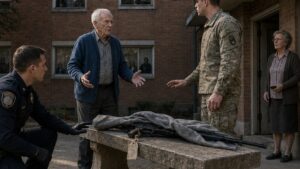
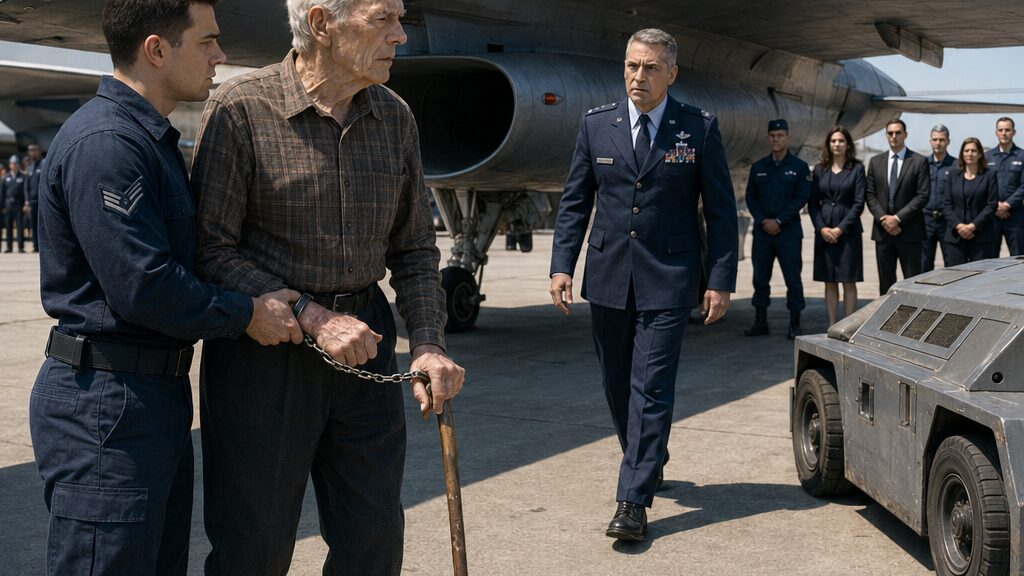
He clipped one end of a short temporary restraint around George’s wrist and the other to the front loop of his own equipment belt. It was not a full arrest restraint. It was meant to control movement until identity and intent could be established.
George’s cane slipped sideways. The chain crossed over the wooden shaft, pinning it against his leg.
“Is that necessary?” the maintenance chief asked.
“He ignored a direct order and entered a controlled area.”
“I was preventing damage,” George said.
“You don’t decide procedure here.”
“No,” George said. “You do.”
The words were quiet. Tyler heard judgment in them anyway.
Early guests had begun gathering outside the memorial hangar. Several stopped to watch. Two airmen near the fighter turned their faces away as if that made them absent.
Tyler keyed his radio. “Security One, I have an unauthorized individual detained at the east flight-line boundary. Elderly male, possible fraudulent credentials, demonstrated detailed knowledge of aircraft configuration.”
The reply asked whether the man was combative.
Tyler looked at George. The old man stood slightly stooped, one hand held close by the restraint, the other trying to free the cane without pulling against the chain.
“Noncombative,” Tyler said.
George used the toe of his worn shoe to steady the cane, then lifted it upright by degrees.
The maintenance chief walked to the intake. He crouched, ran a hand along the lower panel, then called for the tug driver to hold position. Another maintainer brought a clearance gauge.
Tyler watched them confer.
“Six inches left,” the chief finally ordered.
The driver adjusted the tug. The clearance opened.
The chief returned slowly. “He was right.”
Tyler felt the watching faces turn toward him.
George did not smile. He looked only at the aircraft.
“That doesn’t explain why he knows,” Tyler said.
“No,” the chief agreed. “But it explains why we still have an intake.”
Tyler’s radio crackled again. Visitor processing had confirmed no George Campbell on the public list. The private-access note could not yet be located. The memorial coordinator was inside the hangar and not answering.
“You hear that?” Tyler said. “No authorization.”
“The note exists,” George replied.
“Then why did you ask to be taken off the list?”
George’s eyes stayed on the fighter.
Tyler stepped around until he blocked the view. “Why?”
“I did not come to be announced.”
“You came to walk onto an active flight line with an invalid card.”
“I came to see that aircraft.”
“Why?”
George’s jaw moved once. “To leave something.”
The answer sharpened every concern Tyler had. “What?”
“Something that belongs with it.”
“Where is it?”
George did not respond.
Tyler patted the outside of George’s shirt pocket, then stopped when the old man’s expression changed. Not fear. Something colder.
“Do not reach inside my clothing,” George said.
“You are detained.”
“I am aware.”
“Then cooperate.”
“I have.”
“You crossed a security line.”
“To prevent damage.”
“You refuse to identify what you intended to place in restricted equipment.”
“The aircraft is not operational.”
“That is irrelevant.”
“No,” George said. “It is the difference between a security threat and a memorial.”
Tyler leaned closer. “You don’t get to define the difference because you know one old repair.”
The restraint chain tightened as he shifted. It pressed into George’s wrist and dragged against the cane. A fresh pale scrape appeared in the wood.
One of the airmen watching took a step forward, then stopped when Tyler looked at him.
George glanced down at the mark. His face changed more at the scratched cane than it had at the restraint.
Tyler noticed the burned number near the handle.
“Did you carve that yourself?”
“No.”
“Buy it at a surplus store?”
George looked at him then.
Tyler had seen contempt from officers, civilians, and men twice his size. This was not contempt. It was disappointment so controlled that it felt worse.
“The people who made it,” George said, “did not have time for decorations.”
A dark staff vehicle stopped beyond the hangar.
The rear door opened.
A senior officer stepped out in dark-blue service dress, silver stars visible on his shoulders even from a distance. Major General Edward Ramirez had been at the commander’s reception when the security call came over the net. He began walking toward them, fast enough that the aide behind him had to lengthen his stride.
The watching personnel straightened.
Tyler did too.
George did not turn.
General Ramirez’s gaze moved first to the fighter, then to the tug, then to the restraint between Tyler and the old man. His pace slowed.
“Airman Moore,” he called.
“Sir.”
“What is the situation?”
“Unauthorized entry onto the flight line, sir. Suspected false credentials. The individual crossed a marked boundary after repeated orders and stated he intended to place an unidentified object inside the aircraft.”
Ramirez came within several feet. His face was stern, but not in the way Tyler expected. He was looking at George’s profile.
“Has he been searched?”
“Not fully, sir.”
“Has medical evaluated him?”
“No, sir.”
“Has anyone verified the invitation through my office?”
“The public list—”
“My office,” Ramirez repeated.
Tyler felt heat gather beneath his collar. “Not yet, sir.”
George finally turned.
For a moment neither older man spoke.
Ramirez’s expression lost its official stillness. Something passed through it—recognition first, then disbelief, then a pain so private Tyler felt he had stepped into a room without permission.
“George?”
The use of the first name unsettled everyone nearby.
George glanced down at the restraint. “Edward.”
Ramirez moved closer. “What happened to your wrist?”
“It is still attached.”
“That was not my question.”
“He crossed the line, sir,” Tyler said. “He refused to provide complete information, and his credential is decades out of date.”
Ramirez looked at the card in Tyler’s hand.
The faded aircraft silhouette seemed suddenly less like a souvenir.
“Remove the restraint,” Ramirez said.
“Sir, identity verification is still—”
“I have verified him.”
Tyler’s hand went to the release. His fingers did not work cleanly the first time.
The metal opened. George drew his wrist back, rubbing the red band with his thumb. He bent for the cane, but Ramirez reached it first.
The general saw the number burned into the handle.
He stopped.
Tyler watched his eyes travel along the wood to the new chain mark.
Ramirez offered the cane to George with both hands.
Then he said, softly enough that the surrounding silence carried every word, “General Campbell.”
No salute followed. Ramirez’s attention remained on George’s wrist and the slight tremor in the hand accepting the cane.
Tyler knew the surname.
He had known it since childhood, printed in yellowing articles kept in a box under his mother’s bed. Campbell, the commander who had sent most of the formation home. Campbell, who had lived. Campbell, whose official summary had arrived in place of the truth Tyler’s grandmother had asked for.
The shame rising in Tyler did not erase the anger. It struck it and changed its direction.
He looked straight at the old man.
“I know that name,” he said.
Chapter 3: The Commander No One Expected Back
Edward closed the office door and said, “Lieutenant General Campbell, you should have called me.”
George lowered himself into the chair beside the conference table.
“Do not use my title to erase what happened outside.”
Edward remained standing. The dark-blue uniform fit him with the severe precision George remembered from inspection days. The young pilot who had once argued with weather briefers and slept on folded maps had become a wing commander with silver in his hair and two stars on his shoulders.
“I am not trying to erase it.”
“You ordered the restraint removed because you recognized me.”
“Yes.”
“You should have ordered it removed because the immediate threat had passed and a seventy-nine-year-old man was standing still.”
Edward’s mouth tightened. “Both can be true.”
“They were not, until you knew my name.”
A medical technician waited near the desk with gauze and an ice pack. George allowed her to examine the wrist. He did not allow her to fuss over it.
The mark would darken by evening. He had carried worse things unseen.
Edward moved to the window overlooking the hangar. “Moore has been relieved from the post pending review.”
“Pending review is appropriate.”
“I can have him removed from the event.”
“That is your decision.”
“It sounded as though you were about to tell me not to.”
George adjusted the cane between his knees. “Do not mistake my objection to humiliation for an objection to consequence.”
Edward turned. “He restrained you in front of half the wing.”
“He also had an elderly man with invalid access crossing a restricted boundary.”
“He ignored verification.”
“Yes.”
“He called your documents false.”
“Yes.”
“He tightened the restraint after you stopped resisting.”
George looked at the swelling around his wrist. “That is the part requiring examination. Not the fact that the man he restrained once outranked you.”
Edward’s shoulders settled a fraction. “You always did know how to make agreement feel like correction.”
“And you always preferred agreement before facts.”
For the first time, the edge of an old expression crossed Edward’s face. It disappeared when someone knocked.
A civilian woman entered carrying a flat archive box and George’s obsolete access card sealed in a clear evidence sleeve.
“General Ramirez,” she said, then looked at George. “Sir.”
“Emily Clark,” Edward said. “She led the aircraft restoration and assembled the memorial exhibit.”
Emily placed the box on the table. She was in her forties, with rolled sleeves and a pencil tucked behind one ear. Her attention moved immediately to the cane.
“I’ve seen that unit number in the maintenance logs,” she said.
George rested one palm over it.
Edward noticed. “The crew chiefs made it for him.”
“After the mission?” Emily asked.
“Later,” George said.
The word closed the subject.
Emily laid the access card beside the archive box. “Visitor processing found the authorization. It was filed under private aircraft access rather than guest entry.”
Edward exhaled sharply. “So this entire thing—”
“Was avoidable,” George said. “By several people.”
Emily opened a folder. “Your name was originally at the top of the ceremony program.”
“I requested its removal.”
“I know. We thought the request came from your office.”
“I have no office.”
“You still have people who answer when you call.”
“That is not the same thing.”
Edward crossed his arms. “You were the intended guest of honor.”
“The aircraft is not mine.”
“The mission was under your command.”
“The dead were not.”
Silence settled over the table.
Emily looked at Edward before continuing. “The memorial wording has already been printed. It credits General Campbell’s decision with saving the wing.”
George’s hand tightened around the cane.
“Remove it.”
“The ceremony begins in a few hours.”
“Then you have a few hours.”
Edward said, “George, the formation did come home because of your order.”
“Most of it.”
“That distinction is in the memorial.”
“Not strongly enough.”
Edward walked to the table. “Why did you come if you intended to refuse every public acknowledgment?”
George reached into his shirt pocket before anyone could stop him. He removed a small cloth packet, folded twice and secured by a thin cord.
The medical technician looked up.
He placed it beside the card.
“I asked for five minutes before the families arrived,” he said. “I intended to leave this in the cockpit access compartment and go.”
Emily did not touch it. “What is it?”
“Something that was theirs.”
Edward stared at the packet. “You came alone?”
“My daughter drove me to the outer lot.”
“And you sent her away.”
“I told her I could manage.”
Edward gave a humorless breath. “That phrase should be carved over your door.”
The office phone rang. Edward ignored it. A second line lit almost immediately.
Emily opened the archive box and removed a large black-and-white photograph mounted on board. The restored fighter stood in desert camouflage, its nose streaked and one intake panel visibly uneven. A younger George stood in front of it with six aircrew members and four maintainers.
He remembered the instant after the shutter closed. Someone had complained about the heat. Someone else had asked whether photographs counted as maintenance delays. The man at the far right had laughed so hard he bent forward.
Emily placed the photograph near George’s access card.
“We used this to verify the repair you identified,” she said. “The field modification appears in the maintenance record, but the structural note was omitted from the restoration copy.”
George studied the faces without wanting to.
Emily pointed to the man at the far right. “Staff Sergeant Scott Moore. Electronic-warfare officer.”
The room narrowed.
Edward looked toward the closed door. “Tyler Moore?”
Emily nodded. “His grandfather.”
George had not known Tyler’s first name until Edward used it outside. The surname had registered, but Moore was common enough for him to dismiss the thought before it formed.
Now the young man’s anger returned with a different shape. Not simply career fear. Not merely contempt for an old civilian. Recognition waiting for confirmation.
George touched the edge of the photograph.
Scott Moore had possessed an irritating talent for hearing interference before the instruments displayed it. He had also written letters to his wife on paper torn from weather packets because he never remembered stationery.
“He has Scott’s eyes,” George said.
Edward sat opposite him. “Did you know the family was attending?”
“All the families were invited.”
“That is not what I asked.”
George did not answer.
A knock came again. This time a base legal officer entered carrying a tablet.
“Sir, Airman Moore has submitted his initial incident report.”
Edward held out a hand.
The officer gave him the tablet. Edward read, his expression changing line by line.
“What?” Emily asked.
Edward handed the report to George.
The language was formal and defensive. Subject presented obsolete credential. Subject refused complete identification. Subject knowingly crossed controlled boundary. Subject appeared to exploit prior familiarity with base procedures to challenge security authority.
The final paragraph contained a sharper accusation:
Subject’s conduct suggests intentional use of obsolete military association to obtain unauthorized access and provoke preferential treatment.
George read it twice.
“He filed quickly,” Edward said.
“He believes it.”
“Do you?”
George set down the tablet. “I brought a credential I knew was invalid because I hoped its age would persuade someone to ask the right office. I refused to identify my former position. I crossed a boundary.”
“You crossed it to protect the aircraft.”
“That does not make every decision before it wise.”
Edward stared at him. “You are defending his report.”
“No. I am refusing to make mine cleaner than it was.”
Emily slid another folder from the archive box. “There may be a reason he wrote it that way.”
Inside was a copy of the old mission photograph marked for exhibit use. Scott Moore’s name had been underlined in pencil. Beside George’s younger face, someone had written one word in the margin.
Commander.
Edward read it. “His handwriting?”
“We don’t know.”
George did.
The block letters resembled the handwriting on letters he had received for three years after the mission. Questions from Scott’s widow. Requests for details the official report did not contain. Appeals phrased more politely each time, until the last one was not polite at all.
Emily drew a breath. “During restoration, we found references to an audio annex that does not appear in the public after-action file. The index says access requires authorization from the sealing officer.”
Edward looked at George.
George kept his eyes on the photograph.
“The sealing officer was you,” Emily said.
The room seemed to fill with the old auxiliary whine, though the window was closed.
“What is on it?” Edward asked.
George saw Scott Moore bent over his console. He heard another voice asking whether command understood what they were being asked to do. Then static. Then words he had spent thirty-two years refusing to turn into evidence.
Emily placed a single-page index in front of him.
At the bottom waited a blank authorization line.
“We found the recording, General,” she said. “But no one can open it unless you sign.”
Chapter 4: The Mission Report That Proved Too Little
The archive file did not list George Campbell as a witness.
It listed him as the officer who had ordered the final transmission sealed.
Emily read the line twice before turning the folder toward him. The paper had yellowed at the edges, but the signature at the bottom remained sharp. George’s handwriting had once been narrow and decisive, each letter angled forward as if reluctant to waste time.
Now his right hand trembled against the cane.
Edward stood near the closed briefing-room door. “You never told me you sealed it personally.”
“You never asked.”
“I asked you about that mission for twenty years.”
“You asked whether the order was lawful.”
“And you said it was.”
“It was.”
“That is not the same as saying it was right.”
George looked at him. “No.”
The admission quieted the room.
The archive occupied a windowless section below the wing headquarters, where the air smelled of cold paper, dust, and electronics kept alive beyond their intended years. Emily had brought the indexed audio onto an isolated terminal. A red banner warned that access required authorization from the original sealing officer or a designated legal successor.
The cursor waited beside George’s name.
Emily folded her hands to keep from reaching for the keyboard. “Before you sign, I need to explain what we found.”
“You found the annex.”
“We found references to it. The recording itself is segmented. Most of the transmissions were incorporated into the official report. Four minutes and twelve seconds were excluded.”
Edward stepped closer. “On what grounds?”
Emily glanced at George.
“Privacy,” he said.
“Operational sensitivity was the stated reason,” she corrected gently. “But the classification expired eleven years ago. The privacy restriction remained because the crew’s families were never asked for consent.”
George shifted his weight. The cane’s tip clicked once against the floor.
“They were speaking under fire,” he said. “They were not composing history.”
“No,” Emily said. “But history was composed without them.”
The words landed harder than accusation.
She opened the public after-action report. It described a strike formation encountering unexpected surface-to-air activity during a civilian evacuation. It recorded George’s order for the main element to withdraw and noted the loss of one aircraft after a systems failure.
It did not explain why that aircraft remained behind.
Tyler’s family had been left with a sentence about degraded communications and unrecoverable damage. George had been left with the complete transmission and the authority to prevent anyone else from hearing it.
Edward read over Emily’s shoulder. “Play what is already cleared.”
George’s grip tightened.
Emily did not touch the controls. “Only if General Campbell agrees.”
Edward’s impatience surfaced. “We have families gathering upstairs for a memorial built around an incomplete report.”
“And that report has been incomplete for thirty-two years,” George said. “Another five minutes will not kill anyone.”
Edward flinched.
George closed his eyes. “That was careless.”
“No,” Edward said. “It was honest.”
Emily waited.
At last George lowered himself into the chair before the terminal. He placed both hands over the cane handle, covering the burned squadron number.
“Play the cleared portion.”
Emily entered the archive key.
Static filled the room.
Not the soft hiss of an old recording. This static came in hard bursts, clipped by distance and interference. Beneath it sounded engines, warning tones, and voices trained to remain level when nothing around them was.
A controller called headings.
Another voice reported a second missile battery moving toward the evacuation corridor.
Then George heard himself, thirty-two years younger.
“All aircraft able to disengage, turn south and recover.”
His recorded voice carried no hesitation.
The memory did.
Emily watched the waveform. Edward watched George.
A pilot answered with a call sign and acknowledged the order. Two more followed.
Then a fourth voice broke through, strained but controlled.
“We cannot make the turn.”
George’s thumb pressed into the cane.
The recording continued.
The damaged aircraft had lost hydraulic pressure and part of its defensive system. A rescue diversion was suggested from another element. Before George could answer on the recording, Scott Moore’s voice came over the net.
“Negative rescue diversion. Keep them over the corridor.”
Tyler had inherited the same clipped endings to his words.
A second voice asked for confirmation.
Scott answered, “Civilians still moving east. If you pull the cover, they lose the road.”
Edward leaned toward the speaker.
The official report had reduced that exchange to degraded communications.
On the recording, the choice was unmistakable.
The damaged crew knew the formation could not return for them without exposing the evacuation route. They had not simply been left behind. They had understood the cost and refused to make others pay it.
Emily stopped the audio.
No one spoke.
George had imagined this moment for years: someone else hearing the proof, someone else finally understanding that he had not ordered those men to remain. He had believed relief would come with it.
Instead he felt only the old room closing around him.
Edward broke the silence. “They chose.”
“Yes.”
“You let their families believe otherwise.”
“I allowed the report to stand.”
“Why?”
George stared at the blank section of the waveform beyond the cleared audio.
“Because that is not all they said.”
Emily’s voice softened. “The restricted four minutes?”
George nodded.
“What is in it?”
“Fear.”
Edward’s jaw tightened. “They were dying.”
“And anger.”
“At whom?”
George looked at his own old signature on the authorization page.
“At me.”
The air-conditioning unit started with a dull metallic thump.
George remembered every word in the sealed section. The pilot demanding to know why the abort had taken so long. Scott saying command had waited for confirmation while the threat picture worsened. Another crew member asking whether anyone in the operations room understood what delay felt like from inside a failing aircraft.
They had still chosen to remain.
They had also blamed him for the minutes that had narrowed their choices.
Both truths had existed in the same transmission.
Emily drew the public report closer. “If the full recording contains criticism of command, that makes the omission more serious.”
“It makes its release more complicated,” Edward said.
She turned on him. “Complicated for whom?”
“For the families. For the wing. For anyone who thinks a memorial is the proper place to broadcast frightened men’s final private words.”
George looked at Edward. “That was my reasoning.”
“And now?”
“Now I hear how convenient it was.”
Emily sat back.
George continued, “I told myself I was protecting them from becoming a recording played at ceremonies. I told myself their wives and children should remember steadier voices. I told myself no one needed to hear men at the edge of death arguing with the person who sent them there.”
“You did not send them there alone,” Edward said.
“I delayed the abort.”
“The threat picture was uncertain.”
“It was my uncertainty.”
Edward looked away.
Emily pulled up the mission timeline. “How long?”
George knew without reading.
“Three minutes and forty-six seconds between the first recommendation and my order.”
“That does not sound long,” she said.
“It is long enough at five hundred knots.”
The briefing-room door opened.
Tyler stood there with a folded sheet in his hand. He had removed his security belt, but the stiffness remained in his posture. A supervisor waited behind him and did not enter.
Edward’s face hardened. “You were told to remain available for interview.”
“I was. This is relevant to the interview.”
He crossed the room and set the paper on the table.
It was a photocopy of a letter, the creases and stains preserved in gray. At the top was George’s name. At the bottom was the signature of Scott Moore’s widow.
Tyler looked at the waveform on the screen, then at George.
“My grandmother wrote you after the funeral,” he said. “You answered that when the review was complete, she would receive a full account.”
George did not touch the letter.
Tyler flattened it beside the cane.
“She waited three years,” he said. “Then you sent her six paragraphs from the same report everyone else got.”
Edward started to speak, but George raised one hand.
Tyler’s voice remained controlled, which made the accusation more severe.
“You knew they chose to stay. You knew they were angry. You knew what my family believed.”
“Yes.”
“And you promised them the truth.”
George looked at the words he had written thirty-two years earlier.
When the legal and operational reviews are complete, I will ensure you receive the fullest account I am permitted to provide.
At the time, he had considered every word honest.
Now it looked like what it had become: an escape route written in formal language.
Tyler tapped the letter once.
“Did a general’s promise expire,” he asked, “because nobody could make him keep it?”
Chapter 5: What George’s Silence Cost the Living
Tyler placed the old letter beside George’s cane and left his hand there.
“Does a general’s promise expire when no one can force him to keep it?”
Rebecca heard the question from the chapel doorway.
She had arrived expecting to find her father injured, angry, or surrounded by people apologizing too loudly. Instead she found him seated beneath a plain wooden cross in a side room, his restrained wrist darkening beneath the cuff of his plaid shirt. Tyler stood across from him. Edward and Emily remained near the wall, careful now not to occupy the center of something they had helped create.
George read the letter without lifting it.
“No,” he said.
Tyler’s hand withdrew.
Rebecca stepped into the room. “Then why did you act as though it did?”
Her father looked toward her, and the small change in his face made her angrier than resistance would have.
“You came back,” he said.
“You stopped answering.”
“I was occupied.”
“You were detained.”
“That has been resolved.”
“No. The metal is off your wrist. That is not the same thing.”
She set her bag on a chair and knelt beside him before he could object. The mark was already swelling. She had spent years as a military nurse learning how men underreported pain when they believed endurance was a form of leadership.
“Can you move your fingers?”
“Yes.”
“Show me.”
He did.
She touched two fingertips to the pulse beneath the bruise. Strong enough. Uneven only because he was watching Tyler.
Rebecca stood. “You should have let me come with you.”
“I wanted privacy.”
“You wanted no witnesses.”
George’s gaze sharpened. “That is unfair.”
“So was telling me you needed a ride and then making me leave at the outer lot.”
Tyler looked away, suddenly uncomfortable with a conflict no uniform could organize.
Rebecca took the copied letter from the table. “Did you write this?”
“Yes.”
“Did you keep the promise?”
“No.”
The direct answer stopped her.
George had spent much of her life giving truthful answers shaped so tightly that nothing vulnerable escaped with them. She had expected explanation, context, the language of review boards and permissions.
Instead he said only no.
Tyler was not satisfied. “Why?”
George rested both hands on the cane.
Rebecca knew that position. It was how he held himself when standing required effort but he did not want anyone to notice. The cane had not appeared gradually with age, as most people assumed. It had entered their home after the first memorial for the lost crew.
He had collapsed behind the chapel that day, one hand pressed to the concrete wall, the other unable to stop shaking. The squadron maintainers had visited him a week later carrying a length of dark wood carved from a damaged wheel chock recovered with equipment from the mission. They had burned the unit number into the handle and said nothing about why.
George had refused it for two months.
Then he had never gone anywhere without it.
“You told us the cane was for your hip,” Rebecca said.
“It is.”
“Now. Not then.”
Edward glanced toward George.
Rebecca faced Tyler. “He started using it after your grandfather’s memorial.”
Tyler’s anger shifted, not softened, but forced to make room.
George said, “That does not answer his question.”
“No,” Rebecca replied. “It answers yours. You keep believing pain counts as accountability if no one sees it.”
He looked down at the cane.
Tyler pulled out the chair opposite him. “Why didn’t you tell my grandmother they stayed by choice?”
“Because the choice was made after my delay had already reduced their options.”
“That was not your decision to hide.”
“No.”
“And the rest of the recording?”
George’s fingers moved over the chain scratch in the wood. “They were afraid. They were angry. They said things about command that were justified and things that were not. I did not want their last minutes turned into an argument about my career.”
“Your career continued.”
“Yes.”
“My grandmother thought her husband had been abandoned.”
“Yes.”
“Did you know that?”
George lifted his eyes. “Yes.”
The word stripped the room of all defenses.
Rebecca had hated the Air Force for years because it seemed to absorb every part of her father and return only the polished surface. Birthdays interrupted by calls. Meals eaten cold. Her mother learning not to ask whether he would be home. After retirement, the institution remained in him as silence.
But this was not something the Air Force alone had done.
George had chosen it.
A memorial coordinator opened the door without knocking. “General Ramirez, we have a problem.”
Edward turned. “Another one?”
“The families are seated. Press access has begun. The printed program still includes the command tribute.”
George’s head came up. “What command tribute?”
The coordinator held out a program.
Edward took it but did not meet George’s eyes.
Rebecca read over his shoulder.
The ceremony described the restored aircraft as a symbol of the wing’s survival. A boxed section credited then-Colonel George Campbell’s decisive order with saving the formation and preserving the evacuation effort.
The lost crew appeared below in smaller type.
George stood too quickly. The chair legs scraped the floor. Rebecca reached for him, but he caught himself on the cane.
“Remove it,” he said.
“We cannot reprint every program,” the coordinator replied. “The ceremony begins in twenty-three minutes.”
“Then do not read it.”
“The announcer’s script matches the program.”
“Change the script.”
Edward said, “George, the order did save the formation.”
“And their decision protected the corridor.”
“That is also included.”
“In six words.”
The coordinator looked between them. “We need a final decision now.”
Tyler picked up the program. His face tightened as he read the tribute.
“My grandfather gets one line,” he said.
George did not answer.
Rebecca reached into her father’s shirt pocket. He caught her wrist before she could remove anything.
“What are you doing?”
“What you would do if you were not busy hiding.”
She held out her hand.
For several seconds, he did not move.
Then he released the cloth packet from his pocket and placed it in her palm.
Rebecca untied the thin cord. Inside lay an old squadron mission patch, its colors faded, one edge blackened. Four initials had been stitched onto the back by hand.
Tyler stared at it.
George said, “It was recovered from the aircraft’s equipment locker before the wreckage was abandoned.”
“You had this?” Tyler asked.
“I intended to place it inside the restored cockpit and leave before anyone arrived.”
“You came here for that?”
“Yes.”
“Not the ceremony?”
“No.”
“Not the tribute?”
“No.”
Tyler’s anger had nowhere simple to go.
Rebecca refolded the patch and returned it to George. “You wanted to honor them privately because private grief asks nothing of you.”
“That is not fair.”
“It is exactly fair. Private grief lets you suffer without answering anyone.”
George gripped the cane until his knuckles paled.
The coordinator checked the clock. “We need to move.”
Emily stepped closer to the table. “The recording can be prepared for limited playback. Only the cleared segment, unless the families consent to more.”
Edward said, “There is no time to obtain meaningful consent from every family.”
“Then we do not play the private portion,” George said.
Tyler’s eyes fixed on him. “And the rest stays buried?”
George looked at the old letter.
Rebecca watched him reach the place where duty usually closed over feeling. She saw the instinct form: postpone, refer, protect, carry.
This time he did not follow it.
“I told myself I was protecting them,” he said. His voice was low, and no one interrupted. “Because that sounded better than saying I was afraid.”
Rebecca’s throat tightened.
George turned to Emily. “Prepare the section establishing their choice. Provide the families with the full transcript under controlled access after the ceremony. No public release until each family has been consulted.”
Emily nodded. “I can do that.”
He faced Edward. “Remove my tribute from the spoken program.”
“The printed copies—”
“Let them remain. People should see how easily an incomplete account becomes official.”
Edward studied him, then folded the announcer’s script in half. “What will replace it?”
“The truth we can tell without stealing the parts that still belong to the dead.”
The coordinator looked alarmed. “Who is going to say it?”
George slipped the mission patch back into his pocket.
For the first time that day, he did not lean away from the answer.
“I am,” he said.
Then he placed his palm on the sealed-audio authorization line and signed his name.
Chapter 6: The Voices Inside the Restored Aircraft
The announcer had reached the words “the decisive leadership of Colonel George Campbell” when George stepped into the aisle.
“Stop.”
The microphone carried the announcer’s startled breath through the memorial hangar.
Hundreds of faces turned.
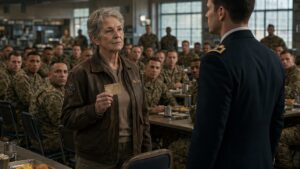
George stood near the rear doors in his faded plaid shirt, one wrist bruised, his wooden cane striking the concrete once as he moved forward. Rebecca walked beside him without touching his arm. Edward followed several paces behind, uniformed and silent.
The restored fighter occupied the center of the hangar beneath white lights. Its gray fuselage reflected the seated families in broken shapes. Beneath the left wing stood a black memorial plaque bearing four names.
George recognized every one before he was close enough to read them.
The announcer stepped away from the lectern.
Edward approached the microphone. “The program has been changed.”
A murmur moved through the rows.
George reached the front. The cane trembled in his hand, whether from effort or memory he could not tell. He looked at the printed tribute laid open on the lectern, then closed it.
“This aircraft did not come home from the mission being remembered today,” he said. “The aircraft before you is its sister airframe, restored in the markings of the one we lost.”
The room quieted.
“I was the commander who issued the withdrawal order. The printed program says that order saved the wing. That is true, but it is not complete.”
A public affairs officer stood near the side curtain, holding a revised script no one intended to use. Emily waited beside an audio console. Tyler stood at the back under supervision, his face unreadable.
George looked at the families.
“I asked for my name to be removed from this ceremony. I believed that was humility. In part, it was avoidance.”
Rebecca lowered her eyes.
George continued. “The official report states that one damaged aircraft was unable to withdraw. It does not state clearly that the crew understood the danger to an evacuation corridor below them. It does not state that they refused a rescue diversion because moving our cover aircraft would have exposed civilians.”
A woman in the second row pressed both hands over the top of her cane. Another family member leaned toward her but did not speak.
George turned to Emily.
She activated the recording.
Static burst through the hangar speakers.
The sound changed the room more completely than any command could have. The restored fighter ceased to be an exhibit. For several seconds it became a machine in flight again, surrounded by warnings and broken radio calls.
George’s younger voice ordered the formation south.
Then came the damaged crew.
“We cannot make the turn.”
A rescue diversion was proposed.
Scott Moore’s voice answered through interference.
“Negative rescue diversion. Keep them over the corridor.”
Tyler took one step forward.
The supervisor beside him did not stop him.
On the recording, another voice asked whether Scott was certain.
“Civilians still moving east,” he replied. “If you pull the cover, they lose the road.”
Emily stopped playback.
The silence afterward contained no ceremony.
Tyler’s mouth had opened slightly. George could see the child he must once have been, listening to family stories built around an empty place at the table.
“He chose?” Tyler said from the back.
The microphone did not catch him, but the room was quiet enough.
George faced him. “Yes.”
“Not an order?”
“No.”
Tyler looked toward the memorial plaque.
George had imagined this truth bringing relief to the Moore family. Instead the young man’s shoulders bent as though a different weight had been placed there.
George understood. Blame was painful, but it was solid. Choice could be harder. Choice meant the dead had acted with a courage their families might admire and still wish they had refused.
“There is more,” George said.
Edward shifted behind him.
George did not look back.
“The recording you heard is not the complete transmission. The remaining portion includes words spoken under extreme pressure. Fear. Anger. Questions directed at command.”
The public affairs officer stepped toward Edward, whispering urgently. Edward raised one hand without turning.
George set the cane against the base of the memorial plaque.
Without it, his body listed slightly to the left. Rebecca moved, but he gave the smallest shake of his head.
He placed both hands on the lectern.
“The crew believed the withdrawal order should have come sooner.”
No one moved.
“They were right to question it.”
Edward’s gaze dropped.
George said, “The first recommendation to abort came three minutes and forty-six seconds before I gave the order. During that time, we were confirming a second threat, the status of the evacuation route, and whether the formation could complete its task. Those were real questions. They do not make the time less real to the people in that aircraft.”
He felt the weakness in his knees and did not hide it by gripping the lectern harder.
“I made the decision with the information available. I believed then that it was defensible. I believe that now. But defensible is not the same as without cost.”
A surviving squadron member in the front row began to cry without sound.
George looked at the closed cloth packet in his palm.
“For thirty-two years, I kept part of the transmission sealed. I told myself I was protecting the crew from having their final fear replayed at ceremonies. I told myself I was protecting their families from words that could not be taken back.”
He untied the cord and removed the faded mission patch.
“What I also protected was my own ability to remain silent.”
He laid the patch on the lectern.
“The families will receive the complete transcript. They will decide what remains private. No recording of frightened men will be used to excuse me, honor me, or simplify them.”
The public affairs officer stopped whispering.
George looked toward Tyler.
“Your grandfather was angry with me.”
Tyler met his eyes.
“He believed I waited too long. In some moments, I believe the same. He also chose to remain because people on the ground had no other protection. One truth does not erase the other.”
Tyler’s face tightened. “Why didn’t you tell us?”
George could have said classification. Legal review. Privacy. Duty.
All were true.
None were enough.
“Because I was ashamed,” he said. “And because silence allowed me to call that shame discipline.”
A sound moved through the room—not applause, not yet. A collective release of breath.
George picked up the patch and stepped toward the fighter. The plaque stood beneath the wing, his cane leaning beside it like an unattended tool.
He placed the patch in a narrow display recess beneath the four names.
“This memorial should not say the wing was saved by one commander’s order,” he said. “It should say the wing came home because crews obeyed, questioned, chose, and sacrificed under conditions no printed program can make clean.”
The woman in the second row rose first. Others followed, not in a wave but unevenly, as age and grief permitted.
George did not interpret it as tribute to him.
He stepped back from the plaque and reached for his cane.
Before he could take it, Rebecca lifted it and placed it in his hand. This time he accepted her help without pretending he had meant to do so.
Edward approached the microphone. “The wing will revise the memorial record and open an independent review of the archive restrictions and today’s security incident.”
George turned toward him. “Do not combine them.”
Edward paused.
“The crew’s truth is not a response to what happened to me outside,” George said. “Do not use one wrong to decorate the correction of another.”
Edward nodded once. “Understood.”
At the rear of the hangar, Tyler spoke to his supervisor. The supervisor shook his head.
Tyler said something again.
Then he walked down the aisle.
Every eye followed him now. He stopped several feet from George, removed his cap, and looked at the bruise on George’s wrist.
George waited for an apology.
Tyler did not offer one.
Instead he faced Edward and pointed toward the microphone.
“Sir,” he said, his voice unsteady but clear, “I need to tell them what I did at the flight-line boundary.”
Chapter 7: Respect Before the Name Is Known
Tyler took the microphone and destroyed the last excuse available to him.
“I knew the name Campbell before General Ramirez said it.”
The admission moved through the hangar in a low murmur. Edward’s expression changed first—not surprise, but the hard stillness of a commander hearing an incident become something worse than poor judgment.
George stood beside the memorial plaque, one hand resting on his cane.
Tyler looked toward him only once.
“I had never seen his face,” he continued. “But I recognized the surname on the old credential. My family kept articles about the mission. I told myself the card was probably fake. I told myself I was protecting the flight line.”
His voice tightened.
“Part of me wanted him to be a fraud.”
No one shifted now.
“I wanted to catch an old man pretending to be connected to something he didn’t understand. And when he crossed the boundary, I used more force than the situation required. After he stopped resisting, I tightened the restraint.”
The bruise beneath George’s cuff seemed to darken under the hangar lights.
Tyler swallowed. “I did that before I knew who he was.”
George watched several faces turn toward him, waiting for the old general’s reaction to decide what theirs should be.
He gave them none.
Tyler finished without asking forgiveness. “I will submit to the investigation and accept the result.”
He handed the microphone to Edward and stepped away.
No applause followed. That was right.
The ceremony ended soon afterward, not with the planned music but with the families approaching the plaque in small groups. Some stopped near George. Others passed him without speaking. One older man gripped his shoulder and said only, “You should have told us.”
George answered, “Yes.”
A woman whose brother’s name appeared on the plaque stood before him for nearly a minute. When she finally spoke, her voice was tired rather than angry.
“I don’t know whether hearing the recording helps.”
“You do not have to decide today.”
“Did it help you?”
George looked at the fighter above them. “No.”
She nodded, as though that answer at least respected the question.
By late afternoon, the hangar had emptied. The formal review began in a security office overlooking the same painted boundary George had crossed that morning.
Tyler sat at one end of the table without his cap. A base legal officer recorded the discussion. Edward occupied the head chair but left the seat beside him empty.
George remained near the window.
Edward read the preliminary options aloud. Temporary suspension from security duties. Reassignment pending investigation. Formal reprimand if the allegations were substantiated.
“A quiet reassignment would limit further disruption,” Edward said after the recorder was paused.
George turned from the glass. “Disruption to whom?”
“The wing.”
“The wing has already been disrupted.”
“The incident has press exposure now.”
“That is not the same as harm.”
Edward’s jaw tightened. “You think I am trying to bury it.”
“I think you are trying to contain it. You were trained to contain damage.”
“So were you.”
“Yes. That is why I recognize the habit.”
Tyler looked between them.
Edward lowered his voice. “What would you have me do?”
“Conduct the review openly. Separate the legitimate security concern from the humiliation. Determine where procedure ended and personal motive began.”
“And Moore?”
“He should not return to the same authority until he understands what he did with it.”
Tyler sat straighter.
George continued, “But sending him to another gate with a different patch on his shoulder changes nothing.”
The legal officer stopped writing.
Edward asked, “What are you proposing?”
“Retraining. Supervision. A formal consequence in his record if the inquiry supports it. And he should assist in revising access procedures for elderly veterans, families, and visitors with outdated documentation.”
Tyler stared at him. “You want me on that project?”
“I want you where you cannot pretend this was only about one old card.”
Edward studied George. “That could be interpreted as leniency.”
“It is not leniency if he must remain close to the harm instead of escaping it.”
Tyler’s face reddened. “Sir, I’m not asking you to protect my career.”
“I am not protecting it.”
“Then why not recommend discharge?”
“Because consequences should answer conduct, not satisfy an audience.”
The words left George with less certainty than they sounded. Mercy had sometimes been another form of avoidance for him—a way to preserve his image of restraint while leaving difficult judgment to others.
He looked at the bruise on his wrist.
“Your motive makes this more serious,” he told Tyler. “Not less. You used procedure to carry a private grievance. You will answer for that.”
Tyler nodded once.
Edward restarted the recorder.
When the meeting ended, a security supervisor brought George’s cane from the evidence room. Tyler asked to return it himself.
Outside, the sun had lowered behind the hangars. The fighter had been moved back toward the flight line, its shadow stretching across the painted boundary.
Tyler approached carrying the cane horizontally in both hands.
The fresh restraint marks were still visible in the wood, but the gray metal residue had been cleaned away.
“I removed the transfer,” Tyler said. “The chain left some staining.”
George ran his thumb over the scratches.
“I can have the handle refinished.”
“No.”
“They may deepen with use.”
“Then they will deepen.”
Tyler released the cane.
An elderly visitor stood near the processing gate, arguing quietly with a clerk. His hearing aids were not working well, and he kept answering questions the clerk had not asked. A line formed behind him.
Tyler glanced toward the supervisor, received a nod, and walked over.
George watched from a distance.
The old visitor held out a damaged identification card. Tyler did not take it away or raise it toward the light. He moved around the counter, stood where the man could see his face, and repeated the question slowly.
When the visitor apologized for delaying everyone, Tyler said, “You don’t need to apologize for taking the time to understand.”
He called the proper office and waited through two transfers.
No one watching knew why that mattered.
That was why it mattered.
Rebecca came through the gate carrying George’s jacket. She held it open, but he did not put it on.
“You ready?” she asked.
“In a moment.”
Tyler returned to the boundary. He stopped on the flight-line side of the painted stripe. George stood on the visitor side. That morning, metal had connected them across it. Now there was only several feet of concrete.
“General Campbell,” Tyler began.
“George.”
Tyler hesitated. “I don’t think I can call you that.”
“You managed when you thought I was nobody.”
The young man absorbed the line without defense.
“I am sorry,” he said. “Not because of your rank.”
George waited.
“I’m sorry because I decided an old man without valid papers could be handled in a way I would never have handled someone important.”
The fighter’s cooling metal ticked behind them.
Tyler looked toward the memorial hangar. “Can you forgive me?”
George could have given him something easier. The young man’s confession had cost him. His grandfather’s voice had been returned to him and complicated everything he had believed. Compassion urged George to close the distance.
Experience warned him against turning forgiveness into another sealed report.
“Not today,” George said.
Tyler lowered his eyes.
“That is not a promise that I never will,” George added. “But forgiveness cannot replace consequence. And it cannot be demanded on the same day the truth arrives.”
Tyler nodded. “Understood.”
George rested the cane beside his shoe. “Your grandfather was a brave man.”
“I know.”
“He was also frightened.”
Tyler’s mouth tightened.
“That does not diminish him,” George said. “Do not let anyone clean him into a symbol.”
“I won’t.”
“And do not clean me into one either.”
For the first time, Tyler almost smiled.
Emily waited inside the archive office with a receipt book and a protective sleeve. George placed the obsolete access card on the desk.
“You are sure?” she asked.
“It belongs here.”
“We can display it with the restoration materials.”
“Display the date it stopped being valid.”
She looked up.
“And the date your procedures failed to recognize it,” he said. “Objects should not be allowed to tell only the flattering half.”
Emily wrote the accession note by hand.
George kept the cane.
At the outer lot, Rebecca reached for his elbow. He nearly said he could manage. The words rose through habit, polished and immediate.
He let them pass.
Her hand settled beneath his arm.
They walked toward the car together.
Behind them, the gray fighter caught the last light along its repaired intake. From a distance, the uneven panel could not be seen. Neither could the names beneath its wing, the sealed years, the chain marks on the cane, or the bruise under George’s sleeve.
Institutions were good at preserving shapes.
People had to preserve the truth inside them.
Rebecca opened the passenger door. George looked back once, not at the aircraft, but at the gate where Tyler stood helping the elderly visitor through.
Then he handed his daughter the cane while he lowered himself into the seat.
It was the first time all day he had allowed someone else to carry it.
The story has ended.