The HOA Contractor Crossed His Mailbox Line and Found a Lawsuit Waiting
Chapter 1: The Sticker Placed Across the Painted Bird
“Kill the grill.”
Patrick Moore said it before the gate of his truck had stopped rattling shut.
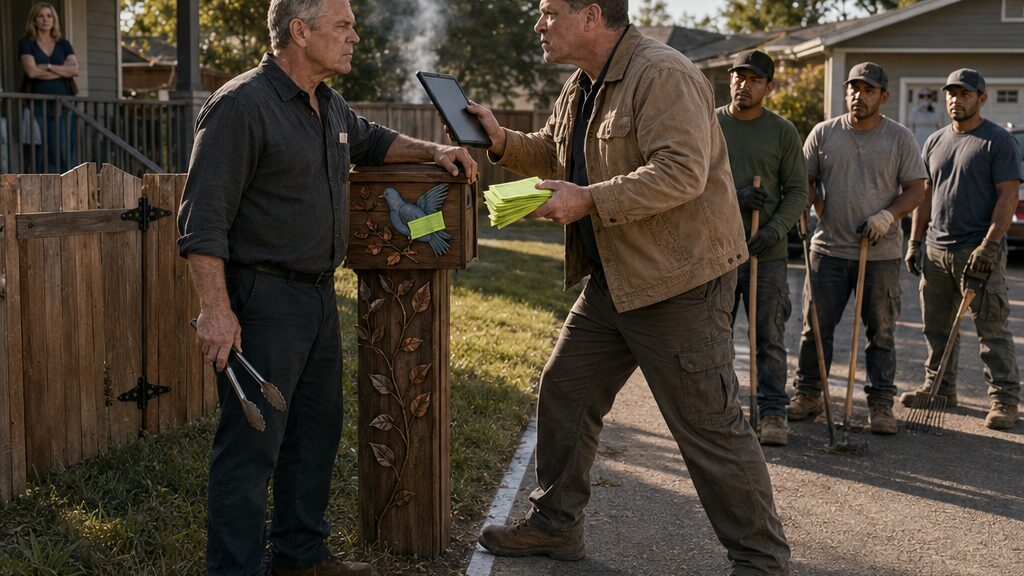
He strode past James Clark’s mailbox with an iPad held upright in one hand, its camera pointed toward the driveway. Three workers followed him carrying tool bags, a ladder, and a plastic case long enough to hold a hedge trimmer. The fourth man remained beside the truck, peeling fluorescent orange stickers from a thick pad.
James stood near the corner of his house with barbecue tongs in his hand.
Behind him, smoke rose in a narrow blue ribbon from the covered grill. It drifted above the fence, thinned in the late-afternoon air, and disappeared before reaching the nearest roofline.
Patrick swung the iPad toward it.
“Documenting active noncompliance,” he said.
James lowered the tongs. “You’re standing on my property.”
Patrick kept walking.
His shoes passed the custom mailbox post at the curb—a dark cedar column wrapped with hammered copper leaves. A painted metal bird rested on one side, wings half open, its blue chest faded by years of sun. At the base, a thin white survey mark crossed the concrete edge of the driveway.
Patrick stepped over it without looking down.
“The community board received multiple health complaints,” he said. “Your smoke violates the neighborhood air-quality standard.”
“There is no neighborhood air-quality standard.”
“There is now.”
The workers spread behind Patrick, uncertain whether to remain on the sidewalk or follow him into the driveway. Patrick made the decision for them with a sharp motion of his free hand.
“Go around back. Shut it down and remove whatever’s causing the nuisance.”
No one moved.
James set the tongs on the brick ledge beside him. “Nobody goes around back.”
Patrick smiled at the iPad rather than at James.
“For the record, the resident is obstructing an authorized correction.”
James had spent thirty-four years in municipal records rooms, where people regularly claimed that a sentence became official merely because someone said it in a confident voice. He had learned to distrust adjectives before nouns. Authorized correction. Emergency access. Community standard.
He walked toward the curb slowly enough that the workers could not mistake his movement for a charge.
“The mailbox post marks the surveyed line,” he said. “Survey completed April eighteenth, five years ago. Everything beyond it belongs to me. None of you has permission to enter.”
Patrick turned the iPad so the lens stayed on James’s face. “The board authorized me.”
“The board cannot authorize you to trespass.”
“The board controls exterior compliance.”
“The board controls what the recorded covenants give it authority to control.”
Patrick’s smile tightened.
Across the street, a porch door opened. A man in a sleeveless shirt stepped outside and rested both hands on his railing. Two houses down, someone lifted a phone behind a front window.
The worker carrying the orange stickers approached the mailbox.
James looked at him. “Don’t put anything on that.”
The worker stopped.
Patrick reached across, tore a sticker from the pad himself, and slapped it over the painted bird.
The paper covered one wing and most of the blue chest.
“Violation posted,” Patrick said. “Failure to comply may result in escalating fines, contractor charges, and legal action.”
James stared at the sticker.
The bird had been William’s idea.
His brother had cut the shape from sheet metal on the workbench in James’s garage, complaining that every mailbox on the street looked as if it had been chosen by the same bored accountant. William had painted the bird twice because the first shade of blue looked purple at sunset. He had held it against the cedar while James drilled the mounting holes.
A mailbox ought to tell people somebody lives here, William had said.
Patrick pushed the sticker’s corners down with his thumb.
The adhesive made a faint tearing sound against the old paint.
James’s throat tightened.
He looked at the workers one at a time.
“You,” he said to the man with the ladder. “You do not have permission to enter.”
The man shifted the ladder against his shoulder.
James pointed to the one with the tool case. “Neither do you.”
Then the man with the sticker pad.
“And neither do you.”
Patrick let out a short laugh. “You think saying it three times changes the board’s authority?”
“No. It changes what each of them can claim later.”
That silenced the workers.
Patrick lowered the iPad by an inch. For the first time, he looked directly at James.
“You’ve been warned for months. Your mailbox is out of character. Your fence stain is nonstandard. Your grill smoke has generated complaints. Every time we contact you, you send some fifteen-page response instead of fixing the problem.”
“I send the pages that apply.”
“You bury people in paperwork.”
“I answer paperwork with paperwork.”
Patrick swung the iPad toward the street.
“Ask your neighbors whether they enjoy breathing this every weekend.”
He pointed toward Sandra Lewis’s house.
Sandra stood behind the screen of her porch door, one hand resting against the frame. She did not step outside.
Patrick took her silence as permission.
“People with breathing issues live right there,” he said. “People who have asked the board to intervene.”
James looked at Sandra. She glanced down.
That hurt more than he expected.
Months earlier, she had stopped beside his driveway while he was cleaning the grill and mentioned that smoke sometimes settled low when the wind came from the west. She had not called it a complaint. She had not asked him to stop cooking. She had accepted a plate ten minutes later.
Patrick turned back to the workers.
“You heard me. Rear yard.”
The man with the tool case stepped off the curb.
James moved until he stood beside the mailbox, one hand resting on the cedar post. It was warm from the sun. Beneath his palm, the grain held a shallow groove William had sanded but never fully removed.
“This is your final warning,” James said.
Patrick lifted the iPad again. “Is that a threat?”
“It is notice.”
“Of what?”
“That you crossed private property after being told exactly where it began.”
Patrick looked down at the white survey mark.
Then, deliberately, he moved his right shoe another six inches into the driveway.
“There,” he said. “Now it’s documented.”
James’s gaze stayed on him.
Patrick seemed disappointed by the lack of reaction.
He turned toward the sticker and caught one corner with a fingernail, as though testing whether it had bonded. When he pulled, the sticker lifted for half an inch.
A blue fleck came away with it.
Small enough to fit beneath a fingernail.
Large enough to expose bare metal on the bird’s chest.
James felt something inside him shift.
For months, he had responded to notices at his desk, each sheet dated, copied, and filed. He had measured damage in photographs and repair estimates. He had told himself that patience was not surrender.
But William’s blue paint clung to Patrick’s orange sticker.
Patrick pressed it back down.
“Once my crew removes the source, you can appeal the charge,” he said.
James took his hand off the post.
“You are not touching the grill.”
Patrick called over his shoulder, “Bring the cutting tools around the side gate.”
This time, the worker with the long plastic case started walking.
Chapter 2: The Complaint Written in Sandra’s Name
The worker opened the plastic case beside James’s side path and lifted out a battery-powered cutting tool.
James stepped into the narrow space between the man and the wooden gate.
The worker froze with the tool hanging at his thigh.
Patrick came up behind him, still recording.
“Move away from my employee.”
James did not look at Patrick. He kept his attention on the worker.
“What did he tell you to cut?”
The man glanced back.
Patrick answered for him. “Any obstruction preventing correction of the violation.”
“The gate is locked.”
“Then unlock it.”
“No.”
Patrick shifted the iPad closer. “Refusal documented.”
James looked past the worker toward Sandra’s porch. She was still behind the screen, but now her phone was in her hand.
“Patrick,” James said, “show me the complaint.”
“You’ve received notices.”
“Show me the complaint that claims an emergency health issue.”
Patrick’s expression changed by a fraction. “Resident information is confidential.”
“You announced where the resident lives.”
“I indicated the affected area.”
“You pointed at Sandra’s house.”
Sandra opened her screen door.
“Did you use my name?” she called.
Patrick turned, and for the first time his recording device moved away from James.
“We protect complainant confidentiality.”
“That isn’t what I asked.”
Sandra crossed her lawn slowly. She wore garden gloves and carried her phone at chest height. She looked uncomfortable before she even reached the sidewalk, as though she had stepped into an argument she had spent months avoiding.
Patrick adjusted his voice into something more official.
“Mrs. Lewis, this process exists to protect residents from retaliation.”
“My name is Sandra.”
“Of course. I’m only saying you shouldn’t feel pressured to discuss a confidential report in front of the subject.”
James felt the phrase land between them.
The subject.
Sandra looked at him, then at the sticker covering the bird.
“I never filed a report,” she said.
Patrick held the iPad still. “You communicated concern about recurring smoke.”
“I told Thomas one afternoon that the wind carried smoke low between the houses. We were talking about roof approvals.”
“That concern was forwarded for action.”
“I didn’t ask for action.”
Patrick opened the leather portfolio tucked beneath his arm. From it he pulled a printed page and held it where Sandra could see the top half but not take it.
“Documented resident impact. Address confirmed.”
Sandra stepped closer.
James saw her expression change.
“That’s my address.”
Patrick lowered the page.
“Then the record is accurate.”
“No.” She removed one garden glove with her teeth and held out her hand. “Let me see it.”
Patrick hesitated.
The worker with the cutting tool lowered it all the way to the grass.
“Let her read it,” James said.
Patrick handed Sandra the page.
She scanned it once, then again more slowly.
“This says persistent respiratory discomfort,” she said. “I never said that.”
“It summarizes the effect.”
“What effect? I don’t have respiratory problems.”
“It is a board-generated summary of communications received.”
“There’s no signature.”
“Complaints do not require signatures.”
“There’s no date.”
“The date is in the system.”
“There isn’t even a quotation from me.”
Patrick took the page back. “Informal comments can still establish a pattern.”
Sandra’s face reddened, partly with anger and partly, James thought, with embarrassment.
“I ate food from that grill.”
Patrick shut the portfolio.
“That doesn’t mean the smoke isn’t a nuisance.”
“It means you don’t get to say I complained when I didn’t.”
Across the street, the man on the porch lifted his phone higher.
Patrick noticed.
His posture straightened, and his voice sharpened.
“This is exactly why complaints remain confidential. People become afraid to stand by their own concerns.”
Sandra looked at him for several seconds. “Don’t use my fear of the board as proof that you’re telling the truth.”
James turned toward her.
She did not look back, but the words had been meant for him too.
Patrick’s phone began ringing inside his jacket. He checked the screen and stepped away from the group.
“Thomas,” he said as he answered.
James could hear only Patrick’s side at first.
“Yes. We’re on site.”
A pause.
“No, he’s refusing access.”
Another pause.
Patrick looked toward Sandra.
“She’s confused about the complaint language.”
Sandra folded her arms.
Patrick lowered his voice, but not enough.
“The crew is ready. I need you to confirm correction authority.”
He listened. His jaw tightened.
Then he tapped the screen and switched the call to speaker.
Thomas Baker’s voice emerged thin and metallic.
“Patrick, complete the correction that was assigned.”
Patrick looked at James with renewed satisfaction.
“You heard him.”
James looked at the phone. “Thomas, are you authorizing entry onto my private property without my consent?”
Silence followed.
Patrick frowned at the screen.
Thomas answered carefully. “The board has authorized enforcement of exterior violations.”
“That was not my question.”
“The board expects residents to cooperate with contracted personnel.”
“Do you have a warrant?”
“This is not a criminal matter.”
“An easement?”
“The association has inspection rights.”
“Do those rights include forced entry through a locked side gate?”
Another pause.
Patrick interrupted. “He’s obstructing the crew and escalating.”
Thomas’s voice hardened. “Complete the correction. Avoid unnecessary confrontation.”
The call ended.
For a moment, no one spoke.
Patrick pocketed the phone as if the missing answers had not mattered.
“You all heard the board president.”
“I heard him avoid the question,” James said.
Patrick turned to the worker. “Proceed.”
The man looked at the cutting tool, then at the gate.
“Mr. Moore,” he said quietly, “are we actually cutting the lock?”
“You are removing an obstruction.”
“It’s a residential gate.”
“It’s an unapproved exterior barrier interfering with authorized access.”
James almost laughed, but there was nothing funny in the worker’s face. The man looked young enough to have taken the job because it came with steady hours and health coverage. He had not expected to be asked to cut through a homeowner’s locked gate in front of half the street.
James stepped slightly aside—not enough to clear the path, only enough to place himself fully within Patrick’s recording frame.
“Listen carefully,” he said. “I am the owner. I do not consent to entry. I do not consent to damage. I do not consent to removal of the gate, the grill, or anything else on this property.”
Patrick gave an impatient sigh. “You’re repeating yourself.”
“I am making sure the record is clean.”
Sandra had moved closer to the mailbox. She touched the edge of the orange sticker but did not pull it.
“There are scratches under this,” she said.
James looked over.
Below the sticker’s lower corner, two parallel marks cut through the blue paint and into the metal. They were older, dull at the edges, and partly hidden by the bird’s wing.
Sandra bent nearer.
“That wasn’t done today.”
“No,” James said.
“When did it happen?”
He did not answer.
Patrick did.
“Prior noncompliant inspections may require contact with exterior structures.”
Sandra straightened. “You mean somebody damaged it before?”
“Normal inspection wear is not damage.”
James felt the old pressure return behind his ribs.
The first time, he had watched through the study monitor while an inspector leaned against the mailbox and dragged a metal clipboard across the bird. James had enlarged the video frame by frame. He had saved it under three file names and requested an estimate from a restoration shop.
He had never gone outside.
At the time, he had told himself the footage was better than an argument.
Sandra looked at him. “Why didn’t you tell anyone?”
Patrick seized the opening.
“Because he would rather build a case than resolve a problem.”
James met his gaze.
There was more truth in the accusation than Patrick understood.
Patrick pointed toward the gate.
“That structure is now part of the violation. Remove it.”
The worker did not lift the cutting tool.
Patrick stepped forward and held out his hand.
“Give it to me.”
Chapter 3: Months of Footage Behind One Locked Door
Patrick wrapped his fingers around the side-gate latch and pulled hard enough to rattle the hinges.
The sound carried James back five months.
He had been sitting in his study then, watching a gray-jacketed inspector approach the mailbox on the camera feed. The man had circled it twice, photographed the copper leaves, and written something on a metal clipboard.
James had remained at his desk.
On the screen, the inspector leaned one shoulder against the cedar post. The bottom edge of the clipboard scraped across the painted bird.
Two silver lines appeared in the blue.
James had half risen from his chair.
Then he had stopped.
The camera was recording. The time stamp was clear. The inspector’s face was visible. James had told himself that opening the door would only create an argument the board might later misrepresent.
He watched the man walk away.
Afterward, he went outside with a ruler, a flashlight, and a camera. He photographed the scratches from twelve angles. He placed a coin beside them for scale. He requested a repair estimate and printed the inspector’s visit log.
He did everything except tell anyone how it felt.
Now Patrick jerked the gate again.
The hinges gave a dry wooden groan.
“Stop touching it,” James said.
Patrick turned the iPad toward him. “Then open it.”
“No.”
James could hear the grill behind the fence. Fat struck hot metal with a soft hiss. The ordinary sound made the scene feel more obscene.
He had known they might come.
Three weeks earlier, an email from Thomas had warned that continued refusal to address “airborne nuisance conditions” could result in contracted correction. The phrase was not in the covenants. James had searched every amendment, meeting packet, resolution, and recorded rule.
Nothing.
He had printed the email anyway.
It joined the binders in his study: notices sorted by date, certified-mail receipts, still images from security footage, survey maps, repair estimates, copies of unanswered requests for legal authority, and the minutes from the meeting where the supposed air-quality standard had never been proposed, discussed, or voted upon.
There was also a folder containing photographs of the mailbox under construction.
James had not opened that folder in months.
The legal documents in his jacket pocket pressed against his ribs when he moved.
Patrick had not noticed the envelope yet.
James preferred it that way.
“Mr. Moore,” the worker beside him said, “I’m not cutting anything unless you show me something in writing.”
Patrick released the latch.
“I showed you the work order.”
“The work order says landscaping correction.”
“The gate blocks access to the landscaping correction.”
“The grill isn’t landscaping.”
Patrick stared at him.
The worker looked away but did not apologize.
Two of the others had drifted back toward the truck. Their tools remained lowered. Patrick’s authority, so impressive when he had arrived with a crew behind him, had begun to look like what it was: a man repeating someone else’s instructions louder than the instructions deserved.
James should have felt relieved.
Instead, he saw the loosened corner of the orange sticker lifting in the breeze.
A fleck of William’s paint remained stuck to the adhesive.
Sandra stood beside the mailbox, still recording.
“You knew this might happen,” she said.
James looked at her.
“The documents,” she continued. “The way you’re speaking. You knew they might try to enter.”
“I knew they had threatened contracted correction.”
“And you didn’t tell anybody?”
“I told the board their authority was disputed.”
“I mean us.”
Patrick gave a short laugh. “He doesn’t need neighbors. He needs an audience.”
James ignored him.
Sandra lowered her phone slightly. “Last month I offered to ask around. Remember?”
He remembered.
She had caught him collecting mail after dark. The newest notice was folded in his hand. She had said several homeowners were tired of Thomas making decisions without votes. She could speak to them, gather statements, ask whether anyone had actually complained.
James had told her not to.
“Statements collected after discussion can be challenged as coordinated,” he said now.
Sandra’s eyes narrowed. “That’s what you said then.”
“It was true.”
“So was the fact that you needed help.”
Patrick stepped between them with the iPad.
“This neighborhood conflict is not my concern. My concern is completion.”
He crouched near the base of the mailbox and reached for the white survey marker embedded beside the driveway.
James moved before he thought.
“Don’t.”
Patrick hooked two fingers beneath the thin painted strip.
“What is this, tape?”
“It marks the surveyed corner.”
“It’s unsightly.”
“It is part of a licensed survey reference.”
Patrick pulled.
The end of the marker lifted from the soil.
James felt his control narrow to a single point.
For months, he had believed the cleanest case would be the strongest case. No shouting. No physical interference. No witnesses whose stories could shift. Only records, dates, images, and the board’s own language.
But the cleanest case had not protected the bird from the clipboard.
It had not stopped Patrick’s sticker.
Now it was not protecting the survey marker.
James stepped closer.
Patrick rose, holding the loosened strip between his fingers.
“Careful,” Patrick said. “You’re getting aggressive on camera.”
James could see himself reflected faintly in the iPad screen: gray at the temples, jaw tight, hands empty at his sides.
He forced his fingers open.
“Put it back.”
Patrick let the strip fall.
It landed crooked across the dirt.
“You can replace it after compliance.”
James looked toward the house.
His study window reflected the street. Behind that glass were the binders, the duplicate drives, the certified receipts, the copy of the filed complaint. On his desk sat the written instruction from his attorney: Do not provoke entry. Preserve all footage. If they enter after clear revocation of consent, confirm by text.
He had followed every instruction.
He had also allowed them to come this far.
The realization did not feel like failure. It felt worse—like accuracy.
Sandra came nearer. “James, what are you waiting for?”
Patrick answered before he could.
“He’s waiting for somebody to touch him so he can claim damages.”
James looked at Patrick.
“No.”
“Then what?”
“For you to make your own choices clearly.”
Something flickered across Patrick’s face.
Not fear. Recognition.
For one second, he understood that the silence around James was not emptiness.
Patrick covered it with contempt.
“You think keeping files makes you dangerous?”
“No.”
James slipped one hand inside his jacket.
Patrick raised the iPad higher.
James removed his phone, not the envelope.
He opened the message thread with his attorney. The last exchange was from that morning.
On site if escalation occurs. Confirm entry only. Do not serve until consent is revoked clearly and captured.
James typed one word.
Entered.
He pressed send.
Patrick turned toward the crew. “Enough delay. We’re going through.”
The response arrived before James could lock the screen.
Serve only after you revoke permission on camera.
He read it twice.
Then he looked at Patrick’s raised iPad, the crooked survey marker, the orange sticker covering William’s bird, and the locked gate behind him.
The evidence was no longer the only thing that needed protection.
Chapter 4: The Authority That Stopped at the Mailbox
The red recording light on Patrick’s iPad flashed inches from James’s face as the worker with the cutting tool placed one boot beyond the painted survey mark.
James raised one hand.
“Stop.”
The worker stopped.
Patrick did not.
He shoved the iPad closer, framing James from the shoulders up.
“For the record, the homeowner is physically obstructing authorized personnel.”
James looked directly into the lens.
“For the record, I am revoking any permission you believe you have to remain on this property. Patrick Moore, your workers, your equipment, and every person acting under your direction must leave now.”
Patrick gave a theatrical sigh.
“You don’t control the common exterior.”
“This is not common property.”
“The board has inspection rights.”
“Show me the clause.”
Patrick shifted his weight.
James continued before he could answer.
“Do you have a warrant?”
“No warrant is required for HOA enforcement.”
“Do you have an easement granting access through that gate?”
“The board authorized correction.”
“Do you have written consent from the owner?”
“You are refusing consent in bad faith.”
“Do you have evidence of an emergency?”
“The smoke complaints establish a health condition.”
“Do you have a covenant provision allowing forced entry to remove a private grill?”
Patrick’s mouth tightened.
Five questions.
No answers.
The worker nearest the gate slowly moved his boot back across the painted line.
Patrick noticed.
“Stay where you are.”
The man looked at him. “He told us to leave.”
“He’s trying to intimidate you with legal language.”
James turned toward the crew.
“I am not threatening anyone. I am telling you that each of you may be named individually if you enter after receiving direct notice.”
One worker set his ladder on the grass near the truck.
Another zipped his tool bag closed.
Patrick swung the iPad toward them. “You’re being paid to finish a job.”
The man with the cutting tool lowered it to the ground. “Not this job.”
Patrick’s expression changed.
Until then, James had seen anger, contempt, and impatience in him. Now there was something more private—a flash of panic that had less to do with property lines than with being watched lose control.
Patrick covered it by stepping closer.
“You think this is some courtroom performance?” he said. “You’ve created months of extra work because you refuse to follow the same standards as everyone else.”
“There is no barbecue-smoke standard.”
“There are nuisance provisions.”
“Not one that gives you entry rights.”
“You hide behind technicalities.”
“Property ownership is not a technicality.”
Patrick thrust the thick neon citation book toward James’s chest.
The edge struck his jacket.
James did not move.
“Take the citation,” Patrick said.
“I do not accept it.”
“It has already been posted.”
“You damaged the mailbox when you posted it.”
“Normal adhesive is not damage.”
“You pulled away paint.”
Patrick pushed the book against him again.
“Take it.”
James looked down at the fluorescent pages.
Each sticker had been preprinted with black boxes for dates, addresses, categories, and escalating charges. The footer contained the landscaping company’s logo, not a county seal, court heading, or municipal department name.
Commercial paper made to look official.
He looked back at Patrick.
“Where were these printed?”
Patrick’s grip tightened. “Irrelevant.”
“Are they issued by the county?”
“No.”
“By a court?”
“This is HOA enforcement.”
“Do they carry any statutory authority?”
“They carry board authority.”
“That was not my question.”
Patrick leaned close enough that James could smell coffee on his breath.
“You have made yourself the neighborhood problem.”
Behind him, Sandra said, “He isn’t the one holding a cutting tool outside somebody else’s gate.”
Patrick turned his head.
“Stay out of this.”
“You used my address to get into it.”
The watching neighbors had moved closer now. No one crossed onto James’s property, but the street no longer felt empty. Phones were raised from two driveways. The man across the road had come down from his porch.
Patrick saw the audience gathering and mistook it for a reason to become louder.
“This community cannot function if one resident decides every rule requires personal approval.”
James rested his hand against the cedar mailbox post.
The wood was solid beneath his palm. He could feel the shallow groove William had failed to sand smooth. The orange sticker trembled in the breeze over the painted bird.
“The community can vote,” James said. “The board can record rules. The association can send lawful notices. What it cannot do is invent authority after the fact and hand it to a contractor.”
Patrick pointed toward the grill smoke rising above the fence.
“You are affecting other people.”
“Then follow the process.”
“We did.”
“No. You created a complaint summary, called it consent, and arrived with tools.”
Patrick’s eyes flicked toward Sandra.
That small movement told James more than another denial would have.
Patrick turned abruptly and grabbed the gate latch.
“Fine,” he said. “I will document the violation myself.”
He pulled.
The gate slammed against its lock.
James stepped between him and the latch.
Patrick raised the iPad almost to James’s nose.
“Touch me and you’re finished.”
James kept both hands visible.
“Let go of my gate.”
“You are interfering with contracted correction.”
“You are trespassing.”
“I’m calling the police.”
“Call them.”
“You’ll be fined for every hour you delay us.”
“Show me the schedule authorizing that charge.”
Patrick’s face flushed.
“You think a stack of records makes you untouchable?”
“No. I think the law applies before you touch the gate, not afterward.”
Patrick shoved the citation book into James’s chest for the third time.
Something in James finally settled.
Not exploded.
Settled.
For months he had believed restraint meant waiting. Standing still. Allowing each new act to become another line in a file.
But restraint could also mean choosing the one act that ended the performance without harming the performer.
James closed one hand around the citation book.
Patrick reacted too late.
James pulled it free.
The pages bent between them.
“What are you doing?” Patrick snapped.
James gripped the book with both hands.
He thought of the clipboard scraping blue paint while he watched from behind glass. He thought of the crooked survey marker at his feet. He thought of Sandra asking what he was waiting for.
Then he tore.
The sound was sharp and dry.
The stack split down the middle.
Orange and yellow pages fluttered between them, catching on Patrick’s jacket, the grass, the curb, and the lower edge of the mailbox.
No one spoke.
Patrick stared at the two broken halves in James’s hands.
James let them fall.
“Your authority ended at my mailbox.”
Chapter 5: The Lawsuit Inside the Sealed Envelope
Patrick reached for his phone so quickly that he nearly dropped the iPad.
“I’m calling the police,” he said. “You destroyed official enforcement materials.”
James looked down at the fluorescent paper scattered across the driveway.
“They are commercially printed stickers.”
“They are HOA property.”
“They belong to your landscaping company.”
Patrick’s thumb stabbed at his screen.
“You just committed destruction of property on video.”
James turned toward Sandra.
“Keep recording.”
She raised her phone higher.
Patrick pointed at her. “You’re participating in this now.”
“I already was,” she said. “You used my address.”
The workers stood near the truck, no longer pretending they might resume the job. One of them picked up half of the torn citation book and studied the footer.
“This came from our print supplier,” he said quietly.
Patrick wheeled on him. “Put that down.”
The worker did.
James reached inside his jacket.
Patrick lifted the iPad again, expecting perhaps a phone or another folded page.
James removed a thick sealed envelope.
Patrick’s expression flickered.
“What is that?”
James stepped to the painted boundary line but did not cross it.
“Patrick Moore, this is a filed civil complaint and notice of an emergency hearing.”
The street seemed to become quieter around the words.
Patrick laughed once.
It was too loud and ended too quickly.
“You can’t serve me yourself.”
“I am not the plaintiff named for service purposes.”
James turned the envelope so Sandra’s camera could capture the stamped case number and the service declaration attached to the front.
“A licensed process server attempted delivery at your business address yesterday. Your registered address was vacant. Under the court-approved alternate service order, delivery may be completed directly with documentation.”
Patrick glanced toward the road as though searching for someone who might contradict James.
No one did.
James continued.
“The complaint names you, your company, Thomas Baker, and the homeowners’ association.”
Patrick’s eyes narrowed. “For what?”
“Trespass. Property damage. Improper interference with use of land. False representation of enforcement authority. Emotional distress. Injunctive relief.”
“Emotional distress?” Patrick said. “Over a mailbox?”
James felt the words strike exactly where Patrick intended.
He kept his face still.
“Over a pattern of surveillance, threats, manufactured complaints, repeated unauthorized entry, and damage.”
Patrick looked at the envelope but did not take it.
“This is a stunt.”
“The complaint was filed three days ago.”
“You knew we were coming.”
“I knew the board had threatened contracted correction.”
“You set this up.”
“I documented your choices.”
Patrick stepped back.
James stepped forward only far enough to hold out the envelope.
“Take it.”
“No.”
Sandra’s camera remained fixed on them.
James said the case number aloud. He stated the court, the filing date, and the scheduled time of the emergency hearing. Then he held the envelope against the front of Patrick’s iPad.
For a moment, the sealed papers covered the glowing recording light.
Lawful process over borrowed spectacle.
Patrick reflexively grabbed the envelope to keep it from falling.
James released it.
Sandra said, “I have the transfer.”
Patrick looked down at what he was holding.
His lips moved as he read the first line through the clear document window.
“Multi-million-dollar damages?” he said.
“Damages sought,” James corrected. “Not awarded.”
Patrick looked up sharply.
James could see the misunderstanding collapse. Patrick had expected either fear or a theatrical bluff. What he held was worse because it was ordinary: stamped pages, dates, claims, exhibits, and a court hearing that would not disappear when the street emptied.
“You’re suing me for doing my job.”
“You made choices after I told you the limits of your job.”
“The board authorized this.”
“That will be part of the hearing.”
Patrick’s phone was still connected. A distant dispatcher’s voice asked whether anyone was injured.
Patrick raised it to his ear.
“No,” he said. “But he destroyed official materials and threatened my crew.”
James looked toward the workers. “Did I threaten any of you?”
The man who had refused to cut the gate answered first.
“No.”
Another shook his head.
Patrick turned away from them.
“He physically obstructed us,” he told the dispatcher.
“On his own property,” Sandra said loudly enough for the phone to capture.
A dark sedan turned onto the street.
It moved too quickly, stopped half over the curb, and Thomas Baker climbed out before the engine had fully settled.
Thomas wore a pale button-down shirt with the sleeves rolled neatly to his forearms. He carried no tools, no tablet, and no visible paperwork. Still, he walked toward the group with the expression of a man arriving to restore order to people who had mishandled it.
“What happened?” he demanded.
Patrick held up the torn citation book and the envelope.
“He attacked the enforcement materials and served me with a lawsuit.”
Thomas’s gaze snapped to James.
“You filed suit?”
“Yes.”
“Without completing the internal dispute process?”
“I completed every recorded step available.”
“You were required to request mediation.”
“I requested it twice.”
Thomas’s confidence faltered for half a second.
Then he looked at the gate, the idle workers, and the scattered stickers.
“This was never supposed to involve forced entry.”
Patrick stared at him.
“You told me to complete the correction.”
“I told you to inspect and address an exterior nuisance.”
“You said the gate could not block enforcement.”
“I did not authorize damage to private property.”
The workers shifted uneasily.
James watched Patrick absorb the betrayal.
It did not make him innocent. But it changed him from a man protected by authority into a man suddenly being offered to authority as a shield.
“You put it on speaker,” Sandra said to Thomas. “We heard you.”
Thomas turned toward her. “I said to avoid unnecessary confrontation.”
“You also said to complete the correction.”
“That does not mean trespass.”
Patrick lifted the envelope.
“The complaint names you too.”
Thomas went still.
The dispatcher’s voice sounded again from Patrick’s phone, asking whether officers were still needed.
Patrick ended the call without answering.
James looked at Thomas.
“The exhibits include board emails, inspection summaries, prior damage footage, survey records, and the notices threatening contractor entry.”
Thomas’s face lost color.
“You obtained board communications improperly.”
“They were attached to notices, included in responses, or produced after my records request.”
Patrick looked between them.
“So you knew,” he said to Thomas. “You knew he was building this.”
Thomas ignored him.
“This can still be resolved,” he told James. “There is no reason to turn a neighborhood disagreement into public litigation.”
James looked at the orange fragments clinging to the grass beneath William’s bird.
“It became more than a disagreement when you turned casual remarks into enforcement evidence.”
Sandra had crouched near Patrick’s open portfolio.
Three loose pages had slid onto the pavement when he accepted the envelope. She picked one up, then another.
Her face changed as she read.
“These are all mine,” she said.
Thomas looked at her. “What are?”
“My address.”
She held up the first page.
“Smoke exposure affecting outdoor enjoyment.”
The second.
“Recurring respiratory concern.”
Then the third.
“Request for immediate corrective action.”
Sandra’s hand began to shake.
“I never submitted any of these.”
Chapter 6: What the Board Called Community Consent
“The board never authorized anyone to enter James Clark’s property.”
Thomas opened the emergency meeting with the sentence before everyone had taken a seat.
The HOA room was too small for the number of people inside. Folding chairs filled the central aisle. Homeowners stood along the back wall and near the coffee station. Patrick sat at one end of the long table with the sealed complaint in front of him. James sat opposite, beside Sandra.
Thomas remained standing.
“The association’s position,” he continued, “is that the contractor exceeded the scope of a limited exterior-inspection assignment.”
Patrick leaned forward.
“That is not what you told me.”
Thomas did not look at him. “You were instructed to document a nuisance and seek voluntary compliance.”
“You told me to complete the correction.”
“The meaning was obvious.”
“It was obvious yesterday too, when you put it on speaker.”
A murmur moved through the room.
Thomas struck the table lightly with his palm.
“This is not a trial.”
“No,” James said. “That is next week.”
The room quieted.
Thomas turned toward him.
“You arrived at the confrontation carrying service papers. That suggests you were not seeking resolution.”
James looked at the clean folders arranged before Thomas. Each had a printed agenda, although no formal notice had gone out until after the lawsuit was served.
“I sought resolution for five months,” James said. “You answered with escalating notices.”
“You rejected every proposed correction.”
“I asked for the rule.”
“The nuisance language is broad.”
“Broad is not the same as invisible.”
Thomas took a breath through his nose.
“We are not here to debate drafting language. We are here to establish what happened and prevent further damage to the community.”
Sandra slid three complaint summaries onto the table.
“Then start with these.”
Thomas looked down.
“My address appears on all three. I did not write them. I did not approve them. I did not ask for enforcement.”
“Those are staff summaries of resident communications.”
“They say ‘resident complaint.’”
“That is an administrative category.”
“They say I requested immediate corrective action.”
Thomas’s gaze moved toward the homeowners standing at the rear.
“Concerns are often expressed informally. Staff must convert them into usable records.”
“By changing what people said?”
“By summarizing.”
Sandra tapped the page marked respiratory concern.
“I never said I had trouble breathing.”
“You mentioned smoke.”
“While asking whether my roof color would be approved.”
Thomas looked toward James as though this proved something.
“The smoke was discussed.”
“So was my roof,” Sandra said. “Did you open a complaint against the sky?”
A few people laughed.
Thomas’s jaw tightened.
Patrick pulled out his phone.
“I have messages.”
Thomas turned sharply. “This meeting is confidential.”
“So was my contract until you decided I acted alone.”
Patrick scrolled, found the thread, and placed the phone on the table.
He read aloud.
“‘Visible compliance is essential before the annual meeting.’ Your message.”
Thomas said nothing.
Patrick continued.
“‘If Clark refuses access, document obstruction and proceed with the exterior correction where possible.’”
“That does not authorize forced entry.”
Patrick swiped again.
“Here. ‘Do not let the decorative post become an artificial stopping point. Go past it if necessary to assess the full condition.’”
The room changed.
Every face turned toward the photographs James had placed on the table—the cedar post, the painted bird, the white survey line at its base.
Thomas stared at Patrick.
“You omitted context.”
“You omitted me from your version of yesterday.”
James watched the two men face each other across the table.
Patrick’s choices remained his own. He had seen the marker. He had heard the warnings. He had grabbed the gate and ordered tools forward.
But Thomas had understood exactly what the mailbox marked.
He had simply chosen language slippery enough to travel in two directions.
A homeowner near the back raised a hand.
“My address appears on one of these summaries too.”
Another voice followed.
“So does mine.”
Thomas looked toward them. “Please submit corrections in writing.”
“We did not submit the complaints in writing,” one of them said.
The quiet that followed was heavier than shouting.
Sandra glanced at James.
“You could have shown us these notices months ago.”
He knew she was right.
Thomas seized on it.
“Exactly. Mr. Clark withheld information, declined neighbor outreach, and waited for a confrontation while carrying prepared litigation. He permitted a misunderstanding to escalate because escalation benefited his case.”
James felt the attention turn toward him.
Patrick sat back, watching.
James could have answered with dates. He could have opened the first binder and recited unanswered requests, delivery confirmations, and meeting references.
Instead, he looked at the photograph on top of his folder.
William stood beside the unfinished mailbox in James’s driveway, one hand resting on the cedar post. Paint marked his fingers. The bird was still bare metal.
James slid the picture into the center of the table.
“My brother built that with me.”
No one spoke.
“William drew the bird on the back of a grocery receipt. He cut it in my garage, painted it twice, and made me redrill the mounting holes because the first set left one wing lower than the other.”
Sandra looked down at the photograph.
“He died nine months later,” James said.
Thomas shifted in his chair.
James continued before he could lose the nerve.
“The first inspector scratched the paint with a clipboard. I watched it happen on a monitor from inside my study.”
Patrick looked toward him.
“I did not go outside,” James said. “I told myself the recording was better evidence than an argument. I photographed the damage. I requested estimates. I filed the right response.”
His fingers rested near the photograph but did not touch it.
“I did everything except stop him.”
The room remained still.
“When Sandra offered to ask whether anyone had actually complained, I told her not to. I said witness statements would be cleaner if people were not discussing the case. That was partly true.”
He looked at her.
“The other part was that I did not want anyone to know how much that mailbox mattered. I thought if the board knew, they would use it. And I thought if my neighbors knew, I would look foolish for caring that much about a piece of painted metal.”
Sandra’s expression softened, but James did not look away.
“So yes,” he said. “I knew another enforcement visit might happen. I carried filed papers because the threats were in writing. I wanted clear evidence.”
Thomas leaned forward.
“You allowed yesterday to develop.”
“I allowed Patrick to make his choices. That does not excuse mine.”
Patrick’s face changed slightly at that.
James turned toward him.
“I should have stopped waiting sooner.”
For the first time since arriving at the mailbox, Patrick had no quick answer.
Thomas gathered the complaint summaries into a stack.
“The association is prepared to discuss settlement.”
A board member beside him placed a typed proposal on the table and slid it toward James.
The first number was large enough to draw a murmur from those nearest him.
James read past it.
Payment for documented repairs. Partial legal expenses. Withdrawal of the air-quality citations. Confidential resolution.
Then he reached the conditions.
The custom mailbox would be removed within thirty days and replaced with an association-approved model to eliminate “future boundary ambiguity.”
James would dismiss Patrick from the suit.
All parties would refrain from discussing complaint-generation practices, contractor instructions, or the terms of settlement.
Sandra read over his shoulder.
“They want the mailbox gone.”
Thomas folded his hands.
“The post has become a conflict point.”
James looked at the photograph of William, then at the settlement amount, then at the phrase confidential resolution.
The board was offering to pay him for the damage if he agreed to erase the object that proved where
Chapter 7: The Boundary James Chose to Keep
“The board authorized me. Move.”
Patrick’s recorded voice filled the courtroom from a speaker no larger than James’s hand.
On the video screen, the red light of the iPad glowed inches from James’s face. Behind Patrick, one worker stood with a boot beyond the painted survey line. Another held the cutting tool beside the locked gate.
The recording continued.
“Do you have a warrant?”
“No warrant is required for HOA enforcement.”
“Do you have an easement?”
“The board authorized correction.”
“Do you have written consent from the owner?”
“You are refusing consent in bad faith.”
The judge paused the video.
Patrick sat rigidly beside his attorney. Thomas occupied the next table with two board representatives and a folder thick enough to suggest organization where none had existed a week earlier.
James sat beside his attorney, hands resting on the settlement proposal.
The large payment figure remained on the first page.
The removal clause remained on the third.
The judge looked toward Thomas’s table.
“The decorative post mentioned in the contractor messages is the same post shown here?”
Thomas’s attorney answered. “Yes, though the board disputes that the message constituted permission to cross a surveyed boundary.”
Patrick turned toward Thomas but said nothing.
The judge resumed the video.
Thomas’s speakerphone voice entered the courtroom.
“Complete the correction that was assigned.”
Then came James’s question about forced entry.
Then Thomas’s careful refusal to answer it.
The video showed Patrick grabbing the gate latch after James had revoked consent. It showed the workers hesitating. It showed Patrick pressing the citation book against James’s chest.
It also showed James tearing the stack in half.
Patrick’s attorney rose.
“My client maintains that this act demonstrates provocation and planned escalation.”
James’s attorney began to respond, but James touched her sleeve.
She glanced at him, then sat.
James stood.
“I was angry,” he said.
Patrick looked up.
“I had carried the filed papers because I believed they might come. I wanted a clear record. When he pushed the sticker book into me, I tore it.”
The judge studied him. “Do you believe that was necessary to protect your property?”
“No.”
The courtroom remained quiet.
“It stopped the performance,” James continued. “But it was not the only way to stop it.”
Patrick’s attorney seemed surprised by the admission.
The judge asked, “Then what relief are you requesting today?”
James looked down at the proposal.
For a week, the settlement amount had occupied the center of every conversation. It could cover legal fees, repairs, and more. It could punish the board in the language institutions understood best.
It would also require silence.
And the mailbox would disappear.
James slid the proposal away.
“I am rejecting the confidentiality clause and the removal requirement.”
A board representative whispered to Thomas.
James continued.
“I am willing to reduce the immediate monetary demand.”
Thomas looked at him for the first time.
“In exchange,” James said, “the association must withdraw every unsupported citation related to the grill, correct every complaint summary created without resident approval, and notify each affected homeowner in writing.”
The judge listened without interruption.
“No contractor or board representative enters my property without written owner consent, a recorded easement, a court order, or a genuine emergency. The association must adopt the same restriction for every home in the community.”
Thomas leaned toward his attorney.
James placed a hand on the photograph of William beside the unfinished mailbox.
“The post stays.”
His voice did not rise.
“The board must fund an independent review of its complaint and contractor practices. Documented damage and reasonable legal expenses must be paid. Nothing prevents residents from discussing what happened.”
Patrick shifted in his chair.
James looked toward him.
“I am not asking the court to destroy his business.”
Patrick’s expression hardened, as though mercy embarrassed him more than anger would have.
“But he must acknowledge that the board’s instructions did not remove his responsibility to stop when the owner revoked consent.”
The judge turned to Patrick.
“Can you do that?”
Patrick stared at the paused image of himself on the screen.
For several seconds, he seemed to search for the louder man he had been at the mailbox.
Finally, he said, “Yes.”
Thomas’s attorney requested a recess.
The negotiations lasted nearly two hours.
When the parties returned, the revised agreement no longer mentioned removing the mailbox. The complaint corrections would be mailed within ten business days. An independent property-management firm would audit the board’s enforcement records. Entry restrictions would be incorporated into the association’s contractor policy and distributed to homeowners.
Patrick’s written acknowledgment occupied only three sentences.
He read them twice before signing.
Thomas signed last.
Outside the courthouse, several reporters and neighborhood residents waited near the steps. Sandra stood beyond them, holding a paper bag and watching James emerge.
Questions rose immediately.
“How much did the HOA agree to pay?”
“Will the board president resign?”
“Did you plan the confrontation?”
Patrick pushed through the cluster with his sample case tucked under one arm. Someone stepped sideways to photograph him. He backed away, missed the curb, and landed in a muddy strip beside the sidewalk.
The case sprang open.
Fluorescent sample stickers scattered across the wet pavement. Two landed on his trouser leg. Another stuck to his sleeve when he tried to rise.
Laughter broke from the gathered neighbors.
Patrick sat in the mud, stunned.
James did not laugh.
Sandra did not either.
She stepped between two raised phones.
“That’s enough,” she said. “You got the picture.”
Patrick looked at James.
For a moment, neither man spoke.
Then James held out a hand.
Patrick stared at it before standing on his own.
He brushed mud from his jacket and gathered the scattered stickers without assistance.
A week later, James stood beside the mailbox with a small brush and a jar of matched blue paint.
The neon adhesive had taken hours to remove. He had sealed the fresh damage and repaired the peeled patch on the bird’s chest. The older parallel scratches remained visible beneath one wing, protected now by a clear coat.
He could have filled them.
He chose not to.
Behind the house, the grill lid was closed over a low flame. Smoke rose through the vent in a thin, harmless ribbon.
James folded the court order and slipped it into his back pocket. In his other hand, he carried the barbecue tongs.
A car door closed across the street.
Sandra approached the side gate with a covered dish held against her hip. Two other neighbors followed at a distance, carrying drinks and a paper sack.
She stopped outside the gate.
“I brought too much food,” she said.
James looked at the latch.
For months, the gate had seemed safest when locked. The mailbox marked where other people’s authority ended, but somewhere along the way he had treated it as the place where everyone else had to stop too.
He lifted the latch.
The gate opened inward.
Sandra noticed the repaired bird as she passed.
“You left the scratches.”
“Yes.”
“William would approve?”
James looked at the uneven wing his brother had once made him redrill.
“He would tell me I used too much clear coat.”
Sandra smiled and carried the dish toward the patio.
James remained beside the open gate for another moment.
The mailbox stood at the curb, unchanged in shape and altered everywhere else—in the repaired paint, the visible scar, and the meaning of the line beneath it.
Then the grill hissed behind him.
James closed his fingers around the tongs and walked back to the people waiting in his yard.
The story has ended.