He Crossed Jacob’s Painted Boundary Line and Called the Police on the Wrong Neighbor
Chapter 1: The Light That Turned His Windows White
The living room turned white so suddenly that Jacob Carter thought something outside had exploded.
Every shadow vanished. The framed photographs on the far wall became pale rectangles. The television screen reflected a hard square of light bright enough to make him raise one hand across his eyes.
Then came the electrical click from across the street.
Jacob stood still and listened.
Behind the closed door of his workroom, cooling fans produced their usual low, steady hum. The sound was softer than the refrigerator compressor in the kitchen and far below the limit shown on every measurement he had taken during the past two months.
Outside, Robert Garcia shouted, “Now you understand what it’s like.”
Jacob crossed to the front window without stepping directly into the beam. A construction floodlight stood beside the curb, mounted on a yellow metal frame and aimed precisely at his living room. Robert held its power cord in one hand as if he had just unveiled something.
Several houses down, a porch light came on.
Robert lifted his chin toward the window. “Turn off that machine.”
Jacob did not answer. He took his phone from his pocket, opened the camera, and recorded the floodlight, its position, and the extension cable running back toward Robert’s driveway.
Only after that did he enter the workroom.
The equipment occupied a reinforced bench along the interior wall: calibration units, shielded processors, two cooling cabinets, and a vibration-isolated testing platform. Jacob serviced control systems for small manufacturers that could not afford their own technical departments. The work demanded stable temperatures, clean power, and long diagnostic cycles. Shutting the equipment down whenever Robert became irritated would destroy hours of testing.
Jacob placed a sound meter near the front vent.
Thirty-six decibels.
He photographed the reading with the floodlight’s glare visible through the doorway.
Outside, Robert began addressing the street rather than Jacob.
“Nobody should have to live beside an industrial plant.”
Jacob heard a woman murmur something from a porch. Another neighbor closed a window. No one challenged Robert.
That silence had helped him before.
The first complaint had arrived as a folded note under Jacob’s windshield wiper.
KEEP YOUR FACTORY OUT OF OUR NEIGHBORHOOD.
Jacob had saved it in a clear sleeve.
The second had been taped to his mailbox.
WE CAN HEAR IT ALL NIGHT.
He had saved that one too, along with dated readings taken from his porch, sidewalk, and curb. When Robert parked his van outside Jacob’s house for six hours with the engine idling, Jacob had recorded it. When Robert stood beside the property line staring through the living room windows, Jacob had added another camera.
The city representative who answered Jacob’s first complaint had called it friction between neighbors.
“Try speaking to him calmly,” she had said.
Jacob had tried.
Robert had told him calm people were the ones who thought they could get away with anything.
Now Jacob returned to the living room and angled his phone toward the front door.
“Robert,” he called through the glass, “move the light.”
Robert spread his arms. “So you admit it bothers you.”
“It’s directed into my house.”
“And your machine is directed into my life.”
“The readings are within the residential limit.”
“You made those readings.”
“The city can make its own.”
Robert laughed, but there was no humor in it. “You think paperwork makes you untouchable.”
Jacob ended the recording only long enough to save it to the remote folder linked to his security system. Then he began another.
A metallic scraping sounded from Robert’s driveway.
Robert disappeared behind his commercial van and returned pulling a filthy municipal garbage can. One wheel skipped sideways, making the bin lurch. Dark liquid glistened beneath its lid.
He dragged it to the empty curb in front of Jacob’s house.
“Those don’t belong there,” Jacob said.
“It’s a public curb.”
“It isn’t collection day.”
Robert went back for a second can.
The odor reached Jacob before the second bin reached the first. Sour food, wet cardboard, and something spoiled enough to sting the back of his throat seeped through the doorframe.
Robert positioned both cans in the floodlight’s beam.
“They stay until you learn consideration.”
Jacob’s jaw tightened.
He looked past the cans to the small orange mark painted beside the curb. A licensed surveyor had refreshed it three days earlier after Robert twice claimed that Jacob’s side yard extended less than the deed showed. From the street, the mark looked trivial—a short line on concrete, easily ignored.
Jacob knew the coordinates by memory.
The garbage cans remained outside it.
Barely.
Robert stepped closer to Jacob’s walkway. “Come move them.”
Jacob kept the door closed.
“You want me on camera,” he said.
Robert’s expression changed for less than a second. The anger did not disappear, but something calculating moved beneath it.
Then he raised his voice again. “Hear that? He’s filming everybody now.”
Linda Martinez stood near the end of her driveway in a robe, her arms folded. She looked from Robert to the floodlight and then toward Jacob’s window. Her face carried the tired caution of someone who wanted the problem to belong equally to both men.
Jacob knew how the scene looked from there.
Robert was loud, but visible. Jacob was a dark shape behind a white window, surrounded by cameras and machines nobody understood.
That was why Jacob had stopped trying to explain.
He backed away from the glass and opened the security console. Four camera views appeared: driveway, front door, side yard, and curb. Each contained a timestamp. Each uploaded independently.
The floodlight burned across three views.
Robert paced for several more minutes, occasionally shouting toward the house. When Jacob refused to emerge, he unplugged the light but left it facing the windows. The sudden darkness made the room feel stained rather than restored.
One by one, the porch lights along the street went out.
Robert returned across the road.
Jacob remained at the console, reviewing the footage frame by frame.
At 8:47 p.m., Robert glanced toward the front-door camera.
He did not merely notice it. He stared directly into the lens.
Then he placed both hands on the nearest garbage can and dragged it several inches closer to the painted survey line.
He stopped with one wheel touching the orange mark.
Robert looked into the camera once more before walking away.
Chapter 2: Every Complaint Left a Different Mark
By sunrise, black liquid had crawled from beneath the garbage can and formed a narrow stream toward Jacob’s driveway apron.
He photographed it before stepping outside.
The smell had deepened overnight. Flies gathered along the lid seam, lifting in a cloud when Jacob approached. He wore gloves and crouched without touching the bin, recording the wheel resting against the orange survey mark.
Across the street, Robert’s van was gone.
Linda stood at the edge of her lawn holding a coffee mug. “You should call sanitation.”
“I did.”
“What did they say?”
“They’re sending someone.”
She looked at the cans. “Robert shouldn’t have put those there.”
Jacob waited.
“But,” she continued, “this has been going on too long. Both of you need to find some middle ground.”
“There is no middle ground between my doorway and his garbage.”
“You know what I mean.”
“I don’t.”
Linda exhaled and looked down the street, perhaps hoping someone else would appear and relieve her of the conversation.
“The machines bother him.”
“They’re quieter than his air conditioner.”
“He says they vibrate at night.”
“They don’t.”
“You could show him.”
“I offered.”
“And?”
“He said entering my house would make him part of whatever I’m doing.”
Linda frowned. “What exactly are you doing?”
The question was not hostile, but Jacob heard the suspicion beneath it. He had heard versions of it from Robert, from the city clerk, and from the first officer who had visited after the idling-van incident.
“Calibrating control systems,” Jacob said.
“For what?”
“Packaging lines. Water pumps. Small manufacturing equipment.”
“So nothing dangerous?”
Jacob looked at her. “No.”
She appeared embarrassed. “People don’t know because you never tell anyone.”
“They could ask without aiming lights through my windows.”
Three months of incidents filled a folder on Jacob’s workbench. He had arranged them by date: photographs, notes, sound readings, screenshots, and complaint numbers.
The earliest images looked almost meaningless.
Robert’s pickup parked partly across Jacob’s driveway for eleven minutes.
A handwritten note taped to the mailbox.
A pile of branches placed beside Jacob’s curb and removed before collection crews arrived.
A photograph of Robert standing near the side yard at midnight, looking toward the ventilation grille.
Individually, each incident could be explained away. Together, they formed a pattern that only Jacob seemed willing to see.
He had shown the folder to a city employee six weeks earlier.
The employee had turned the pages quickly.
“No damage here,” she had said.
“Not yet.”
“Have you tried mediation?”
“He wants the equipment gone.”
“Would reducing your operating hours help?”
“They’re already lawful.”
She had closed the folder. “Lawful doesn’t always mean neighborly.”
Jacob had carried that sentence home with him.
Now the sanitation truck stopped at the curb, its brakes hissing. A worker stepped down, examined the cans, and checked the identification numbers molded into their sides.
“These are assigned two blocks over,” he said.
“Can you remove them?” Jacob asked.
The worker glanced across the street. Robert’s van had returned and was turning into his driveway.
Before the worker could answer, Robert climbed out.
“They’re staged for pickup,” he called.
“Not at your assigned address,” the worker said.
“I’m clearing a property. Temporary overflow.”
“They’re leaking.”
“I’ll handle it.”
The worker looked at Jacob. “If he’s claiming active commercial use, I can issue a placement notice. I can’t remove them as abandoned.”
“They’re in front of my house.”
“It’s a public curb.”
Robert smiled as though the phrase settled everything.
The worker attached a notice to one lid and told Robert the cans had to be moved before the next scheduled route. It was a small correction, and Robert accepted it too easily.
When the truck left, he turned to Jacob.
“See? Public curb.”
Jacob pointed at the leaking stream. “Clean it.”
“You clean it. It’s on your side.”
The liquid had not yet crossed the driveway seam, but the slope would carry it there before noon.
Linda stepped closer. “Robert, just move them.”
His smile vanished. “You stay out of it.”
She stiffened.
Jacob watched her face change—not into courage, exactly, but into recognition.
After Robert went inside, she spoke more quietly.
“I saw him out here Tuesday.”
Jacob said nothing.
“He had a tape measure.”
“What was he measuring?”
Linda looked toward Jacob’s living room. “From the curb to your windows. I thought he was measuring parking space.”
“The floodlight appeared Thursday.”
She lowered her mug. “Maybe he wanted to make sure it reached.”
It was the first time she had admitted that Robert’s actions might be planned.
Jacob glanced at the nearest camera.
Linda followed his gaze. “Are those recording me?”
“They record the edge of my property and the public approach.”
“That’s why he thinks you’re watching him.”
“They were installed after he started coming over at night.”
“You never said that.”
“You never asked.”
The answer landed harder than he intended. Linda turned away, hurt and defensive.
Jacob nearly apologized, but the habit that had kept him silent for months closed around the words. He went inside instead.
By afternoon, he had submitted another complaint containing the floodlight footage, the sanitation notice, photographs of the leak, and the survey documentation. The upload portal reduced three months of harassment to five attachment boxes and a description limited to one thousand characters.
Jacob filled every character.
At 4:18 p.m., the front-door camera sent a motion alert.
Robert stood behind the open rear door of his commercial van. From that angle, his body was shielded from the street, but the camera captured him through the narrow gap between the van and a utility pole.
He raised his phone and photographed Jacob’s front door.
Then he shifted left and photographed the camera itself.
Robert lowered the phone, stared at the lens, and took one deliberate step backward to see whether the camera followed him.
It did not.
He smiled anyway.
Chapter 3: The Van That Never Unloaded in Daylight
At 2:13 the next morning, Jacob’s bedside phone vibrated against the wooden table.
The alert showed movement across the street.
He opened the live feed and saw Robert carrying a boxed computer monitor from the commercial van toward his garage. Robert held the carton with the label pressed against his chest.
Jacob sat upright.
The street was empty. Robert’s driveway light remained off, forcing him to work in the blue-gray wash of a distant lamp. He returned to the van and emerged with two tool cases, then a compact generator with a rental-company sticker partly scraped from its frame.
Jacob recorded the screen locally even though the cameras were already saving to the remote system.
Robert moved quickly but not carelessly. Each time he crossed the driveway, he looked toward Jacob’s house. When he reached the street edge, he stopped several feet short of the orange survey mark.
That detail held Jacob’s attention.
During the day, Robert treated the boundary as an insult. He stepped near it, covered it with a garbage-can wheel, and challenged Jacob to defend it.
At night, with unmarked boxes in his arms, he respected it perfectly.
Jacob enlarged the image.
One case carried a bright inventory tag. The numbers blurred when he zoomed further. The generator’s damaged sticker might have meant anything. Cleanup contractors hauled abandoned property, auction lots, damaged appliances, and discarded tools. Suspicion was not proof.
He closed the live view but did not sleep.
By seven, the van was empty and the garage door was shut.
Jacob opened a new folder on his computer, typed LATE-NIGHT ACTIVITY, then stopped before saving it. The title made him look like what Robert already claimed he was: a man recording his neighbor’s life, collecting ordinary actions until they seemed sinister.
He renamed it EXTERIOR CAMERA ALERTS.
The distinction felt weak even to him.
At noon, a certified envelope arrived from the city’s neighborhood compliance office.
Jacob signed for it at the door and opened it over the workbench.
Robert had filed a written complaint alleging continuous mechanical disturbance, structural vibration, unauthorized commercial activity, intrusive surveillance, and “intimidating camera placement designed to monitor residents rather than property.”
The complaint requested an inspection.
Jacob read it twice.
Robert had described the equipment as dangerous despite never seeing it. He claimed the cameras had appeared before any disagreement. He stated that Jacob refused all attempts at reasonable conversation.
Each sentence was built around a fragment of truth.
The equipment did run for long periods.
The cameras did capture parts of the public street.
Jacob had stopped answering Robert after the fourth hostile confrontation.
The lies gained strength from what Jacob had left unexplained.
He carried the notice outside and stood beside the survey mark. The garbage cans remained at the curb, although Robert had shifted them just far enough to keep the sanitation deadline arguable.
Linda was pruning a hedge near her driveway.
“Did you know he filed a complaint?” Jacob asked.
She removed one glove. “He mentioned calling someone.”
“When?”
“Yesterday.”
“Before or after the floodlight?”
Linda hesitated. “Before, I think.”
Jacob looked toward Robert’s closed garage.
The floodlight had not been an uncontrolled reaction. Robert had filed the official record first, then created the spectacle afterward.
“He told me you were running industrial machinery without permission,” Linda said.
“He knows it’s technical testing.”
“He said you wouldn’t explain it.”
“I explained enough.”
“To him?”
“Yes.”
“To anyone else?”
Jacob folded the notice along its existing crease.
Linda’s expression softened. “I’m not saying he’s right. I’m saying people hear his version because he gives them one.”
Jacob returned inside without answering.
He prepared for the inspection the way he prepared equipment for certification. He printed power records, equipment specifications, sound measurements, zoning correspondence, and client agreements with identifying details removed. He marked every exterior camera’s field of view on a property diagram.
The work calmed him until another alert appeared.
Robert’s van was parked along the street. Its side door stood open.
Inside, Jacob saw stacked electronics, power tools, sealed cartons, and several metal cases. None appeared secured for transport. One television still carried a warehouse label. A red drill case bore a strip of white tape with handwriting across it.
Robert emerged from the garage and caught Jacob watching from behind the curtain.
He crossed the road but stopped on his side of the painted mark.
“You like what you see?” Robert called.
Jacob opened the door but remained behind the threshold.
“You filed a complaint before you brought the light over.”
Robert’s gaze sharpened. “Because I’m doing this legally.”
“Then why stage the cans after filing it?”
“I didn’t stage anything.”
“You measured the angle to my windows.”
Robert glanced toward Linda’s house.
That was answer enough.
“You’ve got cameras pointed at my business,” he said. “Maybe the city will finally make you take them down.”
“They’re pointed at my approaches.”
“They record my van.”
“Your van enters the frame when you park it in front of my house.”
Robert stepped nearer, stopping inches before the orange paint. “You think because you have files and timestamps, you control what happened.”
“I think they show what happened.”
“No. They show whatever angle you chose.”
The sentence stayed with Jacob.
Not because it was true of Jacob’s system, but because Robert sounded as though he had been thinking carefully about angles.
Robert looked toward the front-door camera, then back at Jacob.
“When the inspector comes, I’m making the whole street hear the truth.”
He retreated across the road and slammed the van door.
The city notice listed the inspection for Friday at three in the afternoon.
Jacob checked his calendar.
Friday was the day Robert usually returned early from his cleanup jobs. It was also the final day allowed by the sanitation notice on the garbage cans.
At 5:02 p.m., a second email arrived confirming the appointment.
Jacob printed it and placed it beside the survey map.
Through the window, Robert rolled the floodlight frame out of his garage and positioned it beside the van.
Then he looked toward Jacob’s house as though confirming that the stage would be ready.
Edit
Chapter 4: He Needed Jacob to Lose Control
The inspector’s meter registered Robert’s idling van before it registered anything inside Jacob’s house.
The digital reading climbed, steadied, and remained three points above the measurement taken beside Jacob’s front ventilation grille.
Robert stared at the screen. “That thing’s picking up traffic.”
“There is no traffic,” the inspector said.
The street behind him was empty.
At three minutes past three, Jacob stood beside the curb with a folder tucked beneath one arm. The garbage cans remained near the painted line, their sanitation notice curling at the corners. Robert’s floodlight waited beside the van, unplugged but aimed toward Jacob’s windows.
The inspector moved several feet closer to Jacob’s house and took another reading.
The number dropped.
Robert stepped forward. “You have to test it when his machines are working.”
“They are working,” Jacob said.
Robert turned toward him so quickly that Jacob saw the phone already recording in his hand.
“You expect anyone to believe that?”
The phone was held vertically, its lens centered on Jacob’s doorway. From that angle, it excluded the garbage cans, the floodlight, and most of the curb. Robert had chosen his position carefully. Anyone watching his video later would see Jacob standing outside with a folder while Robert appeared to question him from the street.
Nothing else.
The inspector looked at Jacob. “Can I see the equipment?”
Jacob unlocked the front door.
Robert followed.
“You’ll need to remain outside,” the inspector told him.
“I filed the complaint.”
“And I’m responding to it.”
“I have a right to observe.”
“You have a right to receive the result.”
Robert raised his phone higher. “This is how they do it. Behind closed doors.”
Jacob stepped inside without answering.
The inspector tested the living room first, then the hall and workroom. He examined the cooling cabinets, insulation panels, vibration mounts, and power connections. Jacob supplied the manufacturer specifications and previous readings without being asked.
The hum was more noticeable inside the workroom, but even there it remained steady and low. Nothing shook. No unsecured wires crossed the floor. No improvised fuel supply or industrial exhaust system existed, despite Robert’s written description.
The inspector placed the meter near the exterior wall.
“Forty-one,” he said.
Jacob nodded.
“And outside?”
“Usually thirty-five to thirty-seven.”
“Which is what I’m getting.”
Through the front window, Robert paced beside the floodlight. Every few seconds, he looked toward the house and then toward the neighbors’ windows.
The inspector glanced at the camera above the door. “Do these record audio?”
“Only the one at the entrance.”
“Fields of view?”
Jacob opened the diagram he had prepared. “Driveway, front approach, side access, curb.”
“Across the street?”
“Only what crosses the frame.”
The inspector studied the diagram. “You’re not tracking movement beyond the zones?”
“No.”
“Why add so many?”
Jacob could have answered with the folder. He could have shown the notes, the midnight visits, the idling engine, and the garbage leaking beside the survey mark.
Instead he said, “Because I needed a record.”
The inspector waited, but Jacob offered nothing more.
That silence had once felt protective. Now it made his answer sound evasive.
Outside, Robert shouted, “Ask him what he’s hiding in there.”
The inspector closed the folder. “I think I have what I need.”
They returned to the curb.
Robert immediately aimed the phone at Jacob.
“Well?”
“The equipment complies with the applicable residential limits,” the inspector said.
Robert blinked. “You were inside five minutes.”
“Twenty-two.”
“You tested the wrong thing.”
“I tested the operating system identified in your complaint.”
Robert pointed at Jacob’s house. “Then he turned part of it off.”
“I confirmed the active load.”
“You confirmed whatever he wanted you to confirm.”
His voice rose. A porch door opened down the block.
The inspector handed Jacob a signed preliminary result. “The formal copy will be emailed.”
Jacob looked at the paper. The words COMPLIANT AT TIME OF INSPECTION appeared near the bottom.
For three months, he had imagined that line ending the dispute.
Robert stepped directly into his view.
“You set this up.”
Jacob lowered the document. “You requested the inspection.”
“You knew when he was coming.”
“So did you.”
Robert’s phone shifted slightly.
The lens kept Jacob centered while the inspector moved partly out of frame. Behind Robert, the floodlight and garbage cans remained invisible.
Jacob understood then that Robert did not care what the meter showed. The inspection had never been a search for relief. It had been an audience, an official moment in which Jacob could be pushed until he reacted.
Robert moved closer.
“Tell everybody what those cameras are really for.”
“They record my property.”
“They record my business.”
“Then stop conducting it in front of my house.”
The words came out sharper than Jacob intended.
Robert smiled.
Not broadly. Just enough to show that he had finally obtained a change in Jacob’s voice.
“There he is,” Robert said to the phone. “That’s the real man.”
The inspector stepped between them. “The inspection is complete.”
Robert kept recording. “You don’t hear the vibration because he changed it today.”
“The complaint process includes an appeal.”
“I don’t need an appeal. I need him to shut it down.”
“That is not the finding.”
Robert’s face reddened. “You people always protect the one with paperwork.”
For the first time, the anger sounded less like performance. His gaze moved from Jacob’s folder to the cameras and then toward his own van. Fear showed there, thin and quick.
The inspector left after reminding Robert that further complaints required new evidence.
The moment the city vehicle turned the corner, Robert lowered his phone.
“You think this protects you?” he asked.
“It proves the equipment is lawful.”
“It proves you know how to arrange a test.”
Jacob held up the signed result. “This was your process.”
Robert looked at the paper as though it were a personal insult. “That hum gets inside my head.”
Jacob almost answered with sympathy. Months earlier, he might have offered another tour, another set of measurements, another compromise in operating hours.
Then he saw Robert’s phone still recording at his side, lens pointed upward.
“You’re still filming.”
Robert glanced down. “Public street.”
The phrase had become his answer to everything.
Jacob walked to the painted survey mark and stopped on his side. “Move the cans by the deadline.”
Robert’s eyes followed him to the line.
“You really love that little mark.”
“It tells you where to stop.”
“No paint tells me where to stand.”
“Then the deed will.”
Robert stepped close enough that the toes of his shoes nearly touched the orange stripe, but he did not cross it.
“Sooner or later,” he said, “you’re going to show everyone what you are.”
He returned to his van.
That evening, Jacob added the inspection result to his remote folder. He adjusted the front camera so the full width of the curb appeared without changing the privacy mask over Robert’s windows. Then he activated continuous recording on the entrance audio.
He disliked the decision. It felt like building a room in which Robert would eventually perform exactly what Jacob feared.
At 10:46 p.m., a motion alert appeared.
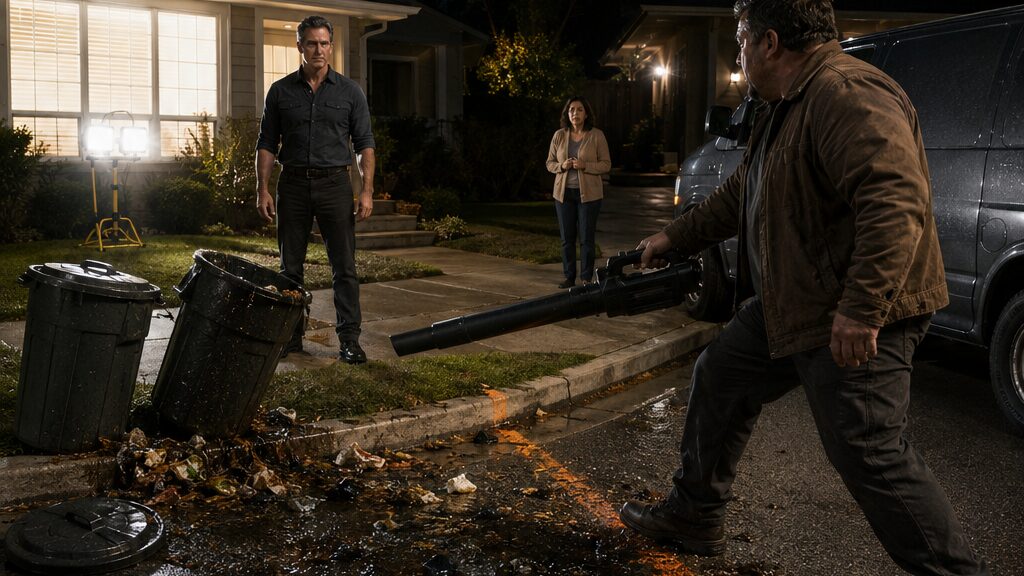
Robert stood beside the garbage cans holding a leaf blower.
He pulled the starter cord once. The engine coughed.
Twice. It caught with a hard mechanical roar.
Robert swept the nozzle across the pavement, testing the blast. Dry leaves and scraps of paper skittered toward Jacob’s curb.
Then he raised the long black tube and aimed it directly at Jacob’s front windows.
Chapter 5: The Last Warning Beside the Painted Line
The first garbage can struck the curb hard enough to throw its lid into the street.
The second landed beside it with a metallic crash. A split bag rolled free, spilling wet paper, spoiled food, and blackened scraps beneath the floodlight.
Robert plugged in the lamp.
Jacob’s living room flashed white.
Before the glare settled, the leaf blower engine caught with a roar.
Jacob stood in the workroom doorway, one hand resting on the wall. The equipment hummed behind him, steady and indifferent. On the security monitor, Robert moved through four synchronized frames: van, curb, front approach, and doorway.
He had arranged everything within view.
Not carelessly.
Deliberately.
Jacob tapped the remote-upload icon, confirmed that continuous recording was active, and slipped his phone into his shirt pocket with its camera running.
Outside, the blower pitch rose.
Garbage lifted from the pavement and scattered across the curb. A paper plate struck Jacob’s hedge. Wet debris slapped against the walkway.
Robert stood beside the painted line, holding the blower in one hand and his phone in the other.
“Maybe now you’ll shut that machine off!”
Jacob opened the front door.
The air smelled of rot and hot electric dust from the floodlight. The blower’s exhaust drifted across the street.
Linda appeared at the edge of her driveway, still wearing the clothes she had worn to work. She looked from the overturned cans to Robert’s phone.
“Robert,” she called, “stop this.”
He ignored her.
Jacob stepped onto the walkway and no farther.
“Turn off the blower,” he said.
Robert angled the nozzle toward the hedge. Mulch and wrappers burst upward.
“You had your inspection.”
“And you cheated it.”
“The equipment passed.”
“You knew exactly what to turn down.”
“Everything was operating.”
Robert laughed toward his phone. “Hear that? He thinks everyone is stupid.”
Jacob saw the frame Robert had chosen. His phone captured Jacob beneath the doorway light, broad-shouldered and motionless. The floodlight itself remained outside the image. So did the overturned cans. Robert’s body concealed the painted survey mark.
A cropped truth.
Jacob pointed once toward the orange stripe.
“Do not cross that line.”
Robert lowered the blower slightly. “Or what?”
“Stay off my property.”
“Your property?” He swung the nozzle across the curb. “You think the whole street belongs to you.”
“Turn it off and move the garbage.”
“Make me.”
Linda took a step toward them, then stopped when Robert aimed the blower near her driveway. He did not send debris toward her. He only let her see that he could.
Jacob felt something old and dangerous loosen inside his chest.
For months he had photographed, measured, submitted, and waited. Every official answer had required a new form. Every neighborly suggestion had asked him to surrender a little more peace so Robert would not become angry.
Now garbage struck his front step while Robert filmed the reaction he intended to manufacture.
Jacob looked at the cameras.
Then at Robert’s phone.
Then at the painted line.
“Last warning,” he said.
Robert’s expression brightened with satisfaction.
He opened the blower throttle.
The engine screamed. A stream of debris shot across the orange mark and struck Jacob’s trousers. Something damp hit his hand.
Robert advanced one step.
His shoe landed on the painted stripe.
Jacob did not move.
Robert took another step, entering the edge of the yard. He kept his phone angled toward Jacob’s upper body, away from his own feet.
“Look at you,” Robert shouted over the engine. “You’ve been waiting for this.”
Jacob could no longer see Linda behind the glare. Only Robert, the nozzle, and the narrow distance between them.
“Back up.”
Robert thrust the blower forward.
The plastic tube struck Jacob below the ribs.
Jacob seized it with both hands.
Robert pulled back, but Jacob had already turned his wrists. The long tube bowed between them. For one second, the motor’s force vibrated through Jacob’s arms.
Then the plastic snapped.
The crack cut through the engine noise.
Robert stumbled, still holding the blower body. The detached nozzle remained in Jacob’s hands.
Silence followed only because Robert released the throttle.
Jacob saw surprise replace triumph on Robert’s face.
He could have thrown the tube aside.
He should have.
Instead, when Robert surged forward, Jacob drove the broken end flat against Robert’s chest and used it as a bar. He did not strike. He pushed.
Robert staggered backward over the survey mark and nearly fell against the garbage can. His phone swung wildly but remained in his hand.
Jacob stopped at the line.
The broken plastic trembled between his fists.
For one terrible instant, satisfaction moved through him. Not joy. Not rage exactly. The brutal relief of having made Robert retreat.
Robert saw it.
His expression changed from shock to calculation.
“You attacked me.”
“You crossed the line.”
“You broke my equipment and hit me.”
“I did not hit you.”
Robert backed toward the van, pressing one hand to his chest. “It’s all recorded.”
“So is everything else.”
That answer unsettled him.
His gaze darted toward the front camera, then the curb camera, then the small lens above the garage.
He had known they were there. But knowledge was not the same as remembering all of them after the plan turned physical.
Linda stepped into the street. “Robert, you pushed the blower at him.”
“Stay out of it.”
“I saw you.”
“You saw him attack me.”
Jacob lowered the broken nozzle.
His hands felt too strong around it. He placed it on the grass beside the painted line, careful not to move closer to Robert.
Robert lifted his phone.
The screen showed Jacob lunging with the black tube.
From Robert’s narrow angle, the floodlight washed the background into brightness. The garbage was below frame. The boundary mark was invisible. The moment before the snap was missing behind Robert’s own arm.
The image looked worse than Jacob had feared.
Robert saw him recognize that.
Then Robert smiled.
He retreated behind the commercial van and called emergency services loudly enough for the entire street to hear.
“My neighbor attacked me with a broken weapon,” he said. “He came out of his house and charged me.”
Jacob’s mouth went dry.
He looked at the cameras again, but the lenses offered no comfort. Evidence did not speak until someone chose to hear it.
Robert continued, his voice shaking with carefully measured panic.
“Yes, he’s still here. He’s holding the weapon.”
Jacob looked down.
The broken nozzle lay on his side of the painted line.
Distant sirens began to rise.
Chapter 6: The First Story Almost Became the Truth
“Keep your hands where I can see them.”
Officer Anthony Lee stood behind the open door of his patrol vehicle, one hand near his belt. Red and blue light moved across Jacob’s house, the garbage cans, and the white glare of Robert’s floodlight.
Jacob raised both hands.
The broken nozzle lay six feet away on the grass.
“He dropped it when you arrived,” Robert shouted from beside the van. “That’s what he used.”
Anthony looked toward the plastic tube, then back at Jacob. “Do not move toward it.”
“I won’t.”
A second patrol vehicle stopped behind the first. Officer Rachel Adams stepped out and moved directly toward Robert, who had one hand pressed dramatically to his chest.
“He came at me,” Robert said. “No warning. He snapped the blower and drove that piece into me.”
Rachel glanced at the running floodlight and the scattered garbage. “Whose cans?”
“Mine. That has nothing to do with the assault.”
Linda stood near her driveway, arms folded tightly against herself.
Anthony approached Jacob with measured steps. “Any weapons on you?”
“No.”
“Phone?”
“In my shirt pocket. It’s recording.”
“Leave it there.”
Jacob obeyed.
He had imagined this moment during every month of documentation. In those imagined versions, he spoke calmly and the evidence arranged itself into an undeniable sequence.
Now his pulse hammered so hard that each sentence seemed rehearsed before he said it.
“He crossed the surveyed boundary with the blower,” Jacob said. “I warned him not to. He thrust the nozzle into me. I broke the tube and pushed him back with it.”
“You pushed the broken end into his chest?”
“The flat side. I used it to create distance.”
Robert shouted, “He admits it.”
Anthony’s eyes remained on Jacob. “Why didn’t you retreat into the house?”
The question struck harder than Jacob expected.
“I was at my doorway.”
“You could have closed it.”
“He was driving garbage onto my property.”
“That doesn’t answer the question.”
Jacob looked toward the painted line. Rachel was photographing Robert’s shoes and the debris pattern. One of his footprints was visible in damp waste beyond the orange stripe.
“I was tired of retreating,” Jacob said.
Anthony’s expression did not change, but the admission remained between them.
Robert rushed forward with his phone. “I have the video.”
Rachel stopped him before he came near Jacob. “Stay there and show me.”
Robert opened the clip.
The recording began with Jacob already outside.
His voice was audible saying, “Last warning.”
Then Robert’s camera shook. The blower nozzle moved out of frame. Jacob seized it, twisted, and lunged forward with the broken tube.
The clip ended as Robert stumbled backward.
No floodlight placement. No garbage dumping. No first warning. No view of the boundary.
Anthony watched it twice.
When he turned toward Jacob, the distance in his face had increased.
“That looks like you advanced.”
“The angle hides his feet.”
“Do you have footage?”
“Yes.”
“Where?”
“My security system. It uploads remotely.”
Anthony told Rachel to remain with Robert and followed Jacob toward the house. He did not permit Jacob to reach into his pocket until they were inside.
The living room still burned white from the floodlight. Jacob turned away from the windows and opened the security application on his phone.
His fingers shook once against the screen.
Anthony noticed.
Jacob forced himself to slow down.
“I have four synchronized cameras,” he said. “The system preserves the original timestamps.”
“Start before the confrontation.”
Jacob selected the curb view.
At 6:41 p.m., Robert dragged the garbage cans into position.
At 6:43, he activated the floodlight.
At 6:44, the blower started.
Anthony watched Robert angle his phone before Jacob opened the door.
“Play the entrance audio,” he said.
Jacob did.
Robert’s words filled the room. Maybe now you’ll shut that machine off.
Then Jacob’s warnings.
Turn off the blower.
Do not cross that line.
Last warning.
On the curb view, Robert’s shoe stepped onto the orange paint and then beyond it. The debris stream crossed first. The nozzle struck Jacob’s body. Jacob grabbed it, twisted, and broke it.
When Robert advanced again, Jacob pushed him back and stopped at the line.
Anthony leaned closer to the screen.
“Replay the contact.”
Jacob did.
There was no swing. No strike. Only the rigid tube held between them as Jacob drove Robert backward.
Anthony’s posture eased, but not completely.
“You should have disengaged sooner.”
“I know.”
It was the first answer Jacob gave without defending himself.
Outside, Robert’s voice rose again.
“He’s editing it in there.”
Anthony took Jacob’s phone and carried it onto the porch, keeping the video open. Rachel watched the same sequence while standing beside the painted mark.
She crouched and pointed toward the ground.
“Debris crossed from this direction. His prints are inside the line.”
Robert shook his head. “That paint is new. He put it there himself.”
Jacob retrieved the survey folder only after Anthony permitted him. The stamped map showed the mark’s location and date.
Rachel compared it to the curb.
Robert’s confidence thinned.
Then he held up his own phone. “His cameras are illegal. They watch my house. This whole thing was bait.”
Rachel examined the visible camera angles. “We’ll address the recording complaint separately.”
“That’s why he did this. He’s obsessed with me.”
Jacob felt the accusation pulling him toward another mistake. He wanted to show the late-night footage immediately, to explain the boxes and tools, to tell the officers that Robert feared being seen.
But he had no proof of theft. Only suspicion.
“My cameras record my approaches,” Jacob said. “I have footage of his van because he parks it in front of my property. I don’t know what’s inside it.”
Robert stopped talking.
The silence was small, but Rachel noticed.
She turned toward the commercial van. Its side door stood partly open, as Robert had left it when he moved behind the vehicle to make the emergency call.
Through the gap, metal tool cases and electronics were visible under the cargo light.
Rachel walked closer.
Robert moved with her. “That’s business property.”
“Stay back.”
“You don’t have permission to search.”
“I’m looking through an open door from where I’m lawfully standing.”
A white inventory tag hung from a boxed monitor near the opening. Rachel read the number into her handheld device.
Robert stepped forward.
Anthony blocked him with one arm. “Do not approach the van.”
“It’s my property.”
“Then remain where you are while we verify what’s visible.”
The device emitted a confirmation tone.
Rachel read the screen again, slower this time.
“Reported stolen eleven days ago.”
Robert’s hand fell away from his chest.
His performance vanished so completely that Jacob felt colder watching it disappear than he had during the shouting.
Rachel reached for the van door to preserve the opening.
Robert lunged toward it.
“I said that’s mine.”
Anthony caught him before he reached the handle and forced him back.
“Step away from the van.”
Robert twisted to look at Jacob.
For the first time that night, there was no accusation in his face.
Only fear.
Then Anthony moved between them and ordered him to turn around.
Chapter 7: What Remained on the Proper Side
The verification tone sounded again before Anthony finished securing Robert’s wrists.
Rachel read the second result from her device, then looked through the open van door at the stacked cases.
“Another match,” she said. “Power tools reported missing from a renovation site.”
Robert stopped struggling.
The floodlight continued to burn across Jacob’s windows. Its white beam flattened the street, turning the garbage, patrol cars, and watching neighbors into sharp-edged shapes. The leaf blower lay near the curb with half its nozzle missing.
Anthony guided Robert toward the rear of the patrol vehicle.
“You don’t understand,” Robert said. “I pick up abandoned property.”
“Then the records will show where it came from.”
“They throw things away all the time.”
“With inventory tags still attached?”
Robert looked toward Jacob as though the question had come from him.
“This is because of those cameras,” he said. “He’s been building this against me.”
Jacob stood on his porch with both hands at his sides. The words should have felt like a confession. Instead, they sounded like one more attempt to make Robert’s choices belong to someone else.
Rachel photographed the visible cargo before touching anything. She called for another unit and began reading serial numbers through the doorway while Anthony kept Robert beside the patrol car.
A boxed monitor matched a burglary report.
A generator matched a rental company’s stolen-property notice.
Two tool cases carried handwritten owner markings beneath strips of white tape.
Each confirmation removed something from Robert’s face. First anger, then confidence, then the wounded expression he had used when the officers arrived.
What remained was exhaustion.
“I was losing jobs,” he said. “People don’t pay. They expect you to haul everything, clean everything, fix everything.”
Anthony did not answer.
Robert stared at the pavement. “Half that stuff was sitting in empty buildings.”
“You can explain acquisition and ownership during the investigation,” Rachel said.
Robert laughed once, bitterly. “Investigation. Sure.”
His gaze rose toward Jacob’s house. “And he gets to stand there like he had nothing to do with any of it.”
Jacob felt the old impulse to stay silent.
It would have been easy. The evidence had already begun speaking for him. Officers were photographing the van. Linda had moved closer to the curb. More neighbors watched from porches, their earlier uncertainty replaced by the safer certainty of seeing Robert in handcuffs.
Jacob could let them invent a cleaner version of him now.
Instead, he stepped down from the porch.
Anthony lifted one hand. “Stay on your property.”
Jacob stopped before the painted line.
Robert noticed and gave a faint, humorless smile. “There. That line again.”
“You crossed it,” Jacob said.
“You wanted me to.”
“No.”
“You put up cameras. You marked the curb. You saved every little thing.”
“Because no one believed the pattern.”
Robert’s jaw tightened. “That machine kept me awake.”
“The inspection proved otherwise.”
“I could hear it.”
Jacob looked at him carefully.
For the first time, Robert’s complaint did not sound completely performed. Beneath everything else—the pride, the lies, the theft, the staged confrontation—there may have been a real irritation that had grown in the space where his failing business, unpaid bills, and fear had no other place to go.
But a true discomfort did not make the floodlight lawful. It did not move garbage by itself. It did not force a man to angle a phone away from his own trespass.
“The hum bothered you,” Jacob said. “The cameras frightened you.”
Robert’s eyes shifted toward the van.
That was answer enough.
“You recorded things that were none of your business,” he said.
“You parked them in front of my house.”
“You could have minded your own life.”
“I tried.”
The words came out quieter than Jacob expected.
He looked at the leaking garbage, the floodlight, and the broken nozzle lying in his grass.
“I kept thinking if I documented enough and said nothing, someone would eventually see it clearly.”
Linda lowered her eyes.
Jacob continued, not for Robert alone. “That gave you room to tell everyone what the silence meant.”
Robert’s expression hardened again. “You still put that tube into my chest.”
“Yes.”
Anthony turned toward Jacob.
Jacob met his gaze. “I should have dropped it after I broke it. I should have stepped back sooner.”
Robert seemed almost disappointed by the admission.
“But you crossed the line with the blower,” Jacob said. “And I stopped you. Both things are true.”
For several seconds, the only sound was the low idle of the patrol cars.
Linda approached Rachel.
“I saw him position the cans,” she said.
Rachel opened her notebook. “When?”
“The first night. He moved one toward the mark while looking at Jacob’s camera. And earlier that week he measured from the curb to Jacob’s windows.”
Robert shook his head. “She’s lying because she wants to stay on his good side.”
Linda flinched, but remained where she was.
“I told myself it was just two stubborn neighbors,” she said. “It was easier than getting involved.”
Rachel wrote the statement down.
Linda looked at Jacob. “I was wrong.”
He nodded once.
There was no satisfaction in it. Her admission could not erase the months when neutrality had made Robert louder and Jacob more isolated. Still, it was true, and she had chosen to say it while Robert could hear.
Another patrol vehicle arrived. The additional officers began securing the van and cataloging what could be seen without disturbing the arrangement.
Anthony moved closer to Jacob.
“The footage supports your account of the immediate confrontation,” he said. “That does not mean every decision you made was the best one.”
“I understand.”
“Once the threat ended, you needed to disengage. And from this point forward, do not move his equipment, his light, his cans, or anything else that belongs to him. Call us. Let the removal be documented.”
Jacob looked toward the floodlight still aimed at his house.
“Even that?”
“Especially that.”
The warning stung because it was reasonable. Jacob had imagined turning the light around himself, placing the broken nozzle beyond the orange mark, restoring every object to the side where it belonged.
But restoration could become another accusation if he treated possession as permission.
Rachel arranged for the floodlight and blower to be photographed, then authorized the light to be disconnected as part of the scene. Under Anthony’s supervision, Jacob gripped the metal frame and rotated it away from his windows.
The beam swept across the pavement, the open van, and Robert’s face before settling on the empty street.
Robert looked away.
After the equipment had been documented, Anthony allowed Jacob to lift the broken nozzle by its intact end. Jacob carried it only as far as the painted boundary and set it down on Robert’s side.
Not thrown.
Not displayed.
Placed.
The orange line remained visible between the plastic tube and Jacob’s shoes.
Robert watched from beside the patrol car.
“You think that makes you better than me?” he asked.
Jacob stepped back onto his walkway.
“No,” he said. “It means I’m done carrying your part.”
Anthony placed Robert in the vehicle.
The door closed with a dull mechanical sound.
By the time the patrol cars left, the floodlight was dark and the van was sealed for further investigation. A municipal crew arrived after sunrise to remove the leaking cans and wash the curb. The spoiled smell faded beneath water and disinfectant.
Linda stood nearby but did not try to make conversation.
Jacob watched the worker’s hose carry the last black streak away from his driveway. For months, he had believed peace would arrive as proof—a ruling, a measurement, a recording so complete that no one could deny what had happened.
Instead, it arrived as work being done.
Statements taken.
Property tagged.
A warning accepted.
A line left visible.
Inside the house, Jacob reopened the curtains.
Morning light entered the living room without force. Nothing bleached the walls. Nothing demanded that he retreat from his own windows.
He went to the workroom and checked the equipment.
The cooling fans continued at their ordinary level. The sound meter rested beside the vent.
Thirty-six decibels.
Jacob set the meter down without photographing it.
For the first time in months, the hum was only a hum.
The story has ended.