When The HOA Tried To Cut His Gate, They Learned Why That Road Had To Stay Open
Chapter 1: The Chain Was Already Under The Bolt Cutters
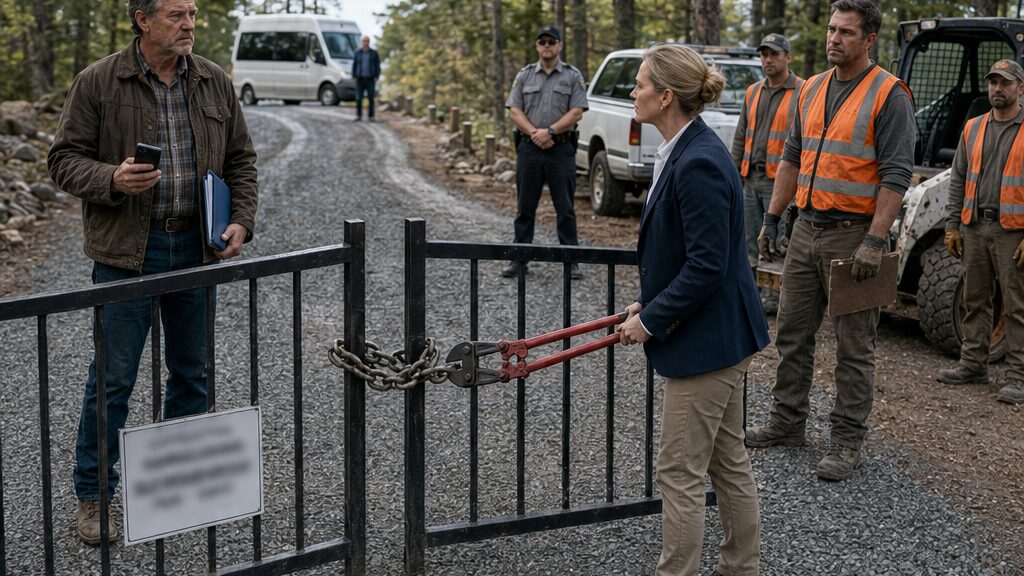
The bolt cutters were already around John Walker’s chain when he stepped onto the gravel.
Catherine Moore had one boot planted against the lower bar of his black gate, both gloved hands on the handles, her blonde hair pinned tight beneath the morning glare. Behind her, a white pickup idled beside two workers in orange vests. A uniformed security guard stood near the road shoulder with his thumbs hooked in his belt, looking uncomfortable but not moving.
John stopped ten feet from the gate, coffee mug still warm in his hand.
“Take those off,” he said.
Catherine looked through the bars as if she had expected him, but not that tone.
“Mr. Walker, you were notified,” she said. “This access obstruction is being removed today.”
The white sign wired to the gate shifted in the breeze between them.
PRIVATE PROPERTY
NO HOA ACCESS
John’s eyes moved from the sign to the steel jaws around the chain. He had bought that chain after the first storm, after tire tracks had gouged the soft shoulder and widened the washout near the culvert. It was not decorative. Nothing out here was decorative anymore.
“You’re cutting a lock on private property,” he said.
Catherine exhaled through her nose, the way people did when they were trying to stay official. “We are correcting an unapproved exterior alteration affecting a community roadway.”
“It’s not a community roadway.”
A worker behind her set down a toolbox. The sound carried through the trees.
Catherine loosened one hand from the bolt cutters and pulled a folded notice from beneath her arm. It was printed on HOA letterhead, clipped to a plastic board. “You installed reinforced posts, widened the gate apron, and blocked historical access without architectural approval. The board has authority to restore compliance.”
John took one step closer. His boots pressed into the damp gravel at the edge of the repair.
The road behind him curved downhill through pine and oak toward the lake house. Three weeks earlier, water had run over that curve like a creek, chewing out the shoulder and exposing the culvert pipe. Before the repair, even a small delivery van had to straddle the rut. A heavier vehicle could slip sideways into the ditch. John had laid fresh crushed stone, hired an engineer to mark the culvert, and set new posts to keep tires away from the soft edge.
He had also sent the paperwork.
Certified copies. Photos. Measurements. A simple explanation he thought was enough.
Catherine tapped the notice with one finger. “You refused to appear for last Thursday’s compliance review.”
“I was home.”
“The review was at the clubhouse.”
“My wife couldn’t be left alone.”
Catherine’s face did not change, but her eyes slid past him toward the road. “That does not exempt you from procedure.”
John felt the first hard flicker of anger in his chest. He did not raise his voice. “Procedure doesn’t give you my road.”
The security guard shifted. The workers looked at Catherine.
She set the notice against the gate, just below the sign. “Mr. Walker, the HOA has received multiple complaints from residents who have used this lane for lake access for years. You do not get to lock the community out because you decided to pour gravel and install posts.”
“I didn’t pour gravel. I repaired a washout.”
“You altered the entrance.”
“I made it safe.”
“You made it noncompliant.”
The word landed colder than an insult because she believed it protected her.
John looked down the road behind him, toward the house hidden beyond the trees. Elizabeth would be near the front room by now, oxygen line looped carefully along the baseboard, pretending not to listen for engines. She had asked him that morning not to let it become a scene. He had promised he would handle it quietly.
Quietly had lasted until the bolt cutters.
One of the workers walked to the right-hand post and marked it with orange spray paint.
John’s head turned.
“What’s he doing?”
Catherine did not look back. “Identifying the nonconforming posts for removal.”
“He marks one more thing, he’s trespassing.”
The worker froze with the spray can still in his hand. The orange line glowed bright against the new timber.
Catherine’s mouth tightened. “Your refusal to cooperate is exactly why this action became necessary.”
“No,” John said. “You made it necessary when you came here with cutters instead of a court order.”
The security guard finally spoke. “Ma’am, maybe we should wait for clarification before any cutting.”
Catherine gave him a quick look. “We’re not entering the residence. We’re removing an obstruction affecting common access.”
John reached into the worn folder tucked beneath his left arm. He had brought it out with the mug, thinking he might need to show one page and end the misunderstanding. The folder was thick now, blue edges softened from being opened too many times: deed, survey, culvert invoice, photos from the storm, proof of delivery to the HOA office.
He did not open it yet.
“Tell your crew to step back,” he said.
Catherine held his stare for a moment, then lowered the bolt cutters but did not remove them from the chain. “You’re going to make this worse for yourself.”
“I’m trying to keep you from making it worse for everyone.”
That made her blink. Not from guilt. From irritation.
Behind her, a second vehicle turned in from the paved neighborhood road. It was a compact skid steer on a flatbed trailer, hauled by another pickup. Its bucket was strapped down, its yellow paint scraped along the edges. The workers straightened as it arrived.
John’s coffee had gone cold in his hand.
Catherine turned just enough to see the machine, then faced him again. “Removal begins today. If you interfere, we will document that too.”
John set the mug carefully on top of the nearest stone pillar inside the gate. His hand was steady, but he could feel the pulse in his thumb.
The driver climbed down from the truck and began unfastening the straps from the skid steer.
John looked at the bolt cutters, the orange mark on the post, the notice clipped below his sign, and Catherine’s polished boots planted on his gravel as if the question had already been decided.
Then the skid steer engine started behind her.
Chapter 2: A Machine Idled Beside The No Access Sign
The worker lowered the saw toward the first post before John reached the gate.
The blade was not running yet, but the gesture was enough. John stepped between the bars and the marked timber, one hand raised, the other holding his phone so the camera saw Catherine, the crew, the security guard, the machine, and the sign shaking above the chain.
“Stop,” John said.
The worker looked past him. “Ma’am?”
Catherine did not answer the worker. She kept her eyes on John’s phone. “Recording does not change the violation.”
“No,” John said. “It records who ordered it.”
The skid steer idled six yards behind her, coughing diesel into the pine air. Its bucket hovered low, ready to lift the loosened posts once the workers cut them free. Gravel trembled near the tires.
Catherine held out the notice through the gate. “Final opportunity. Open it voluntarily.”
John did not take the paper. “I want the removal order in writing, with the board vote attached.”
“You have the enforcement notice.”
“That’s not a court order.”
“It is sufficient HOA authority.”
“It is not sufficient to cut a lock on a private road.”
Catherine’s jaw worked once. “This road has served the lakeside section of the community for years.”
“Because I allowed people through when it was safe.”
“You don’t get to decide that alone.”
“I do when it’s my road.”
A horn sounded behind John.
He turned.
A white medical transport van had stopped at the bend, just inside the tree line, blocked by the closed gate and the crowd gathered around it. The driver leaned forward over the steering wheel, eyes moving from the machine to the workers to John.
John’s hand tightened around the phone.
Catherine followed his look. “Who is that?”
“The visit you’re delaying.”
“What visit?”
John hesitated. The answer sat in his throat, heavier than he expected. He had spent years protecting Elizabeth from being reduced to explanations. She was not a condition, not a case, not an argument to win against a woman with letterhead. She was Elizabeth, who still corrected his grocery lists from the recliner and hated when strangers said brave in that padded voice.
But the van was there. The machine was running. The saw was near the post that kept tires away from the washout.
“Medical transport,” John said.
The worker with the saw lowered it to his side.
Catherine frowned. “For whom?”
“My wife.”
The security guard looked down the road.
Catherine’s expression shifted, not into sympathy, but recalculation. “You did not disclose a medical accommodation in the architectural application.”
“I submitted a repair request with access notes.”
“That is not the same thing.”
John laughed once, without humor. “The road washed out. The van couldn’t get up the slope. I repaired the road so she could get in and out of her own home.”
“You installed unauthorized posts and a gate apron that changed the exterior access.”
“I kept vehicles from sliding into the culvert.”
“You should have waited for approval.”
“She was supposed to wait at the bottom of the road?”
Catherine’s gaze flickered toward the van again. The driver had gotten out now and stood beside the open door, uncertain whether to approach.
John held the phone steady. “Say it on camera. Say the HOA is removing the only safe entrance for a medical van because the gravel doesn’t match your standard.”
“You are mischaracterizing this,” Catherine said.
“Then characterize it.”
For a second, only the skid steer answered, engine knocking behind her.
Mark Green, the crew supervisor, stepped away from the trailer with a clipboard tucked under one arm. He was broad-shouldered, sunburned at the neck, and looking less certain than when he had arrived. He glanced at the van, then at the marked post.
“Mrs. Moore,” he said quietly, “are we cutting around active medical access?”
Catherine turned on him. “You are removing unapproved structural additions.”
“I was told it was a gate obstruction and some posts.”
“That is what it is.”
John pointed to the ditch beside the repaired entrance. The old washout scars were still visible beneath the fresh stone: exposed roots, sunken mud, the black curve of drainage pipe half-buried in rock. “That culvert dropped eight inches during the storm. Before the repair, anything wider than a pickup had to ride the edge. The posts are there because people kept cutting the corner.”
Catherine looked at the ditch as if seeing it would concede something. “You performed work near stormwater drainage without final inspection.”
“I hired an engineer.”
“Not approved by the board.”
“Approved by physics.”
The security guard pressed his lips together, almost a wince.
Catherine lifted the notice again. “Mr. Walker, you are not helping yourself.”
“No,” he said. “I am helping my wife get to an appointment.”
The home-health driver approached the gate slowly. “Sir, we can reschedule if this is a bad time.”
John turned to him. “How long before the next opening?”
The driver glanced down at his tablet. “Friday morning, maybe. If dispatch can fit it. But the doctor wanted today.”
John said nothing.
Friday was four days away. Four days of Elizabeth pretending the tightness in her chest was just the weather. Four days of him watching the oxygen gauge like it could answer back.
Catherine lowered her voice. “I understand this is inconvenient.”
John looked at her then, really looked. “That’s the problem.”
Her face tightened.
“Inconvenient is when someone parks in front of your mailbox,” he said. “This is the road my wife uses to leave our house.”
“Then you should have made the proper accommodation request.”
“I sent you the packet.”
“There is no record of a completed medical accommodation request.”
“I handed it to your office.”
“You handed in a repair packet.”
“With a doctor’s note in it.”
Catherine’s eyes flicked down too quickly.
John saw it.
It lasted less than a second, but it was the first crack in her official face.
“You saw it,” he said.
“I process dozens of resident submissions.”
“You saw it.”
“I saw an incomplete application for exterior modification.”
Mark Green set his clipboard on the hood of the pickup. “I’m not cutting anything while this is in dispute.”
Catherine snapped her head toward him. “Your company accepted the work order.”
“And my company didn’t accept liability for blocking medical access.”
The words changed the air.
The security guard stepped farther from the gate. The workers looked at each other. The skid steer kept idling, suddenly louder because no one wanted to speak over it.
Catherine walked to Mark and spoke low, but John caught enough.
“Document refusal by contractor,” she said.
Mark did not move.
John slipped the phone into his jacket pocket, still recording, and opened the blue folder. He pulled out the survey first, the old one with the county stamp and the parcel line drawn clean around the road from the paved entrance down to the lake house. He had kept that page in a plastic sleeve because his father-in-law had told him, years ago, never argue property lines from memory.
He held it against the gate so Catherine could not ignore it.
The paper trembled only because the morning breeze had picked up.
“Before you cut that chain,” John said, “read whose road this is.”
Chapter 3: The Paperwork Proved Less Than John Expected
“This proves the road,” the county clerk said. “It doesn’t prove the repair was finished right.”
John stood at the records counter with the survey still warm from the copier and felt the morning’s false victory drain out of him.
The clerk had kind eyes and a voice worn smooth from telling people things they did not want to hear. She slid the stamped deed back across the counter, then tapped the second page with one fingernail.
“Parcel boundary is clear,” she said. “Private road, private maintenance responsibility. The HOA can’t claim ownership from this.”
“That should stop them from cutting the gate.”
“It may stop them from claiming the road as theirs. But you said culvert work?”
“Reinforced entrance, gravel, posts. Drainage stayed where it was.”
“Near stormwater?”
John did not answer fast enough.
The clerk turned her monitor slightly and typed in the parcel number. “There’s a drainage easement along that slope. Not an HOA easement. County stormwater. Different issue.”
John rubbed the back of his neck.
He had known about the drainage line in the vague way a homeowner knew about things buried in closing documents. It had never mattered until the storm ripped the shoulder open. The engineer had said the culvert pipe itself did not need replacing. Stabilize the apron. Keep traffic off the edge. Add stone. Set posts. Get it inspected after settling. John had heard the important part: make it safe before the next van comes.
“How long for inspection?” he asked.
“Standard schedule? Two weeks.”
He closed his eyes for half a second.
“But if it affects medical access, you can request priority review.” The clerk looked over her glasses. “You have documentation?”
“In the folder.”
“Then use it.”
John looked down at the blue folder. It had grown thicker since the morning, stuffed now with fresh copies, receipt paper, the engineer’s invoice, and photos printed from his phone: Catherine at the gate, bolt cutters on the chain, the skid steer behind her, the orange mark on the post.
It should have felt like armor.
Instead, it felt like something he had built after the first wall was already breached.
By the time he got home, the medical van was gone. The road was quiet except for the soft crush of his tires over fresh stone. Catherine and her crew had left after Mark refused to cut, but they had not removed the notice. It hung in a plastic sleeve from the gate, clipped below his sign as if the HOA had planted its own flag there.
Elizabeth was at the kitchen table when he came in, oxygen line trailing from the portable concentrator beside her chair. She had one of his printed photos in front of her.
The one where he stood at the gate, shoulders squared, Catherine opposite him, machine behind her.
“You look angry,” she said.
“I was.”
“You don’t usually show it.”
“I didn’t think I did.”
She gave him a small look over the edge of the photo. “You did.”
John set the folder on the table. “County says the deed proves the road. But the culvert repair still needs inspection because of the drainage easement.”
Elizabeth absorbed that without surprise. She had always been faster than him at hearing the part of a sentence he did not want to say.
“So Catherine can still call it unapproved.”
“Until inspection, yes.”
“And the appointment?”
“Driver said maybe Friday.”
Her hand closed slowly over the edge of the photo. She did not complain. That was worse.
John opened his laptop at the table, pulled up the HOA portal, and logged into the account he hated using. The repair request should have been under “resident submissions.” He had uploaded the basic form four weeks ago, then delivered the printed packet the next morning because the file size limit would not accept the doctor’s note, road photos, and engineer sketch together.
The portal spun, opened, and displayed one line.
No completed request received.
John stared at it.
Elizabeth saw his face. “What?”
“They marked it not received.”
“All of it?”
“The portal says no completed request.”
“But you took it to the office.”
“I handed it to the front desk.”
“With the doctor’s note?”
He did not answer immediately.
Elizabeth leaned back. The concentrator hummed between them.
“John.”
“I put it in the packet.”
“That isn’t what I asked.”
He looked at the blue folder. He had made two versions of the packet. One with everything. One without the doctor’s letter, in case the front desk insisted on keeping a copy where half the neighborhood could see it. He remembered standing by the HOA office counter, Catherine visible through the glass wall on a phone call, the clerk reaching for the folder, and Elizabeth’s voice in his head from the night before: Don’t make my lungs a board topic.
“I included the access explanation,” he said.
“John.”
He sat down.
“I didn’t include the full letter in the HOA copy.”
Elizabeth’s expression did not harden. It softened, which felt worse.
“You said you sent it.”
“I sent the engineer note, photos, repair invoice, and a line that said medical transport required safe access.”
“A line.”
“I was trying to protect your privacy.”
“I know.”
“They didn’t need your diagnosis.”
“No,” she said quietly. “But maybe they needed to understand it wasn’t about your gate.”
He looked toward the window. From the kitchen, he could see the top rail through the trees, black against the pale road. The chain still held. The sign still faced outward. For years, that had been enough for him: boundary, proof, warning. Don’t cross.
Now a plastic HOA notice hung beneath it, and somehow the sign looked less like protection than a challenge someone had accepted.
John clicked through the portal again, checking upload history, messages, attachments. Nothing. No repair packet. No note. No record except one automated line acknowledging that a “resident inquiry” had been opened and then closed for incomplete documentation.
“They buried it as an inquiry,” he said.
“Or they never understood what you were asking.”
He hated that she might be right.
He gathered the pages, aligning their edges with too much care. “I’ll fix it.”
Elizabeth reached across the table and put two fingers on the folder before he could close it.
“I asked you not to mention my condition,” she said.
He looked at her hand.
“I know.”
“No,” she said. “Listen to me. I asked you not to put it in writing where they could pass it around like gossip. I asked you because I was embarrassed. Because I didn’t want Catherine Moore discussing my oxygen tank under old business and new business.”
John swallowed.
Elizabeth’s fingers tightened on the folder.
“But I didn’t ask you to fight blind.”
He looked up then.
Her eyes were tired, direct, and frightened in a way she rarely allowed him to see.
“I helped make this easier for them,” she said. “Didn’t I?”
Chapter 4: The Board Turned The Road Into A Violation
Catherine opened the meeting with a photograph of John standing in front of the skid steer.
The image filled the white screen at the front of the clubhouse: John’s brown jacket, his raised hand, the black gate behind him, the white sign above the chain. Someone in the second row whispered before Catherine even spoke. From that angle, the machine looked small and John looked like the obstruction.
“This,” Catherine said, holding the remote at her side, “is what happens when one resident decides the rules do not apply to him.”
John sat in the third row with the blue folder across his knees.
Elizabeth had asked him, before he left, not to let them make her the whole story. He had nodded. Then he had walked down to the gate, removed the HOA notice from beneath his sign, folded it carefully, and put it in the folder. He could still feel the plastic sleeve against his fingers.
Catherine clicked to the next slide. A close-up of the orange paint on the repaired post appeared.
“Unauthorized exterior posts,” she said. “Unauthorized gravel expansion. Unauthorized access restriction. And refusal to comply with removal.”
A board member at the long table leaned toward the microphone. “Was the owner given notice?”
“Yes,” Catherine said. “Notice was placed on site and delivered electronically.”
John looked up. “After the crew arrived.”
Catherine did not look at him. “Residents will be allowed to speak during the comment period.”
The room was fuller than John expected. Neighbors stood along the back wall with folded arms and lake-community impatience. He recognized some of them only by vehicles: the red SUV that used to roll through his road on summer weekends, the green golf cart that had once left beer cans near the lower bend, Patrick Baker in his canvas jacket two chairs from the aisle, watching the screen with a tight mouth.
Catherine advanced to a map of the neighborhood. A thin blue line had been drawn over John’s private road, connecting the paved HOA street to the lake edge.
“For decades,” Catherine said, “residents have understood this lane as part of the lakeside access pattern.”
“Understood wrong,” John said.
The room stirred.
Catherine finally turned toward him. “Mr. Walker, you’ll have your opportunity.”
Patrick raised his hand from the board table. He did not wait for permission. “Catherine, when you say access pattern, do we have an easement?”
Catherine’s face stayed composed. “The association’s position is that long-standing resident use creates a community interest.”
“That’s not what I asked.”
A few people shifted. Catherine looked down at her notes. “Our attorney has advised that the board should preserve access while the matter is reviewed.”
John opened the folder.
The paper sounded louder than he meant it to.
When public comment began, two residents spoke before him. One said her family had always walked that way to reach the lake trail. Another said the locked gate made the neighborhood feel hostile. Neither mentioned the washout. Neither mentioned the machine.
Then Patrick stood.
“I used that road,” he said, turning partly toward John and partly toward the board. “So did a lot of us. I thought it was common access. I’m not proud of saying that, but it’s true.”
Catherine watched him carefully.
Patrick continued, “But if it’s not ours, we need to stop pretending convenience is the same as rights.”
The room went quiet in a new way.
John stood with the survey in his hand.
He did not start with Elizabeth. He almost did. Her name rose behind his teeth, and he held it there, feeling the weight of what he had promised.
Instead, he walked to the front and placed the survey on the document camera. The projected image changed: parcel lines, county stamp, road boundaries, his lot number cleanly marked.
“This is my deeded road,” he said. “It has been my maintenance responsibility since before the HOA was formed. I allowed neighbors through when it didn’t damage the road. After the storm, it wasn’t safe.”
Catherine leaned into her microphone. “No one disputes your concern about storm damage. The issue is whether you had approval to alter an exterior access feature.”
John looked at her. “You brought a machine to remove a repair before checking who owned the road.”
“The board had enough information to act.”
“No,” John said. “You had enough information to pause.”
A murmur moved through the room.
He placed the storm photos under the camera: the rut, the exposed culvert, the track where tires had slipped near the ditch. Then the invoice. Then the engineer’s sketch.
A board member frowned. “When did you submit these?”
“Four weeks ago through the portal. Printed packet delivered the next morning.”
Catherine’s pen stopped moving for half a second.
“The portal shows no completed request,” she said.
“I know what it shows.”
“That is what the board must rely on.”
John reached into the folder and pulled out the certified mail receipt for the follow-up copy he had sent after the portal failed. It proved delivery to the HOA office three days before the first violation letter.
It did not prove what was inside.
He knew that before Catherine said it.
“This receipt does not establish that a complete medical or architectural packet was received,” she said.
Medical.
The word crossed the table and came back at him like a thrown object.
John felt several heads turn. He had not said medical. Catherine had.
Patrick noticed too. His gaze sharpened.
John kept both hands on the edge of the podium. “Then let’s talk about what you did receive.”
Catherine sat back. “The board has a motion before it.”
“So do I.”
“You’re not on the board.”
“No,” John said. “I’m the one whose property you tried to cut open.”
The security guard from Monday stood along the wall near the door. He looked down at the floor.
The chair of the meeting cleared his throat. “Mr. Walker, please finish.”
John gathered the pages, but his fingers lingered on the sealed envelope in the back of the folder—the doctor’s full letter, still unopened in public, still private. He had brought it and still could not make himself use it.
“The road is mine,” he said. “The repair was necessary. I have requested county inspection. Until then, nobody cuts that gate or removes those posts.”
Catherine spoke before the chair could respond. “And until inspection, the board must consider the alteration unapproved and potentially unsafe.”
That word did what she needed it to do.
Unsafe.
Not Catherine’s machine. Not the saw. Not the attempted removal. The repair.
The motion passed by a narrow margin: temporary fine, continued review, no further homeowner work until inspection, and authority reserved for removal if noncompliance continued.
John had proved the road was his and still walked out with a violation.
In the parking lot, he was unlocking his truck when Mark Green came from the shadow near the maintenance shed. He was not wearing a vest now. He looked like a man who had almost stayed away and had decided too late not to.
“Mr. Walker,” Mark said.
John turned.
Mark held out a folded copy of a work order. “You didn’t get this from me.”
John did not take it at first. “What is it?”
“The dispatch sheet from Monday.”
John opened it under the yellow parking lot light.
The removal crew had been scheduled for 7:30 a.m.
The notice Catherine had clipped to his gate was time-stamped 8:12.
Mark watched him read it. “We were sent before she handed you the paper.”
Chapter 5: The Missing Request Was In The Wrong Folder
Mark’s text arrived at 6:14 the next morning with a photo John had to enlarge twice before he understood it.
It was the same work order, but this time the full dispatch screen was visible: crew assignment, equipment code, gate removal authorization, Catherine’s approval initials, and a timestamp from Sunday night. Beneath it, one line had been circled in black.
Resident notice to be posted on arrival.
John sat at the kitchen table in the gray light, the phone in one hand and the blue folder open beneath the other.
Elizabeth was still asleep in the front room recliner, or pretending to be. The oxygen concentrator hummed softly beyond the wall. John had gotten used to that sound the way other people got used to a clock. When it stopped, even for a filter change, the silence made his skin tighten.
He printed the photo, added it to the folder, and drove to the HOA office before it opened.
Catherine was already inside.
Through the glass door, John saw her standing near the copier with a stack of files against her hip. She looked up when he knocked. For a moment, neither of them moved. Then she unlocked the door halfway and held it with her body blocking the gap.
“Office hours begin at nine.”
“You scheduled the crew before notice.”
Her eyes dropped to the paper in his hand, then rose again. “I don’t discuss enforcement actions at the door.”
“You don’t notify people at the door either. You show up with a machine and call that notice.”
Catherine stepped outside and pulled the door shut behind her. “Mr. Walker, the association has a responsibility to address hazards.”
“You marked my repair as the hazard.”
“Unapproved work near drainage can create liability.”
“So can cutting out posts beside a washout.”
She looked tired. Not sorry. Tired in the way people looked when the pressure they used on others had started pressing back.
“You think this is only about me,” she said.
“I think it’s about my road.”
“It is about insurance renewal, emergency access, resident claims, and a board that inherited years of informal use nobody documented properly.”
John stared at her.
For the first time, she sounded less like someone defending a throne and more like someone holding a leaking pipe with both hands.
“That doesn’t give you the right to force it onto me,” he said.
“No,” she said. “But it means your gate affects more than your driveway.”
“My wife’s medical transport affects more than your access pattern.”
Catherine’s face closed again. “Then submit the complete request.”
“I did.”
“The office has no medical accommodation packet.”
John held up the printed dispatch photo. “The office also said I was notified before removal.”
Her mouth tightened.
The door opened behind her, and a clerk looked out, startled to find them standing there. Catherine turned sharply.
“Pull the Walker file,” John said.
The clerk froze.
Catherine said, “That’s not necessary.”
“It is now.”
The clerk looked between them, then disappeared into the office.
Catherine spoke low. “You are creating a public issue out of something that could have been handled through process.”
John almost laughed, but there was no room for it. “Process is what you call it after the machine leaves.”
A car door closed behind him. Patrick Baker crossed the small parking lot holding a manila envelope.
“I asked for the old road files,” Patrick said to Catherine. “You told me they were archived.”
“They are.”
“Then I found one in the clubhouse storage cabinet.”
Catherine looked at the envelope as if it had crawled there.
Patrick pulled out a faded memo and handed it to John. It was ten years old, addressed to a prior board, marked legal review. John scanned the first paragraph and felt the story shift under his feet.
No recorded easement exists over the Walker private road. Continued informal resident use should not be represented as association access. Any emergency-access agreement must be separately negotiated with owner.
Patrick’s voice was rough. “We knew.”
Catherine’s eyes stayed on the memo. “A prior board knew. That does not mean current records were complete.”
“You were on the transition committee,” Patrick said.
Her silence answered before she did.
The clerk returned with a thin hanging file and a thicker folder that did not match the label. Catherine reached for both, but the clerk, perhaps by habit, set them on the small counter beside the door.
John saw his name on the thin file.
Then he saw another label half-covered by a sticky note on the thick folder.
Road Access Dispute.
The clerk lifted the sticky note. “This one has copies of his photos.”
John stepped forward.
Catherine put a hand on the folder. “Internal classification does not—”
“Open it,” Patrick said.
Nobody moved until the clerk did.
Inside were John’s storm photos, the engineer sketch, the repair invoice, and the short note he had written in careful block letters: Medical transport requires stable access to residence. Request priority review if possible.
No full doctor’s letter. No diagnosis. No private details.
But enough.
Catherine closed her eyes for one second, and when she opened them, she looked angry at everyone, including herself.
“This was not submitted as a medical accommodation,” she said.
John took the note from the folder. “It says medical transport.”
“It was filed as road access because the primary dispute was the gate.”
“You made it the gate.”
Patrick looked at Catherine. “You had enough to stop the crew.”
She did not answer.
John left with copies after the clerk, under Patrick’s watchful silence, stamped them received. He did not feel victorious. The folder was heavier now, but the road home felt narrower than before.
At the gate, the orange mark still scarred the post. The HOA notice was gone from beneath his sign because he had removed it, but the clip remained, a small silver bite on black metal.
When he reached the house, Elizabeth’s home-health provider was on speakerphone.
“I’m sorry,” the scheduler said. “The transport company marked the access road as temporarily unsafe after Monday’s incident. We can’t dispatch another van until the route is cleared.”
John stopped in the doorway.
Elizabeth looked at him, the phone beside her hand, her face carefully still.
“I have inspection pending,” John said.
The scheduler paused. “Sir, we need written clearance, not pending review.”
After the call ended, the room held only the concentrator’s hum.
John placed the stamped copy of his note on the table, the one that proved the HOA had received enough to know.
Elizabeth looked at it for a long time.
“They canceled Friday too?” he asked.
She nodded.
The paper between them should have helped. Instead, it had arrived one day after help could still reach her easily.
John sat down across from her. His throat felt tight, but he kept his voice level.
“I need to say what the road is for,” he said.
Elizabeth’s fingers moved to the oxygen line in her lap.
“Not everything,” he added. “Not what you don’t want told. But enough that they can’t pretend it’s gravel and posts.”
She looked toward the window, where the black gate stood hidden beyond the trees.
For a while she said nothing.
Then she turned back to him, tired and clear-eyed.
“If you say it,” she said, “say I’m trying to stay in my home. Don’t say I’m trapped in it.”
Chapter 6: John Opened The Gate Without Giving Them The Road
Catherine arrived Thursday morning with a revised easement form instead of bolt cutters.
That almost made John laugh.
She held the document in a black folder against her blazer while the county inspector climbed from a gray truck behind her. The security guard stood near the shoulder again, farther back this time. Mark Green’s crew had returned too, but their saws stayed in the truck. The skid steer was not running.
John noticed that first.
Then he noticed the form in Catherine’s hand.
“We have a path to resolve this,” she said through the gate.
John stood on his side of the chain with the blue folder tucked under his arm. The repaired road ran behind him, pale gravel over dark earth, posts upright except for the one orange scar. Elizabeth was inside the house with the front curtains open. He knew because he had opened them himself.
“What path?” he asked.
Catherine slid the folder between the bars.
John did not take it.
She sighed. “A limited association access easement. If you sign, the board can approve the repair under emergency conditions and suspend fines pending final compliance.”
Patrick, who had arrived with the inspector but stayed near the truck, looked sharply at her. “That’s not what we discussed.”
“It is a practical resolution,” Catherine said.
John looked at the paper now. “You want me to give the HOA permanent access to my road in exchange for not tearing out a repair you had no right to touch.”
“That is not what this says.”
“That is exactly what that means.”
The inspector, a square-shouldered woman with a county badge clipped to her vest, closed her truck door. “I’m here to inspect drainage and road safety. I’m not here to negotiate easements.”
“Of course,” Catherine said, too quickly.
John took out his keys.
For a moment Catherine’s face changed, as if she thought he had surrendered.
He unlocked the chain himself.
The sound was small, metal sliding against metal, but everyone heard it. He removed the lock, looped the chain over the inside post, and pulled the gate inward just wide enough for the inspector’s truck.
“The gate opens for inspection,” he said. “Not for the HOA.”
The inspector nodded once and drove through.
Catherine started forward.
John stepped into the gap.
“No.”
“Mr. Walker—”
“You can walk in when the inspector asks for you.”
Patrick looked down, hiding something that was almost a smile.
The inspector checked the gate apron first, then the culvert edge, then the line of reinforced posts. She knelt by the drainage slope, pushed a probe into the gravel, and asked John who had placed the stone. He gave short answers and handed her the engineer’s sketch before she asked for it.
Catherine stood outside the gate with her folder held tighter than before.
After twenty minutes, the inspector waved her in.
Catherine entered like the road might accuse her.
The inspector pointed to the posts. “These keep vehicles off the soft shoulder?”
“Yes,” John said.
“And the prior damage?”
John handed her the storm photos.
The inspector studied them, then looked toward the slope. “Given the washout, I would not want repeated unauthorized traffic cutting this corner.”
Catherine stepped in. “The association concern is that the gate blocks emergency and community access.”
“Community access isn’t my issue,” the inspector said. “Emergency access can be addressed without opening this road to general use.”
John looked at Catherine.
Her expression had gone flat.
The inspector continued, “Repair appears stable as installed, subject to written engineer confirmation and a follow-up after heavy rain. The gate and posts are not creating the drainage hazard. If anything, limiting traffic protects the repair.”
The words did not feel like triumph. They felt like air returning to a room.
Catherine opened her folder again. “The board still has to consider architectural compliance.”
John took the sealed doctor’s letter from his blue folder. He did not hand it to Catherine. He handed it to the inspector.
“This explains the access priority,” he said. “I’m asking that only the necessary details be referenced.”
The inspector read enough to understand, then closed the page. Her voice softened but did not become pitying.
“Medical transport requires stable van access to the residence?”
“Yes.”
Catherine looked away.
John made himself continue. “My wife uses oxygen. She has limited mobility. The van cannot safely back down from the bend if the road shoulder fails. The repair keeps the route usable. That is all the board needs to know.”
Patrick stood very still.
The security guard looked toward the house and then at the ground.
Catherine’s hand moved once at her side, a small restless motion. “Mr. Walker, if that had been submitted as a complete medical accommodation—”
“It was submitted as enough to stop a machine.”
She had no answer for that.
The inspector handed the letter back to John. “Here’s what I can put in my report: private road, storm-damaged access repaired for safe residential and medical transport, posts protective of drainage edge, no removal recommended. For emergency services, I recommend a lockbox or coded access device available only to emergency responders and agreed medical transport when scheduled.”
Catherine seized on it. “And HOA management.”
“No,” John said.
“Someone has to administer access.”
“Emergency responders can. Medical transport can call ahead. The HOA does not get a key to my road.”
“That is impractical.”
“What’s impractical is pretending the only choices are cutting my chain or owning my gate.”
The inspector wrote on her clipboard. “A lockbox agreement can be drafted without granting general association access.”
Patrick stepped closer. “I’ll call an emergency board vote.”
Catherine turned to him. “You can’t call it alone.”
“I can request one with two members. I already spoke to another board member after seeing the memo.”
Her face tightened. “Patrick.”
“No,” he said. “We’ve been treating a private road like a missing amenity because nobody wanted to tell residents the truth.”
John watched Catherine absorb that. For the first time, she looked less angry than cornered. Not by John. By the years behind her, by old assumptions, by the kind of mistake that became policy because no one corrected it soon enough.
She looked at the repaired post with the orange mark.
“I was trying to prevent liability,” she said.
John put the doctor’s letter back in the folder. “You almost created it.”
The inspector closed her clipboard. “My preliminary finding is no removal. I’ll send written clearance by end of day, pending engineer confirmation.”
The crew began packing without being told. Mark caught John’s eye and gave one short nod.
John walked back to the gate. For a second, his hand rested on the open bar. He had spent years keeping that gate closed because closed meant safe. That morning, opening it had felt like letting strangers into more than a road.
But it had opened on his terms.
Patrick took out his phone near the county truck. “I’m requesting the emergency vote now.”
Catherine stood just inside the gate, easement form hanging useless at her side.
Patrick looked at the screen, then at John.
“Two members agreed,” he said. “We vote tonight on withdrawing the violation.”
Chapter 7: The Road Stayed Private, But It Was No Longer A Wall
The replacement sign arrived with the wrong words.
John held it at the gate while the delivery driver waited by the truck, engine ticking softly beside the gravel shoulder. The aluminum was clean, white, and official-looking, with black letters that read:
AUTHORIZED HOA EMERGENCY ACCESS ONLY
John stared at the line until it stopped being a mistake and became a warning.
“No,” he said.
The driver looked up from his clipboard. “Sir?”
John turned the sign around and slid it back into the packaging. “Take it back.”
“I just deliver them.”
“Then deliver it back.”
From the road, Patrick Baker stepped out of his truck with a folder under one arm. He saw the sign before John could cover it. His mouth tightened.
“That’s not what we voted on.”
John looked at him. “That’s what someone ordered.”
Patrick took the sign, read it once, and exhaled through his nose. “The agreement says emergency responders and scheduled medical transport. Not HOA access.”
“Then the sign should say that.”
Patrick nodded slowly. “It will.”
The delivery driver looked between them. “So I’m not leaving it?”
“No,” John said, and signed the refusal line.
After the truck left, the gate stood bare except for the old sign and the faint clean rectangles where the HOA notice clip had scratched the paint. One repaired post had been replaced by Mark Green’s crew the day before. The orange mark was gone, but John still knew exactly where it had been.
Patrick rested the folder on the stone pillar. “Meeting starts in an hour.”
“I know.”
“You don’t have to come.”
John gave him a look.
Patrick held up one hand. “All right. I had to say it.”
Inside the house, Elizabeth was ready before he was. She sat near the window with a cardigan over her shoulders and the portable concentrator beside her. Her hair had been brushed back, and the folder with the limited medical statement lay on her lap.
“You refused the sign,” she said.
John paused in the doorway. “You saw?”
“I saw your shoulders.”
He came closer. “It said HOA access.”
Her fingers rested on the paper. “Then it was wrong.”
“That’s what I said.”
“No,” she said, almost smiling. “I’m sure you said less than that.”
He sat across from her. For years he had thought restraint meant saying as little as possible and letting papers, deeds, receipts, and property lines do the work. But silence had space inside it. Other people filled that space with whatever served them.
Elizabeth handed him the statement. It was one paragraph. No diagnosis. No private history. Just the truth that mattered: stable road access was necessary for medical transport to and from the residence.
“You sure?” he asked.
“I’m sure,” she said. “But John?”
He looked at her.
“Don’t go there to punish her.”
He knew who she meant.
Catherine Moore had not apologized after the inspection. She had only said the matter would be reviewed by the board in light of new information. New information, as if the information had not sat in the wrong folder while a machine idled at their gate.
“I’m going to protect the road,” he said.
“And after that?”
He folded the statement and placed it in the blue folder.
“After that,” he said, “I’m coming home.”
The clubhouse was quieter this time.
No slideshow waited on the screen. No photo of John blocking a machine. The board table was still there, and Catherine sat behind it with a neat stack of documents, but the room had lost the restless appetite it had carried before. Residents whispered less. People had seen the county notice by now. They had heard about the work order. They had learned, in pieces, that the road they thought belonged to everyone had never belonged to them.
John took the same third-row seat.
Patrick opened the meeting by reading the county inspector’s preliminary finding into the record. Private road. Storm-damaged access. Repair stable as installed. Posts protective of drainage edge. No removal recommended. Emergency access to be handled by limited lockbox agreement.
Each phrase landed cleanly.
Catherine kept her eyes on the table.
When public comment opened, a neighbor stood and asked whether residents would still be able to walk to the lake through John’s road.
Patrick answered before Catherine could. “No. There is no recorded community access over that road.”
The neighbor sat down, unhappy but silent.
Another resident asked who would pay for the damaged post and removal marks. Patrick looked toward Catherine.
Catherine folded her hands.
“The association will cover repair costs caused by the attempted enforcement action,” she said.
John looked at her then.
Her voice was even, but not easy. “The violation notice should have been paused when medical transport access was referenced. The classification of the packet as a road access dispute was incomplete. The board acted on an incomplete view of the facts.”
It was not an apology, not exactly.
But it was the first time she had placed responsibility anywhere near herself.
John felt the room waiting for him to stand. Waiting for anger, maybe. Waiting for the kind of speech people could repeat later in driveways and comment threads.
He stood with the blue folder in one hand.
“My wife is not a board topic,” he said.
A few heads turned toward the back, toward people who had been hoping for details.
John did not give them any.
“She needs stable access to our home. The county has confirmed the repair supports that. I will agree to a lockbox for emergency responders and scheduled medical transport. I will not grant the HOA a key, an easement, or general access.”
Catherine looked up.
John placed the refused sign order on the table. “And I will not post this.”
Patrick took it, read it, and passed it to the other board members. Catherine’s face tightened when it reached her.
“That wording was not authorized by the vote,” Patrick said.
Catherine looked at the sign for a long moment. “Then it will be corrected.”
The motion came in three parts: withdraw the fine, reimburse John for the damaged post and inspection-related costs, and approve the repair under written safety conditions with limited emergency lockbox access. No general HOA use. No resident lake access through John’s road. No removal authority without legal process.
The vote was not unanimous.
John had not expected it to be.
Catherine voted yes last.
After the meeting, she found him near the clubhouse door. For a second, the old version of her seemed to gather itself: blazer straight, folder close, expression controlled. Then she looked past him toward the parking lot, where residents were leaving in small uneasy groups.
“I thought if we lost control of that road,” she said, “we’d lose control of everything attached to it.”
John waited.
“Insurance questions. Emergency complaints. Residents saying the board let one owner shut down access they believed they had.” She looked back at him. “I should have stopped when I saw the note about medical transport.”
“Yes,” John said.
The single word did more than a speech would have.
Catherine nodded once. “The revised sign will be sent tomorrow.”
“I’ll read it before it goes up.”
“I assumed you would.”
There was almost humor in it, but not enough to soften what had happened.
John walked out without offering his hand.
One week after Catherine brought bolt cutters to his gate, a new sign was bolted beneath the old one.
PRIVATE PROPERTY
NO HOA ACCESS
Below it, smaller and cleaner:
EMERGENCY AND SCHEDULED MEDICAL ACCESS BY WRITTEN AGREEMENT ONLY
John tightened the last bolt himself. Mark had replaced the scarred post so neatly that only a slightly brighter grain in the wood showed where the old one had been. The lockbox sat behind the stone pillar, out of casual view, its code filed with emergency services and the transport company, not the HOA office.
When the medical van arrived that afternoon, John was waiting at the gate.
The driver rolled down the window. “First time under the new setup?”
John nodded.
“Want me to use the box?”
“I’ll open it today.”
He unlocked the chain and drew the gate inward. The metal swung smoothly, no protest, no scrape. The van rolled through slowly, tires staying inside the repaired posts, away from the soft shoulder, away from the culvert that had started all of it.
Elizabeth sat inside by the window, oxygen line tucked carefully, one hand lifted in a small wave.
John raised his hand back.
The gate stood open behind the van, but not because someone had forced it. Not because a board had claimed it. Not because a machine had made the decision for him.
It opened because the road was safe enough to carry what mattered.
When the van disappeared down the curve toward the house, John closed the gate, looped the chain through the bars, and locked it again.
Then he picked up the old blue folder from the stone pillar, held it under one arm, and walked home.
The story has ended.