When the HOA Called His Private Pool a Community Liability, He Found the Cost of Everyone’s Silence
Chapter 1: The Pool Became Everyone’s Liability Overnight
“Mr. Hall’s pool is now classified as shared-risk infrastructure.”
Patricia King said it with one hand resting on her pink binder and the other pointing toward Michael as though she had just identified a structural defect in the clubhouse wall.
The room went quiet.
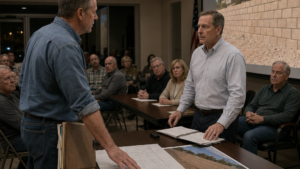
Michael remained seated in the third row, his folded arms resting against his charcoal work shirt. Behind Patricia, the projector displayed a grainy photograph of his backyard fence. Beyond the cedar boards, a strip of blue pool cover was visible.
“My pool,” he said, “is on my deed.”
Patricia gave him the patient smile she used whenever someone mistook disagreement for relevance.
“Ownership isn’t the issue. Exposure is.”
A few chairs shifted. The clubhouse smelled faintly of burnt coffee and carpet cleaner. Sixty folding seats had been arranged for the monthly association meeting, though fewer than thirty residents had come.
Michael looked from the photograph to Patricia’s binder.
“What exposure?”
Patricia opened the binder to a tab marked RISK. The page beneath it carried blocks of dense language and a highlighted paragraph.
“The association’s master insurer reviewed the presence of an unfenced recreational water feature within the development.”
“It is fenced.”
“Separately fenced.”
“It has a locked six-foot gate.”
“There are children in the community.”
“There are children everywhere.”
Ashley Wilson, seated near the aisle, straightened. Her child had wandered near Michael’s gate twice the previous summer while chasing a ball. Michael had returned the ball both times without opening the gate.
“That isn’t really the point,” Ashley said. “One accident could affect everybody’s rates.”
Michael turned toward her.
“My personal liability policy is two million dollars.”
Patricia’s smile tightened.
“This is not a discussion about whether you believe your coverage is sufficient.”
“I don’t believe it. I have the policy.”
“The board has already acted.”
She clicked the remote. A new slide appeared.
SPECIAL RISK ASSESSMENT: $312 PER LOT
A murmur passed through the room.
Michael stared at the amount.
“Per pool owner?”
“Per household,” Patricia said.
The murmur sharpened.
“There are sixty homes,” someone said from the back.
“Yes.”
Michael did the multiplication before anyone else spoke.
“Eighteen thousand seven hundred twenty dollars.”
Patricia closed the binder halfway.
“The total includes insurance adjustments, legal review, administrative compliance, and reserve stabilization associated with the risk category.”
“Associated with my pool?”
“With the community’s exposure.”
His jaw tightened.
He had spent eleven years reviewing insurance-compliance programs before leaving the industry. He knew phrases like associated exposure and reserve stabilization. They were useful because they sounded measurable while often hiding what had not been measured at all.
He also knew how quickly a room stopped listening when an expert began explaining why a phrase meant nothing.
So he asked only, “Where is the insurer’s calculation?”
Patricia looked toward the property manager.
“The underlying file is confidential.”
“Confidential from the people paying it?”
“It contains proprietary risk information.”
Michael glanced at Ronald Miller, the association treasurer. Ronald sat beside Patricia with a calculator near his elbow and his glasses low on his nose. He avoided Michael’s eyes.
“Was there a vote?” Michael asked.
“The board approved the amendment under its emergency authority.”
“What emergency?”
“The possibility of uninsured loss.”
“The pool has been there fourteen years.”
“And exposure can exist for fourteen years before it becomes a claim.”
That line landed more effectively than Michael expected. Several residents nodded. Ashley folded her hands over her purse.
Patricia continued.
“Payment is due within thirty days. Delinquent accounts will incur the standard late charge. Continued nonpayment may result in collection action under the governing documents.”
Michael looked at the projected photograph again. Whoever had taken it had stood on the sidewalk and aimed through the narrow gap between fence boards. The blue cover lay taut across the water, secured at every anchor. It had been installed after his wife became too ill to swim. Keeping it on had become habit long after she died.
He had not opened the pool for two summers.
Now it was being presented as an active hazard.
“Is any other property identified in the amendment?” he asked.
Patricia turned one page in the binder.
“The category applies to all privately maintained aquatic structures.”
“How many are there?”
“That is not relevant.”
“How many?”
The property manager looked down at a printed list.
“One.”
A few people turned toward Michael.
Patricia lifted her chin. “The fact that only one currently exists does not make the rule personal.”
“It makes the bill specific.”
Ashley spoke before Patricia could answer.
“I don’t think anyone is saying you did something wrong, Michael. But if the insurer raised the community’s premium because of the pool, why should everyone else just absorb it?”
He looked at her.
“They shouldn’t.”
The answer seemed to surprise her.
“Then what are you objecting to?”
“The number. The process. The part where nobody can see the file.”
Patricia tapped the binder.
“The board was elected to make decisions that protect property values and reduce risk. We cannot conduct insurance negotiations by committee.”
Michael almost laughed. Not because it was funny, but because he had heard the same logic in corporate conference rooms where managers wanted approval without questions.
Instead, he stood.
“My policy names the association as an additional interested party. The gate meets the county code. The alarm was inspected last year. If the board has an actuarial basis for eighteen thousand seven hundred twenty dollars, provide it.”
Patricia’s expression cooled.
“You may submit a records request through management.”
“I already asked.”
“You asked during a meeting.”
“I asked in writing last week.”
The property manager shifted.
Patricia glanced at her, then back at Michael.
“Then the board will respond within the period allowed by the governing documents.”
“And until then?”
“The assessment stands.”
Michael picked up his jacket from the chair beside him. He could feel the room dividing around him—not into people who trusted Patricia and people who trusted him, but into people who feared the fee and people who feared the pool.
That was more dangerous.
Outside, the streetlights had come on along the cul-de-sac. Sprinklers clicked over small lawns. Through kitchen windows, television light moved against walls.
Michael walked home without speaking to anyone.
At his backyard gate, he checked the lock twice. The latch caught cleanly. The alarm sounded when he opened it, a sharp electronic chirp that stopped when he entered the code.
The blue cover stretched across the pool, darkening under the evening sky. Rainwater from the week before had gathered in a shallow depression near the center. He crouched and tested one of the steel anchors.
Solid.
He went inside and brought out the insurance folder from the cabinet beside his desk. The declaration page confirmed what he had said: two million dollars in personal liability coverage, plus an umbrella policy. The association was listed. The pool and fence were disclosed. No exclusions had been added.
He could have copied the documents and emailed them to every resident.
He could have explained that a master-policy increase attributed to a single residential pool would normally be itemized, limited, and supported by underwriting correspondence.
He did neither.
The neighborhood had ignored every budget meeting for years. Residents had handed Patricia proxies and complained afterward. Michael had stopped attending entirely while caring for his wife. Even after her death, he had kept to the same private routine: work in the garage, groceries on Tuesday, the gate locked, the blue cover closed.
He told himself that the records would settle it.
Facts did not need neighbors.
The next morning, he found a sheet of white paper sealed inside a plastic sleeve and taped directly to the pool gate.
NOTICE OF SPECIAL ASSESSMENT
Amount Due: $312
A yellow warning at the bottom stated that unpaid balances could become a lien against the property.
Michael stood with the key in his hand, looking through the clear sleeve at Patricia’s signature.
Above it, in smaller print, was a line he had not seen on the projector:
Assessment authorized under the board’s amended shared-risk policy, adopted March 18.
March 18 had not been a regular meeting date.
He pulled the notice free and looked toward the clubhouse at the end of the street.
The question was no longer whether Patricia had overreached.
It was who had helped her do it.
Chapter 2: The First Fine Arrived Before Anyone Saw the Records
Betty Lewis placed the lien warning in Michael’s hand before he could set down his garbage bin.
“They’re giving me ten days.”
Her voice was low, though no one else stood near them. She wore a pale cardigan over her house clothes, and one slipper had a darker patch where she had crossed the wet grass.
Michael looked at the letter.
The amount due was $468.
“This isn’t the pool assessment.”
“No. It’s the mailbox.”
He glanced toward the curb. Betty’s black mailbox leaned slightly to one side. A crack ran along the plastic door where the hinge met the body.
“They fined you four hundred sixty-eight dollars for that?”
“First it was seventy-five. Then another seventy-five because I didn’t replace it. Then late charges. Then an inspection fee.” She swallowed. “Now it says collection review.”
Michael read the dates.
The first notice had been issued three days after Betty asked Patricia, during the meeting, whether the pool records would be released.
“Did you appeal?”
“They sent me a form.”
“Did you submit it?”
“I signed what the manager told me to sign.”
“That isn’t what I asked.”
Betty’s face hardened.
“I know what you asked.”
Michael lowered the paper.
She looked toward his backyard fence.
“People think you’re letting us pay because you can afford not to care.”
“My assessment is the same as yours.”
“You know that isn’t what I mean.”
Rain began tapping against the plastic lid of the garbage bin. Behind the fence, water had collected in the center of the blue pool cover, making it sag several inches between the anchors.
Betty pulled her cardigan closed.
“You stand up in that meeting and talk like everybody should understand what you understand. Then you go home.”
“I requested the records.”
“And I requested a hearing. They gave me a form.”
Michael felt irritation rise, automatic and familiar.
“What do you want me to do about your mailbox?”
The hurt in her face came before the anger.
“I wanted you to tell us whether the charge was real before they started punishing people for asking.”
She took the letter back from him.
“You’re the one who knows this stuff.”
Then she walked across the street, one slipper darkening further in the rain.
Michael remained beside the garbage bin until the collection truck turned into the cul-de-sac.
By ten that morning, he was inside the management office.
The property manager sat behind a desk crowded with violation photographs and unopened envelopes. Michael had submitted a formal records request eight days earlier. She located it in a stack beside her keyboard.
“The board is still reviewing the scope.”
“The scope is the insurance correspondence, the invoice, the board minutes, and the assessment calculation.”
“Yes.”
“So what requires review?”
“Some of the documents may be privileged.”
“An invoice isn’t privileged.”
She looked toward the closed door behind her.
“I’m not making that determination.”
“Who is?”
“The board and association counsel.”
Michael placed a copy of Betty’s lien warning on the desk.
“Is the board also reviewing why enforcement increased after residents requested financial records?”
The manager’s mouth tightened.
“Violations are processed separately.”
“By whom?”
“Under the board’s direction.”
“Patricia’s direction.”
“I didn’t say that.”
“You didn’t need to.”
The manager turned to her computer.
“I can show you the nonconfidential portion of the assessment resolution.”
She printed four pages and slid them across the desk.
The first page restated the $312 amount. The second described “enhanced risk-administration services.” The third referred to legal consultation. The fourth contained a budget line labeled contingency and stabilization allocation.
Michael read the phrase twice.
“This isn’t solely an insurance assessment.”
“It’s related to insurance.”
“That isn’t the same thing.”
“The classification created additional administrative needs.”
“How much of the three hundred twelve dollars is premium?”
The manager shook her head.
“That information is in the confidential file.”
Michael looked at the pages again. The language was carefully arranged so that every cost appeared to flow from the pool without identifying any actual service.
“Who drafted this?”
“The board’s consultant assisted.”
“What consultant?”
She reached for the papers.
Michael kept one finger on the final page.
“What consultant?”
“I’m not authorized to discuss vendor contracts.”
He released the page.
Outside, he called Ronald. The treasurer answered after six rings.
“I’m not discussing board business privately,” Ronald said.
“Then discuss arithmetic.”
A pause.
“What do you want?”
“Does the $312 include reserve funding?”
“I can’t answer that.”
“That means yes.”
“It means the board has procedures.”
“Did the insurer invoice the association for eighteen thousand seven hundred twenty dollars?”
Another pause, longer this time.
“Submit your questions in writing.”
“I did.”
Ronald ended the call.
Michael sat in his truck with the four pages on the passenger seat. The rain streaked the windshield, blurring the clubhouse across the parking lot.
Enhanced risk-administration services.
Contingency and stabilization allocation.
Those were not premium categories. They were containers.
Back home, he spread his personal insurance policy, the assessment resolution, and the association’s previous annual budget across the dining table. The prior year’s master insurance premium was listed, but the current year’s had not been included in the meeting packet.
He made three columns on a legal pad.
Insurance.
Administration.
Reserve.
The assessment resolution gave no amount for any of them.
At noon, Ashley knocked on his door.
“My child told me someone took pictures through your fence,” she said.
Michael looked past her toward the sidewalk.
“Someone did.”
“Was it the board?”
“The photograph was in Patricia’s presentation.”
Ashley rubbed one thumb along the strap of her purse.
“I still think the safety issue matters.”
“So do I.”
“Then why didn’t you say that?”
“I said the pool is secured.”
“That sounded like you were telling us not to worry.”
“I was telling Patricia not to invent a price.”
Ashley glanced toward the gate.
“People don’t know the difference.”
“I can’t fix what people refuse to understand.”
Her expression changed.
“That’s convenient.”
She left before he answered.
By evening, Betty’s accusation had settled differently in him. So had Ashley’s.
He had treated clarity as something other people were obligated to reach on their own.
After dinner, he opened the filing cabinet in his study. His old compliance records occupied two drawers. Beneath them sat neighborhood documents he had stopped reading years earlier.
He searched for the March meeting packet.
It was not there.
He checked his email archive instead, using terms from the assessment resolution. Shared risk. Aquatic structure. Stabilization.
One result appeared from December, four months before Patricia’s announcement.
The sender was Patricia King.
The subject line read: Draft Risk Amendment—Request for Technical Review.
Michael did not open it immediately.
He remembered the message now. Patricia had sent it during the last weeks of his wife’s illness, when he answered work-related questions only if they threatened an immediate deadline. He had glanced at the attachment, seen the association logo, and moved it to a folder marked LATER.
Later had never come.
He opened the email.
Patricia’s message was brief.
Michael—given your insurance background, please review the attached language before the board proceeds. I am especially concerned about community exposure from private pools. Your comments would be appreciated.
The attachment loaded.
Across the first page was an earlier version of the same amendment.
Near the bottom, beside a photograph of his blue pool cover, a yellow note carried his own initials.
MH: Classification too broad. Require insurer basis before assessment.
Michael stared at the comment.
He had not merely received the draft.
He had reviewed it.
Chapter 3: Three Numbers Silenced the Entire Clubhouse
The microphone died halfway through Michael’s first sentence.
“The association collected eighteen thousand seven—”
A soft pop came through the speakers, followed by silence.
Michael looked down at the dead green light.
At the front table, Patricia rested one hand beside the audio control panel.
“Your allotted comment concerns your records request,” she said. “Not allegations against the board.”
The clubhouse was full this time. Residents stood along the back wall and crowded the doorway. Betty sat near the aisle but did not look at Michael. Ashley stood beside her child near the rear, one hand on the child’s shoulder.
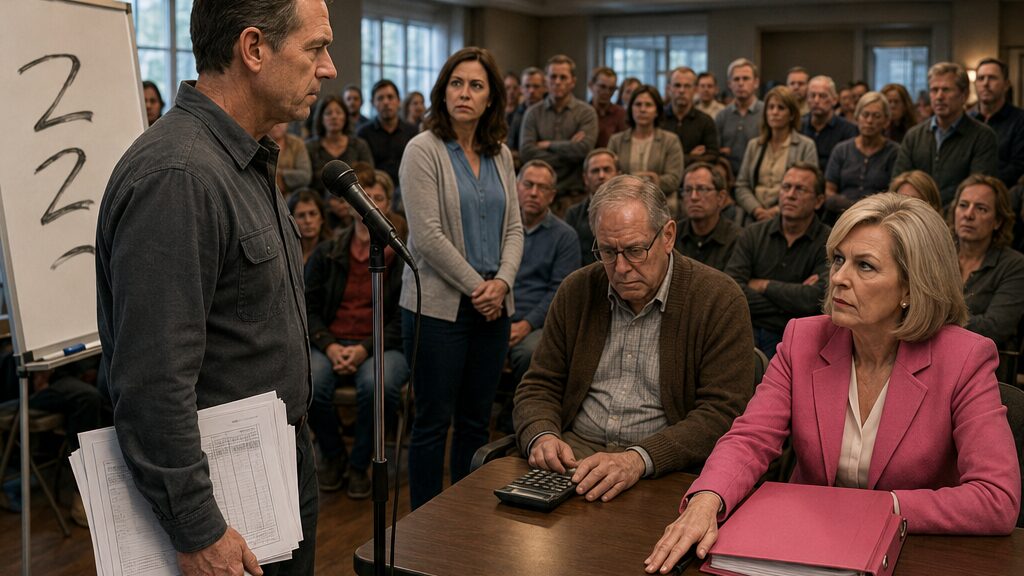
Michael set his papers beside Patricia’s pink binder.
“My records request concerns the assessment.”
“You may state your request.”
“I requested the invoice used to calculate three hundred twelve dollars per household.”
“And the board responded that portions of the file are confidential.”
“The board produced enough.”
Patricia’s eyes narrowed.
Michael turned away from the microphone.
A whiteboard stood against the wall near the emergency exit. He picked up a black marker and wrote in large figures:
$18,720
The room quieted.
Patricia said, “Mr. Hall, you are out of order.”
Michael wrote beneath the first number:
$2,820
Then, below that:
$15,900
He capped the marker.
“Ronald,” he said.
The treasurer looked up sharply.
“Did the association collect sixty payments of three hundred twelve dollars?”
Ronald glanced at Patricia.
“Answering financial questions outside the agenda—”
“Is that number accurate?”
Patricia leaned toward him. “You are not required to participate in this display.”
Michael waited.
Someone near the back said, “It’s basic math.”
Another resident added, “We all paid it.”
Ronald removed his glasses and cleaned them with the edge of his shirt.
“The receivable was eighteen thousand seven hundred twenty dollars,” he said.
The room stirred.
Michael pointed to the second number.
“Did the insurer increase the annual master premium by two thousand eight hundred twenty dollars?”
Patricia closed her binder.
“The premium cannot be isolated from the costs required to address the exposure.”
“That wasn’t the question.”
“Insurance placement involves consultation, legal review, administration—”
“Ronald.”
Ronald’s face had gone pale.
“The endorsement was two thousand eight hundred twenty,” he said.
This time the room did not stir.
It stopped.
Michael let the silence hold.
Then he pointed to the final number.
“Where is the remaining fifteen thousand nine hundred dollars?”
A chair scraped against the floor.
Ashley moved closer to the front.
Patricia stood.
“This presentation is misleading. The assessment resolution clearly states that the amount includes necessary associated expenses.”
“Then itemize them.”
“The board is not obligated to negotiate its budget line by line during homeowner comment.”
“Not negotiate. Explain.”
“The association faced immediate exposure.”
“The insurer charged forty-seven dollars per household.”
A voice near the wall repeated, “Forty-seven?”
Michael nodded.
“Sixty homes. Forty-seven dollars each. That is the premium increase.”
Ashley spoke over the growing murmur.
“Then why were we charged three hundred twelve?”
Patricia addressed the room rather than Michael.
“The policy could not have been secured without risk-management services. Counsel advised the board to act promptly. The reserve position also required stabilization because any uncovered event could have created a special assessment far larger than this one.”
“Reserve position?” someone asked.
Michael looked at Ronald.
The treasurer’s shoulders lowered.
“Part of the balance was transferred,” Ronald said.
“To what?” Michael asked.
“The reserve account.”
“How much?”
Patricia struck the table once with her palm.
“This is precisely why financial matters should not be reduced to three numbers on a board.”
The sharp sound made Ashley’s child flinch.
Michael did not raise his voice.
“How much, Ronald?”
Ronald looked toward the residents, then at the pink binder covering the edge of an invoice.
“Eight thousand,” he said.
The reaction came in pieces.
A disbelieving laugh.
Someone saying, “You moved our money?”
Betty whispering, “Without telling us?”
Patricia reached for control.
“The transfer protected every property owner in this room. Our reserves are below recommended levels. The retaining wall behind the south lots has continued to shift. If it fails, the association bears the cost.”
“That assessment was for the pool,” Ashley said.
“It was for risk.”
“You told us the pool caused it.”
“The pool triggered the insurance review that exposed broader vulnerabilities.”
Michael looked at the whiteboard.
The clean answer he had expected was already breaking apart. The missing money had not simply vanished. Some of it had been moved into a legitimate association account, though under a false explanation.
He pointed to the binder.
“Move that.”
Patricia stared at him.
“The invoice underneath your binder.”
“This document contains proprietary vendor information.”
“Then turn it face down after Ronald confirms the amount.”
“You do not control this meeting.”
“No,” Michael said. “But neither do you alone.”
Ronald reached toward the binder.
Patricia placed her hand on it.
For a moment neither moved.
Then one of the other board members said quietly, “Patricia.”
She released it.
Ronald slid the binder aside.
The invoice beneath it showed a total of $2,820 from the master insurer. Below it lay a second document, partially obscured, bearing the heading CONSULTING SERVICES.
Michael saw the amount before Patricia covered it with another page.
$5,400.
The residents saw enough.
“What consulting?” Betty asked.
Patricia gathered the papers.
“Services necessary to obtain and structure coverage.”
“Who provided them?” Michael asked.
“That contract is under legal review.”
“Was it competitively bid?”
“This is not a procurement hearing.”
“Was it disclosed?”
Patricia’s face had lost its public smile.
She looked at Michael with something closer to calculation.
“You are presenting yourself as though you discovered a secret process,” she said. “But you were consulted before the policy was adopted.”
The room shifted again.
Michael felt it before anyone spoke.
Betty finally looked at him.
Patricia opened the pink binder to a plastic sleeve and removed a printed email.
“Mr. Hall received the draft amendment in December,” she said. “The board requested his technical review because of his professional background.”
Ashley stared at him.
Michael kept his eyes on Patricia.
She held up the page.
“He commented directly on the language.”
The silence was different now. Not shock at a number, but attention turning toward a person.
Michael could have denied the implication. He could have said Patricia ignored his warning. He could have explained the hospital visits, his wife’s final weeks, the unopened messages, the months in which the rest of the world had seemed like paperwork sliding under a closed door.
Instead, he said, “I saw the draft.”
Betty’s mouth tightened.
“When?”
“December.”
“And you didn’t tell anybody?”
“I told Patricia the classification was too broad and that no assessment should be imposed without an insurer’s basis.”
Patricia lowered the email.
“But you did not object publicly. You did not attend the January discussion. You did not warn your neighbors. You allowed the board to proceed.”
Michael looked around the room.
Every face that had turned toward Patricia was now divided between them.
His three numbers remained on the whiteboard, black and undeniable.
So did the email in Patricia’s hand.
He had exposed the board’s arithmetic.
She had exposed his silence.
Chapter 4: The Missing Money Was Hiding Two Different Failures
Michael opened the old email again at 6:12 the next morning, as if the words might rearrange themselves while he slept.
They did not.
Patricia’s December message remained brief and practical. The attachment still carried his initials beside the warning he had typed: Classification too broad. Require insurer basis before assessment.
He had seen the danger before anyone in the clubhouse.
Then he had closed the file.
By seven, copies of the email had begun circulating through the neighborhood. Patricia had not sent the full exchange—only the page showing that Michael reviewed the draft. One resident had slipped it under Betty’s door. Another had posted a photograph of it in the association’s private online group before the property manager disabled comments.
Michael stood at his dining table surrounded by invoices, budget reports, and the three figures he had written on the whiteboard. For the first time, the numbers felt easier than the truth.
A knock came at the front door.
Ronald Miller entered without removing his rain jacket.
“You made me look like a thief,” he said.
Michael stepped aside to let him in.
“You confirmed the numbers.”
“In a room full of people who already decided what they meant.”
“What do they mean?”
Ronald glanced at the papers.
“That depends on which mistake you want first.”
Michael pulled out a chair.
Ronald remained standing.
“The association has thirty-one thousand dollars in reserves,” he said. “It should have more than twice that.”
“For what?”
“The south retaining wall. Drainage. Clubhouse roof. The pavement patching we delayed last year.”
“Why was none of that in the assessment notice?”
“Because Patricia said nobody would approve another repair assessment.”
“So she disguised it as insurance.”
Ronald looked toward the window.
“She called it bundling related risk.”
Michael gave a short, humorless breath.
“That is not a budget category.”
“I know.”
“Then why did you sign the transfer?”
Ronald finally sat.
“Because the engineer’s estimate for the wall was forty-six thousand dollars, and we had enough cash to handle maybe half of it. Because every time we raised dues, owners accused us of wasting money. Because the last reserve-study meeting had nine people in the room, and three left before the vote.”
He rubbed both hands over his face.
“And because Patricia said the new premium gave us an opportunity to correct the shortage before anyone got hurt.”
Michael studied him.
“Did you know about the consultant?”
“I knew there was a consultant. I did not know he was family.”
“How much was paid?”
“Five thousand four hundred.”
“For what work?”
“He dealt with the broker. Reviewed risk language. Attended two calls.”
“Deliverables?”
Ronald looked at him.
“You sound like you already know.”
“I know the invoice did not list any.”
Ronald took a folded sheet from his jacket and placed it on the table.
It was a reserve ledger.
Eight thousand dollars had been transferred from the special-assessment account two days after collection began. Two thousand eight hundred twenty had gone to the insurer. Five thousand four hundred had been paid to a consulting firm.
That accounted for sixteen thousand two hundred twenty dollars.
Michael ran a finger down the page.
“What about the remaining two thousand five hundred?”
“Legal review and management fees. Some is still in the operating account.”
“So the money was not missing.”
“Not in the way people think.”
“It was collected under a false explanation.”
Ronald’s expression tightened.
“Yes.”
The answer landed harder because it was not defensive.
Michael turned to the engineer’s report Ronald had brought. Photographs showed cracks in the retaining wall behind the south lots. In one image, soil bulged through a joint near a drainage outlet. The report recommended stabilization before the next heavy storm season.
A real problem.
A hidden problem.
Patricia had not invented every risk. She had used one visible threat to conceal another.
Ronald looked at the email open on Michael’s laptop.
“You warned her.”
“I typed one comment.”
“You could have come to the meeting.”
“My wife was in hospice.”
Ronald’s anger faltered, but did not disappear.
“I know.”
Michael closed the laptop.
“I stopped reading association mail. I stopped answering calls. I told myself none of it mattered.”
“And Patricia learned that nobody who understood the documents was going to challenge her.”
The sentence stayed between them.
At noon, Michael went to Betty’s house.
She opened the door but kept the storm door locked.
“I came to explain.”
“You came because everyone knows.”
“That too.”
Betty looked past him toward the street.
“Did you see the amendment before she passed it?”
“Yes.”
“Did you know it was about your pool?”
“Yes.”
“Did you tell her it was wrong?”
“I told her the classification was too broad.”
Betty waited.
Michael understood what she was asking.
“No,” he said. “I did not tell the neighborhood.”
Her mouth pressed into a thin line.
“My lien notice came because I asked a question you could have helped answer four months ago.”
“I did not know about the assessment amount.”
“But you knew she was building the rule.”
“Yes.”
Betty unlocked the storm door, not to invite him inside, but so he could hear her without the glass between them.
“You stood in that room like you were the only honest person there.”
“I was angry.”
“So was I.”
“I should have said what I knew.”
“You should have said it before Patricia said it for you.”
Michael nodded.
Betty folded her arms.
“I believed you because you made the numbers plain. I don’t know what to believe now.”
“The numbers are still true.”
“That is exactly how you talk.”
He looked at her.
“What does that mean?”
“It means you think being correct excuses being absent.”
She closed the door gently.
The lock clicked.
Later that afternoon, the property manager allowed Michael to inspect the association’s vendor file under supervision. He sat at a narrow conference table while she placed documents in front of him one folder at a time.
The consultant’s contract was four pages long.
Scope of services: strategic risk coordination, coverage facilitation, community exposure review.
No hourly rate.
No deliverables.
No bidding record.
No conflict-of-interest disclosure.
The signature at the bottom belonged to Jeffrey Carter.
Michael wrote the name on his legal pad.
“Who is he?” he asked.
The manager said nothing.
Michael turned to the W-9. The mailing address was in another county. The emergency contact listed Patricia King.
He looked up.
The manager’s eyes dropped to the table.
“Her brother?”
“Brother-in-law,” she said quietly.
“Was that disclosed to the board?”
“I wasn’t in the executive session.”
“That was not my question.”
She pressed her lips together.
Michael returned to the invoice.
Jeffrey had billed the entire fee in advance, three days before the amendment was formally adopted.
At the bottom of the page, under payment authorization, were two initials.
PK.
RM.
Michael stared at them.
The reserve deficit explained why Patricia wanted money.
It did not explain why her brother-in-law was paid before the rule existed.
Chapter 5: Patricia Finally Explained What the Rules Could Not
Patricia arrived at Michael’s house on Saturday morning carrying a single white envelope.
No binder.
No property manager.
No board members.
She stood outside the locked pool gate in a navy coat, one hand resting on the latch as though testing whether it would give.
It did not.
Michael came down the side path.
“What are you doing?”
“Confirming the gate closes.”
“You already have photographs.”
“Photographs do not tell you whether a latch catches.”
She pulled once more. The metal held.
Beyond the fence, the blue cover stretched tightly across the pool.
Patricia removed her hand.
“I brought a resolution.”
She held out the envelope.
Michael did not take it.
“What resolution?”
“Your assessment would be canceled. The association would confirm that your existing coverage and safety measures satisfy the amended standard.”
“Mine only?”
“Yes.”
“And everyone else?”
“The board would address refunds after the financial review.”
“What do you want?”
Patricia looked toward the neighboring houses.
“Withdrawal of your demand for a special association vote.”
Michael took the envelope then. Inside was a one-page waiver already signed by Patricia and one other board member.
It did exactly what she promised.
His $312 charge would disappear. The pool would be exempt. The board would release the lien threat connected to any assessment dispute on his lot.
At the bottom was a confidentiality clause.
“You called this a resolution.”
“It resolves your complaint.”
“My complaint was that sixty households were misled.”
“Your complaint began with your property.”
“And yours began with a photograph through my fence.”
Patricia’s face changed, not much, but enough.
“Do you know what a child looks like after being pulled from a pool?”
Michael said nothing.
“I do.”
She looked through the boards toward the covered water.
“Years ago, before I moved here, I served on a management committee for another community. A family rented a house with an unsecured pool gate. Everyone assumed the owner’s insurance would handle anything that happened.”
Her hand closed around the gatepost.
“A boy got through. He survived, but not unchanged. The owner blamed the tenant. The tenant blamed the association. The insurer denied part of the claim because the inspection records were incomplete. The board had discussed the gate twice and done nothing.”
Patricia’s voice remained controlled, but the words had lost their meeting-room polish.
“I sat with that child’s mother while attorneys argued about whether the minutes accurately reflected a warning. People who had ignored every meeting suddenly demanded to know why we had not protected them.”
Michael looked at the blue cover.
“That does not justify hiding an assessment.”
“No. It explains why I did not wait for sixty homeowners to become interested in risk.”
“You did not ask them to become interested. You told them what to pay.”
“Because the reserves were failing and the insurer had finally noticed an exposure we had ignored.”
“The insurer increased the premium by forty-seven dollars per household.”
“The insurer would not finalize the endorsement until the risk language was reviewed.”
“By Jeffrey.”
“Yes.”
“Your brother-in-law.”
“Yes.”
The directness surprised him.
“Did the board know?”
“Ronald knew there was a personal connection.”
“Did he know it was family?”
“He knew Jeffrey had worked with me before.”
“That is not disclosure.”
“No.”
The word came quietly.
Michael waited.
Patricia looked down the cul-de-sac.
“The regular broker would not move quickly. Two other consultants would not take a small association on short notice. Jeffrey understood the carrier and turned the language around in three days.”
“He billed five thousand four hundred dollars before the amendment passed.”
“He knew the work had been authorized.”
“By you.”
“By the executive committee.”
“Where are the minutes?”
“There are notes.”
“Not minutes.”
Her eyes sharpened.
“You think every failure is a scheme because you know how to read an invoice.”
“And you think urgency turns permission into paperwork after the fact.”
For a moment, neither spoke.
A child’s bicycle rolled along the sidewalk at the far end of the street. Patricia watched until it passed.
“I did not receive money from Jeffrey,” she said.
“I did not accuse you of that.”
“You let the room believe it.”
“I asked where the money went.”
“And now you know.”
“I know some repaired a reserve shortage you concealed. I know some paid your relative under a contract with no deliverables. I know Betty received a lien warning after asking questions.”
“The mailbox fines began before the assessment.”
“The collection escalation did not.”
Patricia’s jaw set.
“Betty ignored three notices.”
“Because she did not understand them.”
“That does not erase the violation.”
“No. It shows why rules without judgment become punishment.”
Patricia looked at him with tired anger.
“You disappeared for three years, Michael. You did not attend budget meetings. You did not answer the draft review. You did not care how the association functioned until it touched your gate.”
The words found their mark because they were true.
He held up the waiver.
“And you believe that makes this acceptable?”
“I believe it makes your sudden moral certainty incomplete.”
She stepped closer.
“If you proceed with the special vote, I will release the full December correspondence. Not the page you saw at the meeting. All of it. Your notes. My request. The follow-up you never answered.”
“You should.”
Patricia studied him.
“Some of the people supporting you will not.”
“That is their decision.”
“And when the audit costs ten thousand dollars? When refunds empty the operating account? When the wall behind the south lots fails because everyone demanded their money immediately?”
“Then we tell them the truth and let them choose among real costs.”
“They will choose what hurts least today.”
“Maybe.”
“And blame the board tomorrow.”
“Probably.”
A faint, bitter smile touched her face.
“Then you finally understand the job.”
Michael looked at the waiver again. One signature could restore his privacy, remove the charge, and end the pressure on his property.
For years, that would have been enough.
He tore the page once down the middle.
Patricia’s expression hardened.
He tore only the waiver section, leaving the confidentiality clause attached to the lower half.
“I am keeping this,” he said, “because residents should see what you offered.”
“You are making a mistake.”
“I already made mine in December.”
He walked past her toward the front of the house.
At his desk, he completed the formal petition for a special association meeting and attached three documents: the insurer’s invoice, the reserve ledger, and Patricia’s proposed waiver.
Before filing it, he added his December email.
Not just the page Patricia had shown.
All of it.
By sunset, the property manager had confirmed receipt.
The special vote was scheduled for the following Thursday.
Michael stood at the pool gate as the confirmation arrived on his phone. Behind him, the blue cover held steady under the fading light.
This time, there would be no private settlement and no private version of the truth.
Chapter 6: The Audit Vote Required More Than Blaming One Woman
Michael began the emergency meeting with the sentence Patricia had expected him to avoid.
“I knew about the draft amendment in December, and I did not warn any of you.”
The clubhouse was so crowded that the property manager had opened the side doors. Residents stood outside beneath the covered walkway, listening through the doorway.
Patricia sat behind the front table with her pink binder open. Ronald occupied the chair beside her but had placed his treasurer’s key and association calculator on the table as if preparing to surrender both.
Michael stood near the whiteboard.
No microphone had been offered.
He did not ask for one.
“My wife was in hospice,” he continued. “I reviewed one page, wrote that the classification was too broad, and stopped responding. That explains my silence. It does not excuse it.”
Betty sat in the first row. Her lien warning rested folded in her lap.
Michael looked toward her.
“I acted as though understanding the documents made me less responsible for helping anyone else understand them. It did not.”
No one interrupted.
Patricia closed one hand around the edge of her binder.
Michael turned to the board.
“The assessment was still adopted without a homeowner vote. The insurance increase was still forty-seven dollars per lot. The contract with Jeffrey Carter was still undisclosed. Those facts do not become acceptable because I failed too.”
A resident near the back asked, “Are we getting our money back or not?”
Another answered before Michael could.
“We should remove the whole board first.”
Patricia stood.
“If the association issues immediate full refunds, the operating account will fall below the amount needed to maintain insurance and begin the retaining-wall work.”
A wave of objections rose.
She lifted her voice.
“This is not a threat. It is arithmetic.”
Michael uncapped a marker.
On the whiteboard, beneath the earlier figures, he drew three columns.
REFUND
REPAIRS
RECOVERY
“Then let’s use all the arithmetic,” he said.
He wrote $18,720 under the heading.
Below it, he listed the confirmed uses: $2,820 premium, $8,000 reserve transfer, $5,400 consulting fee, and the remaining legal and management expenses.
Ashley moved closer from the back of the room.
“Was the full assessment required by the insurer?” she asked.
Patricia answered carefully.
“The insurer required the endorsement and risk controls.”
“That was not my question.”
Michael looked at Ronald.
Ronald took off his glasses.
“No,” he said. “The insurer did not require a $312 assessment.”
Ashley’s face tightened.
“So we were told we had to pay because of Michael’s pool.”
“The pool triggered the review,” Patricia said.
“But the rest was for a wall and a consultant.”
“For broader association exposure.”
Ashley shook her head.
“My child was part of why I supported this. You knew that. You let me stand here and accuse him of making us pay for his risk.”
Patricia’s expression shifted.
“I did not ask you to accuse anyone.”
“You did not correct me.”
The room went still again, but this time Patricia did not reach for the binder.
Michael opened it himself.
She moved as if to stop him, then let her hand fall.
He turned the pages one by one.
Insurance correspondence.
Draft amendments.
A consultant invoice.
A page labeled executive session notes.
Then an empty sleeve where formal minutes should have been.
Michael held it up.
“There is no recorded vote approving Jeffrey Carter’s contract.”
One of the board members leaned toward Ronald.
“Was there a vote?”
Ronald looked down.
“Patricia and I approved emergency engagement. We intended to ratify it.”
“Did you?” the board member asked.
“No.”
The association attorney, seated against the wall, spoke for the first time.
“The lack of ratification and conflict disclosure creates a governance problem. Whether it creates a recoverable claim will require independent review.”
“Independent from whom?” Betty asked.
“From the current board.”
Patricia’s mouth tightened.
“You are all treating an imperfect emergency response as if nothing was accomplished. We obtained coverage. We identified a reserve crisis. We prevented further delay.”
“And punished people who asked how,” Betty said.
Patricia looked at her.
“Your mailbox violation existed.”
“My cracked mailbox did. The lien threat came after I asked for records.”
“The enforcement schedule was automatic.”
The property manager spoke from beside the door.
“No,” she said.
Every head turned.
The manager’s voice shook, but she continued.
“The board president requested accelerated collection review on three accounts.”
Patricia stared at her.
“You were instructed to enforce existing policy.”
“You gave me the account numbers.”
Betty unfolded the lien notice.
“Was mine one of them?”
The manager nodded.
Betty closed her eyes briefly.
When she looked at Michael, her expression remained guarded.
“You should have told us in December,” she said.
“I know.”
“And you do not get to make yourself the good man because you admitted it first.”
“I know that too.”
She faced the board.
“But he showed us his email. Patricia showed us only the part that protected Patricia.”
The distinction changed the room.
Not absolution.
Trust, offered with conditions.
Michael wrote the proposed audit motion on the whiteboard: suspend the assessment, preserve insurance coverage, commission an independent audit, freeze further consultant payments, and review all retaliatory enforcement.
A resident called for immediate refunds.
Another demanded that the reserve transfer remain untouched.
Someone from the south lots said the retaining wall had shifted again after the last storm.
The meeting broke into overlapping arguments.
Michael listened until the divisions became clear. Residents wanted justice, but each person defined justice by the loss nearest to them.
He erased the word FULL from the refund proposal.
“We cannot return every dollar tonight without creating another emergency,” he said. “That does not mean the board keeps it.”
He drew a schedule.
First refund: the unsupported portion not needed for insurance or urgent engineering.
Second refund: after recovery from Jeffrey’s contract, if the audit found the fee excessive or unauthorized.
Temporary dues: limited, itemized, and tied only to the retaining wall.
A resident near the door laughed bitterly.
“So we get refunded and charged again.”
“Yes,” Michael said.
“That is ridiculous.”
“It is also honest.”
Patricia watched him.
For the first time, there was no contempt in her expression. Only exhaustion.
“You think they will thank you for that?” she asked.
“No.”
The vote required a majority of all lots, not only those present. Proxies had been collected under supervision that afternoon.
The property manager counted them with the association attorney.
Fifty-eight votes supported the audit and suspension plan.
Two opposed.
No applause followed.
Ronald removed the treasurer’s key from the table and placed it before the attorney.
“I resign effective after the records transfer,” he said.
Patricia remained seated.
The attorney informed her that the board would meet separately to consider temporary removal of officers pending the audit.
She closed the pink binder.
The sound was small.
Michael looked at the whiteboard. The figures were no longer a clean accusation. They had become obligations: money to return, repairs to fund, fees to recover, trust to rebuild.
The property manager distributed the adopted motion.
At the bottom, beneath the phased refund schedule, was a new line:
Temporary emergency dues may be levied solely for documented retaining-wall stabilization, subject to monthly public accounting.
Betty read it twice.
“So we won,” someone behind her said.
She looked at Michael.
“No,” she replied. “Now we have to pay for what was actually ours.”
The meeting ended with residents lining up for copies of the records they had once ignored.
Michael remained by the whiteboard until the room emptied.
On it, the three columns stayed visible.
Refund.
Repairs.
Recovery.
For the first time, none of them could be hidden inside a single word like risk.
Chapter 7: The Pool Stayed Private, but the Silence Did Not
Sixty refund envelopes arrived on the same afternoon as the temporary dues notice.
The envelopes were white, ordinary, and addressed by the management company. The dues notice was yellow.
By five o’clock, both had become objects of suspicion.
Residents stood at the cluster mailbox comparing amounts. Some held checks for the first phased refund. Others unfolded the yellow notice and read the monthly charge for retaining-wall stabilization as though it had been slipped into the packet to cancel the victory.
Michael opened his envelope at the edge of the sidewalk.
The refund was less than half of the original assessment.
The attached statement showed exactly why.
Insurance endorsement retained.
Legal and management charges under review.
Reserve transfer temporarily restricted.
Consulting fee subject to recovery.
No unexplained category remained.
Across the street, Betty Lewis held her refund check in one hand and the dues notice in the other.
“So they give me money back,” she said, “then ask for money again.”
“This charge is for the wall,” Michael said.
“I know what it says.”
“The engineering reports are attached.”
“I know how to read now.”
Her tone was not sharp, only firm. Michael nodded.
Three months earlier, he might have begun explaining the difference between an assessment collected under a misleading purpose and a properly noticed temporary due. Now he waited.
Betty looked at the amount again.
“I don’t like it,” she said.
“Neither do I.”
“But I know what it is.”
That was the difference.
The independent audit had taken eleven weeks. During that time, the clubhouse doors remained unlocked during records review hours, and every invoice above five hundred dollars was posted in a glass case near the entrance. The arrangement was awkward and sometimes excessive. Residents appeared with questions about postage, landscaping fuel, and the cost of replacing two broken folding chairs.
Michael answered what he could as a temporary member of the review group.
When he could not, he said so.
The audit report did not deliver the clean conclusion many residents had expected.
There was no evidence that Patricia had received money from Jeffrey Carter.
There was evidence that she had failed to disclose the family relationship, authorized his contract without proper approval, and allowed the assessment notice to imply that the full $312 was required by the insurer.
Jeffrey’s consulting records showed some real work: calls with the carrier, revisions to safety language, and coordination with the broker. They did not support the entire fee. He agreed to repay the undocumented portion rather than dispute the matter through litigation.
The association canceled his contract.
Ronald resigned as treasurer. The audit described his conduct as negligent rather than dishonest. He had approved transfers without demanding complete minutes or itemized support.
Patricia was removed as president by the remaining board.
She did not sell her house.
That fact disappointed some residents more than any line in the audit.
At the next meeting, a homeowner near the rear of the room proposed amending the governing documents to prohibit all private swimming pools.
“It would eliminate the liability entirely,” he said. “No exceptions. No future argument.”
The room began murmuring before he finished.
Michael sat against the side wall. He had expected someone to make the proposal. Fear often survived the facts that had first justified it.
Ashley Wilson raised her hand.
The acting board chair recognized her.
“My child was part of why I supported the original rule,” she said. “I still think the association should require gates, alarms, inspections, and proof of insurance.”
The homeowner nodded impatiently.
“Then banning pools is simpler.”
Ashley looked toward Michael.
“Simpler for whom?”
“For everyone.”
“No. It is simpler for the board.”
The room quieted.
Ashley continued.
“We made Michael’s property into a symbol because it was easier than separating a real safety concern from a financial problem. His pool did not create the reserve shortage. It did not create the missing minutes. It did not create the consultant contract.”
The homeowner crossed his arms.
“It still creates risk.”
“So do retaining walls. So do playgrounds. So do roads. We manage risk. We do not pretend ownership disappears because a board finds it inconvenient.”
Betty lifted her hand from the front row.
“I oppose the ban.”
Several people turned toward her.
She unfolded the draft amendment on her lap.
“I also want this rewritten,” she said. “Half the people in this room could not explain what ‘aquatic exposure mitigation’ means.”
A few residents laughed.
Betty did not.
“If a rule applies to someone’s home, they should understand it before they violate it.”
The final policy required a locked gate, an audible alarm, annual certification of personal liability coverage, and written notice to the association after any material safety change. It did not classify private pools as community property or shared infrastructure. It did not authorize a surcharge without a separate vote and itemized support.
Ashley helped draft the plain-language summary.
Michael reviewed the insurance provisions, then gave the pages back with fewer comments than Patricia’s original draft had received.
The board adopted the policy forty-nine to six.
No one called it a triumph.
After the meeting, the acting chair stopped Michael beside the whiteboard.
“We need a permanent treasurer,” she said.
“No.”
“You have not heard the request.”
“I know the request.”
“You understand the records better than anyone.”
“That is not the same as being suited to the board.”
“You have been doing the work for three months.”
“Temporarily.”
She studied him.
“You are still planning to disappear.”
Michael looked across the clubhouse. Residents gathered around Betty while she explained the refund schedule to someone who had missed the previous meeting. Ashley stacked copies of the safety policy near the door. The property manager replaced an old notice in the glass case with the latest wall invoice.
“I am planning not to make this my life,” he said.
The acting chair smiled slightly.
“That is not what I asked.”
Michael glanced at the whiteboard. The three columns from the emergency meeting had been erased weeks ago, but faint traces remained under the fluorescent light.
Refund.
Repairs.
Recovery.
“I will not join the permanent board,” he said.
Her disappointment was immediate.
“I will stay on the independent review group for six months. Records only. No enforcement. No architectural disputes. No mailbox hearings.”
“That sounds suspiciously specific.”
“It is.”
She extended her hand.
“Six months.”
He shook it.
Outside, Patricia stood near the curb with the pink binder pressed against her side.
Michael had seen her at meetings since her removal, but they had not spoken privately.
She looked older without the front table in front of her.
“The new pool rule passed,” she said.
“It did.”
“It is weaker than I would have written.”
“It is more limited.”
“That is what I said.”
Michael waited.
She looked toward the clubhouse.
“The audit was correct about the disclosure.”
“Yes.”
“And wrong to imply I did not perform any oversight.”
“It did not imply that.”
Her mouth tightened, then relaxed.
“No. I suppose it did not.”
For a moment, they stood with the kind of silence that no longer hid anything useful.
“I still believe people expect boards to prevent disasters they refuse to plan for,” Patricia said.
“They do.”
“And they resent every cost until the damage occurs.”
“They do that too.”
She looked at him.
“You sound less certain than you did in April.”
“I am certain about fewer things.”
A dry smile crossed her face.
“That may qualify you for the board after all.”
“It does not.”
She adjusted the binder beneath her arm.
“I was wrong to use the fines.”
“Yes.”
“I was wrong not to disclose Jeffrey.”
“Yes.”
Her eyes sharpened.
“You could occasionally make an admission easier.”
“You would not trust it if I did.”
This time, her smile remained for a second longer.
“No,” she said. “Probably not.”
She walked toward her house without apology or invitation.
Michael watched until she turned the corner.
The following Saturday, he opened the pool.
He removed the collected rainwater first, then released the anchors one by one. The blue cover slid back across the concrete, exposing water that had stayed clear beneath it. The surface caught the late-afternoon light and sent it wavering against the fence.
He inspected the alarm, tested the gate, and signed the new annual safety form.
At four, Ashley arrived with her child. Betty came carrying a bowl covered with foil. Ronald appeared last, holding a folding chair and looking uncertain about whether he had truly been invited.
“You were,” Michael told him.
The pool was not open to the neighborhood. There was no new rule requiring access, no gesture turning private property into common space.
Michael had invited them.
That mattered.
Betty set the bowl on the patio table.
“I brought too much potato salad.”
“You always say that.”
“I usually do.”
Ashley’s child stood near the shallow end, waiting while Michael checked the gate behind them.
The alarm chirped.
The lock caught.
Michael kept the key in his hand.
Then he folded the blue cover into a clean rectangle beside the fence.
For years, the cover had meant absence. Then accusation. Then proof that people could look at the same object and see whatever fear required.
Now it was simply a cover again—useful, private, and understood.
Michael placed the key in his pocket and joined the others beside the water.
The story has ended.