She Brought Deputies and a Repair Bill, but the Rancher Would Not Sign
Chapter 1: The Bill She Set Beside His Coffee
The first deputy’s truck had barely stopped before John Harris noticed something was wrong.
Not with the trucks. Not with the dust rolling behind them across the ranch yard. Not even with the woman stepping out in a deep purple jacket that looked more suited for a city office than a fence line.
The problem was the way everyone looked at him.
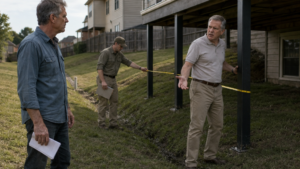
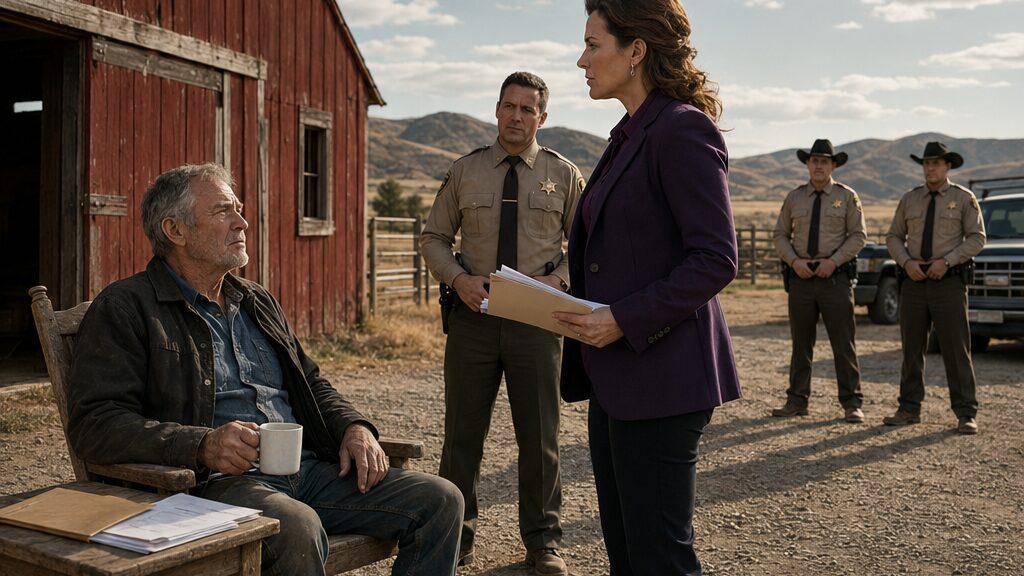
John sat in the old wooden chair beside the red barn, one hand wrapped around his white ceramic coffee mug. The afternoon heat had settled over the pasture, and the cattle were quiet beyond the fence. He had been watching a loose gate hinge near the equipment shed when the vehicles arrived.
Now Laura Roberts stood in front of him with two deputies behind her and a folder tucked under her arm.
She had already decided how the conversation would end.
“John,” she said, walking closer, “we can do this the easy way.”
John looked at the paper in her hand before he looked at her face.
“That usually means someone has already decided what the easy way is,” he said.
Laura ignored the comment. She placed a printed estimate on the small table beside his chair.
The number at the top was large enough that she did not need to point at it.
$68,400.
“The road damage is from runoff coming off your property,” she said. “The retaining slope failed because the water was pushed toward my side.”
John looked down at the estimate. A small metal fence staple sat clipped to the corner of the paper.
A piece of evidence.
Or something meant to look like one.
“You brought the deputies for this?” John asked.
Mark Thomas, the senior deputy standing near the truck, answered before Laura could.
“We’re here for a civil standby,” he said. “That means we’re here to keep things calm. We’re not deciding who owes who money.”
Laura’s expression tightened for just a moment.
“That’s not what I said.”
“It’s what your paperwork says,” John replied.
She opened the second page.
“This is a temporary access agreement. My contractors need to reach the damaged section through your east gate. It’s the safest route.”
John glanced toward the gate near the far fence.
“That gate is on my property.”
“And I’m asking for temporary access because of an emergency.”
“You’re asking for access while asking me to admit responsibility.”
Laura folded her arms.
“You’re making this harder than it needs to be.”
John took another sip from his mug.
The deputies watched. Laura watched harder.
She expected anger. Fear. Maybe a quick agreement from an older ranch owner who did not want trouble.
Instead, John set the mug down directly on top of the estimate.
The wind had started moving the paper.
The mug stopped it.
“I’m not signing that,” he said.
The silence lasted longer than Laura expected.
“You understand what happens next?” she asked.
“I understand you filed a claim.”
“I notified the insurance companies.”
“I figured you did.”
“And if you refuse responsibility, I can pursue a lien.”
John looked at the number again.
The amount was not just a bill. It was pressure.
A number designed to make someone calculate the cost of resisting.
His daughter Emma had warned him about situations like this. She had told him that fighting people with money and paperwork could drain a person faster than any storm.
But John also knew something else.
A person could lose more than money by signing something they knew was wrong.
“Your road wasn’t washed out by my ranch,” he said.
Laura gave a short laugh.
“John, the water came from your side.”
“Did it?”
She stared at him.
“You’re looking at the damage.”
“No,” John said. “I’m looking at your timeline.”
For the first time, Laura’s confidence shifted.
“You have proof?”
John looked past her toward the hills above her property.
He thought about the photographs in his maintenance folder.
The ones he had taken months earlier.
The ones he had never bothered to show anyone because he believed the truth would be obvious.
“I have records,” he said.
Laura stepped closer.
“Records don’t change what happened.”
“Maybe not.”
He looked at the paper beneath his mug.
“But they might change when it happened.”
Mark Thomas glanced at Laura.
She noticed.
“The storm caused the damage,” she said quickly. “The inspection will show that.”
“When?”
She hesitated.
“What?”
“When did the damage happen?”
Laura’s face hardened.
“The storm was last month.”
John nodded slowly.
“That’s not what I asked.”
Nobody spoke.
Finally, Laura pulled the papers back toward herself.
“An adjuster will inspect your culvert in forty-eight hours.”
“My culvert?”
“That’s where the water started.”
John looked toward the drainage ditch near the barn.
He knew the culvert had problems.
He also knew problems did not always tell the whole story.
Laura gathered the estimate and access form.
“This would have been easier if you had just signed.”
John watched her walk away.
The deputies followed, but Mark stayed behind for a moment.
“You know this isn’t a criminal matter, right?” he asked.
“I know.”
“She can’t make you sign.”
“I know.”
Mark looked at the mug sitting on the estimate.
Then at John.
“You always this calm?”
John picked up his coffee.
“No.”
That answer surprised him more than it surprised Mark.
Because it was true.
He was not calm.
He was counting.
The days.
The papers.
The things he had noticed and never reported.
The things he had assumed would explain themselves.
When the trucks disappeared down the gravel road, John remained beside the barn.
The repair estimate was still on the table.
And in forty-eight hours, someone was coming to inspect the one piece of his property that might make him look guilty.
Chapter 2: The Wash Line Beneath the New Gravel
John found the survey ribbon before he found the damage.
It was tied to his fence post, bright orange against the weathered wood, placed on the inside edge of his property line.
Someone had marked his land while he was asleep.
He stood there holding the ribbon between two fingers.
Laura had called it an emergency.
John had learned that emergency was a word people used differently when they needed something.
He walked the fence line slowly, following the direction toward the damaged road. The morning air was cooler, but the ground still carried the dry hardness of late summer.
Near the corner where his pasture met Laura’s gravel road, he stopped.
The washout was obvious.
Loose rock. Broken gravel. A section of the retaining slope carved away.
But something else caught his eye.
The newer gravel was darker than the older ground beneath it.
A repair layer.
John crouched beside the edge.
He did not need a measuring tool.
He had been maintaining land long enough to recognize when something had already happened once.
That afternoon, he went back to the house and opened the maintenance folder.
Emma found him at the kitchen table surrounded by papers.
“You finally opened it,” she said.
John looked up.
“I’ve had it open before.”
“You’ve looked through it.”
“There’s a difference.”
Emma placed her phone on the table.
“I talked to someone who handles property disputes.”
John frowned.
“I didn’t ask you to.”
“I know.”
That answer carried more frustration than anger.
Emma sat across from him.
“Dad, this isn’t a broken fence. This woman is asking for sixty-eight thousand dollars.”
John looked down.
“I know.”
“And she brought deputies.”
“They were there to keep things calm.”
“She brought uniforms because she knew it would pressure you.”
John did not answer.
Because she was right.
Emma opened the photograph he had taken months earlier.
The image showed the same section of road.
At first glance, it looked ordinary.
Then she noticed the fence post.
“Is that the same one?”
John pulled a receipt from the folder.
A hardware store receipt.
The date was written near the top.
“That post was replaced during the fence repair,” he said.
Emma looked between the photograph and the receipt.
“So the wash line was there before the storm?”
John nodded.
“Maybe.”
“Maybe?”
He leaned back.
“That photograph proves the road had a problem before the storm she named.”
“It proves more than that.”
“No.”
Emma looked at him.
“You always do this.”
“Do what?”
“Make yourself smaller when someone pushes.”
John closed the folder.
“I’m trying not to say more than I know.”
“That’s different.”
The words stayed with him.
Later that day, Laura called.
Her voice was professional.
Too professional.
“John, I understand you’re looking into this.”
“I’m looking at my property.”
“The inspection team will need access.”
“Through my gate?”
“Yes.”
“Without an agreement?”
A pause.
“You’re being difficult.”
“No. I’m asking a question.”
Laura sighed.
“My contractor has already provided information showing the water originated from your drainage system.”
John looked toward the folder.
“Who was your contractor?”
“Joseph Campbell.”
John knew the name.
He had seen the equipment.
Months earlier.
Near the upper slope.
He had watched the machines move dirt and assumed the work would not affect him.
That assumption bothered him now.
“Did Joseph tell you when the road first showed damage?”
Laura became quieter.
“He told me what he observed.”
“That wasn’t my question.”
She ended the call shortly after.
That evening, Catherine Lopez from the insurance company called.
Her tone was careful.
“Mr. Harris, I’m reviewing the submitted claim.”
“And?”
“I need to inspect the culvert.”
“You believe it caused the damage?”
“I believe we need to inspect it.”
John appreciated the difference.
After the call, he made copies of the folder.
Not because he trusted the process.
Because he was beginning to understand that private truth was not always enough.
A truth nobody else could see could still lose.
The next morning, Catherine arrived.
Before she even stepped out of her vehicle, she looked toward the drainage channel.
Then she looked at the folder John carried.
“I’ll be honest,” she said. “The contractor statement raises questions.”
“Questions about me?”
“Questions about the water path.”
John nodded.
That was fair.
He led her toward the culvert.
But before they reached it, Catherine stopped.
“There’s something you should know.”
“What?”
“Laura’s file already includes a statement saying the culvert was poorly maintained.”
John looked at the old concrete opening beneath the road.
He knew what she was about to find.
And he knew he would not like it.
The inspection camera entered the pipe the next morning.
The image on Catherine’s screen was not the image John wanted.
Roots.
Packed debris.
A partial blockage.
Catherine looked up.
“Mr. Harris, this culvert has not been cleared recently.”
John said nothing.
Because he knew.
And because admitting it would make everything harder.
Chapter 3: The Culvert That Made Him Look Guilty
The camera stopped inside the culvert, and for several seconds nobody spoke.
John watched the dark image on Catherine Lopez’s screen.
A blocked passage.
A simple fact.
The kind of fact that could become a weapon if placed in the wrong hands.
Laura arrived before the inspection ended.
She stepped from her vehicle with Joseph Campbell behind her.
“You see?” she said.
John looked at her.
“See what?”
“That the problem started here.”
Catherine did not answer immediately.
“That’s not exactly what the inspection shows.”
Laura looked surprised.
“The culvert is blocked.”
“Yes.”
“So the water backed up.”
“Yes.”
“And crossed toward my road.”
Catherine closed the inspection file.
“We need more information.”
Laura shook her head.
“This is exactly why I brought documentation.”
John almost laughed.
Documentation.
The word bothered him.
Because he had documentation too.
He just had never learned to use it like a weapon.
Joseph walked closer to the ditch.
“The water would have followed the easiest path,” he said.
John looked at him.
“And you know that because?”
Joseph glanced toward Laura.
“I graded the area.”
“When?”
“Earlier this year.”
John remembered.
The machines.
The dirt piles.
The temporary fencing.
He remembered thinking the work was temporary.
He remembered deciding it was not his concern.
That memory hurt more than Laura’s accusation.
Because there was a part of the story where he had been silent.
Catherine looked at the notebook in John’s hand.
“Do you have maintenance records?”
“Yes.”
She read the entries.
“Your notes say you cleared this culvert every year.”
John nodded.
“They do.”
“When was the last time?”
John hesitated.
“Two years ago.”
Emma, standing near the truck, looked away.
John knew she was disappointed.
Not because the culvert was blocked.
Because he had done exactly what he always did.
He had handled things privately until they became impossible to ignore.
“I hurt my back,” John said. “Then winter came. Then I thought I would get to it.”
Laura crossed her arms.
“So you admit it was neglected.”
“I admit it needed work.”
“That’s what I said.”
“No.”
John looked at her.
“That’s what you need me to say.”
The words were quiet.
But they landed.
Laura stepped forward.
“Your property caused damage.”
John looked down at the culvert.
Then at the road.
Then at the hills above.
“I don’t know that yet.”
“You’re still denying it?”
“No.”
He turned toward Catherine.
“I’m saying there’s a difference between a problem and a cause.”
Catherine nodded slowly.
That distinction mattered.
But it did not remove the danger.
Because now Laura had something official.
A blocked culvert.
A maintenance failure.
A story simple enough for people to believe.
That evening, Laura came to the ranch again.
No deputies this time.
Just paperwork.
She placed a new agreement on the table.
“The repair amount is reduced,” she said.
John looked at the page.
$24,000.
“And the access?”
“Permanent easement.”
John stared at the document.
The bill had changed.
The demand had softened.
But the road remained.
She wanted the gate.
She wanted a legal path across his property.
“You’re offering to make this easier.”
“Yes.”
“Why?”
Laura looked toward the red barn.
“Because neighbors should solve problems without destroying each other.”
John almost believed she meant it.
Almost.
Then he saw the line about permanent access.
A road was not just a road.
A gate was not just a gate.
His father had taught him that.
Land remembered every agreement made on it.
“I need time.”
Laura nodded.
“Until Friday.”
After she left, Emma sat across from him.
“You could end this.”
John looked at the paper.
“I could.”
“Then why won’t you?”
Because he knew something had changed.
At first, he thought he was fighting a bill.
Now he understood he was fighting a version of the future.
A future where every time someone needed something, they would point to this agreement.
A future where his silence would become permission.
The next morning, John drove to the county records office.
He did not know what he expected to find.
He found an old map.
Faded lines.
A drainage route.
A mark near Laura’s property.
An old swale that had once carried water away from the road.
John stared at it.
The clerk pointed at the faded line.
“That’s approximate.”
“Approximate means?”
“It means it’s not a modern survey.”
John nodded.
Not proof.
Not enough.
But another piece.
When he returned home, there was a message waiting on his phone.
Joseph Campbell.
His voice was low.
“John, we need to talk before Laura makes this worse.”
John replayed the message twice.
Because the person who had helped create Laura’s explanation was now the person trying to warn him.
And that meant the story was not finished.
It meant someone else knew there was more beneath the gravel.
Chapter 4: The Road Deal Hidden Inside the Settlement
The reduced settlement sat beside John’s unpaid medical bill, and that bothered him more than the original demand.
Not because the number was smaller.
Because it looked like a solution.
Emma had placed both papers on the kitchen table before she left for work. One was from the clinic. The other was from Laura.
Two different kinds of pressure.
Two different reasons to sign something quickly.
John stood at the counter, pouring coffee into the same white mug he had carried outside the day Laura arrived with the deputies. The mug had survived years of winters, repairs, and hard mornings.
He wondered how many things on the ranch had lasted simply because nobody had asked too much of them.
When he sat down, he picked up the settlement agreement again.
Permanent access easement.
Those three words bothered him more than the money.
“Dad?”
Emma stood in the doorway.
John looked up.
“I thought you left.”
“I forgot my keys.”
She looked at the papers.
“You’re still thinking about it.”
“Yes.”
“Why?”
John folded the agreement closed.
“Because if I sign it, I’m not just paying for a road.”
Emma walked closer.
“She reduced it from sixty-eight thousand dollars.”
“I know.”
“She’s giving you a way out.”
John looked toward the window.
Beyond the glass was the ranch road that had belonged to his family for decades. The gravel was uneven. The edges were worn. It was not impressive.
But it was his.
“Sometimes a door is only a door,” Emma said.
“And sometimes someone moves the doorway.”
She sighed.
“That sounds like something Grandpa would say.”
John smiled faintly.
“That’s because he did.”
Emma sat across from him.
“Dad, I’m not saying she’s right.”
“But?”
“But I’m scared.”
The honesty in her voice changed the room.
John looked at her.
“Of what?”
“That you’ll spend everything fighting this. That you’ll lose sleep. That you’ll refuse help because you think needing help means you failed.”
John looked down at his hands.
That was closer to the truth than he wanted.
He had spent his life fixing fences, repairing equipment, and handling problems before they reached anyone else.
The ranch had taught him independence.
It had also taught him bad habits.
“Just give me one more day,” he said.
Emma nodded.
“One more day.”
After she left, John drove to the county records office.
He did not bring the folder.
He almost did.
But he stopped himself.
For years, he had carried records as if carrying them was the same as using them.
It was not.
The clerk recognized the property name.
“You’re looking into the road access?”
John looked up.
“Why do you ask?”
“Because Laura Roberts was here last week.”
John waited.
The clerk pulled a faded map from a drawer.
“She asked about historical access routes.”
The paper was old and fragile.
John spread it across the counter.
The lines were faded, but he saw the boundary.
The red barn.
The old fence line.
The road.
Then he saw something else.
A curved marking running across the upper part of Laura’s property.
“What is that?”
The clerk leaned closer.
“Old drainage route.”
John looked at it again.
“That runs uphill from her road.”
“It appears so.”
“Appears?”
The clerk tapped the map.
“These records are old. They’re not a modern survey.”
“So it doesn’t prove anything.”
“No.”
John nodded.
Not enough.
Again.
Every piece of truth arrived incomplete.
But incomplete did not mean useless.
Before leaving, the clerk found another document.
A maintenance record.
A note about the original ranch road.
Not public access.
Private agricultural use.
John stared at the words.
Laura had called it an access route.
She had acted as if his gate was something that could simply be opened because she needed it.
But the county records did not say that.
On the drive home, John stopped beside the red barn.
The afternoon light stretched across the field.
He walked to the corner where the old fence met the road.
He pulled the photograph from his folder.
Then he looked at the actual fence post.
Same wood.
Same bend.
Same repaired section.
The old photograph was not proof of everything.
But now he knew it could prove something important.
The timeline.
When he arrived home, Joseph Campbell was waiting near the driveway.
He stood beside his truck, hat in his hands.
John slowed but did not stop far away.
“You wanted to talk,” John said.
Joseph nodded.
“I do.”
“Why?”
Joseph looked toward the hills.
“Because Laura is starting to say things that weren’t part of the plan.”
John stepped closer.
“What plan?”
Joseph swallowed.
“The grading.”
The answer was quiet.
But it changed everything.
“What about it?”
Joseph looked at the ground.
“I might have something you need to see.”
John did not move.
A month ago, he would have ignored the conversation.
A month ago, he would have assumed the truth would eventually appear without him reaching for it.
Now he understood that sometimes the truth waited until someone had the courage to ask.
“What is it?” John asked.
Joseph opened his truck door.
“A sketch.”
He pulled out a folded piece of paper.
“I should have kept better records.”
John looked at the paper.
Then at Joseph.
“Why are you giving this to me?”
Joseph hesitated.
“Because Laura told me she plans to put all of this on me if the insurance company starts asking different questions.”
The paper remained between them.
Not an answer.
Not yet.
But another piece.
And John knew the next piece might change who everyone believed was responsible.
Chapter 5: The Contractor’s Sketch Left One Line Out
Joseph Campbell did not hand over the sketch immediately.
That was the first thing John noticed.
The second was that Joseph kept looking toward the road, as if expecting Laura’s truck to appear.
“You’re worried about her,” John said.
Joseph folded the paper tighter.
“I’m worried about everybody.”
“That includes yourself.”
Joseph gave a tired smile.
“Yes.”
The honesty surprised John.
They stood beside the truck while the afternoon wind moved dust across the driveway.
Finally, Joseph extended the paper.
“It’s not the whole file.”
John took it carefully.
“What does that mean?”
“It means there were changes.”
John unfolded the sketch.
At first, it looked ordinary.
Measurements.
Elevation notes.
A rough outline of Laura’s hillside.
A proposed drainage adjustment.
But something was missing.
John stared at the lines.
“Where is the old swale?”
Joseph looked away.
“I filled part of it.”
The words landed harder than John expected.
“Why?”
“Laura wanted the slope cleaned up. She was preparing the area for future work.”
“Cabins?”
Joseph did not answer.
That was enough.
John looked back at the sketch.
“You changed the water path.”
Joseph shook his head quickly.
“Not intentionally.”
“But you did.”
“Yes.”
John folded the paper.
“How long did you know this might matter?”
Joseph did not respond.
That was the answer.
“You knew.”
“I thought it would drain normally.”
“Thought?”
Joseph rubbed his forehead.
“John, I’ve worked around dirt my whole life. Sometimes things look different after the first big storm.”
John looked toward the upper slope.
The same slope where he had seen machines months earlier.
The same slope he had watched from a distance.
He had noticed.
And then he had done nothing.
The thought returned like a weight.
His silence had not caused the problem.
But it had allowed other people to tell the first story.
“What does Laura know?” John asked.
Joseph looked uncomfortable.
“She knows I changed the grade.”
“Does she know about the drainage?”
“I told her it might affect the runoff.”
John stared at him.
“And she still filed against me?”
Joseph looked down.
“She said your culvert was the reason the water reached the road.”
John almost believed Joseph did not understand what he was admitting.
Almost.
“So she used the part that was true.”
Joseph said nothing.
That was answer enough.
Later that day, John met Catherine at the edge of the damaged road.
He gave her a copy of the sketch.
Not the original.
He was still learning.
Catherine studied it carefully.
“Where did this come from?”
“A contractor.”
“Did he admit changing the drainage?”
“He admitted enough.”
Catherine looked toward the slope.
The wind moved through the dry grass.
“The blocked culvert still matters.”
“I know.”
That surprised her.
“You’re not arguing against that?”
“No.”
John looked at the pipe opening.
“It needed cleaning.”
Catherine watched him.
“Most people would leave that part out.”
“Most people want to win.”
“And you?”
John looked back at the road.
“I want the right thing to be clear.”
Catherine closed the folder.
“That may be harder.”
“I know.”
The next morning, John received an official notice.
Not from insurance.
From Laura.
Her contractors would arrive Monday morning.
They intended to begin “emergency repairs” using the route through his gate.
Emma read the notice twice.
“She’s doing this anyway?”
John folded the paper.
“She believes she can.”
“Can she?”
John looked toward the gate.
He did not know.
That was the problem.
For years, he had known every inch of his property.
But now paperwork had created a second version of the ranch.
A version where words on pages could become roads through fields.
That evening, John repaired the hinge on the old gate.
Not because he planned to open it.
Because he needed it working.
Emma watched from the porch.
“You’re getting ready.”
John tightened the bolt.
“Yes.”
“For a fight?”
He looked at the gate.
“No.”
She waited.
John placed the wrench down.
“For a conversation where everyone brings the same facts.”
Emma nodded slowly.
It was the closest thing to confidence she had heard from him in weeks.
But Monday morning was coming.
And Laura had already decided where her contractors would enter.
Through John’s gate.
Chapter 6: He Marked the Water’s Path Before Dawn
Before sunrise, John placed the first wooden stake in the ground.
The second went twenty feet away.
The third marked the low point where the grass changed color.
By the time the first vehicle arrived, a line of stakes crossed the ranch like a quiet sentence waiting to be read.
Laura stepped out of her truck and stopped.
“What are you doing?”
John held the folder under one arm.
“Showing the water path.”
She looked across the field.
“You’re making this dramatic.”
“No.”
He pushed another stake into the ground.
“I’m making it visible.”
Mark Thomas arrived a few minutes later.
Behind him came Catherine Lopez.
Joseph arrived last.
Nobody looked comfortable.
That was different from the first day.
The first day, everyone had arrived believing they already knew the ending.
Now everyone was looking.
Catherine walked the route slowly.
She checked the elevation points.
The old drainage mark.
The damaged road.
The culvert.
Then she returned to the group.
“The water could not have started at Mr. Harris’s culvert.”
Laura crossed her arms.
“Because of what?”
“Because the water would have already traveled through this area first.”
She pointed toward the upper slope.
“The source path begins higher.”
Laura looked at Joseph.
He looked away.
John opened the folder.
One document at a time.
The old photograph.
The fence receipt.
The county map.
The contractor sketch.
Not one item solved everything.
Together, they created a timeline.
Laura noticed the coffee stain before anyone else did.
Her eyes moved to the repair estimate.
The original copy.
The same one John had placed his mug on.
“You kept that?”
John looked at the paper.
“Yes.”
“Why?”
“Because it was the first thing you asked me to sign.”
Mark checked his notes.
“Mr. Harris never agreed to liability.”
Laura’s expression changed.
Only slightly.
But John saw it.
The certainty was gone.
Then she reached into her folder.
“I have something too.”
She pulled out a printed email.
John read it.
His own words.
Months earlier.
The message was short.
The culvert could cause trouble if the next storm is heavy.
Emma looked at him.
John closed his eyes for a moment.
There it was.
The part that belonged to him.
He had seen a risk.
He had written about it.
And then he had waited.
Laura lifted the paper.
“You knew.”
John nodded.
“Yes.”
The answer surprised everyone.
Including Laura.
“But knowing a culvert needs maintenance is not the same as causing your road failure.”
He looked at Catherine.
“I should have cleared it sooner.”
Then he looked back at Laura.
“But I won’t sign something that says I created damage I didn’t create.”
Nobody spoke.
The silence felt different from the silence on the day the deputies arrived.
That day, silence belonged to pressure.
Today, it belonged to evidence.
Catherine returned to her notes.
“I need to revise the claim review.”
Laura stared at her.
“Meaning?”
“Meaning the current cause description is not supported.”
The sentence was simple.
But it changed everything.
The repair estimate remained on the table.
The demand remained.
The history remained.
But the story had changed.
Joseph stepped forward.
“I should have documented the grading.”
Laura looked at him.
“You’re blaming me?”
“No.”
Joseph shook his head.
“I’m saying what happened.”
For the first time, nobody was protecting the easiest explanation.
Catherine closed her notebook.
“The claim against John cannot proceed under the submitted cause theory.”
John did not smile.
He did not look at Laura.
He simply picked up his folder.
The same folder he had carried quietly for years.
The difference was that now everyone had seen what was inside.
Three weeks later, he would receive the official withdrawal.
But on that morning, standing beside the red barn and the line of drainage stakes, John understood something important.
The truth had never needed him to become louder.
It had needed him to stop keeping it locked away.
Chapter 7: The Claim Was Gone, but the Boundary Stayed
The envelope was thinner than John expected.
That was what worried him.
For three weeks, he had learned that important things rarely arrived in the size people imagined. The largest threat had arrived on two pages. The strongest evidence had been hidden in a worn folder. The truth had appeared through small details that most people would have walked past.
Now the insurer’s envelope sat on his kitchen table beside his repaired white coffee mug.
John did not open it immediately.
Emma noticed.
“You’re waiting.”
He looked at her.
“For what?”
“For it to be bad.”
John looked back at the envelope.
Maybe she was right.
After weeks of documents, inspections, and arguments, his mind still expected another demand.
Another condition.
Another reason someone else had decided the matter before asking him.
Finally, he opened it.
The letter was short.
The claim against him was withdrawn.
The submitted cause of damage could not be supported by the evidence.
The insurer would continue reviewing the grading work and the contractor’s involvement.
John read it twice.
Then he placed the letter on the table.
Emma watched him.
“That’s it?”
John nodded.
“That’s it.”
She smiled slightly.
“You won.”
John looked toward the window.
The ranch looked the same.
The barn was still red.
The fence still leaned in the same places.
The road still needed repairs.
“No,” he said.
Emma looked surprised.
“What?”
“I proved I wasn’t responsible for something I didn’t do.”
He folded the letter.
“That’s different.”
She sat across from him.
“Dad, most people would call that winning.”
John considered the word.
Maybe she was right.
But the victory did not feel like the moment he had imagined.
There was no satisfaction in watching someone lose.
No feeling of revenge.
Only the quiet relief of no longer carrying a story someone else had written about him.
Later that afternoon, Laura came to the ranch.
No paperwork.
No deputies.
No folder full of estimates.
Just herself.
John met her near the gate.
For a moment, neither spoke.
The silence was not friendly.
But it was honest.
“I received the insurance decision,” Laura said.
John nodded.
“So did I.”
She looked toward the hills.
“They’re reviewing Joseph’s work.”
“I know.”
“I still believe your culvert made the damage worse.”
John did not argue.
Because she was not completely wrong.
“It needed maintenance,” he said.
Laura looked at him.
“You admit that?”
“Yes.”
The answer seemed to surprise her.
“You could have fought that.”
“I don’t need to fight what’s true.”
The wind moved across the field.
For a moment, Laura looked less certain than she had during their first conversation.
Not defeated.
Just tired.
“I need temporary access to repair the upper slope.”
John looked at the gate.
The same gate she had tried to turn into a permanent route.
“Written agreement.”
Laura nodded.
“Limited access.”
“Supervised.”
Another pause.
“And no admission of fault,” she said.
John looked at her.
“That works.”
It was not forgiveness.
It was not friendship.
It was two people acknowledging a boundary.
A real one.
Not just a line on a map.
The following week, John cleared the culvert.
Not because Laura had demanded it.
Not because anyone had forced him.
Because it was his responsibility.
The work took longer than he expected.
The roots were deeper.
The debris was packed tighter.
Emma helped carry tools.
“You know,” she said, “you could have asked for help sooner.”
John smiled.
“I know.”
“That might be the first time you’ve admitted that.”
He looked at the open culvert.
“I’ve been learning a few things.”
“Like what?”
He wiped his hands.
“That keeping records is not the same as sharing them.”
Emma nodded.
“And?”
John looked toward the barn.
“That being quiet doesn’t always mean being strong.”
The repaired mug sat on the workbench.
A small crack ran through one side where it had broken during the weeks of stress.
John had repaired it instead of replacing it.
Emma noticed.
“You fixed that?”
“Yes.”
“Why not throw it away?”
John looked at the mug.
Because it had been there before the accusation.
Before the bill.
Before the deputies.
It had held coffee during ordinary mornings when the ranch felt simple.
“I knew what it was worth,” he said.
A few days later, John removed the old sign near the gate.
The paint was faded.
The wood was worn.
He replaced it with a new one.
Private Road.
Access by Written Permission Only.
He stood there for a while after installing it.
Not angry.
Not celebrating.
Just making something clear.
When he returned to the house, he opened the maintenance folder.
The old photographs.
The county map.
The contractor sketch.
The insurance letter.
Everything had a place now.
Not scattered memories.
A record.
He wrote one final note.
The date.
The culvert repair.
The access agreement.
Then he closed the folder.
Outside, the ranch remained quiet.
Laura’s road would be repaired somewhere uphill.
Her relationship with him would not.
Some things could be fixed.
Some things could only be managed.
John picked up the repaired mug and walked back outside.
For years, he had believed the land spoke for itself.
Now he understood something different.
The land told the truth.
But sometimes, the person standing on it had to speak.
The story has ended.