They Cut Through His Fence for the HOA Gala, So He Made Them Ask Permission
Chapter 1: The Morning Three Fence Boards Disappeared
Jonathan Clark noticed the daylight before he noticed the noise.
A clean vertical strip of morning sun fell across the concrete floor of his kitchen where no sunlight should have been. He stopped with the coffeepot halfway toward his mug and stared through the glass door.
Three boards were missing from his backyard fence.
Not loose. Not broken by wind. Gone.
Through the narrow opening, he could see two men in work shirts moving between his yard and the HOA lawn beyond it. One carried a coil of black cable. The other stepped backward through the gap with a folding table balanced against his hip.
Jonathan set the coffeepot down.
He did not go outside immediately.
That was the habit people sometimes mistook for patience. Jonathan knew better. He disliked arguments enough that he preferred facts before words. Facts stayed where you put them. People moved things around.
He picked up his phone and took a picture through the glass.
Then another.
By the time he opened the back door, one of the workers was kneeling beside the opening.
“Morning,” Jonathan said.
The man glanced up. “Morning.”
Jonathan looked at the exposed fence rails. Fresh screw holes showed where the boards had been removed.
“Where are my boards?”
The worker pointed toward the HOA lawn. “Stacked over there. We’ll put them back.”
“Who told you to take them down?”
“The association.”
Jonathan waited.
The worker seemed to realize that was not enough.
“For the gala setup,” he added. “They said this was the access.”
Jonathan’s yard sat in an awkward strip between the common event lawn and a drainage easement that ran behind several homes on Birchwood Lane. During most of the year, the HOA lawn held little more than a stone fountain and two benches. Once every summer, it became the site of the association’s fundraising gala.
Jonathan had never objected to the music.
He had objected to a landscaper crossing his yard two summers earlier without asking. He had objected when folding chairs were temporarily leaned against his shed the year after that.
Both times, someone had apologized.
Both times, nothing had been written down.
He stepped through the damp grass toward the gap.
Mud had already been tracked across his cracked concrete path.
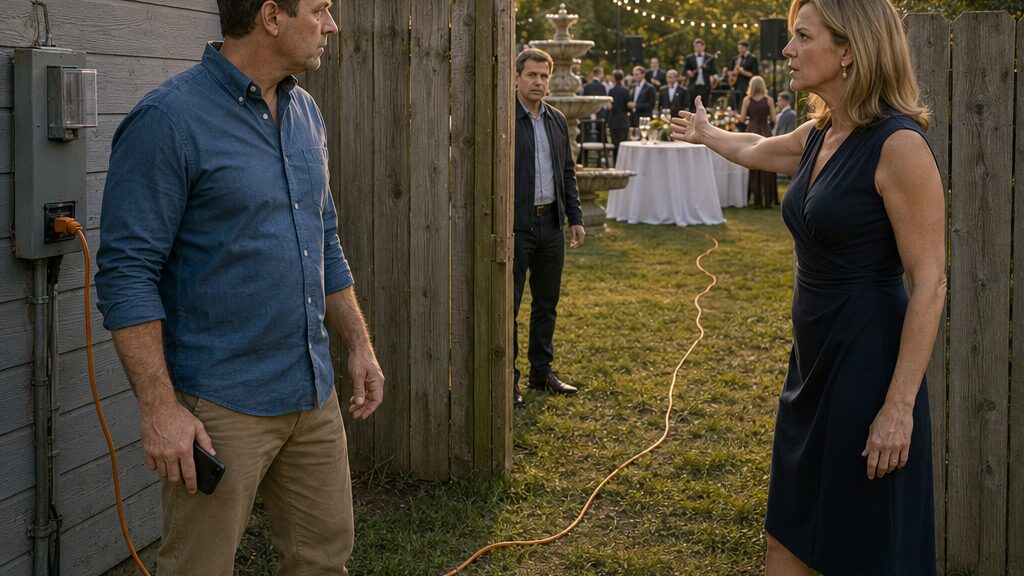
Then he saw the orange cord.
It came from the HOA lawn, passed neatly through the missing fence boards, crossed twelve feet of Jonathan’s yard, and disappeared behind his weathered shed.
The worker stood up.
Jonathan said, “What’s that connected to?”
The man followed his gaze. “Power.”
“I can see that.”
“For the event equipment.”
Jonathan walked toward the shed.
The orange cord bent around the corner and climbed to the gray outdoor subpanel mounted beneath the eave. A heavy plug had been fitted into an outlet below it.
Jonathan stopped.
For a second he simply looked at it.
The electrician who had upgraded the shed circuit five years earlier had installed that panel for Jonathan’s workshop tools and the freezer he kept inside. Jonathan still had the invoice in a filing cabinet.
Now an extension cord as thick as his thumb was plugged into it and running toward the HOA lawn.
He took another photograph.
“What exactly is that powering?” he asked.
The worker shrugged. “Lights, I think. Maybe catering.”
From the far side of the fence came the metallic clatter of rented equipment being unloaded.
Jonathan crouched beside the outlet.
A laminated tag had been zip-tied to the orange cord near the plug.
EVENT POWER.
Below that, in larger letters:
DO NOT DISCONNECT.
Jonathan read it twice.
Something inside him went very still.
It was not the electricity. The cost might be trivial. It was not even the missing fence boards, though the casualness of that irritated him.
It was the instruction.
Someone had come onto his property, connected equipment to his panel, and left a warning telling him what he was not allowed to do with it.
He photographed the tag.
The worker shifted his weight. “If there’s an issue, you’ll need to talk to the board.”
“I plan to.”
“Jessica’s coordinating everything.”
Jonathan knew Jessica Mitchell by sight and by the clipped efficiency of her HOA emails. She had been board president for three years. They had exchanged greetings at the mailbox and once spent ten polite minutes discussing a dead streetlight.
Jonathan straightened.
“Did Jessica tell you this outlet belongs to the HOA?”
The man hesitated.
“She said this was the approved connection.”
That was not the same answer.
Jonathan looked back toward the opening in the fence.
“Who approved removing the boards?”
“The work order says association access.”
“Can I see it?”
The worker’s expression tightened. “You’d have to ask the office.”
Jonathan nodded.
He did not tell the men to stop.
That surprised even him.
Instead, he photographed the fence from inside his yard, then from the HOA side. He photographed the mud on the path, the cord, the plug, the warning tag, and the number stamped on the panel door.
When he returned to the kitchen, his coffee was cold.
His first instinct was to call Jessica.
His second was to wait until he knew what she could plausibly say.
The second instinct won.
Jonathan opened his laptop and pulled up the county property portal.
The aerial map loaded first: his rectangular lot, the HOA lawn behind it, the narrow drainage easement running at an angle beyond the fence.
He zoomed in.
Then he searched for recorded easements.
Drainage.
Utility maintenance.
Nothing labeled event access.
Nothing about the shed.
He opened another browser tab and searched the permit database using his address. It took several tries to find the old electrical record.
There it was.
Accessory structure electrical improvement.
Private residential parcel.
Jonathan copied the permit number into a notebook.
Outside, someone tested a microphone.
A burst of amplified static rolled across the lawn, followed by a man’s voice saying, “Check, check.”
Jonathan turned toward the window.
The orange cord remained visible through the gap in his fence.
For years he had told himself that these little intrusions were easier to tolerate than to fight over.
A truck tire over the edge of his grass.
A landscaping crew cutting through his side gate.
A folding table left against his shed.
Small things.
Always small enough that objecting made him feel unreasonable.
He looked down at the photograph of the warning tag on his phone.
DO NOT DISCONNECT.
Then he wrote the panel number beneath the permit number and started searching the county records again.
Chapter 2: The Panel Was Never Common Property
The parcel map showed Jonathan exactly what he expected to see and one thing he did not.
There was no event-access easement.
He had printed the map and spread it across his kitchen table beside the photographs from the yard. The drainage easement appeared as a shaded strip behind the lots. A separate utility easement crossed one corner near the street.
Neither touched his shed.
Neither said anything about the HOA using his electrical service.
Jonathan circled the panel location in pencil.
At noon, he drove to the county records office because the online database only went back so far.
The clerk behind the counter listened while he explained what he needed.
“You’re looking for recorded easements, not HOA covenants?” she asked.
“Anything giving the association access across this part of my lot.”
She studied the parcel number.
“Drainage maintenance is here. Utility is here. Your association documents aren’t recorded in the same way, but if they claim a property right, I’d expect to see something.”
“And electrical use?”
She gave him a faint smile. “I can’t tell you what rights they have. I can tell you what’s recorded.”
Jonathan appreciated the distinction.
He had already begun making too many conclusions from too little.
The clerk printed two older documents and slid them across the counter.
Nothing changed.
By two thirty he was parked outside his house when Daniel Lewis’s work van pulled up.
Daniel had done the shed upgrade years earlier. He remembered the panel as soon as Jonathan showed him the photograph.
“That’s yours,” Daniel said.
They walked around back.
The orange cord was still connected.
Daniel crouched at the outlet but did not touch it.
“What’s on the other end?”
“HOA event lawn. They said lights. Maybe catering.”
Daniel looked at the cord rating, then at the breaker.
“Could handle some of that. Depends what they’ve got tied in.”
Jonathan handed him the permit copy.
“This was installed under my address.”
Daniel barely looked at it. “Of course it was. I pulled the permit.”
“So they can’t use it.”
Daniel stood.
“I didn’t say that.”
Jonathan frowned.
Daniel wiped his hands on his work pants. “I’m an electrician, not your attorney. I can tell you this panel serves your property. I can tell you I don’t like temporary event equipment being connected without the homeowner knowing exactly what’s on the circuit. I can tell you whoever owns the electrical system ought to control what gets plugged into it.”
“But if it’s mine—”
“Ownership and permission are two different questions.”
Jonathan felt irritation rise and immediately recognized it as irritation at not receiving the simple answer he wanted.
Daniel pointed toward the fence opening.
“If you’ve got some old agreement with the association, that’s not an electrical question. If you don’t, then that’s something you sort out with them. Just don’t make me the guy who told you to shut down a wedding or whatever this is.”
“Gala.”
“Even worse.”
Jonathan almost smiled.
Daniel examined the plug again.
“If they add refrigeration, sound equipment, or more lighting, I’d want to know the load. And if somebody trips over this cord on your property, that’s another conversation.”
That was less satisfying than permission to yank the plug.
It was also more useful.
Jonathan paid him for the visit despite Daniel’s protest and photographed the outlet once more after he left.
Then he logged into his electric account.
He pulled two years of statements and searched his emails for HOA reimbursements.
There were none.
No request for electricity.
No payment.
No annual notice saying the board would use the shed circuit.
Nothing.
At four twelve, Jessica Mitchell called.
Jonathan watched her name appear on his screen.
He let it ring twice before answering.
“Jonathan, hi. I heard there was some confusion with the gala setup.”
“Three boards were removed from my fence.”
“They’ll be restored.”
“And someone’s plugged into my electrical panel.”
There was a pause.
“That’s the normal event connection.”
“Normal for whom?”
“For the association. It’s been used for years.”
Jonathan sat back.
“With my permission?”
“It’s part of the access arrangement behind the event lawn.”
“I pulled the parcel records today.”
Another pause, shorter this time.
“County parcel records don’t necessarily contain every association agreement.”
“Then send me the one you’re relying on.”
Jessica’s voice remained calm, but the warmth disappeared from it.
“Jonathan, nobody is trying to take anything from you. This setup predates me.”
“It predates me too?”
“Yes.”
That stopped him.
He had owned the house for seven years.
“You’ve been using my panel for seven years?”
“I didn’t say that. I said the arrangement predates us.”
Jonathan looked through the window at the orange cord.
“Then send me the arrangement.”
“I’ll see what we have.”
“Until then, no one should be entering my yard.”
“We have contractors on schedules, Jonathan.”
“That’s not an answer.”
“No,” Jessica said. “It’s the practical problem.”
He almost told her to remove everything immediately.
Instead he said, “Send me what you have.”
After the call, he returned to the county documents.
The phrase access arrangement bothered him because it was vague enough to sound official.
At six twenty, an email arrived from Jessica.
Subject: PRIOR ACCESS DOCUMENTATION.
There was no message beyond one sentence.
Jonathan, attached is the agreement I referenced.
He opened the PDF.
The first page was a scanned letter dated nearly twelve years earlier.
The homeowner’s name was not anyone Jonathan knew.
The HOA logo sat at the top.
Halfway down the page, one sentence made Jonathan’s stomach tighten.
The owner agrees to permit association access through the rear property boundary in connection with annual community events and maintenance needs.
Jonathan read it again.
Then he looked toward the backyard.
For the first time all day, the orange cord no longer looked like obvious trespass.
It looked like something he might have inherited without knowing it.
Chapter 3: The Old Permission Was Not What It Seemed
Jonathan recognized his shed in the photograph before he recognized anything else.
It was newer in the image, the siding less faded and the roof darker, but the narrow window and crooked concrete step were unmistakable.
Across the grass ran an orange extension cord.
The photograph was ten years old.
Jessica’s PDF contained six pages: the letter, two email printouts, a photograph from an earlier gala, a drainage plat, and what appeared to be minutes from a board meeting.
Jonathan sat at his kitchen table Saturday morning reading all six again.
The more he read, the less simple the story became.
The previous owner had clearly allowed something.
That much was undeniable.
An old email thanked him for letting the association “run event power again this year.” Another referred to “the usual rear access.”
Jonathan pushed his chair back.
He disliked being wrong more than he liked being angry.
For twelve hours he had treated the cord like proof that the HOA had simply decided his property belonged to them.
Now there was evidence that somebody had invited them there.
Not him.
But somebody.
He walked outside.
The workers were gone for the weekend, leaving the missing boards temporarily covered by a section of construction mesh. The orange cord had been removed.
Jonathan stood where it had crossed the path and studied the HOA lawn beyond the fence.
If Jessica believed the arrangement transferred automatically with the property, then her reaction made more sense.
It did not make her right.
But it made her less easy to dismiss.
Monday morning, Jonathan called the HOA office and asked to see the full historical file.
Jessica was not there when he arrived.
Sarah Green, the treasurer, met him in the small conference room.
“You’ve caused quite a records hunt,” she said.
She smiled when she said it, but not enough for him to mistake it for friendliness.
“I asked one question.”
“You asked a question about something everyone’s treated as settled for a decade.”
“That doesn’t make it settled.”
Sarah pulled a folder from a box.
“No. It makes it old.”
She sat across from him.
Jonathan had seen her walking a small dog past his house most evenings. They had spoken dozens of times without ever saying more than hello.
Now she opened the folder between them.
“The drainage easement is legitimate,” she said.
“I know.”
“It allows access for maintenance along the swale behind the properties.”
“I know that too.”
She looked up. “Then why are we doing this?”
“Because the gala isn’t drainage maintenance.”
Sarah’s fingers stopped on the page.
Jonathan slid Jessica’s scanned letter across the table.
“This says annual events.”
“It does.”
“It also says permit.”
“Yes.”
“Permission isn’t an easement.”
Sarah exhaled.
“We’re not attorneys.”
“I didn’t say we were.”
That landed more sharply than Jonathan intended.
Sarah closed the folder halfway.
“This is exactly why people think you’re making this harder than it needs to be.”
Jonathan felt his shoulders stiffen.
“Three fence boards were removed from my property.”
“They were going to be replaced.”
“Someone plugged equipment into my panel.”
“Which has happened before.”
“Not with my permission.”
Sarah stared at him.
Then she reopened the folder.
For the next forty minutes, they went through the records in date order.
The pattern emerged slowly.
The previous owner had allowed access for the first gala because the common lawn had no convenient power source. The following year, the HOA asked again. Then again.
By year four, the emails became shorter.
Could we use the rear connection Saturday?
Then:
Same setup as last year?
Then there were no requests at all.
Only contractor instructions.
The favor had not become a recorded right.
It had become a habit.
Sarah found an email from the old owner sent nine years earlier.
Please make sure someone calls before entering the yard. Last year a crew came through without notice.
Jonathan read it twice.
“That sounds familiar.”
Sarah did not answer.
A few pages later, another message appeared.
The owner had complained about mud near the shed.
The HOA apologized.
The following summer, permission was granted again.
Jonathan sat back.
“He kept saying yes.”
“Exactly,” Sarah said.
“After being asked.”
“Usually.”
“That word matters.”
Sarah’s mouth tightened.
Jonathan knew he was pressing too hard, but part of him wanted her to admit the difference in a sentence he could carry home like evidence.
Instead she said, “For years, nobody treated this as hostile.”
Neither had the previous owner, apparently.
That unsettled Jonathan more than he expected.
He had built a clean moral picture in his head: his land, their intrusion, his proof.
But the previous owner had lived with the same arrangement and repeatedly chosen cooperation.
Maybe the neighborhood had not changed.
Maybe the person who had changed was the one living in the house.
Jonathan thought about smaller conflicts from his seven years there—the landscaper, the folding tables, the truck tire across the grass.
He had complained each time after the fact.
He could not remember once walking into the HOA office before something happened and simply saying, I need you to ask me first.
He preferred written complaints because they did not require him to stand in a room and explain why something bothered him.
Sarah turned another page.
“Here’s the drainage map Jessica sent you.”
Jonathan looked at it.
A handwritten notation near the bottom referred to rear access, but the line pointed toward the swale, not his fence.
“So that’s maintenance only.”
“Looks like it.”
“And the event permission is separate.”
Sarah nodded reluctantly.
That was the small answer he had been looking for.
Then she pulled a loose photograph from the back of the folder.
It showed the old owner standing beside Jonathan’s shed during a gala setup, smiling at someone outside the frame. The orange cord ran past his boots.
On the back, someone had written: Thanks again for helping us out.
Not right.
Not easement.
Helping us out.
Jonathan looked at Sarah.
“This was a favor.”
“It became routine.”
“Those aren’t the same thing.”
“No,” she said. “They aren’t.”
For the first time, Sarah sounded less defensive than tired.
Jonathan began gathering the papers.
Then a folded yellow sheet slipped from between two meeting agendas.
It was handwritten.
The ink had faded, but the message was still legible.
Rear-yard electrical connection approved for this year’s fundraiser only. Future access to be confirmed with homeowner before each event.
Jonathan stopped.
Sarah leaned closer.
Neither spoke for several seconds.
At the bottom was a date from eight years earlier and initials from a former board secretary.
Jonathan felt the satisfaction first.
Then suspicion followed it.
If this note had been in the HOA file all along, the question was no longer whether the association’s old permission had limits.
The question was who had known those limits before the workers ever touched his fence.
Chapter 4: A Certified Letter Started the Countdown
“Be reasonable for one weekend.”
Jessica Mitchell said it from the other side of Jonathan’s front walk on Tuesday morning, as though she were asking him to move a trash can instead of surrender control of part of his property.
Jonathan stood just inside the open door.
Jessica held a slim folder against her side. She was dressed for work, hair pulled back, expression composed. Nothing about her suggested the person who had ordered contractors through his fence.
“I’ve been reasonable for seven years,” Jonathan said.
Her eyes narrowed slightly.
“That’s not really an answer.”
“It is from where I’m standing.”
She looked past him toward the side yard, where the repaired fence boards were visible beyond the house.
“The gala is Saturday. Vendors are contracted. The caterer has deposits. The lighting company is scheduled. We have nearly two hundred reservations.”
Jonathan waited.
Jessica lowered her voice.
“The association has used that access for years. You know that now.”
“I know the previous owner allowed it.”
“Repeatedly.”
“After being asked.”
Jessica opened the folder.
“We can argue about the wording, or we can solve the practical problem.”
She handed him a sheet showing projected expenses for temporary power.
Jonathan scanned the number at the bottom.
It was far higher than he expected.
“You’d need all this just to stop using my panel?”
“To replace the setup this late? Yes.”
Generators. Cable ramps. Distribution equipment. An electrician on site. Additional refrigeration support.
Jonathan looked at her.
“So that’s why you’re still planning to use it.”
“It’s why I’m asking you not to turn a manageable disagreement into a financial disaster.”
The wording bothered him.
Not because it was entirely false.
Because it made his property sound like the inconvenience.
Jessica continued.
“The fundraiser covers landscaping reserves, the playground insurance increase, and part of the common-area maintenance budget. This isn’t some private party for the board.”
“I never said it was.”
“But you know what happens if we cancel.”
“I haven’t asked you to cancel.”
“Then let us use the connection Saturday, and after that we’ll review everything.”
Jonathan almost laughed.
“That’s exactly how this became normal.”
Jessica closed the folder.
For a moment neither of them spoke.
Then she said, “What do you want?”
The question came too quickly, and Jonathan realized she expected a number.
He had spent the weekend adding up electricity estimates, fence repair, Daniel’s visit, and his own time. The total sat on a yellow legal pad in his kitchen.
But hearing Jessica ask made the arithmetic feel beside the point.
“I want nobody on my property unless I say they can be there.”
“We can put that in writing.”
“Before Saturday?”
Her silence answered him.
Jonathan shook his head.
Jessica took one step closer.
“What if the association reimburses you privately for the fence and the electrical use?”
“Privately?”
“We don’t need to make a public issue out of it.”
There it was.
Not payment.
Silence.
Jessica must have seen something change in his face because she added, “I’m trying to keep this from becoming bigger than it is.”
Jonathan thought of the handwritten note Sarah had found.
Future access to be confirmed with homeowner before each event.
“Does the board know the old permission was conditional?”
Jessica’s jaw tightened.
“The board knows we’ve used the same arrangement for years.”
“That’s not what I asked.”
“Jonathan—”
“Does the board know?”
Jessica looked toward the street.
A landscaping truck passed slowly behind her.
“We have people who joined the board long after that note was written.”
Again, not an answer.
Jonathan felt a familiar impulse: end the conversation, close the door, write everything down afterward where no one could interrupt him.
He followed it.
“I’ll send my position in writing.”
Jessica stared at him.
“You could just tell me now.”
“I have.”
“No. You’ve told me what you don’t want.”
Jonathan’s hand tightened on the edge of the door.
She turned away before he could respond.
By Friday morning, the certified envelope was on its way.
Jonathan had rewritten the letter four times.
The final version was short.
No association contractor, vendor, employee, or guest had permission to enter his fenced yard for event purposes. No event equipment had permission to connect to the electrical service on his shed. Any unauthorized connection remaining after 5:00 p.m. Saturday would be disconnected.
He included photographs and the old handwritten note.
Then he sent a copy by email.
At 10:18 a.m., Sarah replied.
Received.
At 10:46, Jessica replied.
Your position is noted. The association reserves all rights.
Jonathan read the sentence several times.
Nothing else followed.
Saturday afternoon, trucks began arriving shortly after noon.
Jonathan tried not to watch.
He changed an air filter. Tightened a loose cabinet hinge. Cleaned tools that did not need cleaning.
By three, music from a sound check drifted across the fence.
At three thirty, he walked to the shed.
The outlet was empty.
For the first time all week, Jonathan felt some tension leave his shoulders.
Maybe they had listened.
Maybe Jessica had found another solution.
He went inside and made coffee.
At 4:07, a metallic scrape came from the backyard.
Jonathan froze.
Another scrape.
Then a voice.
“Lift it higher.”
He set the mug down and stepped outside.
Two event workers stood on the far side of the fence.
One of the repaired boards had been loosened.
Through the opening came the bright orange end of an extension cord.
Jonathan watched it slide across his grass.
One foot.
Three feet.
Five.
A worker stepped through after it.
When he saw Jonathan, he stopped.
“We were told the connection was approved.”
Jonathan looked at the orange cord lying between them.
Then toward the lawn beyond the fence, where white tablecloths were already moving in the late-afternoon breeze.
“By whom?”
The worker hesitated.
“HOA president.”
Jonathan looked at his watch.
Fifty-three minutes remained before five o’clock.
Chapter 5: At Five O’Clock He Pulled One Plug
At 4:59 p.m., the string quartet was still playing.
Jonathan stood beside his shed with his phone in one hand and the certified-mail receipt in the other.
Across the fence, the gala had become exactly the kind of evening the association brochures promised.
White linen tables curved around the stone fountain. Glasses caught the low sunlight. Small lights hung between rented poles. Guests in jackets and dresses moved through the lawn with drinks in their hands.
The orange cord crossed all of it invisibly from their point of view.
From Jonathan’s side, it was impossible to miss.
He had photographed the plug at 4:42.
He had photographed the panel.
He had photographed the reopened fence gap.
At 4:51, the event coordinator approached him.
“Mr. Clark?”
Jonathan nodded.
“I’ve been told there’s a disagreement about the electrical connection.”
“There isn’t a disagreement about whether I gave permission.”
The coordinator glanced at the cord.
“I don’t handle property issues.”
“Neither do I handle gala logistics.”
“I’m just trying to keep the event running.”
Jonathan looked at his watch.
4:56.
“I sent notice.”
“I know.”
“Then you know what happens at five.”
The coordinator rubbed the back of his neck.
“We were told another power source would be available if necessary.”
Jonathan looked past him.
“Is it?”
The man did not answer.
At 4:58, Jessica appeared.
She came through the opening in the fence without hesitating.
Jonathan noticed that first.
Not the dark dress. Not her tight expression.
The fact that she entered his yard again.
“Jonathan.”
“Jessica.”
“You’ve made your point.”
“No. I’ve sent a notice.”
She looked toward the shed.
“You disconnect that now, the sound system goes down. Some of the perimeter lights go down. We may lose temporary refrigeration.”
“Then disconnect your equipment from my circuit yourself.”
“We don’t have time.”
“You’ve had a week.”
Her composure cracked.
“For what? To spend thousands of dollars because you suddenly decided an arrangement that’s existed for a decade offends you?”
Jonathan felt the words land.
There was truth inside the insult.
He had tolerated smaller intrusions.
He had never confronted the pattern directly.
But that did not create permission.
Jessica stepped closer.
“If you do this now, everybody out there is going to know exactly who shut this down.”
Jonathan looked through the fence.
A server carried a tray between tables.
A musician turned a page of sheet music.
Near the fountain, an elderly couple posed for a photograph.
Jessica lowered her voice.
“You will be responsible for ruining a community fundraiser because you couldn’t wait one more evening.”
That was the pressure she had been counting on.
Not a legal argument.
Embarrassment.
Jonathan imagined walking back into his house.
The event would continue.
Monday would bring another meeting. Another apology. Another assurance.
And next year somebody would say the same thing.
We’ve always done it this way.
His watch changed to 5:00.
Jonathan put the certified receipt in his pocket.
“Anything on your side of the fence stays on your side,” he said. “Anything connected to my private circuit comes off now.”
Jessica stared at him.
“Don’t.”
Jonathan reached down.
He pulled the plug.
The effect was not cinematic all at once.
The quartet kept playing.
Sunlight still covered the lawn.
Then the speakers near the fountain went dead with a soft pop.
A section of decorative lights blinked out.
From beyond the fence came a sharp electronic alarm.
Someone near the catering truck called out.
Several guests turned.
A microphone gave one last burst of static and went silent.
Jonathan stood with the orange plug in his hand.
He had imagined this moment all week.
In those private versions, satisfaction arrived instantly.
It did not.
What arrived was silence.
Not complete silence—the musicians were still playing acoustically—but enough that the interruption spread visibly across the lawn.
The event coordinator hurried back through the gap.
“Did you just disconnect it?”
“Yes.”
“We’ve got refrigeration on that distribution.”
“You told me there was another source.”
“There was supposed to be.”
Jessica said nothing.
That told Jonathan more than anything else could have.
The backup was not late.
It did not exist.
The catering manager appeared behind the coordinator.
“How long is this going to be down?”
Jonathan held out the plug.
“This isn’t my equipment.”
The manager looked from Jonathan to Jessica.
“I was told this circuit was approved.”
Jessica’s face had gone pale with anger.
“We’re dealing with it.”
The manager shook his head.
“I need an answer, not a discussion.”
Jonathan felt the situation expanding beyond the clean boundary he had drawn around it.
Vendors.
Food.
Guests.
People who had no role in removing his fence.
He looked at the panel.
“My freezer circuit is separate. I’m not shutting off the panel. I’m disconnecting the event extension only.”
The coordinator nodded quickly, as if that distinction mattered to him.
Jessica did not.
“This is exactly what I warned you about.”
“No,” Jonathan said quietly. “This is what I warned you about.”
For several seconds they faced each other beside the weathered shed.
Then the coordinator took the cord from Jonathan’s hand.
“We’ll get temporary power.”
Jessica turned on him.
“From where?”
“We’ll figure it out.”
The question stayed in the air.
From the lawn came another alarm.
The catering manager was already on his phone.
Jonathan stepped toward the fence gap.
“I’m closing this after your people clear my yard.”
Jessica laughed once without humor.
“You’re serious.”
“Yes.”
“Tonight?”
“Yes.”
She looked toward the gala.
Guests were beginning to whisper. Several had moved closer to the fountain, trying to understand what had happened.
Jessica’s voice dropped.
“You wanted everyone to see this.”
Jonathan opened his mouth.
Then stopped.
Because some part of him had.
Maybe not the guests.
Maybe not the vendors.
But he had wanted the board to experience a consequence too large to ignore.
He had wanted their inconvenience to become visible.
That realization cooled whatever satisfaction remained.
“I wanted you to believe me,” he said.
Jessica shook her head.
“You could’ve picked up the phone.”
“So could you.”
Her expression changed.
Only slightly.
Enough for him to know the accusation had found its mark.
Jonathan waited until the event workers removed the cord and the last equipment case from his yard.
Then he replaced the loose fence board temporarily and latched his side gate.
He went inside.
The coffee he had left on the counter was cold.
Twenty minutes later, there was a knock at his front door.
Jessica stood on the porch.
She no longer looked polished.
Behind her, the common lawn glowed unevenly as portable battery lights and vehicle lamps filled some of the darkness.
“We’ll be sending you a demand,” she said.
“For what?”
“Vendor losses. Emergency equipment. Whatever else results from what you did.”
“I gave written notice.”
“And we’ll let counsel decide what that means.”
Jonathan leaned against the doorframe.
“You knew the connection was disputed.”
“And you knew there were two hundred people out there.”
There was no answer that made either fact disappear.
Jessica stepped back.
“The board will pursue every cost caused by this shutdown.”
Then she walked away.
Jonathan closed the door slowly.
For a week, the question had been whether he would have the nerve to pull one plug.
Now that he had, a different question had taken its place.
Who was going to pay for everything that happened afterward?
Chapter 6: The Board’s Story Began Falling Apart
The demand arrived Sunday at 8:14 a.m.
Not by mail.
Email.
Jonathan opened it while standing barefoot in his kitchen.
The subject line read: NOTICE OF CLAIMED EVENT LOSSES.
He read the attachment once.
Then again.
Emergency generator rental.
Additional vendor labor.
Food loss.
Sound-system interruption.
Lighting reconfiguration.
Contractual penalties.
The preliminary total was large enough that Jonathan pulled out a chair before finishing the page.
He had expected anger.
He had not expected an itemized number.
At the bottom, the letter said the association reserved the right to seek additional damages.
Jonathan printed it.
That was his first instinct now.
Print.
File.
Document.
He carried the pages into the spare bedroom he used as an office and placed them beside his photographs, certified-mail receipts, permit copies, and the handwritten note from the old records file.
By Monday, his dining table had disappeared beneath paper.
He built a timeline.
Friday: contractors entered.
Friday: panel confirmed private.
Monday: conditional-permission note discovered.
Friday: certified notice received.
Saturday: unauthorized connection restored.
Saturday, 5:00 p.m.: disconnected.
Every fact had a page behind it.
Facts calmed him.
Then Sarah called.
“We need to talk.”
“About the demand?”
“About more than that.”
They met Tuesday afternoon in the HOA records room.
Sarah had three storage boxes open on the floor.
Jessica was not there.
“She’s meeting with counsel,” Sarah said before Jonathan asked.
Jonathan placed the demand letter on the table.
“Some of these charges don’t make sense.”
“I know.”
He looked at her.
Sarah slid a vendor invoice toward him.
“The generator was already on reserve.”
Jonathan scanned it.
The contract date was from three weeks before the gala.
“So they can’t charge me the full rental.”
“No.”
Another invoice.
“The sound company charged an emergency labor fee, but no equipment was damaged.”
Another.
“The lighting vendor’s extension work was covered under the original event package.”
Jonathan sat back.
The number in the demand was shrinking page by page.
Not disappearing.
Shrinking.
Sarah folded her arms.
“I told the board we shouldn’t send that letter until we verified everything.”
“Jessica sent it anyway?”
“The attorney drafted the language. Jessica approved sending it.”
Jonathan felt a small, hard satisfaction.
He did not like how familiar it felt.
“So she exaggerated.”
Sarah gave him a tired look.
“The claim was preliminary. Don’t turn it into something it isn’t.”
Jonathan almost argued.
Instead he waited.
Sarah pulled another folder from the box.
“This is what I actually called you about.”
Inside was a proposal dated four years earlier.
Independent electrical service for common event lawn.
Jonathan read the estimate.
It included a permanent pedestal, dedicated meter, buried conduit, and weatherproof event connections.
“Why wasn’t this done?”
Sarah tapped the second page.
Deferred.
The following year:
Deferred again.
Then a board note:
Current rear access remains available. Project may be postponed.
Jonathan’s eyes stopped on the signature line.
Jessica Mitchell, Board President.
He looked up.
“She knew.”
“She knew there was a proposal.”
“She knew independent power was needed.”
Sarah hesitated.
“Needed is too strong. Recommended.”
Jonathan held up the paper.
“Because the existing connection was on private property.”
“Yes.”
The word settled between them.
Sarah sat down.
“I supported postponing it.”
Jonathan had not expected that.
She looked directly at him.
“The reserve was short that year. Playground resurfacing had already gone over budget. Insurance jumped. We could either spend money on infrastructure we used twice a year or keep using something that, as far as we understood, had worked for years.”
“As far as you understood?”
“I didn’t know about the handwritten note.”
“Jessica did?”
Sarah did not answer immediately.
She reached into the folder and removed an email printout.
The sender was the former board secretary.
The recipient was Jessica.
The date was three years earlier.
The message referred to questions about rear-yard access and included a sentence Jonathan read twice.
Because the original permission was owner-specific and historically renewed by request, we should obtain current written consent before treating the Clark property as continuing event access.
Jonathan placed the page flat on the table.
“She knew.”
This time Sarah did not correct him.
“Yes.”
The room seemed smaller.
Jonathan had wanted that answer.
Now that he had it, he felt less triumphant than he expected.
“Why wouldn’t she tell the board?”
Sarah stared at the boxes.
“Because then we would’ve had to fund the project.”
“That’s it?”
“No.”
She rubbed her forehead.
“Because once you admit you’ve been doing something informally, every year afterward looks worse. Jessica’s good at keeping things moving. That’s why people vote for her. She hates telling people something doesn’t work.”
Jonathan thought of Jessica at his door.
Be reasonable for one weekend.
It had not been greed.
Not exactly.
It had been pride wearing the clothes of practicality.
A flaw Jonathan recognized too easily.
Sarah slid one final invoice toward him.
“This one is real.”
The catering manager’s refrigerated equipment had been without stable power long enough that one small specialty vendor discarded prepared food rather than risk using it.
The amount was not enormous.
It was not zero.
“They were told the circuit was approved,” Sarah said.
Jonathan looked at the invoice.
“They had nothing to do with my fence.”
“No.”
“Or the old agreement.”
“No.”
“They’re charging the HOA?”
“Right now.”
Jonathan leaned back.
For days he had divided the world into clean columns.
His property.
Their violation.
His notice.
Their choice.
But consequences did not respect columns.
The caterer had relied on what the HOA told them.
So had the sound technician.
So had the workers.
Being right about the cord did not make every cost on the other side imaginary.
Sarah watched him.
“What are you thinking?”
“That the demand is inflated.”
“It is.”
“And some of it is legitimate.”
“Yes.”
Jonathan looked at the coiled orange cord lying inside a clear evidence bag on the end of the table. Someone from the board had collected it after the event.
For a week, it had represented one thing.
Someone crossing a line.
Now it looked like something else too.
A line everybody had stepped over while convincing themselves somebody else had permission.
“I was going to send a response tonight,” Jonathan said.
Sarah gave a small, humorless smile.
“Of course you were.”
He looked at her.
“What does that mean?”
“It means every time this gets uncomfortable, you write a letter.”
“I like records.”
“You like not having to look at people when you tell them they’re wrong.”
Jonathan’s first reaction was anger.
His second was recognition.
Sarah stood.
“We have an emergency board meeting Thursday.”
“I’m sure I’ll receive notice.”
“I’m not asking you to read the notice.”
She closed the folder.
“I’m asking you to come.”
Jonathan glanced at the evidence bag, the invoices, the email proving Jessica had known the arrangement was revocable.
He could already imagine the response letter.
Numbered exhibits.
Dates.
Amounts.
Everything precise.
Everything safely on paper.
Sarah reached the door.
“If you want this fixed instead of just documented, show up Thursday and say it where everyone can hear you.”
Then she left him alone with the coiled cord and a stack of invoices that no longer told a simple story.
Chapter 7: He Brought Receipts, Not a Revenge Invoice
By the time Jonathan entered the clubhouse Thursday evening, someone had already decided he wanted thousands of dollars.
He heard the number before he reached the meeting room.
“Nine hundred for access alone,” a resident whispered near the coffee station. “Then inspection fees, reconnection fees—”
Jonathan kept walking.
Inside, every folding chair was occupied. More residents stood along the walls. The gala shutdown had traveled through the neighborhood faster than any board email ever had.
At the front table sat Jessica Mitchell, Sarah Green, two other board members, and the HOA attorney.
Jessica looked exhausted.
Jonathan placed his folder on the table reserved for him.
Then he set down one more thing.
The orange extension cord.
Coiled neatly.
A murmur moved through the room.
Jonathan immediately regretted bringing it.
It looked theatrical sitting there.
He had meant it as evidence.
To everyone else, it looked like a trophy.
Jessica noticed too.
“Is that necessary?”
“No,” Jonathan said.
He moved it from the center of the table to the floor beside his chair.
That small act quieted the room more effectively than anything he could have said.
The HOA attorney began with procedural language: disputed access, documented notice, vendor losses, association obligations.
Jonathan listened.
He had prepared twelve pages of notes.
Every date was indexed.
Every invoice was tabbed.
He knew exactly where Jessica’s email sat in the sequence.
Then the attorney said, “Mr. Clark has also indicated claims of his own.”
Heads turned toward Jonathan.
Sarah looked at him carefully.
Jonathan opened his folder.
On top was the draft he had written Sunday night.
Fence repair.
Electrical use.
Inspection expense.
Administrative time.
Unauthorized access charges.
A reconnection fee he had invented mostly because he had been angry.
The total was satisfying.
That was why he knew he should not use it.
Jonathan slid the page aside.
“I’m asking for the cost of restoring my fence,” he said. “Daniel’s inspection invoice. Documented electricity attributable to association use where it can reasonably be calculated. And a permanent solution so my property isn’t part of the event infrastructure anymore.”
A resident near the wall raised a hand slightly.
“That’s it?”
Jonathan looked at him.
“That’s what I can document.”
Jessica’s eyes shifted to the discarded draft.
“You had other charges.”
“I did.”
“What happened to them?”
Jonathan thought about the specialty food vendor.
About the catering manager asking how long the power would be down.
About the strange pleasure he had taken when the demand against him began shrinking.
“I decided being angry doesn’t turn every inconvenience into a debt.”
The room became very still.
Jessica looked away first.
Sarah opened a binder.
“I have a motion.”
One of the board members groaned softly.
Sarah ignored him.
“Fund a dedicated electrical service for the common event lawn. Restore Mr. Clark’s fence at association expense. Adopt written procedures requiring homeowner permission for any temporary access across private lots.”
The second board member leaned forward.
“Do you know what that costs?”
Sarah did.
She read the number.
Several residents reacted.
Jessica closed her eyes for a second.
Jonathan understood then why the project had been postponed.
It was not a trivial expense.
It would affect reserves.
Possibly dues.
Possibly projects residents actually cared about.
The board had not created the problem because everyone involved was malicious.
They had created it by repeatedly choosing the cheaper inconvenience when the inconvenience belonged to somebody else.
The attorney turned to Jessica.
“There is also the matter of prior knowledge.”
Jessica’s posture changed.
Sarah placed a printed email on the table.
Jonathan recognized it immediately.
The former secretary’s warning.
Owner-specific.
Renewed by request.
Current written consent recommended.
One of the board members stared at Jessica.
“You had this?”
Jessica looked at Sarah.
Then Jonathan.
“Yes.”
The room stirred.
Jessica held up a hand.
“I received it three years ago, when we were reviewing the electrical proposal. At that time, the Clark property had been used for years without objection.”
Jonathan almost spoke.
Then stopped.
Jessica continued.
“The board had a reserve problem. We had insurance increases. Playground repairs. Drainage work. The electrical project was easy to postpone because nothing had gone wrong.”
“Something had gone wrong,” Jonathan said.
Jessica looked at him.
“You just didn’t have to deal with it.”
Her expression hardened.
“I dealt with complaints constantly.”
“Not mine.”
“You barely spoke to us.”
There it was.
The room seemed to disappear for Jonathan.
Because she was right too.
He had sent emails.
Submitted forms.
Photographed tire marks.
Written complaints after crews crossed his grass.
He had built a paper trail of everything that irritated him while rarely sitting across from anyone and saying what it meant.
Jessica leaned forward.
“You think I ignored you. Half the time I didn’t know there was a problem until you sent something written like you were preparing for court.”
A few people shifted uncomfortably.
Jonathan felt heat rise into his face.
He could defend himself.
He had records proving nearly every complaint.
But that was not the same as answering her.
He looked down at his hands.
“When I bought that house,” he said, “I assumed if people needed something from my property, they’d ask.”
His voice sounded quieter than he intended.
“When they didn’t, I complained. Then it happened again. So I documented more. I thought if I could make the record perfect enough, eventually nobody could dismiss me.”
No one interrupted.
Jonathan looked at Jessica.
“What I should’ve said years ago was simpler.”
He paused.
“When people come through my gate without asking, it makes me feel like I don’t live there. Like my property is just empty space between the association and whatever it wants.”
Jessica’s face changed.
Not dramatically.
Her shoulders lowered.
Jonathan continued.
“I should’ve said that directly.”
He touched the folder.
“But you still knew permission was supposed to be renewed.”
Jessica stared at the email in front of her.
The silence lasted long enough that somebody near the back coughed.
Finally she said, “Yes.”
One of the board members leaned toward her.
“Jessica.”
She did not look at him.
“I knew the original permission wasn’t a permanent easement.”
The attorney stopped taking notes.
Jessica folded her hands.
“I also knew that if I brought the electrical project back to the board, I would have to explain why we’d been treating private access as permanent when it wasn’t.”
Sarah asked, “So why didn’t you?”
Jessica gave a tired laugh.
“Because I thought I could fix it later.”
Jonathan recognized the answer.
Not because he agreed with it.
Because he had lived his own version of it.
Later, he would have the conversation.
Later, he would say clearly what bothered him.
Later, somebody else would understand.
Jessica faced the residents.
“I made the easier decision. Then I defended it because admitting it was wrong became harder every year.”
No one applauded.
No one needed to.
Sarah called for the motion.
The vote to fund independent electrical service passed.
The fence restoration passed.
The access policy passed unanimously.
Then someone asked whether Jessica intended to resign.
She looked toward Jonathan.
For a moment he wondered if the whole room expected him to answer.
He did not.
That choice belonged to her and the board.
Jessica faced the room.
“I’m not resigning tonight.”
Several people reacted.
She continued before they could speak.
“But I will accept a review of contracting and access procedures, and I won’t chair that review.”
It was not punishment.
It was not absolution either.
Jonathan looked down beside his chair.
The orange cord remained coiled on the floor.
For the first time since he had found it running across his grass, he no longer wanted it to prove anything.
Chapter 8: The New Fence Had No Hidden Gate
Six weeks later, Jonathan heard power tools behind his house and went outside before irritation could decide what they meant.
Three workers stood beside the fence.
One held a clipboard.
“Mr. Clark?”
“Yes.”
“We’ve got authorization to replace this section.”
The worker held out the paperwork.
Jonathan recognized his own signature at the bottom.
He had signed it four days earlier.
For a second, he felt almost foolish.
Then he smiled.
“Right. Come through the side gate.”
The difference was so small it would have been invisible to anyone else.
A knock.
A piece of paper.
Permission before entry.
Yet the entire yard felt different.
The damaged boards came down one by one.
The contractors replaced them with matching cedar and rebuilt the section where repeated removal had weakened the rails. They did not create an access panel. There was no hidden gate, no removable section reserved for future events.
A fence was simply a fence again.
Beyond it, another crew had already finished trenching along the edge of the common lawn.
Daniel Lewis stood beside a new weatherproof pedestal when Jonathan walked over.
“Look at that,” Daniel said. “The HOA has entered the modern age.”
Jonathan inspected the meter.
“Completely separate?”
“Completely.”
“No connection to my shed?”
Daniel pointed toward Jonathan’s house.
“I’d have to work pretty hard to make that happen now.”
Jonathan laughed.
Daniel tightened the panel cover.
“Sometimes the expensive solution is just the solution you should’ve paid for the first time.”
Jonathan looked toward the new fence.
“That seems to be the theme.”
The association reimbursed him for the fence, Daniel’s original inspection, and the documented electrical use they could reasonably trace.
The figure was smaller than the amount Jonathan had once imagined charging.
It felt better.
The inflated demand against him had also disappeared after the vendors and board sorted their own contracts. Jonathan agreed to cover nothing beyond his own documented responsibilities, and the HOA stopped trying to make him responsible for every consequence of the gala.
The specialty food vendor was paid through the association.
Jonathan was glad.
He did not put that feeling in writing.
One afternoon, a week after the electrical work passed inspection, Jessica knocked on his front door.
She was carrying the orange cord.
Jonathan looked at it.
“I thought the board had that.”
“We did.”
She held it out.
“It’s yours, technically. Daniel says it was originally sold with some of the old event equipment, but nobody wants it.”
Jonathan took the coil.
“That sounds ominous.”
Jessica almost smiled.
For several seconds they stood without knowing what came next.
Their relationship had not magically become friendly after the board meeting.
Jessica still chaired ordinary meetings.
Sarah oversaw the new procedural review.
Two residents had demanded Jessica resign.
Others argued that removing someone who had finally admitted the mistake would accomplish less than changing the system.
Jonathan had stopped following every neighborhood discussion.
That was new too.
Jessica glanced toward his backyard.
“The fence looks good.”
“It does.”
“The contractor invoice was higher than I expected.”
“I promise I didn’t set the price.”
“I know.”
Another silence.
Then Jessica said, “I am sorry.”
Jonathan looked at her.
She did not rush to qualify it.
“I was so used to thinking of that connection as part of the event setup that I stopped thinking about what it meant for it to be on your property.”
Jonathan turned the orange cord once in his hands.
“I could’ve talked to you before I sent the certified letter.”
Jessica raised an eyebrow.
“You could have.”
“I still would’ve said no.”
“I know.”
That made him laugh unexpectedly.
Jessica smiled this time.
“That would’ve been the problem.”
“No,” Jonathan said. “It would’ve been the conversation.”
She considered that.
Then nodded.
He did not invite her in for coffee.
She did not ask.
Partial reconciliation, Jonathan discovered, mostly looked like two people leaving a conversation without needing to win the last sentence.
He carried the cord to the shed.
For weeks he had considered throwing it away.
Instead, he coiled it properly and placed it on a shelf above his workbench.
Not evidence.
Not a trophy.
Just an extension cord entirely on his side of the fence.
The first small community event using the new electrical service took place in early fall.
Nothing elaborate.
A few tables.
Food.
Children moving between the common lawn and their parents.
Jonathan stayed home for most of it.
Near sunset, he heard a knock at the side gate.
Not pounding.
Not somebody calling his name from inside the yard.
Three ordinary knocks against the wood.
Jonathan walked outside.
A neighbor stood on the other side holding a folding chair.
“Sorry to bother you. One of the legs came loose. Someone said you might have a wrench.”
Jonathan looked through the slats.
The gate was still closed.
The neighbor had not reached over to unlatch it.
Had not assumed.
Jonathan opened the gate.
“Yeah,” he said. “Come on through.”
The neighbor stepped inside only after Jonathan moved aside.
It took less than ten seconds.
No certified envelope.
No photograph.
No record for a file.
Jonathan closed the gate behind them and led the way toward the shed.
Above the workbench, the old orange cord stayed exactly where he had put it.
And this time, nobody crossed the yard without asking.
The story has ended.