The Farm Association Fined Him Over One Gate, Then Its Own Records Exposed Thirty-Seven Unauthorized Notices
Chapter 1: The Orange Envelope Hanging From the Farm Gate
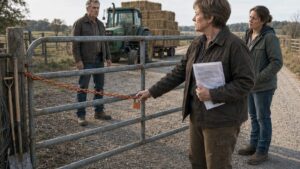
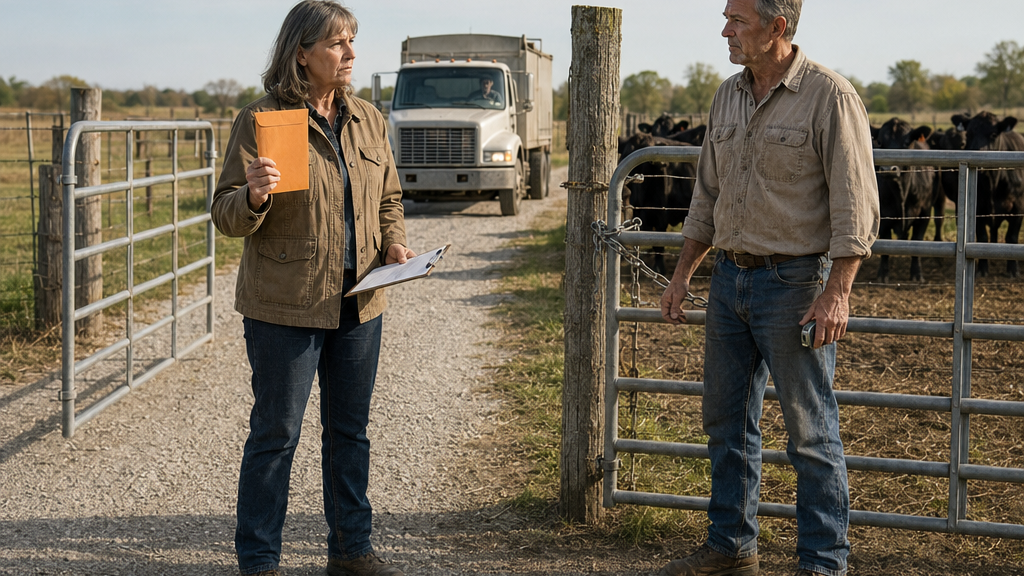
The feed truck stopped twenty yards short of Mark Anderson’s gate because Deborah Martin was standing in the middle of the gravel lane with an orange envelope raised in one hand.
The driver leaned out his window.
“Want me to back out?”
“No.” Mark wiped his palms on his work pants and walked toward the entrance. “Give me a minute.”
The truck idled behind Deborah, diesel pulsing against the quiet pasture. Beyond the gate, a dozen cattle had already gathered at the sound of the engine.
Deborah did not move.
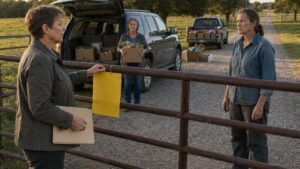
She wore work boots, dark jeans, and a clean canvas jacket, and she held a clipboard against her hip. The orange envelope looked absurdly bright against it.
“You received notice last week,” she said.
“I received an email saying the association was reviewing access points.”
“This is the formal notice.”
Mark took the envelope but did not open it.
Deborah pointed toward the galvanized chain looped through the livestock gate and cedar post.
“That has to come off.”
Mark looked at the chain, then at the separate metal access gate ten feet to the right. The wider gate opened onto the shared agricultural lane and had been installed specifically so feed trucks, hay trailers, and emergency equipment could enter without moving cattle through the narrower livestock opening.
“The truck fits through there,” he said.
“That isn’t the issue.”
“It’s waiting to fit through there right now.”
The driver lowered his gaze and pretended to check something on the dashboard.
Deborah’s mouth tightened.
“The association adopted an access standard. Chains and locking devices that interfere with immediate access are prohibited.”
“This chain doesn’t interfere with that gate.”
“It is part of the entrance.”
Mark finally opened the envelope.
Inside was a single orange notice with his parcel number, the date, and a penalty amount. Below that was a reference to the association’s shared-access standard and a deadline forty-eight hours away.
He read the cited sentence twice.
Then he walked to the post where he kept a tape measure in a small weatherproof box.
Deborah watched him pull it out.
“What are you doing?”
“Measuring.”
He opened the association gate fully, hooked the tape to one inside post, and stretched it across the opening.
“Fourteen feet, eight inches.”
“I know how wide the gate is.”
“Then you know the chain on this one doesn’t narrow it.”
He pointed at the livestock gate.
“The locked gate is eleven feet. The unlocked association gate is fourteen-eight. Your notice says the entrance has to maintain twelve feet of unobstructed access.”
“It also says access equipment can be reviewed.”
“Reviewed by who?”
Deborah shifted the clipboard against her hip.
“The association.”
“That’s not a person.”
“Mark.”
He held out the orange sheet.
“Show me where it says this chain violates the rule.”
She took the page, tapped the cited paragraph, and handed it back.
He read it again.
Nothing in the paragraph banned a chain on an adjacent livestock gate. Nothing required every gate in an entrance to remain unlocked. It required a minimum clear opening for shared-road access and permitted parcel-specific restrictions when approved through the association’s access-review process.
Mark looked up.
“This says restrictions get reviewed.”
“They have been.”
“Who reviewed mine?”
Deborah paused.
It lasted only a second, but Mark noticed.
“The association has been inspecting every entrance on the lane.”
“That wasn’t my question.”
The feed truck engine rose briefly, then settled back to idle.
Mark could feel the driver’s impatience without looking around. The cattle could feel it too; they crowded closer to the fence, bawling toward the truck.
Deborah lowered her voice.
“We have been too casual about access for years. Trucks have gotten stuck. Culverts have been damaged. People leave equipment where it shouldn’t be. We cannot wait until somebody needs an ambulance before we decide the lane ought to stay open.”
Mark glanced at the clear opening beside her.
“It is open.”
“Today.”
“It’s been open every day since I put that gate in.”
“And now it has been reviewed under the new standard.”
“By who?”
Again, Deborah did not answer directly.
She flipped a page on her clipboard.
“You have forty-eight hours to correct the violation. After that, additional penalties begin.”
Mark stared at her.
Not because of the amount. The first penalty was irritating, but not enough to hurt him. What bothered him was the certainty in her voice. The notice treated the question as settled even though she had been unable to identify the part of the rule he had broken.
He folded the orange paper once and slipped it back into the envelope.
“If I remove that chain, will you approve the gate?”
“Yes.”
“Without measuring it?”
“I’ve already inspected it.”
“You just said the association reviewed it.”
“That is what I mean.”
“No,” Mark said. “It isn’t.”
Deborah’s eyes hardened.
“You always do this.”
“Do what?”
“Turn a practical matter into an argument over wording.”
Mark almost laughed, but the driver shifted his truck into neutral with a metallic clunk.
Mark stepped aside.
“I’m going to let him through.”
“Then remove the chain.”
“No.”
He unlatched the separate association gate and swung it wide.
The truck rolled forward with several feet to spare on both sides.
Deborah had to step onto the grassy shoulder.
Mark stood beside the open gate while the truck passed between them. Dust lifted from the gravel and settled over Deborah’s boots.
The driver gave Mark a small nod before continuing toward the feed bins.
Mark closed the gate behind him but left it unlatched.
“There,” he said. “Access.”
Deborah brushed dust from her jacket.
“You are still under notice.”
“Then I want the inspection record.”
“You can request records through the secretary.”
“I want the committee approval attached to this notice.”
That stopped her.
The cattle bawled again behind him.
Deborah looked toward the lane instead of Mark.
“The review committee does not have to physically inspect every gate.”
“I didn’t ask whether they came here.”
He held up the envelope.
“I asked who approved this one.”
Her grip tightened on the clipboard.
“The chair can act when an access problem is obvious.”
“Does the rule say that?”
“We are not doing this beside a feed truck.”
“The truck’s gone.”
For the first time that morning, Deborah looked less irritated than careful.
She drew a breath.
“The committee did not inspect your gate in person.”
Mark said nothing.
Deborah added, “That does not make the notice invalid.”
Maybe it did. Maybe it did not.
But as she turned and walked back toward her pickup, Mark looked down at the orange envelope and realized he was no longer wondering whether he should remove the chain.
He was wondering what process had produced the notice in the first place.
Chapter 2: The Rule Book Said Less Than Deborah Claimed
At nine that night, Mark found the sentence Deborah had quoted.
He did not find the authority she claimed came with it.
The association handbook lay open on the desk in his farm office, its corners softened by years of being shoved beneath seed invoices, equipment manuals, and tax folders. He had ignored most of it since buying into the shared-lane agreement.
He read the access section for the fourth time.
“Minimum unobstructed width of twelve feet.”
His gate provided nearly fifteen.
“Locks, chains, equipment, fencing, or fixed obstructions may be subject to corrective action where they prevent reasonable shared or emergency access.”
His chain did not.
Then came the sentence that made him sit back.
“Parcel-specific corrective notices shall be documented following review by the access committee or other duly authorized association action.”
Mark picked up Deborah’s orange notice.
No committee members were listed.
No vote was listed.
No meeting date.
There was only Deborah’s signature as chair.
He opened his laptop and drafted a records request, then deleted half of it because it sounded angrier than he intended.
He had no interest in becoming the man who wrote three-page letters about a gate.
He wanted the notice gone.
That was all.
By Tuesday morning, Timothy Baker had agreed to meet him at the association storage shed.
Timothy served as treasurer mostly because nobody else wanted to. He kept receipts, dues records, gravel invoices, and enough meeting paperwork to know where things were supposed to be.
He unlocked the shed and gave Mark a wary look.
“I’m not taking sides.”
“I didn’t ask you to.”
“That usually means somebody is about to ask me to.”
Mark followed him inside.
The shed smelled of paper, dust, and old fertilizer sacks. A metal filing cabinet stood beside a workbench covered in road maps and culvert diagrams.
Timothy opened the second drawer.
“What exactly do you want?”
“The approval attached to my notice.”
Timothy found Mark’s parcel folder quickly.
Inside were copies of annual dues, an old drainage complaint, two road-maintenance assessments, and the new orange violation notice.
Nothing else.
Timothy looked through the folder again.
“That it?”
“You tell me.”
He checked a binder on the shelf.
“Could be in committee minutes.”
They went through the most recent meeting records.
There were board votes on gravel purchases, ditch clearing, mowing contracts, and a culvert replacement near the county road.
No gate review.
Timothy frowned.
“Maybe Deborah kept the inspection sheets separately.”
“Would that count as committee approval?”
“No.”
The answer came too quickly.
Mark looked at him.
Timothy rubbed his jaw.
“I mean, not by itself. The rules say committee review or authorized association action.”
“What counts as authorized association action?”
“A board vote. Or something already delegated in the bylaws.”
“Was enforcement delegated to Deborah?”
“For routine notices, maybe. I’d have to look.”
“Mine says parcel-specific corrective action.”
Timothy shut the binder.
“I can read.”
Mark let the edge in his voice pass.
He had spent too many years treating disagreement like a machine problem: identify the faulty part, isolate it, replace it. People did not work that way, and Timothy was doing him a favor by opening the records.
“Sorry.”
Timothy nodded once.
They found the bylaws in another folder.
The chair could send reminders for existing obligations. She could authorize temporary action if the lane was physically blocked. She could schedule emergency maintenance.
But parcel-specific compliance penalties followed the same language Mark had already read: documented review by the committee or formal association action.
Mark tapped the page.
“So I’ve got a procedural objection.”
“You’ve got a question,” Timothy said.
“Same thing if nobody can answer it.”
“That attitude is why Deborah hates talking to you.”
“She doesn’t have to enjoy it.”
Timothy looked at him for a moment.
“No. But you ought to know she’s been sending a lot of these.”
Mark stopped.
“How many?”
“I don’t know.”
“You’re the treasurer.”
“I track money. I don’t necessarily track every warning unless it turns into a charge.”
“But charges come through you.”
“Eventually.”
Timothy returned to the filing cabinet and pulled out a thick ledger.
He ran a finger down one page.
“Fence setbacks. Culvert edges. Gate access. Roadside equipment. Brush clearance.”
“All penalties?”
“Some warnings. Some charges. Some corrected before they got that far.”
“Who approves them?”
Timothy did not answer.
Mark watched him.
“You already know what I’m asking.”
“I assumed the paperwork was being handled.”
“By Deborah?”
“By the committee.”
“Have you seen committee minutes?”
“Not recently.”
The shed suddenly seemed smaller.
Mark glanced at the row of parcel folders.
He had come there wanting one missing page.
Now he was looking at an entire cabinet.
“Which file has the most?”
Timothy gave him a sharp look.
“We’re not going through everybody’s business.”
“I didn’t say we were.”
“You were about to.”
Mark folded his arms.
“I’m trying to figure out whether mine is an accident.”
Timothy hesitated.
Then he looked toward the cabinet.
“There’s one file I noticed because I kept having to add payment entries.”
He pulled the bottom drawer open.
The folders were alphabetical by surname.
His hand stopped on Johnson.
Rachel Johnson’s folder was so thick the paper tab had bent forward under its own weight.
Mark knew Rachel’s place. Everyone on the lane did.
Small cattle pasture. Old barn. Narrow frontage. Her husband had handled most association matters before he died, and afterward Rachel usually mailed her dues and kept to herself.
Timothy rested his hand on the folder but did not remove it.
“I’m telling you this because you asked whether yours is the only one.”
“And?”
“No.”
Mark looked at the bowed folder.
“How many?”
Timothy exhaled.
“I never counted.”
Then he pulled it free.
The ledger sheet clipped to the front contained line after line of dates.
Mark’s eyes went to the number written beside the total entries.
Thirty-seven.
Chapter 3: Thirty-Seven Entries Beside One Quiet Farm
The number looked wrong.
Mark counted the lines anyway.
Seven on the first page.
Ten on the second.
Twelve on the third.
Eight on the last.
Thirty-seven.
Some were only warnings. Others had progressed to monetary penalties. The subjects varied: roadside brush, fence wire near the lane, a livestock panel stored beside a shed, a drainage ditch that needed clearing, a chain across an interior gate, grass around a marker post.
No single item looked dramatic.
Together they filled four pages.
Mark leaned over the workbench.
“She paid these?”
“Some.”
Timothy pointed to several entries marked with receipt numbers.
“Others were corrected. A few were carried over.”
“Thirty-seven in how long?”
“About four years.”
Mark looked back at the file.
His own orange notice had felt ridiculous that morning. Rachel’s record made it feel different.
“Did everybody get this many?”
“I told you, I don’t know.”
“You have the records.”
“I also told you I’m not opening every parcel file because you’re angry.”
“I’m not angry.”
Timothy raised an eyebrow.
Mark closed Rachel’s folder.
“All right.”
He knew what his father would have said.
Handle your own business.
It had been the rule for everything. Broken baler? Fix it. Bad price? Negotiate better. Neighbor’s fence leaning? Let the neighbor deal with it unless cattle crossed.
Mark had lived by that logic long enough that it felt like common sense rather than inheritance.
His notice was his business.
Rachel’s was Rachel’s.
By three that afternoon he had almost convinced himself of it.
Then he drove past her place.
Rachel was standing at the edge of the lane with pruning shears in one hand, cutting blackberry canes away from a marker post.
Her fence was older than Mark’s, patched in places with different gauges of wire. At the entrance hung a steel gate gray with age.
A galvanized chain looped through it.
Mark slowed.
The chain was older than his. Rust stained one link near the latch, but the arrangement was nearly identical.
He pulled onto the shoulder.
Rachel straightened.
“If you’re here to inspect me too, you’re late. Deborah was here last month.”
Mark got out.
“I saw your association file.”
Her expression changed.
“You what?”
“Timothy showed me the ledger.”
“He shouldn’t have.”
“I asked whether my notice was unusual.”
Rachel clipped one more cane and let it fall.
“So now you know.”
“Thirty-seven.”
“Apparently.”
“That doesn’t bother you?”
She looked at him as though the question itself was tiring.
“It bothered me the first ten.”
Mark glanced at the gate.
“Did she cite that chain?”
“Twice.”
“For blocking access?”
“For being capable of blocking access. Wording changes depending on the year.”
“Did you fight it?”
“The first time.”
“What happened?”
“I wrote a letter. Got another letter back.”
“And?”
“And I had cattle to feed.”
She gathered the cut blackberry stems into a small pile.
Mark stepped closer to the gate.
“How wide is this opening?”
“Twelve and a half feet.”
“So compliant.”
“It was when my husband put it in.”
“Then why pay?”
Rachel’s shears stopped.
“Because after he died, I had enough things that needed arguing.”
There was no self-pity in it.
That made Mark feel worse.
She nodded toward the house.
“One year it was the brush. Then the culvert. Then a panel leaning behind the barn. Half the time I fixed whatever they wanted because it was easier. Couple times I paid because the notice said access privileges could be restricted if the account stayed delinquent.”
Mark frowned.
“They can’t lock you out of the road to your own parcel over a disputed fine.”
“You sure?”
“Yes.”
“Were you sure yesterday?”
He did not answer.
Rachel gave him a tired half smile.
“That’s what I thought.”
He looked toward the lane.
Her farm was quieter than his, no feed truck, no equipment moving that afternoon. A pair of cows grazed behind the old fence. Nothing about the place suggested a landowner obstructing everybody else’s access.
“I’m challenging my notice,” he said.
“I heard.”
“From who?”
“Deborah stopped here after she left your place.”
That surprised him.
“What did she say?”
“That you were making trouble over a chain.”
“She told you that?”
“She said the association needed people to understand that exceptions become habits.”
Mark felt his jaw tighten.
Rachel watched him.
“She’s not wrong about everything, Mark.”
“I didn’t say she was.”
“There have been problems on this lane. People park trailers wrong. Somebody blocked the ditch with gravel two summers ago. One of the delivery trucks tore up the shoulder because it couldn’t turn.”
“I know.”
“But thirty-seven still feels like thirty-seven.”
Mark looked back at her chain.
“Come to the meeting if this turns formal.”
Rachel’s gaze sharpened.
“What meeting?”
“My challenge.”
“You said you were challenging yours.”
“I am.”
“Then why would I come?”
He hesitated.
Because her file helped prove his point.
The thought arrived before he could make it sound better.
Rachel saw enough in his face.
“You want my papers because they make your papers look worse.”
“That isn’t what I meant.”
“It’s close.”
Mark rubbed the back of his neck.
“I’m trying to get my notice withdrawn.”
“And I’m trying to finish trimming this before dark.”
The old reflex rose in him.
Fine. Handle your own business.
He stepped back.
“Then forget I asked.”
Rachel’s expression cooled.
“I didn’t ask you to come here.”
“No.”
“You came because you found my file.”
“Yes.”
“And now you know this isn’t only about your gate.”
Mark felt cornered by a responsibility he had never volunteered for.
“That doesn’t mean I can carry everybody’s case into my hearing.”
Rachel stared at him.
“I didn’t ask you to carry me anywhere.”
The words landed harder than if she had raised her voice.
She bent and picked up the blackberry canes.
“I asked whether, if you’re going to argue the process is wrong, you plan to mean the process or only your notice.”
Mark had no answer he liked.
So he chose the one that protected the boundary he understood.
“I need to get mine settled first.”
Rachel nodded once.
“Then do that.”
He drove away irritated with her, then irritated with himself for being irritated.
At the next bend, he slowed.
A newer parcel sat uphill from Rachel’s place, its entrance rebuilt the previous spring.
Mark had passed it dozens of times without paying attention.
Now he did.
A wide steel gate crossed the lane entrance.
A heavy chain was wrapped through the latch.
Unlike Rachel’s setup, there was no separate open-access gate beside it.
A tractor attachment sat close enough to the shoulder that a large truck would have to swing wide around it.
Mark stopped his pickup.
He stared through the windshield.
Rachel had followed him far enough down her frontage to see where he was looking.
She did not walk closer.
She only called from beside her old fence.
“That gate’s been like that since May.”
Mark turned toward her.
Rachel rested one hand on her weathered chain.
“Deborah has never cited it.”
Chapter 4: The Committee That Had Not Met in Eleven Months
The last signed access-committee minutes were dated eleven months earlier.
Mark checked the binder twice before sliding it across the workbench toward Timothy.
“That’s the last one?”
Timothy looked at the date and frowned.
“There ought to be more.”
“There aren’t.”
Wednesday morning light came through the association shed’s dirty window and fell across the open binders. Mark had spent nearly an hour working backward through agendas, maintenance reports, and meeting notes.
The committee was supposed to have three members.
For the first few years, its records were ordinary: culvert inspections, driveway-width complaints, brush clearance, places where farm equipment had narrowed the lane.
Then the minutes simply stopped.
No resignation notice.
No replacement appointments.
No record dissolving the committee.
Just silence.
Timothy opened another folder.
“Maybe the secretary kept loose sheets.”
“We checked those.”
“I know.”
Mark tapped the stack of orange notices they had been permitted to compare against the meeting records.
“Yet these kept going out.”
Timothy sat on the edge of the workbench.
“I should’ve noticed.”
Mark almost told him he should have.
Instead he said, “You were getting the money after the fact.”
“That doesn’t make me feel better.”
Mark understood that. Responsibility had a way of becoming obvious only after someone laid all the pieces beside each other.
He pulled out his own notice.
“Deborah said the committee reviewed this.”
“She said the association reviewed it.”
“Same difference when she’s talking.”
“Maybe not legally.”
Mark looked at him.
“That’s the problem.”
They drove separately toward the county-road entrance, where Mark wanted to compare gates instead of paperwork.
Rachel’s old entrance measured a little over twelve feet.
Mark’s separate association gate measured almost fifteen.
The newer gate uphill from Rachel’s parcel measured thirteen feet six inches when fully open—but the heavy chain across it was locked, and a tractor attachment remained parked close to the shoulder.
Mark photographed nothing.
He wrote the measurements on paper.
If he challenged Deborah, he wanted to do it with facts nobody could dismiss as angles on a phone screen.
Timothy watched him stretch the tape across the opening.
“This one’s worse than yours.”
“By the written standard?”
“If the chain stays locked, yes.”
“Any notice?”
Timothy checked the parcel list he had brought.
“None I can find.”
Mark let the tape retract.
“Why?”
“Maybe Deborah hasn’t inspected it.”
Rachel’s words returned to him.
Deborah has never cited it.
Mark looked up the lane.
“You believe that?”
Timothy did not answer.
A pickup approached from the direction of Deborah’s property.
She slowed when she saw them.
Then she pulled onto the shoulder.
“What are you two doing?”
“Measuring entrances,” Mark said.
“I can see that.”
Deborah got out.
Her expression moved from Mark to Timothy.
“You’re participating in this?”
Timothy shifted his weight.
“I’m checking records.”
“You’re the treasurer.”
“Yes.”
“Not an investigator.”
Mark folded the tape measure.
“Then maybe somebody ought to appoint one.”
Deborah ignored him.
“Timothy, association records contain private owner matters.”
“We haven’t copied financial details.”
“That is not the point.”
“The point,” Mark said, “is that this gate has no notice.”
Deborah looked at the newer entrance.
“There may be one pending.”
“Is there?”
She looked back at him.
“Not every situation is identical.”
“That’s what I’m trying to understand.”
“You’re trying to prove I singled you out.”
“I’m trying to understand how thirty-seven notices went to Rachel and none went here.”
The name changed Deborah’s expression.
Not guilt.
Something sharper.
“You pulled Rachel into this?”
“No.”
“Does she know you’ve been through her records?”
“She knows.”
“And she gave you permission?”
Mark did not answer quickly enough.
Deborah gave a short, humorless laugh.
“So now you’re protecting process?”
That landed.
Timothy looked down.
Mark felt the rebuke because part of it was deserved.
“I’m not claiming I handled that perfectly.”
“No,” Deborah said. “You’re claiming I didn’t.”
“I’m saying the committee hasn’t met in eleven months.”
Deborah went still.
Timothy raised the binder.
“We can’t find signed minutes after last September.”
For the first time, Deborah looked less like someone interrupted during work and more like someone deciding how much to say.
“The committee stopped meeting formally.”
Mark waited.
“Why?”
“Because one member quit. Another was caring for her husband. We couldn’t get three people in the same room.”
“Then who approved notices?”
“I inspected the problems.”
“That isn’t the committee.”
“Somebody had to do the work.”
Mark looked toward the lane.
“You could have called a board vote.”
“Every time brush grew into the shoulder? Every time somebody left a trailer where a truck couldn’t turn?”
“For penalties? Maybe.”
Deborah’s jaw tightened.
“You think this is paperwork because nothing bad happened to you.”
She opened the back door of her pickup and pulled out a folder.
Not orange notices.
Photographs.
She handed Mark the first one.
A vehicle sat crooked on the lane near the county road. Its rear doors were visible. Ahead of it, a flatbed trailer had been left half across the gravel.
The second photograph showed deep tire tracks where the vehicle had tried to edge around.
The third showed several people moving the trailer.
Mark looked closer.
“Emergency vehicle?”
“Yes.”
“When?”
“Three years ago.”
Deborah’s voice had changed.
“The ambulance lost four minutes getting to the lower parcel. Maybe four minutes would never have mattered. Maybe they would have.”
Mark lowered the photograph.
Deborah looked past him toward the road.
“I was standing right here when the driver told us he could not get through. Everybody apologized afterward. Everybody promised we would keep twelve feet clear.”
Timothy said quietly, “That still doesn’t authorize—”
“I know what the bylaws say.”
Deborah snapped the words, then checked herself.
She took the photographs back.
“I also know what happens when nobody wants to enforce them.”
Mark’s certainty shifted.
Not disappeared.
Shifted.
The danger had been real.
The committee failure was also real.
“You should’ve replaced the committee,” he said.
“With whom? You?”
Mark had no answer.
Deborah nodded.
“That’s what I thought.”
She put the photographs away.
“People like rules when the rule protects them. They hate the person who has to tell their neighbor no.”
“You didn’t tell everyone no.”
Her face hardened again.
“If you’re accusing me of favoritism, say it plainly.”
“I’m saying similar gates got different treatment.”
“Similar isn’t identical.”
“Rachel got thirty-seven entries.”
“And Rachel had repeated maintenance issues.”
“Thirty-seven?”
“Over years.”
Mark looked at the newer chained gate.
“And this?”
Deborah hesitated.
“There are ownership circumstances you don’t know.”
“What circumstances make a locked chain safe?”
“That is not what I said.”
“No. It’s what you avoided saying.”
The conversation had reached the place where neither of them could retreat without admitting something.
Deborah finally lowered her voice.
“Your notice can be withdrawn.”
Mark stared at her.
“What?”
“I can recommend that the association treat your gate as compliant because of the separate access opening.”
“That was true Monday.”
“I’m trying to resolve this.”
“And Rachel?”
“This is not Rachel’s meeting.”
“There isn’t a meeting.”
Deborah glanced at Timothy, then back at Mark.
“I will cancel your penalty. No additional charges. You keep the association gate unobstructed.”
Mark waited.
Deborah added, “And you stop turning a correctable process problem into an accusation against every enforcement decision made in the last year.”
The offer was practical.
Clean.
Exactly what Mark had wanted forty-eight hours earlier.
Deborah opened her pickup door.
“Think about whether you want your gate fixed,” she said, “or whether you want a war over everybody else’s.”
Chapter 5: The Private Deal Mark Nearly Accepted
The written offer was clipped to Mark’s equipment-shed door when he arrived Thursday morning.
Deborah had made it simple.
His current penalty would be withdrawn.
His gate would be recognized as compliant because the separate association opening exceeded the required width.
No additional enforcement action would follow as long as that access gate remained clear.
At the bottom was one additional condition: Mark would withdraw his request for review of prior gate-access enforcement.
He read it twice.
Then he folded it and put it in his shirt pocket.
For the next hour he serviced a hay rake and tried not to think about it.
The offer gave him everything he had originally asked for.
His chain could stay.
The feed trucks could keep coming.
No fine.
No meeting.
No more mornings spent reading association bylaws.
He removed the galvanized chain from the gate anyway because one link had begun catching against the latch.
The weight settled into his palm.
He carried it to the shed, cleaned grit from the links, lubricated the stiff section, and took it back outside.
Handle your own business.
He could almost hear the phrase.
He looped the chain through the gate again.
His business was settled if he signed.
By midmorning, he drove toward Rachel’s farm.
She was replacing a broken fence staple near the lane when he stopped.
She saw him but did not come over.
Mark walked to the fence.
“I owe you an apology.”
Rachel struck the staple once with her hammer.
“For which part?”
He accepted that.
“For going through your file before asking. And for acting like your notices mattered only because they helped mine.”
She drove the staple flush.
“That’s two parts.”
“Probably more.”
Rachel rested the hammer against the post.
“What happened?”
Mark pulled Deborah’s offer from his pocket and handed it across the fence.
Rachel read it.
When she reached the final condition, she gave the paper back.
“Well.”
“She’ll cancel mine.”
“I can read.”
Mark looked at her gate.
“What would you do?”
Rachel laughed once.
“You came all the way down here to ask me that after telling me yesterday you needed to handle your case first?”
“Yes.”
“That’s almost funny.”
“I deserve that too.”
She studied him for a moment.
Then she set the hammer on the post.
“I paid six.”
“Six what?”
“Penalties.”
Mark’s attention sharpened.
“I thought some were warnings.”
“Most were. Six I paid.”
“How much?”
“Enough.”
“Rachel.”
She looked away.
“Not enough to lose the farm. Enough to notice.”
“Why?”
“One notice said unpaid association charges could affect my standing for shared-road privileges.”
“That doesn’t mean they could block your road.”
“I know that now.”
“Did you ask?”
“The first time. I got three pages back explaining duties, assessments, safety, cooperation, all of it. Never a plain answer.”
She rubbed dirt from her thumb.
“My husband used to handle these things. After he died, I didn’t want every disagreement becoming proof I couldn’t manage the place alone.”
Mark said nothing.
“So I paid some,” she continued. “Fixed some. Ignored a few until another letter came.”
“And Deborah knew?”
“She knew I didn’t like meetings.”
That sentence bothered him more than the amounts.
Not because it proved malice.
Because it suggested Deborah had learned which owners resisted and which did not.
Mark pulled the offer out again.
Rachel nodded at it.
“You can sign.”
He looked at her.
“I mean it. Your gate is your gate.”
“You wanted me to raise your case.”
“No. I asked whether you meant what you were saying about the process.”
Mark folded the paper along its existing crease.
“There’s supposed to be a full review.”
“There was supposed to be a committee too.”
“I can request an emergency association meeting.”
“And then what?”
He had expected relief when he reached this point.
Instead he felt the weight of everything Deborah had shown him: the ambulance stuck behind the trailer, the torn shoulder, the real need for access.
“I don’t want every notice thrown out just because her paperwork was bad.”
Rachel’s expression softened slightly.
“Good.”
“That surprise you?”
“A little.”
He almost smiled.
“I want the ones without approval reviewed.”
“That sounds like work.”
“It is.”
“And who do you think they’ll ask to do it?”
Mark looked at her.
Rachel smiled without much amusement.
“There’s the problem with insisting committees ought to function.”
He tucked the settlement back into his pocket.
“Will you come if I request the meeting?”
Rachel picked up her hammer.
“No.”
The answer was immediate.
Mark blinked.
“Why?”
“Yesterday you told me you needed to settle yours first.”
“I was wrong.”
“Yes.”
“So come say that.”
Rachel shook her head.
“I spent four years learning that every time I spoke up, I got another envelope or another explanation. I’m not walking into a room because you changed your mind overnight.”
“You think I’m using you again?”
“I think I’m tired.”
She turned back to the fence.
Mark stood there longer than he should have.
His apology had not purchased cooperation.
Maybe that was another habit he needed broken—the idea that once he admitted a mistake, everyone else should make the next step easy.
He drove home with Deborah’s agreement still unsigned.
At the equipment shed he took it out again and laid it on the workbench.
One signature.
That was all.
He could return to feeding cattle, repairing machinery, watching commodity prices, and complaining about the association only when the annual assessment arrived.
He picked up a pen.
The ambulance photograph came back to him.
Then Rachel saying she had paid because she feared losing road privileges.
Both things could be true.
The lane needed rules.
Deborah had enforced those rules through a process she knew had stopped functioning.
Mark set the pen down.
He tore the settlement once through the middle.
Then again.
He carried the pieces to the farm office and opened his laptop.
The bylaws allowed an emergency meeting if enough owners requested review of a matter affecting common access or association governance.
Mark did not write an accusation.
He listed three questions.
Which parcel-specific penalties had been issued without committee review?
Which represented genuine immediate access hazards?
What process would govern future enforcement?
He read the request twice before sending it to the secretary, Timothy, and Deborah.
Ten minutes later his phone rang.
Deborah.
He let it ring once more before answering.
“You rejected the offer,” she said.
“Yes.”
“Why?”
“Because my gate isn’t the only question anymore.”
“You are going to invalidate legitimate safety notices.”
“No.”
“That is exactly what this does.”
“I asked for review.”
“You know how these meetings go. Half the owners will hear ‘bad paperwork’ and decide every rule is optional.”
“Then explain which ones weren’t.”
Silence.
Mark could hear wind against Deborah’s phone.
She said, “You’re making this personal.”
“No. I was making it personal when all I cared about was my fine.”
Another silence.
Then Deborah said, “You’d better be prepared to tell them what you want instead.”
After the call ended, Mark looked at the torn agreement on his desk.
He had wanted freedom from the association.
Instead, he had just requested more of it.
By noon, the secretary confirmed the threshold had been met.
The emergency full-association review would be held that evening.
Chapter 6: The Emergency Meeting About More Than One Gate
Deborah began the emergency meeting by offering to cancel Mark’s penalty in front of everyone.
The room went quiet before Mark had even taken his seat.
“I want this clearly stated in the minutes,” she said. “Mark Anderson’s entrance provides sufficient width through the secondary access gate. I recommend withdrawal of his current penalty.”
Six landowners sat around the folding tables in the association meeting room. Timothy had the financial ledger open beside him. The secretary sat with a laptop.
Mark had brought three things.
The galvanized chain.
His written gate measurements.
Copies of the committee records.
He set the chain on the table.
Metal struck wood with a dull weight.
Deborah’s eyes moved toward it.
“If that settles Mark’s complaint,” she continued, “we can address committee appointments separately.”
Mark remained standing.
“It doesn’t.”
One of the landowners shifted in his chair.
Deborah looked at Mark.
“You asked for review of your notice. I just recommended withdrawal.”
“I asked for review of enforcement issued without the required process.”
“So this is no longer about your property.”
“No.”
The word surprised even Mark with how easily it came out.
Two days earlier, that would have been exactly his objection.
Deborah folded her hands.
“Then tell everyone what you want.”
Mark had deliberately kept his notes short.
He did not want to perform outrage.
He laid the committee minutes on the table.
“The last signed access-committee meeting we found was eleven months ago.”
Timothy spoke before Deborah could.
“That’s correct.”
Mark placed several notice dates beside it.
“Parcel-specific penalties continued after that.”
Deborah said, “The committee stopped meeting formally because we lost functioning members.”
“I know.”
“And access problems did not stop.”
“I know that too.”
That changed the room.
Deborah had expected denial. Mark could see it.
He continued.
“You showed me the photographs from three years ago.”
A landowner near the end of the table looked up.
“The ambulance?”
Deborah nodded.
Mark said, “A trailer blocked the lane. An emergency vehicle lost time getting around it. That was real.”
Deborah’s posture eased by a fraction.
“So was the need for a standard,” Mark said. “What I’m questioning is who decided individual violations after the committee stopped functioning.”
Deborah leaned forward.
“I did inspections because nobody else would.”
“And some conditions needed correcting.”
“Yes.”
“But you also issued penalties.”
“When owners ignored notices.”
“Without committee review.”
“When the issue was obvious.”
Mark slid his measurements across the table.
“My gate was obvious too, according to you. It also has fourteen feet eight inches of clear access.”
One landowner picked up the page.
Deborah said, “And I have recommended canceling that penalty.”
“That fixes mine.”
Mark looked around the table.
“It doesn’t tell us whether the process worked.”
He opened Rachel Johnson’s ledger summary.
He had removed payment amounts and anything unrelated to enforcement.
“Thirty-seven entries over four years.”
A chair scraped against the floor.
Deborah’s face tightened.
“Rachel’s parcel had repeated maintenance problems.”
“Some of them were real.”
Deborah hesitated.
Mark continued before she could frame him as unwilling to admit it.
“Her brush did grow into the shoulder once. Her drainage ditch needed clearing one year. I’m not asking anyone to pretend those things didn’t happen.”
Timothy looked at him, then at Deborah.
Mark placed another sheet beside Rachel’s summary.
“But she was cited twice over a chained gate that still measures above twelve feet.”
“That gate has other limitations,” Deborah said.
“And the newer gate uphill?”
No one spoke.
Mark gave its measurements.
“Thirteen feet six. Locked chain. Tractor attachment close to the shoulder. No notice on file.”
One of the landowners frowned.
“Why not?”
Deborah took a breath.
“The owner was working through a family transfer. I allowed time.”
Mark nodded.
“That may be reasonable.”
Deborah looked surprised.
“But where is that discretion written down?”
“It isn’t.”
“Then Rachel sees one standard, that owner gets another, and nobody except you knows why.”
Deborah’s restraint finally cracked.
“Because somebody has to use judgment.”
“Yes.”
Mark leaned both hands against the table.
“But judgment is not the same thing as being the whole process.”
Nobody moved.
He heard the furnace click on in the corner.
Deborah looked around the room.
“You all remember what this lane was like before we tightened enforcement.”
Several people nodded.
“Trailers left overnight. Brush narrowing turns. People storing implements along shared frontage. We had the ambulance incident. We had a feed truck tear up the south shoulder because it could not turn.”
Her voice was controlled again, but not cold.
“I asked for volunteers. People complained about meetings. Committee members quit. Owners wanted problems handled, but nobody wanted to be the person handling them.”
Mark knew there was truth in that.
He had been one of those owners.
Annual notices asking for committee volunteers had gone into his trash more than once.
Deborah looked directly at him.
“You want to know why I kept doing inspections? Because when I stopped asking politely, things got corrected.”
“And when did you decide your inspection counted as committee approval?”
Her mouth tightened.
“When it became clear the committee wasn’t coming back.”
The secretary stopped typing for a moment.
There it was.
Not a hidden conspiracy.
Not a forged vote.
A decision Deborah had made because she thought the alternative was worse.
Timothy spoke quietly.
“But we never authorized that.”
Deborah turned toward him.
“No. You let me do it.”
Timothy’s face reddened.
“That’s fair.”
The admission changed something.
Responsibility spread around the table.
Mark looked at the chain in front of him.
He had come prepared to prove Deborah wrong.
That no longer seemed sufficient.
One landowner said, “If we void everything, we’re telling people the rules never mattered.”
Another answered, “If we keep everything, we’re saying signatures don’t matter.”
The room broke into overlapping voices.
Deborah tried to regain order.
Mark sat down.
For several minutes he listened.
That was harder than arguing.
Some owners feared refunds.
Some feared dangerous gates returning.
One wanted every citation issued after the committee stopped meeting canceled automatically.
Mark disagreed.
When the room quieted, he stood again.
“I don’t think we should erase a blocked lane because the paperwork was bad.”
The owner who had demanded cancellation frowned.
“Then what exactly are you asking?”
“Suspension.”
Mark pointed at the records.
“Stop collecting disputed penalties issued without committee approval. Review them. If the underlying condition clearly violated an access rule, issue a new notice through a valid process. If it didn’t, credit the charge back.”
Deborah stared at him.
“That could take months.”
“Then we appoint people tonight.”
“Who?”
Mark almost said not me.
The answer reached his mouth.
He stopped it there.
Before he could say anything else, the door opened.
Rachel Johnson stepped inside.
She looked uncomfortable enough that Mark immediately knew how much it had cost her to come.
She carried a thin folder.
Deborah sat straighter.
“Rachel.”
Rachel nodded once.
“I’m not here because Mark asked me.”
Mark accepted the distinction.
Rachel took the empty chair nearest the door.
She placed six receipts on the table.
“I paid these because I thought unpaid penalties could jeopardize my right to use the shared lane.”
Deborah said, “Nobody intended to deny you access to your property.”
Rachel looked at her.
“Then somebody should have said so plainly.”
Deborah opened her mouth, then closed it.
Rachel continued.
“Some notices were fair. I let brush go too long one summer. My ditch needed cleaning. I’m not asking for those back.”
She touched two receipts.
“These were for the gate.”
Another.
“This was for a panel behind my barn that could not be seen from the travel lane unless somebody came onto my frontage.”
Deborah said, “It was within the setback.”
“Maybe. Review it.”
Rachel slid the receipts toward the middle of the table.
“That’s all I’m asking.”
Mark looked at her.
She did not look back.
She did not need him to speak for her.
That, he realized, had never been the point.
The meeting lasted another hour.
They did not invalidate every notice.
They did not remove Deborah as chair that night.
They did something less dramatic and more difficult.
They separated safety from authority.
By a majority vote, collection on disputed parcel-specific penalties issued during the period without recorded committee review was suspended.
A temporary audit would classify each notice as an immediate access hazard, an ordinary maintenance matter, or unsupported enforcement.
Future monetary penalties would require documented review.
The access committee would be restored.
Timothy would reconcile credits after the audit.
When the secretary read the motion back, Deborah sat very still.
Then she said, “I want one addition.”
Everyone looked at her.
“No suspended penalty should permit an active obstruction to remain where emergency access is presently compromised.”
Mark nodded.
“I agree.”
Deborah looked at him.
For the first time since Monday, neither of them appeared surprised by the other.
The amendment passed.
Then the main motion passed.
Not unanimously.
Enough.
Timothy closed the ledger.
Rachel gathered her receipts but left copies with the secretary.
Mark picked up his galvanized chain.
It felt different in his hand than it had Monday.
Not proof that nobody could tell him what to do.
Proof that if rules belonged to everyone, the work of maintaining them did too.
As the room emptied, Deborah remained at the table.
Mark headed for the door.
“Mark.”
He turned.
She looked exhausted rather than defeated.
“You got your review.”
“We got one.”
Deborah gave a small nod toward the chain.
“Now we need a system that actually works.”
Mark looked down at the metal links.
He knew what she was really asking.
Not whether the association needed reform.
Who was going to help build it.
Chapter 7: The Same Chain Under a Different Rule
The new inspection began with the same galvanized chain lying across Mark’s palm.
The difference was that this time three people were standing at the gate, and no one pretended one person’s judgment was enough.
Mark held the chain while the temporary access-review panel measured the opening.
“Fourteen feet, eight inches,” the survey contractor said.
The county road technician checked the approach angle from the shared gravel lane.
“Clear enough for standard emergency access.”
Timothy wrote both measurements on the inspection form.
Mark looked toward the livestock gate.
The old chain still showed the bright scrape where it had rubbed against the latch for years.
He had replaced the stiff link but kept the rest.
There had been suggestions that he remove it completely.
He had refused.
Not because he needed to prove anything anymore.
Because the gate still held cattle.
The new standard did not ban chains. It required that the association’s designated emergency-access opening remain clear and that any secured opening affecting the shared lane use an approved release method.
Mark had installed one the previous week.
A small standardized emergency-release box was mounted beside the association gate.
The county road technician tested it.
The latch opened.
The wide gate swung clear.
“Pass,” he said.
Timothy wrote that down too.
Mark almost smiled.
Three weeks earlier Deborah had stood in nearly the same spot holding an orange envelope and telling him the chain itself was the problem.
Now the chain was still there.
The rule was still there too.
What had changed was everything between them.
The audit had taken longer than anyone expected.
Thirty-seven entries in Rachel’s file had become twenty-one matters requiring no further action, ten valid maintenance concerns, four charges that had never progressed beyond warnings, and two gate penalties that lacked both committee approval and a clearly documented obstruction.
Those two were credited back.
Several other landowners received smaller credits.
Other notices were reissued through the restored committee because the underlying conditions were real.
A trailer still could not be stored in the shared lane.
Brush still had to be cut back from blind corners.
A culvert could not be blocked just because the person who placed gravel over it had meant well.
Mark had learned something he had not expected to learn when he started.
Some people had used the procedural mess as an excuse.
One landowner argued that because Deborah lacked proper committee approval, he should be allowed to leave a hay wagon partly in the lane indefinitely.
The new committee told him no.
Another insisted that every previous warning should disappear.
The audit disagreed.
Bad process had not turned every bad decision into a good one.
That mattered to Mark.
It also mattered to Deborah.
He had not seen much of her during the audit except at full association meetings.
She had stepped down as chair after the first week.
Not because anyone forced her out.
She said the review would be cleaner if she was not directing the same system examining her decisions.
Mark had expected relief.
Instead, the announcement had left the room strangely quiet.
Deborah had made mistakes.
She had also spent years doing work nobody else wanted.
That fact had become harder to ignore once the committee calendar started filling.
The panel members argued over inspection times.
People canceled.
Forms had to be corrected.
Measurements disagreed by half an inch.
One owner refused to answer calls.
Another wanted a Saturday appointment and then did not show up.
By the second week, Mark understood how easy it must have been for Deborah to tell herself that doing it alone was simply more efficient.
He also understood more clearly why that could never be the answer.
The survey contractor packed his tape.
The county road technician pointed at the release box.
“Keep that clear of mud.”
“I will.”
Timothy handed Mark a copy of the signed inspection.
“Congratulations. Your famous chain survived.”
“It was never famous.”
“Depends who you ask.”
A pickup rolled slowly down the lane.
Deborah was driving.
She stopped at the entrance but did not get out immediately.
For a moment, Mark expected the old tension.
Then she lowered the window.
“Inspection?”
“Passed.”
She nodded.
“Good.”
Timothy closed the clipboard.
“You want a copy?”
“I’m not chair.”
“You’re still an association member.”
Deborah looked at him.
“That has been made very clear.”
There was enough dryness in the remark that Mark almost mistook it for bitterness.
Then she smiled slightly.
It was the first time he had seen her do that since the dispute began.
She got out of the pickup.
Without the clipboard, she looked less official and somehow older.
She walked to the gate and examined the emergency-release box.
“This would have solved half the arguments five years ago.”
Mark said, “Probably.”
“We talked about standardized releases once.”
“What happened?”
“Nobody wanted to pay for them.”
Timothy laughed.
“That sounds like us.”
Deborah ran a finger along the edge of the box.
“The ambulance incident made me think every locked gate was a future obstruction.”
Mark looked at her.
“You never said it that plainly.”
“I thought I had.”
“You said people were irresponsible.”
“Some were.”
“Some still are.”
That earned another small smile.
Then Deborah’s expression settled.
“I should have stopped issuing penalties when the committee stopped meeting.”
Mark did not answer immediately.
She looked toward the shared lane.
“I kept thinking I would rebuild it next month. Then something else happened. Somebody parked wrong. Somebody let brush grow. Somebody complained that nobody was enforcing anything.”
“And it got easier to sign the notice yourself.”
“Yes.”
Mark nodded.
He did not tell her it was all right.
It had not been.
He also did not need her punished again.
The audit had already said what needed saying.
Deborah glanced at the chain.
“I still hate that thing.”
Mark smiled.
“I know.”
“But it’s compliant.”
“That must hurt.”
“A little.”
Timothy shook his head.
“Look at that. Progress.”
Deborah went back to her truck.
Before she opened the door, she looked at Mark.
“The temporary panel still needs another landowner next month.”
Mark frowned.
“I heard.”
“You volunteered.”
“For this audit.”
“You wrote ‘temporary access review panel.’ Nobody wrote an end date.”
“That sounds like something the old chair would say.”
“It sounds like something a voting landowner is saying.”
She got into the pickup and drove away before he could answer.
Timothy looked at him.
“You are going to do it.”
“No.”
“You already are.”
“I hate committees.”
“That is becoming the committee’s favorite sentence.”
Mark picked up his signed inspection.
He wanted to say no.
Then he remembered the first orange envelope.
The thick Johnson file.
The missing eleven months.
He sighed.
“Next month.”
Timothy grinned.
“That is how it starts.”
Later that afternoon, Mark drove to Rachel’s farm.
She was beside her gate with a sack of mineral feed in the bed of her pickup.
When she saw him, she leaned against the tailgate.
“How official are you today?”
“Dangerously.”
“That bad?”
“I passed inspection.”
“Condolences.”
He held out a folded statement from the association.
Rachel took it.
The two unsupported gate penalties had been credited to her account. The remaining valid maintenance charges stayed.
She read the page slowly.
“They didn’t wipe all of it.”
“No.”
“Good.”
Mark looked at her.
She shrugged.
“I did let that ditch get bad.”
“I remember.”
“You could pretend not to.”
“No.”
Rachel folded the statement.
“That’s better.”
Mark reached into his pocket and took out a small card.
“What’s that?”
“The emergency-access code for the release box at my gate.”
She stared at him.
“You giving me a key now?”
“A code.”
“Same difference.”
“If something happens and the main access needs opening, you won’t have to wait on me.”
Rachel took the card.
For several seconds, she said nothing.
Then she slipped it into her shirt pocket.
“Your father would hate this.”
Mark blinked.
“You knew my father?”
“Everybody knew your father.”
“He believed people handled their own business.”
Rachel nodded.
“He also borrowed my husband’s tractor every spring for nine years.”
Mark laughed before he could stop himself.
“That sounds like him.”
“People are complicated.”
“So are rules.”
“That too.”
He looked at her old chain.
A standardized release box had been installed beside her gate as well.
The chain remained.
Rachel followed his gaze.
“Funny.”
“What?”
“All that trouble, and they didn’t even take the chains away.”
Mark rested one hand on the gate.
“Turns out the chains weren’t the problem.”
“No.”
She looked down the gravel lane.
“Usually isn’t the thing everybody is pointing at.”
Mark left a few minutes later.
At his own entrance, the cattle were waiting near the fence.
He opened the gate, drove through, and closed it behind him.
The galvanized chain clicked against the latch.
Same sound as before.
But the orange notice was gone.
The access box was mounted beside the post.
The inspection sheet was signed by three people.
And in Mark’s pocket was the date of the next committee meeting he had already agreed to attend.
He looked once toward Rachel’s place down the lane, then turned back toward the barn.
There was hay to move before evening.
The gate settled shut behind him.
The story has ended.