They Opened Her Farm Turnouts to Weekend Traffic—Then the First Tow Exposed What the Road Committee Had Ignored
Chapter 1: The Signs Were Gone Before Saturday Noon
Catherine Nelson knew the turn was wrong before she saw the cars.
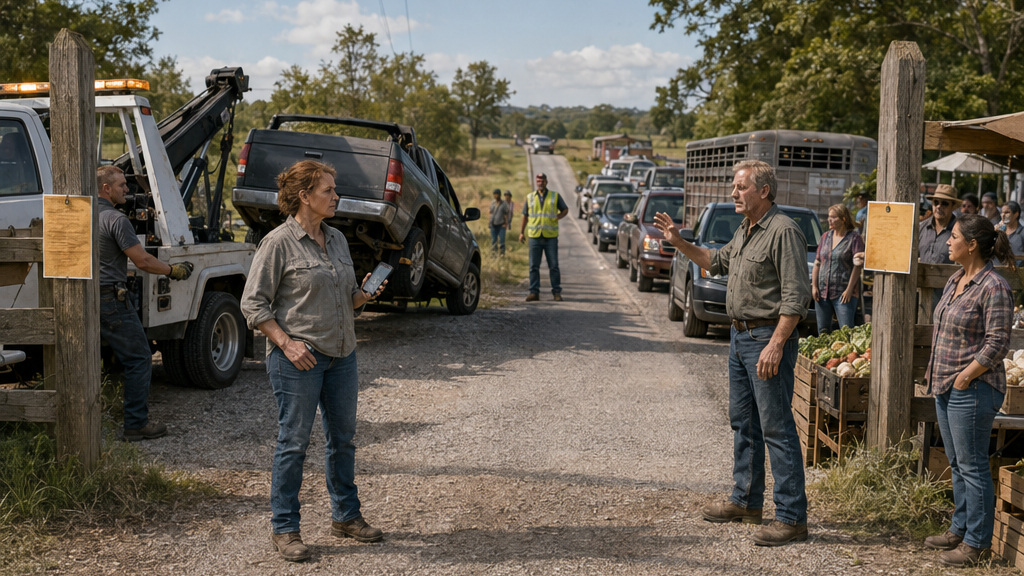
Her cattle trailer was already angling too wide across the gravel lane, the rear tires edging toward the ditch, when she lifted her eyes past the hood of the pickup and saw a white SUV sitting squarely in the western turnout.
A second vehicle occupied the eastern one.
Both places had been empty when she left before sunrise.
Catherine stopped.
Behind her, six bred heifers shifted inside the trailer. The movement rolled through the steel floor in a dull series of thumps. One animal bawled. The pickup idled beneath her hands.
She looked again, as if the vehicles might rearrange themselves if she gave them a second chance.
They did not.
The western turnout was the wider of the two, a flattened crescent of packed gravel that let her swing a livestock trailer through the farm entrance without dragging the back axle across the ditch. The eastern turnout sat closer to the pasture fence. Neither had ever been public parking.
Yet the white SUV had its windows down and a paper market map tucked under the windshield wiper. The dark pickup across from it had two folding chairs visible in the bed.
Saturday market traffic.
Catherine eased forward until the nose of her truck was nearly even with the first vehicle, then stopped again.
There was nowhere to go.
A row of cars stretched farther up the shared lane toward the weekend farm market, parked tight along the grass shoulder. People carried canvas bags, coolers, flower bundles, and cardboard produce boxes. Someone had set a temporary arrow sign near the road association’s mailbox kiosk.
Catherine pressed the brake harder.
The heifers shifted again.
She lowered her window.
“Whose SUV is this?”
A man walking with two children glanced over. “No idea.”
“You see who parked it?”
He shook his head and kept moving.
Catherine put the truck in park.
When she climbed down, the first thing she noticed was not the SUV.
It was the post beside it.
Her PRIVATE FARM ACCESS sign was gone.
For several seconds she stared at the two screw holes in the weathered wood. Rust stains showed where the metal bracket had sat for years.
She crossed the lane.
The second post was bare too.
Both signs.
Gone.
That changed the problem.
An ignorant visitor might park in the wrong place. Two ignorant visitors might.
But strangers did not ordinarily arrive with screwdrivers and remove matching signs from opposite sides of a farm entrance.
Catherine took out her phone.
She photographed the western post first, close enough to capture the empty screw holes. Then the SUV’s plate. Then the position of the vehicle against the arc her trailer needed. She walked across and did the same with the dark pickup.
A young man in a reflective vest approached from farther up the lane.
“You need some help?”
Catherine turned.
He had a laminated volunteer badge clipped to his shirt.
“Are you directing parking?”
“Just trying to keep people moving.”
“Who told people they could park here?”
He looked at the two vehicles, then at Catherine’s truck and cattle trailer blocking part of the lane.
“These spots are open for market traffic today.”
“They’re not spots.”
He hesitated.
“They told us the gravel turnouts were temporary overflow.”
“Who is ‘they’?”
“The road association.”
Catherine slid the phone into her back pocket.
“Who from the association?”
The volunteer’s expression tightened in the way people’s expressions often did when they suddenly realized they had stepped into an argument they had not created.
“Samuel, I think.”
“Samuel Thompson?”
“Yes, ma’am.”
Behind Catherine, one of the heifers kicked the trailer wall.
The volunteer flinched.
Catherine did not.
“Did Samuel tell you the signs had been removed?”
“I didn’t remove anything.”
“I didn’t ask if you did.”
He looked toward the market.
“He said those areas were open on Saturdays because the road gets packed.”
Catherine glanced up the lane.
He was not wrong about the traffic.
Vehicles were squeezed along both shoulders. A horse trailer waited near the bend. Two families had stopped beside each other to talk, forcing pedestrians around them. Farther up, someone was trying to reverse a pickup into a gap between parked cars.
Catherine turned back to her own entrance.
The problem remained simple.
Her trailer could not make the turn.
“Find the owners of these two vehicles.”
The volunteer shifted his weight. “I can ask at the check-in table.”
“Please do.”
He walked quickly uphill.
Catherine returned to her truck.
She had spent enough of her life watching temporary arrangements become permanent to distrust the word on principle.
Temporary feed storage in her father’s machine shed had lasted eight years.
Temporary use of the south pasture by a neighbor had ended with an argument over where the fence belonged.
Temporary permission to cross a hayfield during one wet harvest season had turned into tire tracks the following spring because somebody had told somebody else it was allowed.
Catherine did not object to helping people.
She objected to help being converted into entitlement while she was still standing there.
A woman came hurrying down the lane with a canvas market bag bouncing against her hip.
“Is that your SUV?” Catherine asked.
The woman nodded. “I was told to park here.”
“I need you to move it.”
“Oh.” The woman looked toward the volunteer station. “They said this was overflow.”
“It isn’t.”
The woman glanced at the empty signpost.
“Well, there wasn’t a sign.”
“There was yesterday.”
That was enough.
The woman’s face changed.
She set her bag in the rear seat, backed out, and drove uphill without arguing.
The second driver arrived several minutes later, apologetic but confused. When both vehicles were gone, Catherine climbed back into her truck and began the turn.
Even with the turnouts clear, the angle was tight.
She pulled left, then cut right. The trailer swept across nearly the full western gravel arc before the rear axle cleared the ditch.
Catherine watched it in the mirror.
The volunteer had returned and was standing near the post.
He watched too.
For the first time, he seemed to understand that the gravel was not simply unused space beside a lane.
Catherine got the trailer inside the gate, stopped near the barn, and unloaded the heifers.
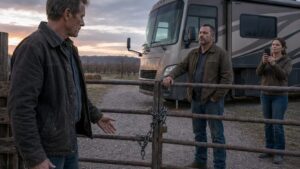
Only then did she call Samuel Thompson.
He answered on the fourth ring.
“Catherine.”
“Did you authorize market parking on my turnouts?”
There was a pause.
“I authorized temporary overflow in a few places along the lane.”
“That wasn’t my question.”
Another pause.
“Yes.”
Catherine looked back toward the road.
“Did you authorize somebody to remove my signs?”
“They were confusing people.”
“They were supposed to.”
“Catherine, we had cars backed almost to the county road last Saturday.”
“You opened my land.”
“We opened gravel beside a shared road for a few hours.”
“My gravel.”
“Nothing was damaged.”
She closed her eyes once.
There it was: the quiet assumption underneath everything.
If no fence had been cut and no crop flattened, then nothing meaningful had been taken.
“Put the signs back,” she said.
“We can talk after the market.”
“No. Put them back.”
Samuel exhaled.
“I’m not undoing the traffic plan in the middle of the day.”
Catherine looked at the two bare posts.
“Then send me that answer in writing.”
This time Samuel did not reply immediately.
When he finally spoke, his voice had cooled.
“All right.”
Catherine ended the call.
The traffic continued moving beyond her gate.
A child laughed somewhere up the lane. A truck door slammed. The market carried on as if nothing had happened.
Catherine opened her camera again and took one final photograph.
Two empty signposts.
Two cleared turnouts.
And the shared road running between them as though someone else had already decided where her property ended.
Chapter 2: Temporary Use Was Still Her Land
Samuel’s written answer arrived eleven days later.
Catherine saw the message on her laptop before breakfast and left it unopened until she had fed the cattle.
That was deliberate.
She knew herself well enough to understand the value of chores before correspondence.
By seven-thirty she was back at the farmhouse kitchen table with coffee, her reading glasses, and the folder where she had placed photographs from the first Saturday.
She opened the message.
Samuel had made it sound reasonable.
That annoyed her more than if he had been rude.
The road association, he wrote, had implemented a temporary weekend traffic-management plan because attendance at the farm market had exceeded available roadside capacity. Several widened gravel areas along the private lane were being used between late morning and midafternoon to reduce congestion and preserve through access.
Catherine read the paragraph twice.
Her turnouts were not called hers.
They were “widened gravel areas.”
The signs were described as “temporary access markers.”
Their removal had been “necessary to avoid conflicting parking instructions.”
She kept reading.
At no point did Samuel claim that Catherine had consented.
At no point did he apologize for not asking.
Near the bottom, he wrote that the arrangement would remain in effect through the remainder of the market season while the association evaluated more permanent solutions.
Catherine leaned back.
Remainder of the season.
So much for a few hours.
She printed the message.
Then she printed her original complaint and placed Samuel’s response behind it.
On the corner of the table sat two rusted brackets.
A volunteer had found them in a plastic bin near the market check-in table three days after the first confrontation and left them by Catherine’s gate.
No signs.
Just the brackets.
Catherine had cleaned the dirt off without polishing away the rust.
Now she placed them on top of Samuel’s printed message.
Temporary, she thought.
She carried the folder to her truck and drove into the county seat.
The records office occupied the first floor of an older brick building beside the courthouse annex. Catherine had not needed to pull the original farm plat in years.
The clerk brought out a scanned copy first.
Catherine studied it at the counter.
The lane was easy to identify: a narrow strip running along the northern edge of the Nelson parcel before continuing east toward the properties beyond it.
The western turnout appeared as part of Catherine’s described parcel, its curved edge drawn outside the shared road easement.
The eastern gravel area did too.
She pointed.
“I need the recorded version showing the easement limits.”
The clerk enlarged the image.
There it was.
The road association had maintenance rights within a defined corridor.
The turnouts sat beyond it.
Catherine felt satisfaction, but not surprise.
She had known where her land was.
What she needed now was proof that did not depend on Samuel believing her.
The clerk printed a certified copy.
On her way home, Catherine stopped beside the lane.
The market was not operating that day, and the road seemed almost absurdly ordinary without the Saturday traffic.
Grass bent along the shoulders where tires had pressed it flat.
At her entrance the two posts still stood bare.
She got out and walked the western turnout with the plat in hand.
The paper showed lines.
The ground showed consequences.
Fresh tire impressions crossed the gravel in several directions. Somebody had pulled far enough toward the pasture fence to crush a patch of weeds near the ditch.
Nothing catastrophic.
Nothing she could point to and call destruction.
That, she understood, was part of Samuel’s argument.
If the land looked unharmed, why make trouble?
Her phone rang.
Samuel.
She considered letting it go to voicemail, then answered.
“I assume you read my response.”
“I did.”
“I wanted to make sure you understood the arrangement is limited.”
“Through the rest of the market season.”
“Limited in time.”
“Without my permission.”
Samuel was silent for a moment.
“We’re trying to manage a road problem.”
“You removed my signs.”
“Because people were getting conflicting directions.”
“My signs were the accurate directions.”
His voice sharpened slightly.
“This road serves more than your farm, Catherine.”
“And those turnouts do not.”
“That depends on what you mean by serve.”
She stared at the plat.
“There’s a recorded easement corridor. I’m standing here with it.”
“I’m not talking about the deed. I’m talking about the road.”
“That’s convenient.”
“No, it’s practical.”
Catherine folded the plat once, carefully along an existing crease.
“Put the signs back before Saturday.”
“We can’t.”
“Can’t or won’t?”
“We won’t change the traffic plan two days before another market.”
There it was.
Not confusion.
Not a mistake.
A decision.
Catherine’s grip tightened around the phone.
Samuel continued, quieter now.
“You could have come to the traffic meeting last month.”
“I wasn’t required to attend a meeting about giving away my land.”
“It wasn’t about giving away your land.”
“Then why did you need mine?”
Samuel did not answer directly.
“We had to do something.”
Catherine looked up the lane toward the market grounds.
For a moment she almost asked what had happened.
Almost.
Instead she said, “You’ll have something formal from me.”
She ended the call.
Only after the silence returned did she recognize the mistake.
Samuel had offered, however badly, the edge of an explanation.
She had refused to ask for it.
That afternoon Catherine spread the certified plat across her kitchen table.
The boundary lines were not dramatic.
No red circles. No bold declaration.
Just measurements, bearings, easement notes, and the quiet authority of a record made long before the current argument.
She set the two rusty brackets beside the paper.
Then she called Nicholas Scott.
He had handled an access dispute for her years earlier and had an office above an insurance agency in town.
“I need you to look at a road easement,” she said.
“Boundary question?”
“Not exactly.”
“What happened?”
“The road association opened two parts of my property for public parking.”
Nicholas was silent.
“Public parking?”
“Weekend market overflow.”
“With your permission?”
“No.”
“Put everything you have in a folder. Don’t call anybody else.”
“I already called Samuel.”
“I assumed you had.”
Catherine frowned.
“He’s refusing to stop.”
“Then definitely don’t call him again.”
She looked at Samuel’s printed message.
“What if people park there Saturday?”
“First we determine what rights you actually have. Then we determine what you can legally do about it.”
“I know what rights I have.”
Nicholas gave a short sigh.
“That sentence is how people create expensive problems while technically being correct.”
Catherine did not like the line.
Which was probably why she remembered it.
Before hanging up, Nicholas asked her to send photographs of the turnouts, the empty signposts, Samuel’s response, and the plat.
Catherine did.
Then she sat alone at the kitchen table and reread the certified boundary description.
Both gravel turnouts were exactly where she had always believed them to be.
Inside her property.
Outside the road easement.
The question was no longer whether Samuel knew she objected.
He did.
The question was why he was willing to continue anyway.
Chapter 3: The Tow Notice Changed the Crowd
“Being right doesn’t give you permission to be sloppy.”
Nicholas Scott said it before Catherine had finished sitting down.
His office smelled faintly of old paper and burnt coffee. The certified plat lay open across his desk beside Samuel’s email and Catherine’s photographs.
Catherine set her purse on the floor.
“I’m not planning to be sloppy.”
“You’re angry.”
“That’s different.”
“Sometimes.”
He tapped the plat.
“The ownership issue looks strong. The easement description does not appear to include either turnout.”
“Then they stay out.”
“They should.”
Catherine watched him.
“But?”
“But if you want vehicles removed, you follow the towing rules exactly. Posting, placement, notice period, operator requirements. No improvising because Samuel made you mad.”
“He did not make me mad.”
Nicholas looked over his glasses.
Catherine let the silence sit.
“Fine,” she said. “He made me mad.”
“That’s the first useful thing you’ve said this morning.”
Nicholas slid a page toward her.
He had marked the relevant private-property towing requirements.
“You install compliant notices. You document when they go up. You use a licensed operator. You do not touch anyone’s vehicle yourself. You do not threaten anybody. And you do not tell the tow company to remove something unless the conditions are satisfied.”
Catherine read every line.
“What about the association signs?”
“What signs?”
“The volunteers use temporary parking arrows.”
“If they direct people onto your property after you’ve posted lawful notices, that becomes their problem. Do not remove their signs unless they’re on your land.”
She nodded.
Nicholas leaned back.
“I’m also sending Samuel a formal letter today.”
“Good.”
“It won’t say what you want it to say.”
“What do I want it to say?”
“Something satisfying.”
Despite herself, Catherine nearly smiled.
“What will it say?”
“That the turnouts appear outside the easement and that continued unauthorized use exposes the association to consequences. It will request immediate restoration of your markers and suspension of parking directions onto your property.”
“And if he ignores it?”
Nicholas pushed the towing sheet closer.
“Then you’ll already know what not to do wrong.”
By Thursday afternoon, Catherine had two new signs installed.
They were not pretty.
Bright lettering warned that unauthorized vehicles on private property were subject to towing.
She mounted one near each bare wooden post, then photographed them from the lane, from the driveway, and from the approach market visitors would use.
The old private-access signs had still not been returned.
Their absence bothered her more than she expected.
Those weathered rectangles had never seemed important when they were present.
Now every empty screw hole looked like a decision made in a room where she had not been invited.
Friday passed quietly.
Saturday did not.
By ten-thirty the lane had begun filling.
Catherine watched from near the equipment barn as pickups and SUVs moved toward the market. She had already finished moving cattle for the morning. The trailer sat parked inside her fence.
At eleven-fifteen the first volunteer arrived at the junction carrying a fluorescent flag.
At eleven-twenty-eight, a pickup slowed beside Catherine’s western turnout.
The driver looked at the tow notice.
Then at the volunteer.
The volunteer pointed directly toward the gravel.
Catherine felt something inside her go still.
The pickup turned in.
A second vehicle followed twenty minutes later.
She waited.
Nicholas had told her to wait.
The notice existed to remove ambiguity, not merely decorate the argument.
At noon Catherine walked down to the turnout with her phone.
The first pickup belonged to a man browsing the market. The second was a dark crossover.
Jennifer Flores was standing beside the road with boxes of preserves stacked on a folding cart.
She saw Catherine photographing plates.
“You really going to tow them?”
“If they remain after the notice requirements are met.”
Jennifer looked at the signs.
“They told people those didn’t apply during market hours.”
Catherine lowered the phone.
“Who told them that?”
“The volunteers.”
“Samuel?”
“I don’t know if he said it himself.”
Jennifer glanced uphill.
“Catherine, the road’s a mess.”
“That doesn’t make this public.”
“I didn’t say it did.”
Jennifer rubbed one hand over the cart handle.
“My truck nearly got boxed in by the bend. People are parking wherever they can.”
“Then Samuel needs a plan.”
“He thinks this is the plan.”
Catherine looked at the two vehicles.
“That’s the problem.”
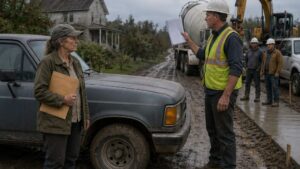
By early afternoon, a licensed tow truck rolled slowly down the lane.
People noticed immediately.
Heads turned.
A few market visitors stepped out of the road to let it pass. Someone raised a phone.
The operator stopped beside Catherine.
She showed him the photographs documenting the signs and the required notice period. He checked the postings himself.
Then he looked at the western pickup.
“You authorizing removal?”
Catherine read the plate aloud and matched it to her photograph.
“Yes.”
The operator lowered the wheel-lift.
The steel arms slid beneath the pickup’s rear tires.
A small crowd formed almost instantly.
“What’s happening?”
“Is somebody getting towed?”
“I was told this was parking.”
The pickup’s owner came running down the lane.
“Hey! Stop!”
The tow operator paused.
The man looked at Catherine.
“That’s my truck.”
“I know.”
“The parking guy told me to put it here.”
Catherine pointed at the bright sign beside him.
“That sign was here when you arrived.”
“He said it was fine during the market.”
Catherine turned toward the volunteer stationed farther uphill.
He was watching.
“So did he,” she said.
The owner looked from Catherine to the operator.
“This is ridiculous.”
“It’s private property.”
“It’s gravel.”
Catherine felt the old anger rise at the word, the same way it had when Samuel called the turnouts widened areas.
She kept her voice level.
“It is still private property.”
The operator finished securing the truck.
The owner swore under his breath, then stopped himself.
“Who do I call?”
The operator gave him the impound information.
Catherine said nothing else.
The truck lifted.
For one strange second, the rear wheels hung in the air beside the bare wooden post where Catherine’s original sign had been removed.
That image drew every eye on the lane.
A private boundary made visible by machinery.
The tow truck pulled away.
The crowd did not disperse immediately.
Catherine expected satisfaction.
Instead she felt exposed.
The second vehicle remained in the opposite turnout.
Jennifer came closer.
“You proved your point.”
“I’m not proving a point.”
“What are you doing, then?”
“Stopping them from using my property.”
Jennifer looked uphill.
“So where do they go?”
Catherine followed her gaze.
Without the western turnout, incoming cars were stacking behind a pickup trying to parallel park along the shoulder. A delivery van had stopped partly in the lane. A livestock trailer farther back could not get around it.
For the first time that day, Catherine saw the road not as Samuel’s excuse but as a physical problem.
Still, she did not move.
The second vehicle stayed long enough to meet the towing conditions.
Catherine authorized that removal too.
By the time the tow operator began securing it, Samuel’s truck had appeared near the market entrance.
He walked down the lane quickly.
“Catherine.”
She faced him.
“You’re actually towing people.”
“Yes.”
“They were directed here.”
“I know.”
“By volunteers trying to keep the road open.”
“Your volunteers.”
Samuel looked at the sign.
Then at the departing tow truck.
“You could have called me.”
“I did.”
“That was before this.”
“That was before you ignored me.”
People nearby had gone quiet.
Samuel noticed.
His jaw tightened.
“This is making the traffic worse.”
“Then stop sending people onto my land.”
Jennifer stepped between them only enough to be noticed.
“Samuel, she posted it.”
“I can see that.”
“You should’ve stopped the volunteers.”
Samuel looked at her.
“And put cars where?”
No one answered.
A horn sounded uphill.
Then another.
A pickup towing a livestock trailer had stopped behind the delivery van. The trailer angled across part of the lane while its driver tried to back out.
Jennifer looked at Catherine.
“That’s what I was talking about.”
Samuel turned toward the congestion, then back.
For the first time, Catherine saw something in his face that was not irritation.
Fear.
It appeared only briefly.
But it was there.
Samuel pulled out his phone.
“I’m calling an emergency association meeting for tonight.”
Catherine folded her arms.
“Good.”
“At the fire hall. Seven.”
“I’ll be there.”
Samuel started away.
Then he stopped.
“You think this is only about parking.”
Catherine looked at him.
“What is it about?”
But Samuel had already turned toward the line of stalled vehicles.
He did not answer.
Chapter 4: The Emergency Samuel Never Mentioned
Samuel Thompson did not begin the emergency meeting with Catherine’s deed.
He began with a map.
It was spread across two folding tables inside the volunteer fire hall, held flat at the corners by a coffee mug, a stapler, and one of Catherine’s missing private-access signs.
She stopped when she saw it.
The sign was scratched along one edge, its faded lettering dulled by years of sun. The rusted bracket was still attached.
Samuel noticed where she was looking.
“I brought that because it’s part of what we’re discussing.”
“You had it.”
“The volunteers took it down.”
“And gave it to you.”
“Yes.”
Catherine took a seat without answering.
About a dozen road-association members sat in folding chairs. Jennifer Flores was near the back. The volunteer market coordinator had a notebook open on her lap. At the far end of the table stood a representative from the local fire district.
That was the first thing Catherine had not expected.
Samuel waited until everyone settled.
“We’re here because two vehicles were removed from the Nelson property this afternoon and because traffic conditions on the lane became unsafe.”
Catherine folded her hands.
“Those are two separate issues.”
“They became the same issue today.”
“No. One was caused by your association directing vehicles onto private property.”
A murmur passed through the room.
Samuel’s mouth tightened, but he did not snap back.
Instead, he pointed to the map.
“This is the road.”
A red line marked the narrow lane from the county road to the market grounds. Several handwritten arrows showed places where vehicles could pass.
Then Samuel tapped a circled bend.
“Three Saturdays ago, an ambulance came in here.”
The room changed.
Catherine looked at the fire-district representative.
Samuel continued.
“A visitor collapsed near the market. The ambulance got through the county-road entrance, but vehicles were parked on both shoulders from here to here.”
His finger traced the bend.
“They lost time.”
“How much?” Catherine asked.
The fire-district representative answered.
“Just under four minutes from the entrance to the market area.”
Catherine stared at him.
Four minutes on a rural road was not an inconvenience.
It was a long time.
“Was the patient harmed because of the delay?”
“We can’t say that.”
Samuel leaned both palms on the table.
“That isn’t the point.”
Catherine looked at him.
“No. It matters.”
“It matters that next time it could be worse.”
There was no triumph in his voice now.
No suggestion that he had finally found the argument that would defeat her.
He sounded tired.
The representative pointed to the map.
“The lane is technically wide enough for emergency access if shoulders remain clear. The problem is that during market hours, people park anywhere they think they can fit.”
Jennifer spoke from the back.
“Because we don’t have enough designated places.”
Samuel nodded.
“Exactly.”
Catherine looked at the map again.
Her two turnouts were marked in yellow.
They were among the few wide areas near the worst section of the lane.
“So you decided to use mine.”
Samuel met her eyes.
“I decided we needed breathing room.”
“You decided you had the right.”
“I decided I wasn’t going to have another ambulance stuck behind somebody buying tomatoes.”
The sharpness returned for a moment.
Then Samuel sat down.
Catherine felt something shift inside her—not agreement, but the collapse of one assumption.
She had believed Samuel kept pushing because he was embarrassed to retreat.
That might still be part of it.
But not all of it.
He had been frightened.
And frightened people were capable of convincing themselves that necessity erased permission.
The market coordinator cleared her throat.
“We asked for more parking options last month.”
Catherine looked toward her.
“We also asked adjoining owners to come to the traffic meeting.”
Samuel did not look at Catherine.
Jennifer did.
Catherine knew what was coming before anyone said it.
The coordinator continued carefully.
“Catherine, Samuel asked if you’d attend.”
“I remember.”
“You declined.”
“Yes.”
“Why?”
Catherine leaned back.
“Because the question he sent me was whether the association could use private roadside areas for overflow. Mine were not available.”
Samuel looked up.
“I asked you to discuss traffic.”
“You asked me to discuss access to my land.”
“Because your land is next to the road problem.”
“And I said no.”
The fire hall went quiet.
Catherine heard how it sounded.
Not legally.
Legally, she still believed she was correct.
But the room was not a courtroom, and Samuel’s map was not pretending to redraw her deed.
It was showing a problem she had refused to look at because she disliked the proposed answer.
Jennifer spoke softly.
“You didn’t know about the ambulance, did you?”
Catherine shook her head.
“No.”
Samuel’s gaze dropped.
“I should’ve told her.”
It was the first admission he had made all evening that cost him something.
Catherine looked at him.
“Yes. You should have.”
Samuel nodded once.
“But you still opened my property without asking.”
“I asked.”
“You asked me to attend a meeting. You never asked permission after I declined.”
“No.”
“And after I objected, you kept doing it.”
Samuel’s face hardened.
“Yes.”
There it was.
His reason did not erase his choice.
For the first time, Catherine could hold both facts at once.
The association had faced a real safety problem.
Samuel had still crossed a boundary that was not his to move.
One of the association members pointed toward the sign lying on the table.
“Can’t we just put those back and use somewhere else?”
Samuel gave a humorless laugh.
“Where?”
No one answered.
He turned the sign around with two fingers.
“This is the problem. We’re treating those two gravel areas like they’re sacred when, most days, they’re empty.”
Catherine looked at him.
“Empty?”
“You know what I mean.”
“No. Tell me.”
Samuel gestured toward the map.
“They’re widened gravel beside the lane. No building. No crops. No gate across them. Most Saturdays they sit there unused while cars choke the road twenty feet away.”
Something cold and precise moved through Catherine.
Not anger this time.
Recognition.
Samuel did not understand.
None of them did.
Jennifer glanced at Catherine.
“What?”
Catherine looked at the yellow marks on the map, then at her old sign pinning one corner down.
For years she had assumed the purpose of the turnouts was obvious because it was obvious to her.
She had never explained the trailer arc.
She had never shown anyone the buried stock-water shutoff.
She had never needed to.
Until now.
Catherine stood.
Samuel frowned.
“Where are you going?”
“Home.”
“We’re not finished.”
“No.”
She picked up the weathered sign from the table.
Samuel watched her.
Catherine held it against her side.
“Tomorrow morning, bring your truck to my place.”
“What for?”
“Eight o’clock.”
Samuel stared at her.
“If you want to keep calling that unused gravel,” she said, “come watch me use it.”
Chapter 5: The Gravel Was Part of the Farm
At eight the next morning, Catherine was already backing her longest livestock trailer toward the pasture gate when Samuel’s truck came down the lane.
Jennifer arrived behind him.
Catherine had not invited her.
Jennifer climbed out and lifted both hands.
“I figured somebody should watch who isn’t mad at either of you.”
“I’m not mad,” Catherine said.
Samuel shut his door.
Jennifer looked between them.
“Of course not.”
Catherine had placed one of the old private-access signs back against its western post. She had not bolted it down. It leaned slightly, as if waiting to see whether it still belonged there.
Samuel noticed.
“You got that from the meeting.”
“It’s mine.”
“I know.”
That answer was different from the ones he had given before.
Catherine walked toward the trailer.
“Stand by the fence.”
Samuel followed.
The trailer was a long stock unit she used when moving several animals at once. Empty that morning, it still required far more room than a pickup.
Catherine climbed into the cab.
Before starting, she lowered the window.
“Watch the rear axle.”
Samuel stepped back.
She pulled forward along the lane, passed her entrance, then began the turn.
The pickup nose swung left.
The trailer followed slowly.
Its rear wheels crossed deep into the western turnout, exactly where the white SUV had sat the first Saturday.
Samuel’s expression changed.
Catherine continued.
The trailer cleared the ditch with less than two feet to spare.
Then she stopped.
Jennifer walked to the rear corner.
“That’s tighter than I thought.”
Catherine put the truck in park and climbed down.
“Now imagine a vehicle here.”
She pointed to the center of the turnout.
Samuel studied the angle.
“You could make a wider approach from the road.”
“With no traffic, maybe. With vehicles parked on the opposite shoulder, no.”
“You managed the first Saturday after they moved.”
“Because both turnouts were clear by then.”
Samuel looked toward the road.
Catherine could see him rebuilding the scene in his head.
The cattle trailer.
The blocked gravel.
The narrow lane.
But she was not finished.
“Come across.”
She led them to the eastern turnout.
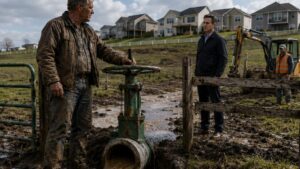
Near the pasture fence, she knelt and brushed loose gravel away from a round metal lid nearly flush with the ground.
Jennifer crouched beside her.
“What is that?”
“Stock-water shutoff.”
Samuel looked closer.
Catherine hooked two fingers under the recessed handle and lifted the lid.
Below it, in a shallow concrete box, sat the valve controlling the main branch feeding troughs in the lower pasture.
“If I lose a line below the hill, this is where I shut it down.”
Samuel frowned.
“You drive over this?”
“The box is rated for farm traffic. But I need access to it.”
Jennifer looked toward where market vehicles had been parked.
“They were sitting right over this.”
“One was.”
Samuel rubbed his jaw.
“You never said anything about a valve.”
“You never asked what the turnouts were for.”
“I asked you to come to the meeting.”
“And I refused.”
Catherine straightened.
The words were harder to say than she expected.
“I should have come.”
Samuel looked at her.
That was not absolution, and she did not intend it as one.
She continued.
“But if I had shown you this in the first five minutes, you still would not have had authority to remove my signs.”
“No.”
It came without argument.
Jennifer glanced at Samuel.
He looked at the exposed valve.
“No,” he repeated. “I wouldn’t.”
For a while none of them spoke.
Then a pickup towing a short utility trailer came down the lane. There was no market that Sunday, so it passed easily.
Catherine watched it go.
“That’s the other part.”
Samuel followed her gaze.
“What?”
“The road.”
She walked to the western turnout and looked uphill.
“Close both of these completely on Saturdays and you lose two of the only places people have been using to get out of each other’s way.”
Samuel gave her a tired look.
“That’s what I’ve been trying to tell you.”
“No. You’ve been telling me that because the road has a problem, my land becomes part of the solution.”
“What’s the difference?”
“The difference is whether you ask.”
Samuel looked away.
Catherine continued.
“I could put boulders across both turnouts today.”
“You could.”
“And then your emergency problem gets worse.”
“Yes.”
The admission landed between them.
Jennifer folded her arms.
“So everybody’s right enough to be miserable.”
Catherine almost smiled.
Samuel did not.
He looked at the old sign leaning against the post.
“I thought those areas were basically spare shoulder.”
“That was your mistake.”
“You thought the deed meant you didn’t need to discuss the road.”
“That was mine.”
Samuel glanced at her.
For the first time since the dispute began, neither of them appeared to know what the next move was.
Catherine walked back to the trailer.
“Stand there again.”
Samuel frowned.
“Why?”
“I want to try something.”
She repositioned the trailer, this time pretending only half the western turnout was available.
Jennifer stood near the gravel edge, marking an imaginary parked vehicle.
Catherine began the turn.
The trailer came around.
Closer.
Closer.
The rear corner drifted toward the fence.
Jennifer lifted a hand.
“Stop.”
Catherine stopped.
The trailer corner was less than a foot from a fence post.
She climbed down.
Samuel had gone quiet again.
“There,” Catherine said. “That’s why I need the whole radius when I’m hauling stock.”
Jennifer nodded toward the eastern side.
“But you don’t need both turnouts for the trailer.”
“No.”
Samuel looked at her.
Catherine met his eyes.
There was the first shape of an answer.
Not a pleasant one.
Not a permanent surrender.
But perhaps something narrower.
“One turnout might be usable sometimes,” she said.
Samuel’s eyebrows lifted.
“Sometimes?”
“When I’m not moving cattle. When nobody blocks the valve. When the association controls who parks there. When emergency access stays clear.”
Jennifer gave a small laugh.
Samuel looked at her.
“What?”
“She’s negotiating.”
“I am not.”
“You just listed conditions.”
Catherine ignored her.
Samuel walked toward the western signpost.
“What about Saturdays?”
“Not all Saturdays are the same.”
“We need something predictable.”
“And I need something I can revoke.”
Samuel shook his head.
“That won’t work if every week depends on whether you wake up in a good mood.”
Catherine’s face cooled.
“Then we’re done.”
He immediately raised a hand.
“That came out wrong.”
“It did.”
He rubbed the back of his neck.
“I mean we need a system people can understand.”
Catherine looked at the road.
A system.
Not an assumption.
Not a favor that slowly became a right.
Something written.
Something limited.
Something that recognized the boundary instead of pretending it did not exist.
She lowered the stock-water lid and covered its edge with gravel again.
Then she pulled out her phone.
Samuel watched.
“Who are you calling?”
“Nicholas.”
“For another demand letter?”
Catherine looked at the two turnouts.
One needed for trailer swing.
One hiding the valve.
Both hers.
The lane between them belonging, in a different way, to everyone who depended on it.
“No,” she said.
When Nicholas answered, Catherine walked several yards away.
“I need you to draft something.”
“What kind of something?”
She looked back at Samuel and Jennifer standing beside the old sign.
“Not a demand.”
Chapter 6: Winning the Argument Did Not Clear the Road
The next Saturday proved that Catherine could win the property argument and still lose the road.
By eleven in the morning, traffic had backed from the market entrance nearly to the county pavement.
Her restored temporary notices kept both turnouts clear.
The result was exactly what Samuel had warned about.
A pickup stopped on the shoulder to let an oncoming SUV squeeze past. Behind it, three more vehicles waited. A farm truck trying to leave the market had nowhere to pull aside.
Catherine stood beside her gate watching the line grow.
Samuel walked down from the market with a radio clipped to his belt.
He did not look pleased.
He also did not say I told you so.
That helped.
“County road’s starting to stack,” he said.
“I can see it.”
“We moved volunteers farther down.”
“It isn’t enough.”
“No.”
Catherine looked toward the western turnout.
Clear gravel.
Useful gravel.
Her gravel.
She had spent two weeks fighting to make that distinction visible.
Now she was about to allow someone else to use it.
The difference, she reminded herself, was not the tires.
It was the permission.
“Nicholas finished the draft.”
Samuel looked at her.
“You brought it?”
“It’s in the house.”
“Now?”
“Work session at one.”
Samuel glanced at the line of vehicles.
“We might not make it to one.”
Catherine considered the traffic.
Then she pointed at the western turnout.
“You can use that one for passing only until noon. No parking.”
Samuel blinked.
“Today?”
“Today.”
“Verbally?”
“Don’t get used to it.”
He almost smiled.
“Fair enough.”
He radioed the volunteer.
Within minutes, traffic began using the turnout as a controlled pull-off. One vehicle waited there while another passed. The line loosened.
Catherine watched carefully.
Nobody parked.
Nobody crossed into the eastern turnout.
At noon Samuel had it closed again without being asked.
That mattered more than she expected.
At one, the association gathered around folding tables behind the market barn for the scheduled work session.
Nicholas had prepared a short license agreement.
Catherine laid copies on the table.
Samuel read the first page.
“Revocable.”
“Yes.”
“Seasonal.”
“Yes.”
“One turnout only.”
“Yes.”
“No overnight use, no permanent improvements, no claim of continuing access.”
“Yes.”
He looked up.
“You really had him write every fear you’ve ever had into this thing.”
“Not every fear.”
Jennifer, seated across from them, covered a smile.
Samuel kept reading.
The western turnout could be opened during designated market hours when Catherine had no scheduled livestock movement. The association would be responsible for signs, volunteers, and keeping the entire trailer-turning radius available upon notice.
The eastern turnout remained private at all times because of the water-service access.
Samuel tapped that section.
“That part makes sense now.”
“It made sense before. You just didn’t know why.”
“Because you never told me.”
Catherine held his gaze.
“Yes.”
The word surprised him into silence.
She continued.
“I should have attended the traffic meeting. I should have explained how the farm uses those areas.”
Samuel nodded.
Then Catherine placed another sheet on top of the draft.
“But this is separate.”
He read it.
His expression changed.
“Tow reimbursements.”
“The drivers were directed onto my property by association volunteers.”
“They ignored posted warnings.”
“Some did. They were also told those warnings did not apply during market hours.”
Samuel looked at Jennifer.
She nodded.
“I heard that too.”
Samuel leaned back.
“So the association pays the impound charges?”
“For the vehicles removed after being misdirected by your volunteers.”
“That’s going to be unpopular.”
“So was being towed.”
One board member shifted in his chair.
“Why should dues pay for drivers who didn’t read signs?”
Catherine answered before Samuel could.
“Because the association created the contradiction.”
The board member started to respond.
Samuel raised a hand.
“She’s right.”
Everyone looked at him.
Samuel stared down at the reimbursement page.
“We told volunteers those turnouts were open. We did not withdraw that instruction after the new notices went up.”
Catherine watched him closely.
He had not yet said the harder part.
Not in front of everyone.
Samuel turned another page.
“What about emergency access?”
“The license requires the turnout to remain available as a passing bay even when parking isn’t permitted.”
“And if you’re moving cattle?”
“Then I notify the coordinator before market opening and the turnout stays closed.”
“That still leaves us short on busy weekends.”
“It leaves you one turnout you didn’t legally have yesterday.”
Jennifer nodded.
“That sounds like progress.”
Samuel gave her a look.
She shrugged.
Catherine pointed to another clause.
“The association also agrees to look for a longer-term parking solution instead of treating this as permanent.”
Samuel sighed.
“There it is.”
“There what is?”
“You don’t trust us.”
“No.”
The answer came so quickly the table went quiet.
Catherine did not soften it.
“I trust written limits more than good intentions.”
Samuel sat back.
Something in his face closed.
For a moment Catherine wondered whether she had pushed too hard.
Then he said, “I suppose I gave you a reason.”
“You did.”
“So did other people before me, apparently.”
Catherine looked at him.
She had never told him those stories.
Not the borrowed field crossing.
Not the shed.
Not the arrangements that kept stretching because nobody wanted to be the first person to say enough.
Samuel looked down at the agreement again.
“I thought if the road needed something, the association had to act.”
“You did have to act.”
He looked up.
“You’re saying that now?”
“I’m saying you had to solve the road problem.”
She tapped the license.
“You did not get to redefine my property while doing it.”
Samuel read the first paragraph once more.
Then he set the pages down.
“If we accept this, I want it recorded in the minutes that the association can’t treat the license as an easement.”
Nicholas had already included that clause.
Catherine pointed to it.
Samuel found it and gave a short, reluctant laugh.
“Of course he did.”
“One more thing,” Catherine said.
Samuel’s expression sharpened.
“What?”
“The signs.”
“We’ll put them back.”
“Both original signs.”
“One is damaged.”
“Then repair it.”
“And the market-use marker?”
Catherine took a small prototype from beneath the papers.
It was a removable placard designed to hang below the western private-access sign only during authorized hours.
Samuel stared at it.
“So the private sign stays.”
“Yes.”
“Even when we’re using the turnout.”
“Especially then.”
Jennifer picked up the placard.
“That’s going to confuse fewer people than taking the sign down.”
Samuel gave her a dry look.
“Thank you.”
“You’re welcome.”
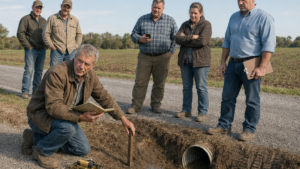
The conversation moved into details.
Hours.
Volunteer responsibility.
Advance notice.
No vehicles blocking the water access.
Reimbursement procedure.
None of it felt dramatic.
That was exactly why Catherine trusted it more than Samuel’s old temporary arrangement.
At last Samuel gathered the pages.
“I’ll put this to a recorded vote Tuesday.”
Catherine nodded.
He remained seated.
“There’s something else.”
She waited.
Samuel looked around the table.
“When we vote, I’ll state for the record that I authorized removal of the signs.”
Catherine said nothing.
“And that I authorized use after you objected.”
The room had gone still again.
Samuel’s jaw tightened.
“I believed I was protecting access to the road.”
Catherine watched him.
He had finally reached the sentence he had avoided since the first Saturday.
“That didn’t give me authority over your turnouts.”
There was no applause.
No dramatic reaction.
Just Jennifer lowering her eyes to the agreement and one board member slowly turning his pen between his fingers.
Catherine preferred it that way.
“What changed your mind?” she asked.
Samuel looked through the open barn doors toward the lane.
“Watching your trailer almost take out that fence post helped.”
Jennifer laughed once.
Samuel continued.
“And watching the road today.”
Catherine followed his gaze.
Vehicles were moving now.
Not perfectly.
But moving.
Samuel stacked the papers.
“Tuesday night. Recorded vote.”
Catherine gathered her copy.
As she stood, Samuel touched the removable market placard.
“If this passes, next Saturday we put the old sign back and this beneath it?”
“If I authorize the turnout.”
He nodded.
This time he did not correct the wording.
He did not say when we open it.
He said, “If you authorize it.”
Catherine carried her copy toward the door.
Behind her, Samuel called the meeting adjourned.
For the first time since the signs disappeared, Catherine was no longer waiting to learn what Samuel thought he could do.
Now she was waiting to see whether he was willing to tell everyone, on the record, what he could not.
Chapter 7: The Same Posts Held Different Signs
Samuel Thompson was holding Catherine’s old sign against the western post when she came down the driveway Saturday morning.
For a second she thought he had already bolted it in the wrong place.
Then she saw the pencil marks.
He had lined the original screw holes up exactly.
The sign still bore the scrape along its lower edge from being removed, and one corner had been straightened rather than replaced. Samuel held it steady while a volunteer tightened the first bolt.
Catherine stopped several yards away.
Samuel looked over.
“Morning.”
“Morning.”
The volunteer glanced between them, uncertain whether to continue.
Catherine nodded toward the sign.
“Go ahead.”
The drill whirred.
The weathered metal settled back against the post.
PRIVATE FARM ACCESS.
Below it hung nothing yet.
The removable market placard rested on the tailgate of Samuel’s truck.
The association had approved Catherine’s license Tuesday night. The vote itself had been almost anticlimactic: questions about liability, volunteer staffing, advance notice, reimbursement, then hands raised around a folding table.
Samuel had done what he promised.
Before the vote, he stated for the record that he had authorized removal of Catherine’s signs and continued directing vehicles onto the turnouts after Catherine objected.
He did not excuse it.
He explained the emergency concern, then said the concern did not give the association authority over land outside the easement.
Catherine had expected the admission to feel larger.
Instead, she had mostly felt tired.
By Friday, the association had also approved reimbursement for the drivers whose vehicles were towed after volunteers told them the posted restrictions did not apply.
That mattered to her.
The drivers had made mistakes, but they had been placed inside a contradiction the association created.
Now Saturday would test whether the new agreement worked outside a meeting room.
Samuel tightened the second bolt himself.
“There.”
Catherine walked closer.
The sign sat exactly where it had before.
Not prettier.
Not newer.
Restored.
Samuel picked up the removable placard.
“Do you want this hung now?”
Catherine looked toward the market.
Only a few vehicles had arrived. The lane was still open.
“No.”
Samuel paused.
“Not yet?”
“I’m moving cattle at nine-thirty.”
He nodded immediately.
“All right.”
No argument.
No reminder that crowds would increase.
He handed the placard to the volunteer.
“Keep it off until Catherine clears the turnout.”
The volunteer nodded.
Catherine noticed the wording.
Not until traffic gets bad.
Not until Samuel decides.
Until Catherine clears it.
She turned toward the barn.
At nine-twenty, she brought the livestock trailer out.
The western turnout remained empty.
A volunteer had placed a cone near its entrance and stood there waving incoming traffic farther uphill.
Catherine made the turn cleanly.
The trailer wheels swept through the same gravel arc that had been filled with market vehicles two Saturdays earlier.
Samuel stood beside the lane watching.
When Catherine straightened the rig, he lifted a hand.
She stopped.
“You finished with this turnout after you come back?”
“Yes.”
“Until when?”
“Two-thirty, unless I call sooner.”
Samuel nodded.
“Then we’ll open it at ten.”
Catherine hesitated.
The sentence that followed still felt unfamiliar.
“You have permission.”
Samuel looked at her.
“Under the license.”
“Under the license.”
He smiled faintly.
Catherine drove on.
By ten-fifteen the market was busy.
When she returned on foot, the removable placard hung beneath her private-access sign. One volunteer directed vehicles through the western turnout as a passing bay. Another prevented anyone from parking there.
The eastern turnout remained untouched.
A pickup slowed near it.
The driver pointed.
The volunteer shook his head and directed him onward.
Catherine felt something loosen in her shoulders.
Jennifer Flores came down the lane carrying an empty produce crate.
“Looks almost civilized.”
“Give it time.”
Jennifer laughed.
“I heard they approved the reimbursements.”
“They did.”
“Samuel wasn’t happy about it.”
“He shouldn’t have been.”
“No.”
Jennifer stopped beside the restored sign.
“But he voted for it.”
Catherine looked toward Samuel, who was helping a driver reverse away from a crowded shoulder.
“He did.”
Jennifer touched the edge of the market placard.
“You know this thing makes the point better than the old setup ever did.”
“What point?”
“That they’re using it because you said they could.”
Catherine looked at the two signs together.
That was exactly what Samuel had failed to understand at the beginning.
The physical use could look identical.
A truck could occupy the same patch of gravel.
A tire could cross the same line.
But consent changed everything.
Near noon, the system faced its first real problem.
A cattle pickup came down the lane towing a loaded stock trailer earlier than Catherine expected.
She recognized the rig as belonging to a livestock buyer scheduled to meet her at the farm.
The western turnout was currently being used to alternate traffic through the narrow section.
Catherine looked at her watch.
The buyer was nearly an hour early.
Samuel saw the trailer at the same moment.
He raised his radio.
Before Catherine could say anything, the volunteer at the turnout came toward her.
“Ms. Nelson?”
Catherine turned.
“We need to know if you want the turnout closed.”
The question was simple.
That was why it mattered.
The volunteer was not asking Samuel.
He was asking her.
“Yes,” Catherine said. “Close it now, please.”
The volunteer nodded.
“No problem.”
He removed the market placard from beneath the private-access sign and carried it to the side of the lane.
Samuel radioed uphill.
“Hold incoming traffic for two minutes.”
Vehicles stopped.
The livestock buyer pulled forward.
Catherine walked to the entrance and guided him with one hand.
“Wide left first.”
The pickup swung out.
The trailer followed.
Its rear axle crossed the western gravel in a long arc, clearing the ditch and fence exactly as Catherine had shown Samuel the Sunday before.
Several waiting drivers watched.
No horns.
No confusion.
Within three minutes the trailer was inside Catherine’s gate.
The volunteer looked at her.
“Do you want us to reopen it?”
Catherine glanced at the trailer disappearing toward the barn.
She could have said no.
The turnout was hers.
The agreement gave her that choice.
For years, that fact alone would have been enough.
She looked instead at the vehicles waiting patiently along the road.
“Yes,” she said. “Until two-thirty.”
The placard went back beneath the old sign.
Traffic began moving again.
Later, when the crowd thinned, Samuel walked down to Catherine’s gate.
“We had one emergency-access check from the fire district.”
“How’d it go?”
“Clear lane the whole way.”
Catherine nodded.
“Good.”
Samuel looked at the western turnout.
“I should have asked.”
She knew he was not talking about that morning.
“Yes.”
“And you probably should’ve come to that meeting.”
Catherine looked at him.
“Yes.”
He gave a short laugh.
“That may be the most agreement we’re going to get.”
“Probably.”
They stood without speaking for a moment.
The market noise carried faintly down the lane.
Samuel touched the edge of the restored sign.
“I thought putting this back would feel like losing.”
Catherine looked at him.
“And?”
“It feels more like knowing where the line is.”
She considered that.
“A line isn’t always a wall.”
Samuel nodded.
“No.”
At two-thirty, the volunteer removed the market placard for the last time that day.
The old private-access sign remained.
Catherine hitched her trailer near dusk and pulled toward the entrance.
Samuel’s truck was already gone.
Jennifer was packing the last of her boxes.
The lane behind Catherine was open.
She made the turn through the western gravel, straightened the trailer, then stopped long enough to close the farm gate behind her.
The chain settled against the post with a familiar metallic weight.
Beyond it, a pair of vehicles passed each other cleanly where the turnout widened the road.
Catherine watched them go.
Her boundary had not disappeared.
Neither had the road’s needs.
For once, neither required pretending the other did not exist.
She latched the gate and walked back toward the barn while the restored sign remained on its post and the road beyond it stayed open.
The story has ended.