The HOA Fined Him Over a Video Nobody Could Produce, So He Asked One Question They Couldn’t Answer
Chapter 1: They Kept Mentioning a Video Benjamin Had Never Been Allowed to See
The photograph attached to Benjamin Martin’s violation notice showed an empty strip of grass.
No landscaping crew. No mower. No broken property. No person at all.
Yet the sentence printed beneath it said that video evidence corroborated allegations that Benjamin had threatened contractors, obstructed authorized maintenance access, and damaged association property.
Benjamin read the page twice before he turned it over.
There was nothing on the back.
The packet had been pushed halfway beneath his front door sometime before eight Monday morning. Four sheets, stapled at the corner, bearing the management company’s logo and the date of the incident from the previous Thursday.
He stood in the entryway in his socks, coffee cooling in his hand.
The first page imposed a fine.
The second quoted sections of the community rules.
The third summarized the alleged confrontation.
The fourth was the photograph of empty grass.
Benjamin set the cup down.
He had spent most of his working life estimating commercial construction projects. He trusted numbers less than people assumed and paperwork more carefully than people expected. A number without a basis was not evidence. A confident sentence without a source was not evidence either.
He carried the packet to the kitchen table.
Three claims had been combined into one paragraph.
Threatened a landscaping crew.
Intentionally obstructed common-area maintenance.
Damaged association landscaping during the confrontation.
Benjamin took a pencil from the drawer and drew three short lines in the margin.
Threat.
Obstruction.
Damage.
Then he circled the phrase video evidence.
What video?
He knew about the confrontation. He had been there.
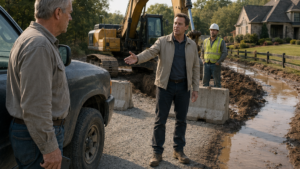
On Thursday morning a landscaping crew had brought a commercial mower down the narrow strip between his house and William Scott’s. Benjamin had gone outside when he heard the engine near the side fence.
What happened after that was exactly why he did not want to answer a four-page accusation with a rushed email.
He opened his laptop instead.
Rachel Allen, the community manager, answered his first message in eleven minutes.
Benjamin had written only:
Please send me the video referenced in the violation notice, including the full recording rather than a clip, along with the source of each allegation.
Rachel replied:
The incident has already been documented by management. You will have an opportunity to address the violation through the normal hearing process.
Benjamin read it once.
Then again.
He typed:
I am not asking whether it has been documented. I am asking for the video the notice says corroborates the allegations.
He waited.
Outside, a mower started three houses down. For a second he felt the same physical irritation he had felt Thursday—the approaching mechanical hum, the assumption that someone could simply enter the narrow side strip because somebody somewhere had said it was allowed.
His email alert sounded.
Rachel’s second answer was shorter.
The evidence will be reviewed as appropriate by the board.
Benjamin leaned back.
That was not an answer either.
He went outside with the violation packet folded in his hand.
The strip between his house and William’s was hardly dramatic. It was a band of lawn wide enough for a riding mower, narrowing near the rear gate. An irrigation head sat close to Benjamin’s foundation. A row of shrubs divided the back portion from the association-maintained drainage area farther beyond.
Nothing looked damaged.
He walked slowly from the driveway to the rear corner.
There were tire impressions from Thursday, already fading. One branch on a low shrub had been bent but not broken. The irrigation head remained intact. No torn sod. No crushed edging.
Benjamin crouched and took photographs.
Then he stopped himself.
The photographs proved only what the yard looked like four days later.
They did not prove what had happened Thursday.
He knew that distinction mattered.
His phone buzzed.
A new email from Rachel.
The hearing had been scheduled for Thursday at 6:30 p.m. in the clubhouse. Failure to resolve the balance afterward could trigger additional charges under the association’s enforcement schedule.
Benjamin looked back at the grass.
He disliked hearings. He disliked committees even more.
At work, years earlier, a disagreement over a subcontractor’s estimate had taught him something he had never quite unlearned. He had tried to explain himself too quickly. Every clarification became a new sentence somebody could quote without the sentence before it. By the end, he had felt as if he were arguing against a version of himself assembled by other people.
Since then, when accused unfairly, Benjamin had become careful.
Sometimes too careful.
He returned inside and spread the packet beside his laptop.
He created three headings on a yellow legal pad.
WHO SAW IT?
WHO WROTE IT?
WHAT SUPPORTS IT?
Under the first heading he wrote the names he knew.
Rachel Allen.
William Scott.
Landscaping crew.
Board?
Under the second he wrote:
Violation summary.
Incident report?
Video summary?
Under the third:
Video — not provided.
Photo — empty yard.
Witness statements — not provided.
Damage photos — none.
He stared at the page.
There was a satisfaction in reducing an accusation to parts. It made the thing smaller.
But it did not make him calmer.
Around noon, William came out next door carrying a trash bag. He glanced toward Benjamin’s kitchen window and looked away.
Benjamin almost went outside.
He could have asked him directly.
Did you say I threatened them?
Did you say I damaged something?
Instead Benjamin stayed where he was.
If William had filed the complaint, Benjamin wanted the complaint itself, not William’s Monday-afternoon reconstruction of it.
That was the kind of distinction Benjamin believed protected him.
By late afternoon, the distinction had started to feel more like a wall.
Rachel sent another message at 4:17.
Benjamin opened it standing at the kitchen counter.
Mr. Martin,
The board will consider the documented incident, including the contractor report, neighbor complaint, photographic materials, and incident video, at Thursday’s hearing.
You may provide any information you believe relevant.
Rachel Allen
Community Manager
Benjamin’s eyes stayed on two words.
Incident video.
Not possible video.
Not reported video.
Incident video.
A specific thing, apparently important enough to corroborate three accusations and important enough to be named twice in one day.
He typed a reply.
Will the incident video be played at the hearing?
His finger hovered over Send.
He considered adding his own account of Thursday.
He considered attaching the photographs he had just taken.
He considered writing that no threat had been made and no property had been damaged.
Then the old instinct returned.
Let them show what they had first.
He sent only the question.
At 5:02, Rachel answered.
Yes. The board can review the incident video at Thursday’s hearing.
Benjamin printed the email.
He placed it behind the violation notice.
For the first time all day, his irritation gave way to something colder and more useful.
If the video existed, he would watch it.
If it showed him doing something wrong, he would deal with that.
But if three accusations had been built around a recording, then before he defended himself against somebody else’s description of what happened, he wanted to see the recording with his own eyes.
Thursday evening now had one question waiting for it.
What, exactly, was on that video?
Chapter 2: The Blank Screen Changed the Meaning of Every Accusation in the Room
“The video corroborates the reported behavior.”
Rachel Allen said it before Benjamin had even taken his coat off.
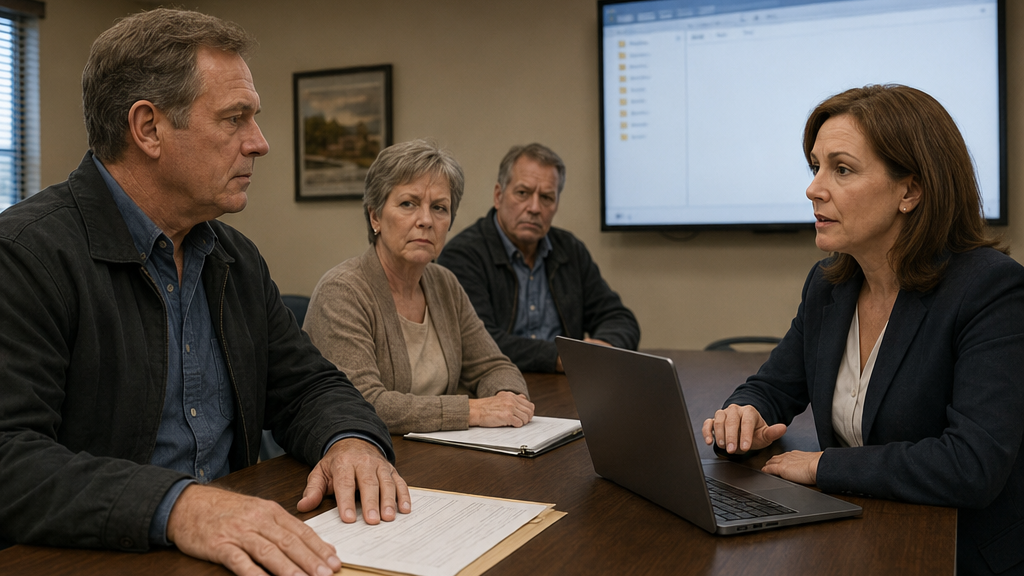
The clubhouse meeting room held twelve stackable chairs, a folding table, a wall-mounted television, and the faint smell of burnt coffee. The HOA president sat at the center of the table. Kathleen Brown, the treasurer, had a binder open in front of her. An architectural committee member sat to her right.
William Scott occupied a chair against the wall.
Two other homeowners had come for unrelated hearing matters and now watched with the careful stillness of people trying not to look interested.
Benjamin sat opposite the board.
Rachel had arranged several pages into a neat stack.
“The violation concerns interference with an authorized landscaping crew,” she said, “as well as threatening conduct and damage to association-maintained property. Management received a neighbor complaint, contractor information, and video corroboration.”
Benjamin placed his own packet on the table.
“I’d like to see the video before I answer the allegations.”
Rachel’s expression tightened almost imperceptibly.
“We can go through the findings first.”
“I’ve read the findings.”
“The hearing procedure normally begins with management’s summary.”
“I understand.” Benjamin kept his voice level. “But the summary says the video corroborates those findings. I’d like to see what it corroborates.”
The HOA president looked toward Rachel.
“Can we put it up?”
“Yes.”
Rachel opened her laptop.
A cable ran from the laptop to the television. The screen changed from the HOA logo to a pale desktop full of folders.
Benjamin felt several people shift behind him.
Rachel opened one folder.
Then another.
She clicked through files with dates in their names.
Nothing opened.
She returned to the previous directory.
Benjamin said nothing.
That seemed to make Rachel move faster.
“This was sent through our management portal,” she said.
She opened the portal.
A loading wheel spun.
Then a list of attachments appeared.
PDF.
JPG.
PDF.
DOCX.
No video.
Rachel clicked one of the PDFs and immediately closed it.
Kathleen leaned toward the screen.
“Which attachment is supposed to be the recording?”
“It may have been linked rather than attached.”
Rachel searched her email.
The television now displayed a mailbox search field.
She entered Benjamin’s address.
Several messages appeared.
Then the incident date.
Then William’s name.
Benjamin watched without moving.
For three days he had imagined this moment producing something decisive—a camera angle, a sound, a sequence that either helped him or hurt him.
Instead the room watched Rachel open empty pathways to a file nobody could find.
The HOA president cleared his throat.
“Do we have the recording or not?”
“We have documentation of it.”
Benjamin looked at Rachel.
“That isn’t what he asked.”
The president raised a hand slightly, not quite reprimanding either of them.
Rachel drew a slow breath.
“The office received information extracted from the recording.”
“Extracted by whom?” Benjamin asked.
“The incident was processed by staff.”
“Who watched it?”
Rachel looked at him.
“Mr. Martin, we are not going to turn this into an interrogation of management staff.”
“I’m asking because your notice says the video corroborates three claims.”
“The evidence was reviewed in the normal course.”
“By whom?”
A silence opened in the room.
Benjamin could feel William watching him from behind.
Rachel clicked another folder.
Empty.
Kathleen closed her binder.
“Rachel,” she said, “have you personally watched the video?”
Rachel’s hands stopped above the keyboard.
“I reviewed the incident documentation.”
Kathleen waited.
“That wasn’t my question.”
Rachel looked toward the president.
Then back at Kathleen.
“No. I did not personally watch the original recording.”
The atmosphere in the room changed so quietly Benjamin almost missed it.
Nobody gasped.
Nobody whispered.
The television simply continued displaying a file directory with no video inside it.
Kathleen turned toward the president.
“Have you watched it?”
“No.”
The architectural committee member shook his head before being asked.
Kathleen looked back at Rachel.
“So who did?”
“The office assistant processed the submission.”
“Did the assistant watch it?”
Rachel’s mouth tightened.
“She prepared the incident summary based on the materials received.”
Benjamin leaned forward slightly.
“Based on the video?”
Rachel did not answer immediately.
“Based on the submission.”
“That’s different.”
“The summary is consistent with the complaint.”
“Then show us the complaint.”
Rachel clicked back to her documents folder.
This time she opened a one-page file.
At the top were the words INCIDENT SUMMARY.
Benjamin had never seen it.
Rachel printed a copy from the clubhouse printer and passed one to the board, then one to Benjamin.
He read quickly.
The language was more detailed than the violation notice.
Resident confronted authorized contractors in an aggressive manner.
Resident positioned himself to prevent equipment access.
Resident threatened escalation if workers continued.
Damage to planted area occurred during confrontation.
Video supplied by reporting homeowner supports sequence of events.
Benjamin looked up.
“Who wrote this?”
Rachel said, “Management staff.”
“Who supplied the video?”
“The reporting homeowner.”
Benjamin glanced toward William.
William’s eyebrows had drawn together.
Benjamin turned back to Rachel.
“What exactly does ‘supports sequence of events’ mean if the person writing this may not have watched it?”
Rachel folded her hands.
“Mr. Martin, the absence of the original file tonight does not mean the incident did not occur.”
“I didn’t say it did.”
“You’ve declined multiple opportunities to provide your version.”
“Because you told me a video established what happened.”
“It supports what was reported.”
“By whom?”
Rachel’s patience showed its first visible crack.
“The landscapers were stopped from performing authorized work. That much is not disputed.”
“I haven’t disputed it because I haven’t answered yet.”
“Then perhaps now would be a good time.”
Benjamin looked down at the summary.
There was something almost seductive about defending himself immediately. He could say no threat had been made. He could say nobody damaged anything. He could explain the side yard and the mower and the worker who kept rolling forward after Benjamin told him to stop.
But the page in front of him had become more important than his frustration.
He tapped the first sentence.
“Who observed aggressive behavior?”
Rachel said nothing.
He tapped the second.
“Who says I threatened escalation?”
Still nothing.
He tapped the last line.
“And who watched the video before writing that it supports this?”
The HOA president shifted in his chair.
Rachel said, “We can obtain clarification from the management office.”
Kathleen looked at the document again.
“So tonight we have a summary referring to footage none of us has seen, and we don’t know whether the person who wrote the summary saw it.”
“That does not erase the neighbor complaint,” Rachel said.
“No,” Kathleen replied. “But it changes what weight I give the summary.”
For the first time that evening, Benjamin felt something loosen in his chest.
Not victory.
Credibility.
There was a difference.
Rachel opened another document.
“We do have the written complaint.”
William straightened behind Benjamin.
Rachel began reading.
“On Thursday morning, Mr. Martin confronted the crew and prevented them from using the side access—”
William spoke before she finished.
“That’s what I reported.”
Rachel paused.
William stood.
His voice was not loud, but the room had become quiet enough that it carried.
“I reported he stopped the crew. I said there was an argument.”
Rachel looked toward him.
“Yes.”
William pointed at the incident summary in Benjamin’s hand.
“I never told you he threatened anybody.”
Nobody moved.
Rachel said, “The threat language came from the combined incident materials.”
William’s face changed.
Not into sympathy for Benjamin.
Into suspicion.
“What combined materials?”
Rachel glanced at the laptop.
William took one step closer to the table.
“I sent you an email and a video from my doorbell camera.”
Benjamin turned fully toward him.
William continued.
“The camera doesn’t even have audio that far down the side yard.”
The statement landed without drama.
That made it worse.
Benjamin looked at the blank television screen.
For days the question had been what the recording showed.
Now a different question had replaced it.
If William had never accused him of making a threat, and the video apparently could not have captured the words, who had turned an argument into an official threat?
Chapter 3: The Neighbor’s Original Complaint Was Smaller Than the Story Built Around It
William Scott was standing in Benjamin’s driveway Saturday morning with a folded sheet of printer paper in his hand.
Benjamin saw him through the front window and almost let him knock twice.
Instead he opened the door.
William held out the page.
“This is what I sent Rachel.”
No greeting.
No apology.
Benjamin took it.
“Original email?”
“Printed from my sent folder.”
Benjamin looked at the header.
Thursday, 9:18 a.m.
The morning of the confrontation.
William had written that the landscaping crew had been prevented from passing through the side yard, that Benjamin had “come out angry,” and that the crew had eventually left without completing the work.
There was no threat.
No damaged property.
No claim that Benjamin had touched a worker.
No claim that he had damaged plants.
The message ended with a request for management to “deal with the access issue before this keeps happening.”
Benjamin read it again.
William shoved his hands into his jacket pockets.
“I wasn’t trying to get you fined for threatening people.”
“You were trying to get me fined for something.”
“I was trying to get them to finish the landscaping.”
Benjamin folded the paper along the crease William had already made.
“You could have asked me what happened.”
William gave a humorless laugh.
“You could’ve asked me before standing in front of their mower.”
There it was.
Not alliance.
Not even peace.
Just a narrower argument.
Benjamin appreciated that more than he wanted to admit.
“Come inside,” he said.
William hesitated, then followed him to the kitchen.
Benjamin placed the original complaint beside the violation packet and the incident summary.
Three versions of the same morning.
The complaint was the shortest.
The incident summary was the most detailed.
The violation notice sat somewhere between them but carried the greatest consequences.
Benjamin aligned the pages at the top.
William watched him.
“You always do that?”
“Do what?”
“Make paperwork look guilty.”
Benjamin ignored the remark.
He moved a finger down the first page.
“Your email says I stopped the crew.”
“Yes.”
“The summary says I positioned myself to prevent equipment access.”
“That sounds like the same thing.”
“It is close enough.”
William looked surprised.
Benjamin moved his finger lower.
“Your email says I came out angry.”
“You did.”
“The summary says aggressive manner.”
William shrugged.
“I wouldn’t fight over that.”
“Neither would I.”
Benjamin looked at him.
“Your email says nothing about threats.”
“No.”
“Nothing about damage.”
“No.”
“Nothing about escalation.”
“No.”
Benjamin tapped the incident summary.
“Then those came from somewhere else.”
William stared at the pages.
The defensiveness in his face began to fade.
“I assumed the landscapers told them more.”
“Did Rachel say that?”
“No.”
“Did the crew talk to you afterward?”
“Not really. One guy said they weren’t going back through there until management sorted it out.”
Benjamin sat down.
William remained standing.
“What exactly did your camera show?”
William looked toward the kitchen window, as if the answer might be outside.
“The side of the mower. You walking out. The crew stopping. Mostly the corner of my garage blocks it.”
“Audio?”
“You heard me Thursday night. Not from that distance.”
“And you sent the clip?”
“Yes.”
“When?”
“Same email. Attachment.”
Benjamin’s attention sharpened.
“So there was a video.”
“There was.”
“Do you still have it?”
William shook his head.
“The doorbell system overwrites local clips unless I save them. I sent it because I figured management would save it.”
Benjamin stared at him.
For the first time, the missing video stopped feeling imaginary.
It had existed.
That made the situation stranger, not simpler.
William pulled out a chair.
“Look, Ben.”
Benjamin disliked being called Ben by people who only did it when they wanted to soften something.
William continued anyway.
“You did block them.”
“I know.”
“And you were angry.”
Benjamin said nothing.
William leaned forward.
“You walked straight in front of that mower.”
Benjamin looked down at the papers.
There was the part he had avoided.
Not because it proved the violation notice.
Because it proved he had his own uncomfortable version of Thursday.
“I told them to stop.”
“You stood close enough that the operator had to shut it down.”
“They were crossing beside my house.”
“They’d been told they could.”
“By who?”
William paused.
“Management.”
“That doesn’t answer whether they actually could.”
“You think I know the easement map?”
“No.”
“Then stop talking to me like I approved it.”
Benjamin looked up.
William’s irritation was genuine.
So was something else.
Embarrassment.
“I thought that strip was HOA access,” William said. “They’ve been cutting back there for years.”
“They cut the drainage area behind us.”
“They come through this way.”
“Sometimes.”
“Exactly.”
“Sometimes doesn’t create permission.”
William rubbed a hand over his face.
“This is why nobody talks to you about this stuff.”
Benjamin felt the words more sharply than he expected.
“Because I ask what the rule actually says?”
“Because every conversation turns into a deposition.”
For several seconds neither spoke.
Benjamin looked toward the side window.
The narrow strip of grass was visible between the houses.
Thursday, the mower had been halfway down it before Benjamin came outside. The operator had slowed when Benjamin raised his hand.
Then kept inching forward.
Benjamin had stepped directly in front of it.
Not touching it.
Not threatening anyone.
But close enough to force the operator to stop.
He had told them, sharply, to get the machine off his property.
One worker had said they were authorized.
Benjamin had answered that whoever authorized them could come explain it personally.
His voice had not been calm.
William was right about that much.
Benjamin had spent days refusing to answer because he wanted to see the evidence first.
But he also knew there were photographs on his phone from shortly after the confrontation.
He had taken them before the crew left.
He had not sent those either.
William reached for his email printout.
Benjamin placed a hand on it.
“Can I keep this?”
William looked at him.
“For the hearing record?”
“Yes.”
“Fine.”
Benjamin pulled a fresh sheet from his printer and copied the two documents side by side.
Complaint.
Incident summary.
He marked the phrases that appeared only in the later version.
Threatened escalation.
Damage to planted area.
Aggressive confrontation.
William leaned over the table.
“That one,” he said.
He pointed to damage to planted area.
“I definitely never said that.”
Benjamin nodded.
“The violation says damaged association landscaping.”
“What landscaping?”
“That’s what I asked myself.”
William sat back.
The hostility between them had not disappeared. It had merely become more precise.
Oddly, that made the room feel less tense.
William looked at the side-by-side pages again.
“I still think you handled the crew badly.”
Benjamin said, “Maybe I did.”
William studied him, as if that answer had not been available in the version of Benjamin he had been arguing with.
Then he said, “Rachel told them they could use that strip.”
Benjamin stopped.
“When?”
“The week before.”
“How do you know?”
“She emailed about the landscaping schedule. Said the crew had been instructed to use the side access between our lots so they could get equipment to the rear drainage area.”
Benjamin’s eyes went to the window.
“Do you have that email?”
William’s expression tightened.
“I probably do.”
“Will you send it?”
William did not answer immediately.
“You’re going after Rachel now?”
“No.”
“It sounds like it.”
“I’m trying to find out who told the contractor it had permission.”
“She did.”
“That’s not the same as whether she had authority to do it.”
William stood.
“You really can’t help yourself.”
Benjamin almost argued.
Instead he looked at the three documents on the table.
Complaint.
Summary.
Violation.
Each one more certain than the last.
“No,” he said quietly. “Maybe I can’t.”
William picked up his jacket.
At the doorway, he paused.
“For what it’s worth, I didn’t think she was inventing anything.”
Benjamin looked at him.
“I thought the crew must’ve reported the rest.”
“That’s what I thought you had.”
William gave a short nod.
“Guess we both assumed somebody else knew more.”
After he left, Benjamin remained at the kitchen table.
His first instinct was satisfaction.
William’s complaint was narrower than the HOA’s version.
The threat allegation did not come from him.
The video could not have supplied clear audio.
The damage claim remained unsupported.
Then Benjamin looked again at the phrase prevented equipment access.
That one had a source.
William.
And, Benjamin knew, his own photographs.
The story had not become simple.
It had only become harder to lie to himself about which parts were weak and which parts were true.
His phone chimed.
An email from William.
Forwarded message.
Benjamin opened it.
The original sender was Rachel Allen.
The subject concerned scheduled landscaping work near the rear drainage area.
Benjamin read until one sentence stopped him.
The contractor has been instructed to use the side access between the Martin and Scott residences for equipment entry.
Benjamin sat very still.
Rachel had not merely received a complaint after the confrontation.
Before the mower ever reached his yard, she had personally told the crew to use the strip.
The missing video was no longer the only question.
Now Benjamin needed to know whether Rachel had ever confirmed she had the right to send them through there at all.
Chapter 4: Benjamin Found the Management Error, Then Realized His Silence Had Helped It Grow
The contractor’s work note was only six lines long, but the fourth line changed the shape of the dispute.
ACCESS CONTACT: R. ALLEN.
Benjamin read it standing at the property-management office counter.
Below the line was a brief instruction: equipment access approved between Martin/Scott residences for rear drainage maintenance.
No map was attached.
No easement reference.
No board authorization.
The office assistant had printed the contractor file after Benjamin submitted a written records request. She placed the remaining pages on the counter without comment.
Benjamin looked through them carefully.
Scheduling emails.
An invoice estimate.
A maintenance map showing the rear drainage strip in pale shading.
Nothing specifically marking the narrow grass between his house and William’s as association property.
He held up the contractor note.
“Was there anything attached to this authorizing the route?”
The assistant looked at the screen.
“That is everything in the job folder.”
“Any access diagram?”
“No.”
“Board approval?”
“I don’t see one.”
Benjamin thanked her.
He had expected the answer to feel better.
Instead, carrying the pages back to his truck, he felt the familiar urge to turn uncertainty into certainty simply because the uncertainty favored him.
Rachel had told the crew to use the strip.
That did not automatically mean she had acted improperly.
Maybe she had relied on an older maintenance practice. Maybe another document existed. Maybe the board had discussed it without recording the route precisely.
Benjamin sat behind the wheel and forced himself to stop.
That was the discipline he had demanded from them.
He could not abandon it when the missing information pointed in his direction.
At home, he took the contractor note into the side yard.
The mower tracks had almost disappeared.
He walked the route slowly.
At the front, the strip appeared open. Farther back, the space narrowed between his foundation and William’s property. The association drainage area began behind the houses, and crews had occasionally crossed from one yard or another to reach it.
Occasionally.
Benjamin had never objected when workers carried trimmers through on foot.
A commercial mower was different.
So was permission given in advance without asking him.
He photographed the transition from his side yard into the drainage area, then went inside and pulled out the community plat he had received when he bought the house.
The rear drainage easement was clear.
The side access was not.
There were lines, dimensions, and utility markings, but nothing Benjamin could confidently read as a permanent association equipment corridor.
That was useful.
Not decisive.
His phone lay beside the map.
For several minutes he resisted opening the photo gallery.
Then he did.
Thursday morning appeared as a row of thumbnails.
He had taken seven photographs.
The first showed the mower partly down the side strip.
The second showed one of the landscaping workers standing beside it.
The third—
Benjamin stopped.
There he was.
His reflection appeared faintly in the glass of the patio door, but another photograph captured him more clearly because he had taken it while holding the phone low.
The mower filled the center of the image.
Benjamin stood directly in front of it.
Not beside it.
Not at a safe distance gesturing for the operator to stop.
Directly in its path.
His shoulders were rigid. One arm was extended.
The machine had stopped only a few feet from him.
Benjamin enlarged the image.
He remembered the moment precisely now.
The operator had slowed.
Benjamin had raised his palm.
The mower had continued creeping forward.
Benjamin had stepped into the middle of the strip.
“Turn it off.”
The operator had shut the engine down.
Then the argument began.
Benjamin sat at the kitchen table with the phone in his hand.
He had spent a week insisting on precise language.
He had also written Rachel, more than once, that he had nothing further to add until the HOA produced its evidence.
Technically, that was not a lie.
He had chosen not to add anything.
But the photographs showed why that choice had not been neutral.
They showed an act that could reasonably be described as obstruction.
William had seen it.
The landscapers had experienced it.
Benjamin had known it.
He had simply refused to give management the part of the story that did not help him.
He opened the incident summary again.
Resident positioned himself to prevent equipment access.
That sentence no longer bothered him.
The next one did.
Resident threatened escalation if workers continued.
Benjamin knew what he had actually said.
“If somebody authorized you to cross here, get them out here to explain it. Until then, move the machine.”
His tone had been hard.
One worker had told him they would call management.
Benjamin had replied, “Good. Call whoever sent you.”
No threat.
But not calm either.
The distinction mattered.
So did the omission.
Late that afternoon, Kathleen Brown called.
“I wanted to ask you something before we schedule another formal hearing,” she said.
Benjamin leaned against the kitchen counter.
“Go ahead.”
“I reviewed the contractor records.”
“So did I.”
“There doesn’t appear to be a document establishing that side route as a designated equipment access.”
“That’s what I found.”
“That doesn’t necessarily resolve the property question.”
“I know.”
Kathleen was quiet for a moment.
“I also spoke with the landscaping contractor.”
Benjamin’s grip tightened on the phone.
“What did they say?”
“That they were told by management to use that route. They understood it was authorized.”
“By Rachel?”
“Yes.”
Benjamin looked toward the side yard.
Kathleen continued.
“The foreman also said you stepped in front of the mower.”
Benjamin did not answer.
“He said there was no physical contact.”
“There wasn’t.”
“He said you were angry.”
“I was.”
“He did not report hearing a threat.”
Benjamin closed his eyes briefly.
That should have felt like another point in his favor.
Instead, he heard the shape of the whole account becoming clearer, including the parts he had kept out of it.
Kathleen said, “Do you have anything showing what happened?”
Benjamin looked down at his phone.
“Yes.”
“What kind of thing?”
“Photographs.”
A pause.
“You’ve had them this whole time?”
“Yes.”
Kathleen did not scold him.
That made the question worse.
“Why didn’t you provide them?”
Benjamin watched a car move slowly past his front window.
“Because the notice said they had video evidence. I wanted to see what they were claiming before I gave them anything else.”
“I understand that.”
He waited.
“But?”
“But now we have two problems instead of one.”
Benjamin said nothing.
“The HOA overstated evidence it couldn’t produce. That’s one problem. The other is that you knew you had information relevant to what actually happened and deliberately held it back.”
“I wasn’t required to prove their case for them.”
“No.”
Her answer came quickly.
“You weren’t.”
Benjamin frowned.
Kathleen continued, “But if your goal is an accurate record, you can’t only demand accuracy from the parts that hurt you.”
The words sat between them.
Benjamin looked at the contractor note beside his old plat.
Rachel had made an assumption about access.
William had made an assumption about what management knew.
The board had made an assumption about what staff verified.
And Benjamin had made one of his own—that silence was somehow outside the chain of distortion.
Years ago, after the workplace dispute, he had promised himself he would never again talk himself deeper into somebody else’s version of events.
He had kept that promise so tightly that it had become another kind of avoidance.
Kathleen said, “There’s an informal board review Thursday.”
Benjamin stared at his photographs.
“What are you asking me to do?”
“I’m asking whether you’re willing to tell them exactly what happened.”
“I’ve been asking for exactly that from them.”
“I know.”
Her voice softened, but only slightly.
“I’m asking whether you’re willing to do it even if the full version makes you look worse.”
Benjamin looked again at the image of himself standing in front of the mower.
This time he did not minimize the distance.
He did not reinterpret the posture.
He simply looked at it.
“I’ll be there,” he said.
Chapter 5: Rachel Had Been Wrong About the Evidence but Not About Everything Benjamin Did
“I stopped the mower.”
Benjamin said it before Rachel Allen could open her folder.
The informal review was smaller than the first hearing. No other homeowners sat along the wall. The HOA president, Kathleen Brown, Rachel, and the architectural committee member occupied the same folding table, but the television remained off.
Benjamin placed his phone face down in front of him.
“I stepped directly in front of it,” he continued. “The operator slowed. I moved into the path. He shut the machine off.”
Rachel looked at him with visible surprise.
Benjamin did not enjoy that.
He had rehearsed several openings on the drive over, all of them more comfortable.
None sounded as useful as the truth.
“I told the crew they weren’t crossing the side yard until somebody explained why they had authority to be there. I was angry. I spoke sharply.”
Rachel opened her mouth.
Benjamin raised a hand, not to silence her but to finish.
“I did not threaten anyone. I did not touch anyone. I did not damage landscaping.”
He unlocked his phone and placed the first photograph on the table.
The mower.
His body in front of it.
Then the later photographs showing the strip after the crew left.
Rachel studied them.
Kathleen said, “These were taken that morning?”
“The first three were during the confrontation. The rest within fifteen minutes afterward.”
The HOA president looked at Benjamin.
“Why didn’t you give us these at the first hearing?”
Benjamin felt the old reflex rising.
Because you were the ones making the accusation.
Because you claimed to have better evidence.
Because I did not owe you help.
All technically defensible.
None complete.
“I wanted management to produce what it said it had,” he answered. “And I didn’t want to hand over anything until I knew the case against me.”
Rachel’s expression hardened.
“So you withheld evidence.”
“Yes.”
The admission shifted the room.
Benjamin continued before anyone could use it for him.
“That was deliberate. I thought if I said less, there would be less to misrepresent.”
Rachel gave a small, incredulous shake of her head.
“And yet you’re criticizing management for working from incomplete information.”
Benjamin looked at her.
“Yes.”
Kathleen’s eyes moved between them.
For a moment Rachel seemed almost relieved to have found ground under her feet again.
“The contractor reported that you obstructed authorized work,” she said.
“I obstructed the mower.”
“So that portion of the violation was accurate.”
“The action was accurate. Whether the access was authorized is still unresolved.”
Rachel opened the contractor file.
“Management had a long-standing understanding that crews could use that route.”
“Is that written anywhere?”
“We had prior practice.”
“Prior practice of carrying tools through or driving commercial equipment through?”
Rachel paused.
Benjamin let the distinction sit without pressing.
The HOA president turned to her.
“Why was the contractor instructed to use that specific side?”
“The rear drainage area needed maintenance. Access from the street on the other end was partially blocked by parked vehicles and landscaping materials. This was the most efficient route.”
“Did you verify the easement?”
Rachel’s jaw tightened.
“I relied on prior maintenance patterns.”
“So no?”
“No formal verification was completed before the instruction.”
Benjamin watched her carefully.
There was no pleasure in the answer now.
A week earlier, he might have treated it like a win.
But Rachel looked less like someone caught in a scheme than someone cornered by a sequence of decisions she had once considered routine.
Kathleen opened the first incident summary.
“Then we need to discuss how this became a behavioral violation containing allegations beyond obstruction.”
Rachel straightened.
“The office received the complaint and the video attachment. Staff prepared an initial summary.”
“Did staff watch the video?”
Rachel looked toward the dark television.
“The attachment was not retained properly.”
“That isn’t what I asked.”
Rachel exhaled.
“I spoke with the office assistant yesterday.”
Benjamin looked up.
Rachel continued.
“She did not watch the entire clip.”
The HOA president frowned.
“Did she watch any of it?”
“She opened it briefly. She saw Mr. Martin approach the mower. The file apparently failed during upload or transfer afterward.”
Kathleen tapped the summary.
“Then where did ‘threatened escalation’ come from?”
Rachel looked at the page.
“The assistant described the interaction as escalating.”
Benjamin felt the distinction before Rachel finished.
Kathleen did too.
“Escalating became threatened escalation?”
Rachel’s face colored.
“I consolidated the incident material.”
“You wrote that phrase?”
“Yes.”
The room went still.
Benjamin looked down at his own hands.
This was the answer he had been looking for since Monday.
It did not feel as clean as he expected.
Rachel spoke again, more slowly.
“The contractor had been turned away. William’s complaint said Mr. Martin was angry. Staff described the confrontation as escalating. The video showed him moving toward the equipment. I understood those pieces together as a threat of further escalation if the crew continued.”
Benjamin asked, “Did anyone tell you I made a threat?”
“No.”
“Did the video contain words you understood as a threat?”
“No.”
“Then it was your interpretation.”
Rachel looked directly at him.
“Yes.”
The word cost her something.
Benjamin could hear it.
Kathleen turned to the next allegation.
“Damage.”
Rachel closed her eyes for a moment.
“The crew reported a planted area had been disturbed.”
Benjamin slid his photographs forward.
“Which area?”
Rachel looked at them.
“The original note didn’t identify one.”
“Did anyone inspect it?”
“No.”
The architectural committee member finally spoke.
“So we have obstruction that occurred, questionable access authorization, threat language that was inferred, and damage that wasn’t verified.”
Rachel said, “That is a fair summary.”
Benjamin almost smiled at the phrase.
He did not.
The HOA president leaned back.
“I think the fine should be withdrawn.”
The decision came so quickly Benjamin felt the room relax around it.
Rachel nodded once.
“I can remove the financial charge today.”
Kathleen looked at Benjamin.
He knew he was supposed to feel finished.
The money would disappear.
No late fees.
No formal collection track.
A week of frustration reduced to zero dollars.
Rachel began gathering the pages.
“We can note the fine was administratively canceled while maintaining the incident notation for future reference.”
Benjamin’s attention sharpened.
“What incident notation?”
Rachel stopped.
“The record of the confrontation.”
“Which version?”
“The management record.”
Benjamin reached for the violation packet.
It still contained the words threatening conduct and property damage.
“You’re removing the fine but leaving this?”
“The file needs to reflect that an incident occurred.”
“An incident did occur.”
Rachel seemed almost surprised.
Benjamin continued.
“I stopped the mower. Put that in the file.”
Kathleen watched him closely.
“But the threat didn’t happen.”
Rachel said, “The notation can indicate the violation was canceled.”
“That isn’t the same thing.”
“It shows no penalty remains.”
Benjamin slid the packet toward her.
“The words remain.”
The HOA president said, “Mr. Martin, practically speaking, the matter would be closed.”
Benjamin looked at him.
Years earlier, he would have accepted that sentence.
Practically speaking.
Good enough.
Move on.
He thought of William’s email, then the staff summary, then the violation notice. Each version had carried forward language from the one before it, gaining certainty as it traveled.
If this packet remained, the next manager would not see uncertainty.
They would see history.
Rachel said, “I’m offering the full financial relief you requested.”
Benjamin shook his head.
“That was what I requested when I thought this was only about the fine.”
He turned the packet so the first page faced the board.
“I’m not asking you to erase what I did.”
Rachel stared at him.
“I blocked the mower. I was angry. Write that accurately.”
Then he tapped the two unsupported findings.
“But if you leave those in the record because removing them is inconvenient, then the part that isn’t true stays true on paper.”
Chapter 6: Removing the Fine Was Easy; Correcting the Record Required Someone to Admit How It Happened
The draft resolution withdrew Benjamin’s fine in the first paragraph and preserved the disputed accusations in the second.
He noticed it before the monthly board meeting officially began.
Kathleen had left a copy at his chair.
The language was careful.
Financial penalties associated with the landscaping-access incident would be rescinded.
Management records would otherwise remain unchanged.
Benjamin read the sentence twice.
Across the clubhouse, Rachel arranged papers beside her laptop.
William sat three chairs behind Benjamin.
They had barely spoken since Saturday.
The HOA president called the meeting to order.
Routine items moved first—landscape expenses, pool repairs, a lighting proposal. Benjamin listened with the resolution folded in his lap.
When his matter finally came up, Kathleen did not introduce it as a fine appeal.
“This is a records-correction issue,” she said.
Rachel looked at her but said nothing.
Kathleen distributed three documents.
Benjamin recognized them immediately.
William’s original complaint.
The management incident summary.
The violation notice.
Placed side by side, they looked almost harmless.
Three sheets of white paper.
Kathleen addressed the board.
“The question is not whether an argument occurred. It did. The question is which statements in the association record are supported and how unsupported language entered the file.”
The president nodded toward Benjamin.
“You may speak first.”
Benjamin stood.
He had prepared notes.
He left them on the table.
“I blocked the landscaping mower.”
William looked up.
Benjamin continued.
“I intentionally stood in front of it because I believed the crew was entering property they had no confirmed right to cross. I was angry, and I spoke sharply.”
The words felt different in a full board meeting than they had in the smaller review.
More exposed.
More permanent.
“That should remain in the record.”
Rachel’s eyes lifted toward him.
Benjamin turned to the first document.
“William’s complaint supports that much.”
William shifted in his chair.
Benjamin looked back at him.
“Is that fair?”
William hesitated only a second.
“Yes.”
Benjamin returned to the board.
“The contractor also supports it. My photographs support it. I’m not asking you to replace an inaccurate record with a flattering one.”
Kathleen slid the second page forward.
“What about the threat?”
“No firsthand witness has identified one.”
Rachel said, “Agreed.”
The single word changed the room.
Benjamin had expected qualification.
There was none.
Kathleen asked, “Damage?”
Rachel answered again.
“Unverified.”
The president looked down at the three pages.
“Then why does the current draft leave the incident record unchanged?”
No one answered immediately.
Finally Rachel folded her hands.
“Because management records are generally retained as originally issued, with later dispositions attached. That preserves the administrative history.”
Benjamin said, “Preserving history is fine. Preserving unsupported findings as if they were findings is different.”
Rachel nodded slightly.
“I understand the distinction.”
Kathleen pointed to the documents.
“Then we need the administrative history to include how the language changed.”
She read from William’s complaint.
“‘Came out angry and stopped the crew from continuing through the side yard.’”
Then the incident summary.
“‘Confronted authorized contractors in an aggressive manner. Threatened escalation if workers continued.’”
Then the violation notice.
“‘Threatening conduct toward association contractors.’”
Each sentence sounded stronger aloud than it looked on paper.
Kathleen stopped.
“The first statement has a source. The second contains interpretation. The third presents that interpretation as a finding.”
The architectural committee member leaned forward.
“And damage follows the same pattern?”
Rachel nodded.
“The crew mentioned disturbance near the planted area during a phone conversation. The location was not documented. It was entered into the summary before verification.”
Benjamin asked, “Who entered it?”
Rachel looked at him.
“I approved the summary.”
There it was.
Not a hidden conspiracy.
Not an anonymous failure.
A decision.
Rachel continued before anyone else spoke.
“The landscaping work was already delayed. I had instructed the contractor to use the side route based on prior practice. When the crew was turned away, I treated the reports as confirmation that the resident—not the access instruction—was the operational problem.”
Benjamin heard something in her voice he had not heard before.
Not apology exactly.
Recognition.
She looked toward the board rather than at him.
“I should have verified the access status first.”
The president asked, “And the video?”
“The original file is unavailable. It should never have been described as corroborating specific conduct after staff could no longer verify what the file contained.”
William raised his hand from the back row.
The president recognized him.
William stood awkwardly.
“I want something corrected too.”
Benjamin turned.
William held a copy of his original email.
“I complained about Ben stopping the crew.”
Benjamin almost objected to the nickname, then let it go.
William continued.
“I still think he handled it badly. I still think standing in front of a mower was unnecessary.”
A few eyes shifted toward Benjamin.
He nodded once.
William looked at Rachel.
“But I didn’t report a threat. I didn’t report damage. If the association record says those things came from my complaint, I want that changed.”
Rachel’s expression tightened, but this time she did not defend herself.
“Understood.”
William sat.
The board moved into discussion.
One member worried that rewriting records would create a precedent.
Kathleen answered that attaching a corrected finding was not rewriting history; it was documenting the outcome accurately.
The president asked whether the access question itself needed resolution.
Rachel said the contractor had been instructed not to use the side strip until the association obtained a proper access review.
Benjamin listened without interrupting.
That restraint no longer felt like withholding.
It felt like waiting until he had something necessary to say.
The discussion lasted twenty minutes.
Then the president called for a vote.
The fine would be rescinded.
The record would be amended to state that Benjamin had intentionally obstructed the mower during a disputed access attempt.
The allegations of threats and property damage would be marked unsupported and withdrawn.
The association would require serious conduct findings to identify either primary evidence or firsthand testimony. Summaries based on interpretation would have to be labeled as such.
The motion passed.
No one applauded.
Chairs creaked.
Paper shifted.
Somebody in the back began gathering a coat.
Benjamin felt strangely grateful for the absence of celebration.
Rachel remained seated after the vote.
Kathleen handed her the original violation packet.
“We’ll need the corrected language entered before the minutes are finalized.”
Rachel took it.
For several seconds she looked at the page she had once defended.
Then the president asked whether she wanted to state the correction for the record.
Rachel’s shoulders rose slightly with a breath.
“Yes.”
She looked toward the secretary taking minutes.
“The association confirms that Mr. Martin obstructed landscaping equipment during a disputed access event. Management has not established that Mr. Martin threatened contractors or damaged association property. Those findings were based on unsupported inference and are withdrawn.”
Benjamin did not look around the room.
He looked at Rachel.
She met his eyes briefly.
Neither smiled.
The correction did not make Thursday morning disappear.
It did not make his behavior wise.
It did not make her decision harmless.
But for the first time, the official version of the event was no longer asking either of them to be simpler than they had actually been.
When the meeting ended, William passed behind Benjamin’s chair.
He stopped.
“So what happens next time they need to get back there?”
Benjamin folded the corrected resolution.
“I guess somebody asks before they send the mower.”
William gave a short breath that might have been a laugh.
“And you answer?”
Benjamin looked at him.
It was a fair question.
Before he could respond, Rachel approached carrying the marked packet.
“The contractor will use a different route for now,” she said. “We’ll send both of you the access plan once it’s reviewed.”
William nodded.
Benjamin did too.
Rachel started to walk away, then stopped.
“One more thing.”
Benjamin waited.
“The missing video will stay in the administrative log.”
His expression tightened.
Rachel added, “Not as evidence.”
She held up the corrected page.
“As an unavailable source.”
Benjamin considered that.
Then nodded.
For once, absence would be recorded as absence.
Nothing more.
Chapter 7: What Remained After the Missing Video Was Finally More Important Than the Video Itself
The mower arrived three weeks later, and Benjamin Martin heard it before he saw it.
The low engine note came from the street, slowed near his driveway, then stopped.
For an instant his body reacted before his mind did. His shoulders tightened. His attention shifted automatically toward the narrow strip between his house and William Scott’s.
Then Benjamin saw where the landscaping trailer had parked.
Across the street.
Not beside his yard.
The crew leader stepped down holding a clipboard instead of steering equipment toward Benjamin’s house.
Benjamin had received the access request two days earlier.
It had been almost comically specific.
Rear drainage maintenance. Tuesday between nine and eleven. Equipment entry from the association service lane on the opposite end. Workers might need pedestrian access along the rear boundary to inspect irrigation runoff, but no motorized equipment would cross between the Martin and Scott residences without separate permission.
At the bottom was a line asking homeowners to contact management with questions before work began.
Benjamin had read it three times.
Not because anything seemed wrong.
Because nothing did.
He stepped onto his porch.
The crew leader glanced toward him.
“Morning.”
“Morning.”
“We shouldn’t need your side.”
“I saw the notice.”
The man nodded.
That was the whole exchange.
No argument.
No declaration of rights.
No machine creeping toward him while he tried to decide whether anyone had bothered asking permission.
Benjamin stood there another moment, almost disappointed by how ordinary it was.
Then he heard his gate latch.
William appeared along the side fence.
“Got a minute?”
Benjamin looked toward the crew.
“They sent you over?”
“No.”
That answer alone made Benjamin curious.
William stopped several feet away, hands in his pockets.
“I wanted to ask you something before I call management.”
Benjamin waited.
William pointed toward the narrow strip behind them.
“The new access diagram they sent shows the equipment route on the other side, but it also marks this as homeowner pedestrian access to the rear easement.”
“I saw that.”
“Do you think that means association people can walk through here whenever they want?”
Three weeks earlier, Benjamin would have asked William what provision he was relying on.
He would have wanted the exact diagram version, the recorded easement language, the management interpretation, perhaps the date of the last amendment.
All of those questions still mattered.
But William had come over before filing a complaint.
That mattered too.
“I don’t know that it means whenever they want,” Benjamin said. “My understanding is they can reach the drainage easement for necessary work. If they tell us first, I don’t have a problem with somebody walking through.”
William looked at him.
“That simple?”
Benjamin almost smiled.
“For walking through? Yes.”
“And equipment?”
“Ask me first.”
William nodded slowly.
“Fair enough.”
He started toward his house, then stopped.
“You know, you could’ve said that before.”
Benjamin leaned against the porch post.
“So could you.”
William considered the answer.
“Also fair.”
This time they both smiled, though only slightly.
William walked home.
Benjamin remained outside as the landscaping crew unloaded equipment across the street.
The service route was less convenient than the shortcut between the houses. He could see that immediately. Workers had to guide the mower around a curve near the community fence, and one had to move a temporary marker before the machine could pass.
It added perhaps five minutes.
That was all.
Five minutes had been hiding beneath weeks of notices, arguments, records requests, and accusations.
Benjamin knew the dispute had never really been about five minutes.
Efficiency had simply been the first assumption.
Then came the second assumption: that an established practice must equal permission.
Then another: that an angry homeowner blocking equipment must be the problem.
After that, each assumption had inherited the authority of the one before it.
His phone vibrated.
An email from the association.
The board had approved the revised enforcement policy.
Benjamin opened the attachment.
It was less dramatic than he expected.
Two paragraphs.
For violations involving alleged threats, harassment, intentional property damage, or comparable serious conduct, enforcement notices would identify whether the finding rested on firsthand testimony, primary documentary evidence, or a management interpretation of other materials.
If a primary source could not be reviewed or retained, it could not be described as corroborating a specific allegation.
Benjamin read that sentence twice.
Then he put the phone away.
He did not feel victorious.
The policy would not prevent people from making bad judgments.
It would not turn volunteer board members into investigators.
It would not guarantee that managers stopped taking shortcuts when schedules became inconvenient.
It merely required them to name the difference between what they knew and what they thought.
That seemed small.
Benjamin had learned small distinctions could carry surprising weight.
Later that afternoon, an envelope appeared in his mailbox.
The return address belonged to the property-management company.
Inside was the final corrected violation packet.
Benjamin carried it to his kitchen table.
The original version remained included, exactly as Rachel had said it would.
But a correction sheet had been attached on top.
Obstruction of equipment: confirmed.
Threatening conduct: unsupported and withdrawn.
Property damage: unsupported and withdrawn.
Access authorization: disputed at time of incident; subsequent equipment route revised.
Benjamin ran his thumb along the edge of the paper.
Then he reached the evidence list.
William Scott written complaint.
Contractor statement.
Benjamin Martin photographs.
Management correspondence.
Video submission.
Beside the last item was a parenthetical note.
Original source unavailable; contents not independently verified.
Benjamin stared at it.
Weeks earlier, the missing video had seemed like the center of everything.
He had imagined that if it could only be found, it would answer the dispute cleanly.
Perhaps it would have shown him stepping in front of the mower.
Perhaps it would have shown how far the crew had entered.
Perhaps it would have made him look more aggressive than he remembered.
Perhaps less.
He would never know.
For a while, that had bothered him.
Now the uncertainty had finally been given the only label it deserved.
Unavailable.
Not proof.
Not innocence.
Not guilt.
Unavailable.
Through the kitchen window, Benjamin saw William speaking with one of the landscapers near the rear fence.
William pointed toward the drainage area.
The worker looked toward Benjamin’s house.
William said something Benjamin could not hear, then walked over.
Benjamin opened the back door before William reached it.
“They need to inspect the runoff grate,” William said. “Guy wants to walk through your side because the gate on the service lane is blocked by the mower.”
Benjamin looked past him.
The worker waited near the property line rather than entering.
Three weeks ago, Benjamin might have asked why the mower was blocking its own access route.
He might have suspected convenience creeping back into policy.
Instead he looked at the worker and raised a hand.
“Walking through is fine.”
William nodded toward the man.
The worker entered the strip on foot.
He carried a small tool bag.
No mower.
No assumption.
He passed Benjamin with a brief thanks and continued toward the drainage area.
Benjamin watched him go.
William remained beside the porch.
“Look at us,” he said. “Almost functioning like neighbors.”
“Don’t get ambitious.”
William laughed.
It was the first uncomplicated sound Benjamin had heard from him in weeks.
Then he headed home.
Near sunset, the landscaping crew finished and drove away.
There had been no confrontation.
No emergency email.
No complaint.
The revised route had taken longer and worked anyway.
Benjamin went back inside.
The corrected violation packet still lay on the kitchen table.
He picked it up and opened the trash cabinet.
For several seconds he held the packet above the bin.
Then he closed the cabinet.
He walked to the small desk in the spare room where he kept tax records, warranties, surveys, and old household documents.
He found the folder he had made when the first notice arrived.
On the tab he had written HOA—SIDE ACCESS.
Benjamin placed the corrected packet inside.
He kept William’s original complaint.
He kept Rachel’s instructions to the contractor.
He kept his own photographs, including the one showing himself directly in front of the mower.
He kept the page identifying the video as unavailable.
Not because he expected another fight.
Not because he wanted proof that he had won.
The folder contained something more useful than that.
It contained the version in which everybody had been partly wrong.
Rachel had assumed authority she had not confirmed and turned interpretation into fact.
William had complained instead of walking next door.
The board had trusted a summary because summaries were easier than checking sources.
Benjamin had demanded complete truth from everyone else while withholding the part of his own truth that made him uncomfortable.
None of those things canceled the others.
That was the part he wanted to remember.
Outside, the narrow strip of grass between the houses looked exactly as it had before any of this began.
There was no marker announcing what had happened there.
No permanent scar.
No sign that an argument over a mower had become a dispute over evidence, language, and who was responsible for saying what they actually knew.
Benjamin shut the filing drawer.
His phone buzzed once.
A message from William.
Crew finished. Gate clear.
Benjamin typed back.
Thanks.
He looked at the reply before sending it.
A few weeks ago, he might not have answered at all. The information required no response. Nothing needed correcting.
But silence, he understood now, was not always precision.
Sometimes it simply left an empty place where another person would build an explanation.
Benjamin pressed Send.
Then he turned off the desk lamp and walked back toward the kitchen, leaving the corrected packet filed where he could find it if he ever needed it—and where, if things continued as they had that day, he probably never would.
The story has ended.