The Runaway’s Wrench: The Orphan Boy Who Solved Austin’s Coldest Motorcycle Murder
CHAPTER 1: THE BOY IN THE BAY
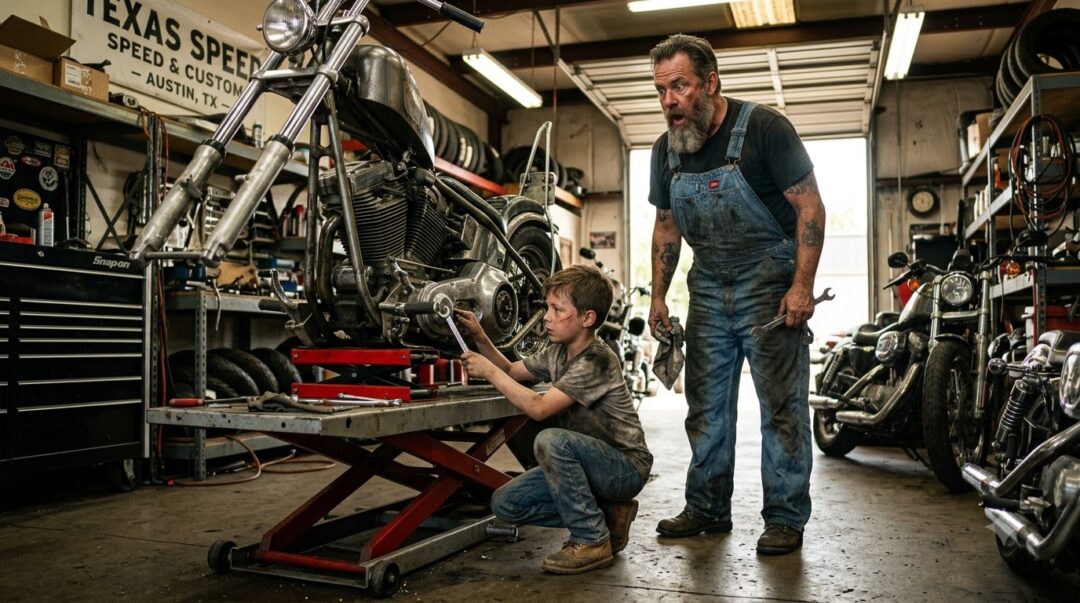
The halogen lighting inside Lone Star Precision Speed in East Austin, Texas, was a blinding white glare that bounced off polished concrete floors, stainless steel tool chests, and rows of mirror-finished chrome engines. It was seven in the evening, and the hot June humidity of the Colorado River basin hung heavy in the air, mixing with the sharp scents of lacquer thinner, high-octane race fuel, and 50-weight Bel-Ray motor oil.
Elevated five feet in the air on the central hydraulic lift table sat a forty-thousand-dollar custom bobber: a 1965 Harley-Davidson Panhead engine fitted into a hand-milled rigid drop-seat frame, finished in immaculate candy-apple red metalflake.
Standing beneath the raised front wheel, rubbing his aching temples with grease-stained knuckles, was Mack “Anvil” Henderson. At forty-eight, Mack was a legend in the Texas custom bike scene—a burly, broad-chested master mechanic and president of the Lone Star Motorcycle Club. His beard was a thick wedge of iron-gray, his denim overalls smudged with carbon soot, his arms thick as fence posts from thirty years of torquing cylinder heads.
For three straight days, Mack had been battling a phantom electrical misfire that had completely baffled his top dyno technicians. The bike would idle with a purr, but the moment the throttle cracked past two thousand RPM, the ignition circuit would drop voltage, the front cylinder would cut out with a ragged backfire, and the digital telemetry would go dead.
Mack had replaced the stator, the dual-fire coils, the electronic ignition module, and the entire braided wiring harness. Nothing worked.
He threw his test light onto the metal rolling cart with a loud, frustrated clang, swearing under his breath as he reached for a cold bottle of Shiner Bock.
“You’re checking the wrong end of the circuit, mister.”
The voice was high, slightly raspy from thirst, coming from the shadowed recess between two towering steel parts racks near the back roll-up door.
Mack froze, his hand hovering over the beer bottle. His dark eyes narrowed in immediate suspicion as he pivoted on his steel-toed work boots. “Who’s in my shop?”
Stepping out from behind a stack of twenty-one-inch Avon tires was a young boy who could not have been more than ten years old.
He was tiny, thin as a willow reed, dressed in an oversized gray mechanics shirt with the sleeves rolled four times past his wrists, stained with motor oil and road grime. His dark jeans were torn at both knees, revealing scraped, bloody skin, and a deep purple bruise mottled his left cheekbone beneath a smear of dark grease. But beneath his tangled black hair, his dark brown eyes possessed an astonishing, razor-sharp intelligence that took in every wire, every relay, and every bolt on the elevated motorcycle in a single sweeping glance.
Mack scowled, crossing his heavy arms over his denim chest. “How did you get past the yard gate, kid? This ain’t a playground. I’ve got twelve-hundred-volt dyno lines live in this room.”
The boy didn’t retreat. He took two steps closer to the hydraulic lift, pointing a small, calloused index finger toward the lower transmission cross-member beneath the rear cylinder head.
“You’re getting an intermittent voltage drop because your main chassis ground strap bolt is threaded into a powder-coated frame lug,” the boy said. His voice was completely steady, delivered with the calm, matter-of-fact certainty of an aerospace engineer. “Your ground strap has copper braids, but whoever powder-coated that frame didn’t mask the internal threads before baking the enamel. When the motor hits two thousand revs, the engine harmonics vibrate the bolt against the insulated paint, breaking the ground loop and starving the electronic module.”
Mack stared at the ten-year-old boy in utter, disbelieving silence.
Across the shop bay, Sal and Preacher—Mack’s veteran mechanics—burst out laughing from behind the tire-mounting station.
“Hey, Anvil!” Sal chuckled, wiping his hands on a shop rag. “Looks like you just got out-diagnosed by a fourth-grader. Want me to go get him a juice box so he can tune the carburetors next?”
Mack didn’t laugh. He slowly lowered his arms, his gaze fixed on the boy’s calm, fearless face. Mack had spent thirty years building championship motorcycles; he knew that ninety-nine percent of professional mechanics in Travis County wouldn’t have thought to check the grounding threads on a freshly painted show bike.
Mack reached to the tool cart, picked up a forged chrome-vanadium half-inch combination box wrench, and tossed the tool toward the boy.
The wrench tumbled through the bright halogen glare.
The ten-year-old boy’s right hand flashed out with blinding, effortless coordination, catching the heavy chrome wrench cleanly by the handle in mid-air, the tool snapping into his palm with a crisp metallic click.
“The ground lug is hidden behind the lower oil line bracket,” Mack said, his voice dropping into a low, testing rumble. “You have twenty seconds to show me I’m wrong before I call child protective services to come pick you up.”
The boy didn’t hesitate. He stepped beneath the hydraulic lift table, reached his small arm through the tight two-inch clearance between the exhaust pipe and the transmission housing without even looking, and seated the wrench’s box end over the hidden bolt head.
In two smooth, expert turns of his wrist, the bolt backed out.
The boy pulled the bolt from the chassis, held it in his small palm, and presented it to Mack.
Around the steel threads of the grade-eight bolt was a thin, hardened ring of baked candy-apple red powder coat.
Mack’s jaw went slack. The beer bottle nearly slipped from his fingers.
The boy reached into his pocket, pulled out an old brass wire toothbrush, cleaned the paint from the threads with four quick strokes, and threaded the bolt back into the chassis, torquing it down until the copper ground strap bit directly into bare metal.
Mack reached up, flicked the ignition toggle on the Panhead’s handlebar, and pressed the starter button.
BOOOM.
The 1965 Panhead erupted into life with an earth-shaking, razor-sharp roar of pure, unblemished American power. Mack twisted the throttle—the tachometer needle swept instantly past two thousand, three thousand, four thousand RPM with zero misfire, the twin straight pipes singing with the flawless, rhythmic heartbeat of a master-tuned machine.
Mack killed the ignition, the deafening echo rolling through the rafters into a stunned, church-like silence.
Mack leaned down, looking directly into the ten-year-old boy’s dark eyes, his voice trembling with a mixture of shock and awe. “Who the hell taught you how to wire a custom Panhead, kid?”
The boy didn’t answer right away. He reached into the open primary casing, pointing his small finger toward a microscopic signature stamped into the aluminum case beneath the front sprocket—a signature Mack had thought was an anonymous factory casting mark: MA – 2021.
“My name is Leo Alvarez,” the boy whispered, his voice trembling as fresh tears welled in his dark eyes. “My father was Mateo Alvarez. He built this engine three years ago before Hector Salazar murdered him in an abandoned warehouse on Airport Boulevard.”
CHAPTER 2: THE RUNAWAY’S TALE
The name hit Mack Henderson like an eight-pound sledgehammer to the chest.
“Mateo Alvarez…” Mack whispered, the color draining from his weathered face.
Across the shop bay, Sal and Preacher stopped their work, the tools in their hands freezing in mid-air as the memory of Austin’s darkest unsolved mystery washed over them like cold river water.
Three years ago, Mateo Alvarez had been the most brilliant, self-effacing motorcycle chassis designer in Central Texas—a quiet Mexican-American prodigy who worked out of a small garage in Montopolis, fabricating one-of-a-kind titanium frames and floating oil bags for high-end boutique builders. And then, one rainy November night, Mateo vanished. His workshop had been stripped to the bare concrete walls, his machinery stolen, and three weeks later, his burned pickup truck was recovered from the Colorado River with zero physical remains.
The Austin Police Department had classified it as a missing persons case tied to cartel border smuggling, letting the file gather dust in the cold-case vaults.
Mack dropped to both knees on the polished concrete floor, bringing his massive frame level with ten-year-old Leo.
The hot summer breeze blowing through the cracked roll-up door carried the heavy aroma of wood smoke from the barbecue pits along East 7th Street, but inside the repair bay, the temperature seemed to drop to freezing. Mack stood motionless, his massive chest rising and falling with heavy, agonizing breaths as the full horror of Leo’s ordeal settled into his mind. For three years, he had believed his best friend had simply walked away or fallen victim to an anonymous highway accident; to learn that Mateo had died defending his boy from a cartel chop-shop was a revelation that cut through the veteran’s heart like an oxy-acetylene torch. Sal handed Leo a clean shop towel and a chilled bottle of spring water, his tough mechanic’s facade melting into pure, protective tenderness as the ten-year-old drank with desperate, trembling gulps.
He looked closely at the boy’s face—at the high cheekbones, the slight cleft in the chin, and the deep, soulful brown eyes that were an exact, heartbreaking duplicate of Mateo’s.
“Your father was Mateo…” Mack murmured, his voice thick with a sudden, overwhelming grief. “Mateo was my road brother in the early nineties, Leo. When this shop nearly went bankrupt during the crash, Mateo spent three weeks here without taking a single dollar, helping me finish eight custom choppers to pay the bank. Where have you been for three years, son? Where have you been hiding?”
Leo’s small hands gripped the chrome half-inch wrench with white-knuckled desperation, fresh tears cutting clean paths through the dark grease on his cheeks.
“Hector Salazar has an underground chop-shop,” Leo whispered, his voice trembling with the horror of three years of captivity. “Beneath an old cedar mulch warehouse off Highway 71 outside Bastrop. He kidnapped my dad because my dad invented a hydraulic modular stamping die that can alter the vehicle identification numbers on stolen luxury motorcycles in thirty seconds.”
Leo wiped his face with the frayed cuff of his oversized shirt. “My dad refused to stamp the stolen bikes for Salazar’s cartel pipeline. So Salazar… he shot my dad in front of me on the concrete floor. And then he locked me in the sub-basement with three other boys. He forced us to wire the electrical harnesses on sixty stolen Harley-Davidsons every month, because our hands were small enough to fit inside the frame tubes.”
Mack’s jaw clenched until the muscles along his temples knotted like iron cables. “How did you get out, Leo?”
“I hid inside the waste oil drum on the disposal truck this morning,” Leo choked, shivering despite the Texas summer heat. “I crawled through the drainage ditch behind the slaughterhouse and ran along the railroad tracks for eight miles. I saw the Lone Star neon sign from the highway, and I remembered my dad told me: If anything ever happens to me, find the man with the anvil tattoo on his forearm.“
Mack looked down at his right forearm, where an antique blacksmith’s anvil was tattooed in faded blue ink beneath his military jump wings.
Before Mack could speak, the shop’s perimeter security monitor on the wall clicked with a sharp electronic chime.
Preacher stepped to the monitor, his eyes widening in immediate alarm as he zoomed the exterior camera on the gravel yard outside the front roll-up door.
Parked at the edge of the industrial alley, fifty yards from the garage bay, was a heavily modified black Ford F-250 Super Duty pickup, its windows blacked out with limousine tint, its diesel engine idling with a deep, predatory rumble. Standing beside the driver’s door, wearing dark sunglasses and tactical windbreakers, were two men with cartel teardrop tattoos beneath their eyes, scanning the Lone Star workshop with handheld thermal optical scanners.
“They tracked him,” Preacher warned through clenched teeth, his hand reaching beneath the cash counter for an automatic twelve-gauge Benelli shotgun. “Salazar’s spotters are outside the fence right now.”
Mack rose to his full, towering height of six-foot-two. The weariness and frustration that had burdened his face all afternoon had vanished, replaced by the terrifying, ice-cold fury of a silverback gorilla defending its young.
He reached down, picked up Leo in his massive arms as easily as if the boy were an infant, and set him gently inside the reinforced steel cab of his antique mobile tool truck parked in Bay Four.
“Sal, lock the front bay doors and drop the steel hurricane shutters,” Mack commanded, his voice shaking the rafters like a thunderclap. “Preacher, get on the radio. Call every chapter of the Lone Star MC in Travis, Hays, and Bastrop counties. Tell them Mateo Alvarez’s son is in our shop, and Hector Salazar has twenty minutes to pray before we tear his empire down to the dirt.”
CHAPTER 3: THE SHOP SIEGE
The heavy galvanized steel hurricane shutters rolled down across the three front bay doors of Lone Star Precision Speed with a deafening metallic screech, their locking pins dropping into the concrete deck with concussive, authoritative clangs. Inside, the bright halogen work lights hummed in the sudden, enclosed gloom, illuminating three master mechanics who had transformed into an unyielding tactical defense squad.
Preacher stood beside the shop’s secondary electrical breaker panel, his Benelli shotgun held at the low ready, his headset crackling with the urgent, incoming transmissions from forty Lone Star club riders roaring toward East Austin from the Hill Country highways.
“Chapter One is five miles out on Highway 183,” Preacher reported, his eyes tracking the perimeter monitors. “Chapter Two is crossing the river bridge from Montopolis right now.”
Outside on the industrial gravel apron, the black Ford F-250 didn’t wait for reinforcements.
The heavy four-wheel-drive truck slammed into reverse, swung around in the narrow alleyway, and accelerated forward at forty miles an hour, its reinforced steel pipe push-bumper slamming directly into the center hurricane shutter.
BOOM.
The heavy corrugated steel shutter buckled inward, the six-inch structural steel guide rails screeching under the kinetic impact of the three-ton vehicle. The truck backed up ten feet and rammed the door a second time, tearing the bottom mounting bolts clean out of the concrete floor in a shower of mortar dust and sheared iron rivets.
The side door of the truck flew open, and four men in dark tactical windbreakers spilled onto the concrete threshold, leveling short-barreled automatic submachine guns into the smoke-filled bay.
“Hand over the boy, Henderson!” the lead cartel shooter screamed over the idling diesel engine. “Salazar has a fifty-thousand-dollar bounty on the kid’s head! Hand him over or we’ll burn this entire facility to the ground!”
Mack didn’t answer with words.
He stepped from behind the hydraulic lift table, holding a three-foot commercial high-pressure solvent hose connected to an industrial cleaning pump operating at three thousand pounds per square inch of pressurized kerosene degreaser.
Mack squeezed the brass trigger.
A high-velocity, sixty-foot jet of atomized industrial solvent erupted from the brass nozzle with a deafening hydraulic hiss, striking the lead shooter squarely in the face and chest. The stinging chemical blinding agent knocked the gunman backward into his companions, his submachine gun discharging harmlessly into the steel ceiling rafters.
Simultaneously, Sal hauled the emergency release valve on the shop’s five-hundred-gallon pneumatic air tank.
A concussive shockwave of two hundred PSI compressed air blasted through the bay doors, blowing the four shooters flat onto the gravel driveway outside in a disorienting cloud of dust and flying metal shavings.
Before the cartel gunmen could recover their weapons, the high-pitched shriek of screaming motorcycle tires tore through the alleyway.
Emerging from both ends of the narrow industrial corridor came twenty heavy American V-twin choppers of the Lone Star Motorcycle Club, their high-beam halogen spotlights pinning the black pickup truck in a blinding crossfire of light.
Road Captain Dutch led the charge, his massive cruiser slamming into the rear quarter-panel of the cartel pickup with an acoustic crunch that crushed the taillight assembly and wedged the truck against the concrete retaining wall.
Twenty leather-clad bikers vaulted off their machines, heavy iron tire spoons, steel chain locks, and heavy chrome torque wrenches flashing under the sodium streetlights as they overwhelmed the four shooters within ten seconds, disarming them with ruthless efficiency and pinning them face-down into the oily gravel beneath heavy combat boots.
Mack stepped through the crumpled hurricane shutter, stepping over the shattered glass, his heavy boots crunching on the gravel.
The concrete bay floor was littered with smoking cartridge casings, shattered safety glass, and pools of milky degreaser that hissed where hot bullet fragments had landed. Preacher checked the heavy steel hinges on the remaining hurricane shutters, his tactical shotgun held across his chest with practiced discipline. He had served with Mack in the 1st Cavalry Division during Desert Storm; both men understood that when cartel spotters were deployed to silence a child, half-measures were an invitation to slaughter. The time for legal paperwork and police reports had passed; out here in the industrial alleys of East Austin, survival was written in iron and high-octane gasoline.
He reached down, caught the lead shooter by the tactical collar of his windbreaker, and hauled the man six inches off the ground.
“Where is Hector Salazar’s compound in Bastrop?” Mack growled, his voice dropping into that terrifying, subterranean gravel.
The shooter spat blood onto Mack’s boot, his eyes wild with terror. “I’m not telling you anything, biker! Salazar will kill my whole family!”
Mack reached into his denim pocket, pulled out the chrome half-inch wrench Leo had used to fix the Panhead, and laid the hardened steel box end against the shooter’s left kneecap.
“You’ve got three seconds to give me the GPS coordinates,” Mack said, his voice flat as a tombstone. “Or you’ll never walk on this leg again.”
The shooter’s nerve broke in two seconds of cold reality. “The old cedar mulch plant! Three miles east of the Bastrop river bridge, down Old Sayers Road! Salazar is loading twenty stolen bikes into a commercial tractor-trailer right now! He’s executing the other three apprentice boys at midnight before crossing the border at Laredo!”
Mack dropped the man like a sack of damp sand, turned on his heel, and looked back at the workshop.
Standing in the crumpled opening of the bay door was ten-year-old Leo, holding his father’s brass wire brush in his small hand, his dark eyes burning with fierce, unshakeable courage.
“Mack,” Leo said, his voice ringing through the alleyway. “My dad built a hidden tracking receiver into the frame of that red Panhead on the lift. If you take that bike, the digital speedometer will lead you straight to Salazar’s bunker.”
CHAPTER 4: THE DECODING OF THE FRAME
The night air over East Austin was thick and heavy, carrying the distant scent of cedar smoke from the Hill Country and the electric ozone of a gathering summer thunderstorm over Travis County. Inside Lone Star Precision Speed, the crumpled hurricane shutter had been propped open with two heavy hydraulic floor jacks, allowing the warm night breeze to clear the lingering fumes of kerosene solvent from the repair bays.
Surrounding the central hydraulic lift table were thirty battle-hardened outlaw bikers of the Lone Star MC, their arms crossed over their patched denim and leather cuts, their weathered faces grave as they watched ten-year-old Leo Alvarez work.
The fluorescent work lights of the assembly bay buzzed with a steady sixty-cycle hum that seemed to synchronize with the rapid, focused movements of Leo’s hands. The thirty outlaw bikers who packed the workshop stood in absolute, respectful silence, marveling at the boy’s extraordinary mechanical literacy. Most ten-year-old boys in Austin were playing video games or riding bicycles in suburban cul-de-sacs; Leo Alvarez had spent three years inside an industrial slave-labor chop-shop, using his father’s brilliant engineering training to survive under the constant threat of execution. Dutch reached down to touch the hand-carved welds along the candy-apple red frame, feeling the delicate, rhythmic ripples of molten chromoly that only a true master could create. Mateo Alvarez had poured his soul into this motorcycle, creating an unyielding mechanical testimony that would outlive the men who had tried to erase him.
Leo was perched on a wooden milk crate beside the Panhead’s transmission housing, a pair of precision chrome dial calipers in his left hand and a fine three-millimeter brass punch in his right.
“My dad was an artist, Mack,” Leo explained, his small fingers tracing the delicate hand-hammered welds along the motorcycle’s lower frame rails. “He knew Salazar was stealing bikes from dealerships across Dallas, Houston, and San Antonio. So every time Salazar forced him to weld a frame, my dad secretly stamped a micro-matrix barcode into the inner face of the chromoly tubing beneath the swingarm pivot.”
Leo dipped a small cotton swab into a bottle of nitric acid etching solution, dabbing the clear liquid over a tiny, two-inch square of bare metal near the rear motor mount.
As the acid dissolved the microscopic surface oxidation, a faint, razor-sharp pattern of alphanumeric characters began to glow under the ultraviolet inspection lamp:
VIN-OVERRIDE / BASTROP-LOGISTICS-09.
SERVER IP: 192.168.44.102 – PORT 8080.
CIPHER KEY: MATEO-LEO-1982.
Dutch, the club’s road captain, leaned over the frame, whistling softly through his teeth in sheer admiration. “That’s a direct satellite telemetry IP address. Mateo didn’t just build a motorcycle—he built an electronic tracking beacon inside the steel skeleton.”
Preacher connected his ruggedized military-grade field laptop to the motorcycle’s digital ignition port using an OBD-II diagnostic cable. He typed in the IP address and the cipher key Leo had uncovered.
BEEP.
The laptop’s high-resolution screen flashed bright green, opening a real-time satellite telemetry mapping interface.
On the screen, pulsing with a bright red tracking beacon in the dense pine woods outside Bastrop, was the exact layout of Hector Salazar’s subterranean chop-shop: a six-acre industrial compound disguised as an abandoned cedar mulch recycling depot, complete with underground bunkers, vehicle assembly bays, and the real-time GPS locations of four armed perimeter guard towers.
Beneath the map, a digital cargo manifest flashed in bold amber text:
SHIPMENT ID: CARTEL-LAREDO-EXPRESS.
CARGO: 24 STOLEN CUSTOM MOTORCYCLES ($1.8 MILLION).
DEPARTURE TIME: 23:45 CST (42 MINUTES REMAINING).
STATUS: CLEANING CREW AUTHORIZED FOR SUB-BASEMENT LIQUIDATION.
The encrypted barcode was an unalterable digital confession, an ironclad technological testament that no crooked judge or bought border agent could ever erase. Mateo had anticipated his own demise, and in doing so, had constructed the trap that would ensure his son’s ultimate salvation.
The breath caught in Leo’s throat. His small hand gripped Mack’s heavy denim sleeve with sudden, desperate terror.
“The other three boys…” Leo choked, his voice cracking with agony. “Miguel, Carlos, and little David. They’re nine and eleven years old, Mack! Salazar’s men are going to execute them before the truck leaves for the border!”
Mack Henderson looked at the digital countdown timer ticking away on the laptop screen: 00:41:18… 00:41:17…
He turned to face the thirty riders gathered in the shop bay.
His amber eyes burned with a terrifying, righteous fury that commanded instant, unyielding obedience.
“Brothers of the Lone Star,” Mack’s voice resonated through the steel rafters like an iron bell. “Three years ago, we failed to protect our brother Mateo Alvarez because we didn’t see the snakes crawling in the grass. Tonight, Mateo’s son has given us the chance to balance the ledger. We ride for Bastrop. We take Salazar’s compound apart with our bare hands. And we bring those three children home alive.”
Every rider in the shop felt the sacred weight of this mission; they were not just recovering stolen iron, they were reclaiming the stolen honor of a murdered Texas brother. The thirty bikers slammed their fists against their leather cuts and toolboxes in an earth-shaking, synchronized salute that shook the concrete floor.
Mack reached down, picked up the chrome combination wrench Leo had used to diagnose the Panhead, and slid the tool into the custom leather tool scabbard mounted to the handlebars of the red machine.
He looked down at Leo. “You’re riding with me, Leo. Your father built this machine to hunt predators. It’s time to let the Panhead run.”
CHAPTER 5: THE LONE STAR MOBILIZATION
The roar of thirty heavy American V-twin engines firing simultaneously into life was an earth-shaking, subterranean thunder that rattled the tin roofs of East Austin and echoed across the dark waters of the Colorado River.
Mack Henderson swung his heavy leg over the red Panhead, the freshly torqued ground strap providing a flawless, razor-sharp electrical connection that made the 1965 engine idle with the deep, terrifying purr of an uncaged predator.
He settled Leo into the custom padded passenger saddle behind him, wrapping a heavy steerhide kidney belt securely around the boy’s waist, strapping the buckle tight against his own back. He reached into his saddlebag, pulled out an antique pair of British RAF flying goggles with split lenses, and fitted them over Leo’s dark eyes.
“Hold on to my cut, Leo,” Mack said over the engine rumble. “We’re running Highway 71 at a hundred miles an hour. Whatever happens on that road, you keep your head down and trust the iron.”
Leo nodded, his small hands locking firmly around the thick leather seams of Mack’s vest, feeling the immense, comforting vibration of his father’s engine pulsing straight into his chest.
Mack raised his right fist high into the humid night air, signaling the formation into an aggressive, double-echelon road wedge.
“ROLL OUT!” Mack roared into his helmet radio.
The thirty-motorcycle convoy erupted out of the Lone Star yard onto Airport Boulevard, their high-beam halogen spotlights slicing through the summer haze as they banked east onto Highway 71 toward Bastrop.
The highway was a dark four-lane ribbon of blacktop winding through the rolling cedar hills and pine forests of Central Texas.
The hot night air was a rushing gale that battered against Leo’s leather-wrapped chest, the scent of crushed juniper and parched cedar blowing off the Edwards Plateau in suffocating waves. But beneath his helmet goggles, the young boy’s eyes were wide and fearless, his small hands welded to the heavy steerhide seams of Mack’s vest. For three long years, he had been trapped in the dark, suffocating bowels of an underground workshop, his world defined by fluorescent lights, beatings, and the constant fear of death. Out here on the open Texas highway, surrounded by the deafening roar of thirty heavy choppers charging through the night, he felt for the first time that his father’s spirit was flying beside him. Mack leaned his massive frame into the high-speed sweepers with the effortless grace of a master, the red Panhead responding to every subtle touch of throttle and bar like a living, breathing extensions of his own will.
Mack rode point, his speedometer needle hovering pinned at one hundred and five miles an hour, his dual upswept fishtails barking with raw, deafening power that sent deer scattering into the mesquite brush along the shoulders.
Behind them, Dutch and Preacher flanked the red chopper on their heavy cruisers, providing an impenetrable rolling steel shield that kept Leo sheltered from the crosswinds.
Fifteen miles east of Austin, near the crossing of Onion Creek, the flashing yellow hazard strobes of a heavy commercial semi-truck appeared in the distance.
It was an eighteen-wheel flatbed car-hauler belonging to Salazar’s logistics fleet, loaded with six crushed automobile chassis, deliberately parked diagonally across both eastbound lanes of the highway to form an impassable fifty-ton barricade of steel and iron.
Standing on the highway shoulder beside the truck was a cartel spotter holding an electronic radio detonator, wired to four heavy road flares taped to punctured gasoline drums along the guardrail.
“ROADBLOCK AHEAD!” Dutch’s voice shouted through the radio headsets. “HE’S PREPARING TO BLOW THE FUEL SLICK!”
Mack didn’t touch his brakes.
He checked the roadside topography with the instinctual, lightning-fast calculation of a veteran dirt-track racer.
To the right of the blocked highway, separated by a steep four-foot drainage ditch, was an abandoned gravel access road used by Texas power utility trucks to service the high-voltage transmission towers cutting through the pine woods.
“TAKE THE UTILITY EASEMENT!” Mack bellowed into his radio. “FOLLOW MY LINE!”
Mack leaned the heavy red Panhead hard to the right, dropping off the asphalt shoulder at eighty miles an hour.
The motorcycle launched into the air, clearing the four-foot drainage ditch in a magnificent, heart-stopping jump, its custom girder forks soaking up the brutal impact as the knobby tires slammed down onto the wet gravel of the utility trail.
Behind him, thirty skilled riders followed the line with surgical, flawless discipline, their heavy cruisers roaring through the ditch in a furious spray of red clay and limestone dust, bypassing the blocked highway completely.
On the road above, the cartel spotter saw the entire motorcycle convoy emerge from the woods behind his truck. In sheer panic, the man dropped his detonator into the ditch, jumped into an idling pickup truck, and sped away toward Bastrop with tires screaming.
Mack accelerated down the gravel utility trail, the Panhead’s open straight pipes roaring like an artillery barrage through the silent pine forest.
Ahead, through the parting trees, the towering sheet-metal silos of the abandoned cedar mulch plant loomed against the stormy sky, illuminated by security floodlights and guarded by four heavily armed sniper towers.
It was eleven-forty in the evening.
Five minutes remained before the execution order. Every revolution of the custom-forged wheels was a declaration of defiance against the cartel bosses who believed they could steal children and murder honest craftsmen with impunity in the state of Texas.
CHAPTER 6: THE BASTROP RAID
The abandoned cedar mulch plant was a sprawling, ten-acre industrial fortress hidden deep in the loblolly pines off Old Sayers Road. The air smelled of damp pine bark, rotting mulch, diesel exhaust, and the acrid chemical tang of industrial paint strippers.
Surrounding the central corrugated-steel processing shed was a ten-foot chain-link fence topped with razor wire, patrolled by four guard towers fitted with high-intensity halogen searchlights and armed cartel marksmen carrying semi-automatic rifles.
Parked in front of the main warehouse bay was an enclosed fifty-three-foot commercial refrigerated tractor-trailer, its diesel refrigeration unit humming with a subterranean clatter as four loaders in greasy coveralls strapped the last of twenty stolen luxury motorcycles into the cargo racks.
Standing beside the truck’s rear doors was Hector Salazar.
At fifty, the cartel boss was dressed in an expensive embroidered Western shirt and ostrich-skin boots, a gold Rolex gleaming on his wrist, a nickel-plated Colt .45 automatic pistol holstered on his hip. He was checking his diamond-encrusted watch with impatient, venomous irritation.
“Wrap up the chains, you idiots!” Salazar barked to the loaders. “The border crossing team in Laredo is waiting at three in the morning! Where is the cleaning crew for the basement?”
From the warehouse office, two enforcers in rubber aprons stepped onto the loading dock, carrying two five-gallon cans of industrial acetone and a suppressed nine-millimeter pistol.
“We have the acetone ready, boss,” the lead enforcer said. “The three kids are locked in the tool vault beneath the dyno room. Once we dump the solvent and light the fuse, the whole underground section will burn at two thousand degrees. The fire department will rule it an accidental chemical explosion.”
Salazar sneered, nodding with cold indifference. “Do it clean. Leave zero forensic remains.”
Before the enforcers could turn toward the basement stairs, a sound emerged from the dark pine forest that stopped every heart in the compound.
It wasn’t the distant rumble of traffic on Highway 71.
It was the terrifying, apocalyptic roar of thirty high-displacement American V-twins charging out of the tree line at ninety miles an hour, their open straight pipes echoing off the metal silos like a squadron of dive-bombers.
CRASH.
The main chain-link security gate was obliterated as Mack Henderson’s red Panhead slammed through the padlocked steel mesh in an explosion of flying chain links and sheared aluminum posts.
Flanking Mack in a screaming, high-speed wedge came thirty Lone Star riders, their halogen spotlights pinning the loading dock in a blinding wall of white light.
“ATTACK! WE’RE UNDER ATTACK!” the guard in Tower One shrieked, raising his rifle, but Dutch swung his heavy cruiser beneath the tower leg, firing an eight-pound iron grappling hook attached to his rear frame, dragging the rusted wooden tower legs until the entire structure collapsed into the mulch pile with a deafening splintering crash.
The other three towers were suppressed within fifteen seconds as Preacher and six veteran riders deployed high-intensity flare launchers, blinding the snipers and forcing them to drop their weapons.
On the loading dock, Salazar drew his nickel-plated .45, firing three wild rounds toward the approaching red motorcycle.
Mack didn’t swerve. He brought the Panhead to a screeching, forty-foot highside slide across the concrete apron, coming to a halt directly at the foot of the loading ramp.
Mack stepped off the machine, holding the chrome half-inch combination wrench in his right hand, his scarred face carved from absolute, merciless granite.
“Salazar,” Mack growled, his voice vibrating through the concrete floor. “Step away from those basement stairs.”
Salazar’s eyes bulged in utter horror as he saw ten-year-old Leo step down from the motorcycle saddle, pointing an accusing finger at the cartel boss.
“Leo…” Salazar stammered, backing toward the refrigerated trailer, his gun trembling. “You… you were supposed to be dead in the oil tank!”
“My dad taught me how to survive in the dark, Salazar!” Leo shouted, his voice ringing through the warehouse with fierce, triumphant courage. “And he built the machine that brought your executioners to your door!”
Salazar raised his pistol, aiming point-blank at Leo’s chest.
Before the cartel boss could squeeze the trigger, Mack moved with the blinding, explosive speed of a striking cobra.
Mack hurled the heavy chrome half-inch wrench with the pinpoint accuracy of an Olympic javelin thrower.
The solid steel tool cut through the fluorescent light with a high-pitched whistle, striking the cylinder of Salazar’s nickel-plated .45 with bone-shattering force.
CRACK.
The pistol was ripped from Salazar’s hand, clattering harmlessly into the drainage ditch, while the impact shattered the bones in the cartel boss’s shooting wrist.
Salazar shrieked in agony, clutching his mangled hand, collapsing to his knees on the concrete loading dock.
Mack closed the distance in two strides, his heavy combat boot pinning Salazar’s neck against the diamond-plate steel dock with three hundred pounds of immovable, righteous pressure.
“Dutch, Preacher—breach the basement!” Mack roared.
Dutch and Preacher kicked open the heavy iron doors leading to the subterranean tool vault. Within thirty seconds, the two veterans emerged into the bright lights of the warehouse, carrying three terrified, soot-streaked young boys in their arms—nine-year-old Miguel, eleven-year-old Carlos, and ten-year-old David—alive, uninjured, and weeping with overwhelming relief.
Leo rushed up the loading dock, throwing his arms around his three friends, the four boys crying and laughing in an emotional embrace that washed away three years of living hell.
Outside the compound gates, the high-intensity blue and red strobes of twelve Texas Ranger interceptors and federal transport vans filled the pine forest with flashing light, sirens wailing with triumphant, legal authority as federal law enforcement swarmed the facility.
CHAPTER 7: THE MASTER’S VINDICATION
The morning sun over East Austin was bright, clean, and warm, burning away the lingering humidity of the river basin and washing the brick facade of Lone Star Precision Speed in golden light.
The morning sun was climbing higher into the cloudless Texas sky, reflecting off the chrome exhaust headers of fifty heavy motorcycles parked along Airport Boulevard in a dazzling, blinding display of silver and gold. Local residents from Montopolis and East Austin had begun gathering outside the workshop fence, bringing platters of hot breakfast tacos, fresh melon, and iced horchata to celebrate the safe return of the four kidnapped boys. For three years, Hector Salazar’s cartel enforcers had cast a dark, suffocating shadow over the neighborhood, extorting small body shops and intimidating local families; today, looking at the Texas Ranger cruisers and the smiling, soot-streaked young hero on the lift table, the entire community knew that the reign of terror was broken forever.
The crumpled hurricane shutter had already been removed by club welders, replaced by an open, sunny bay that welcomed the morning breeze off the Colorado River.
Parked on the central hydraulic lift table was the candy-apple red Panhead, its chrome polished to a dazzling mirror finish, the freshly torqued ground bolt gleaming proudly beneath the transmission housing.
Surrounding the shop were fifty motorcycles belonging to the Lone Star MC, their riders gathered in a broad, respectful circle around the central lift table.
Standing at the front of the shop was Texas Ranger Captain James Calder, who had just delivered the official confirmation to Mack and Leo:
Hector Salazar and eighteen cartel operatives had been indicted on thirty-two federal counts of racketeering, commercial trafficking, kidnapping, and capital murder. The underground Bastrop chop-shop had been dismantled, twenty-four stolen luxury motorcycles had been returned to their rightful owners, and the three young apprentices had been reunited with their families in San Antonio.
Most importantly, the murder of Mateo Alvarez had been formally resolved, his name cleared of all false cartel associations, and the state historical commission had officially recognized his revolutionary chassis designs as a masterwork of Texas industrial craftsmanship.
Captain Calder walked over to Leo, knelt on one knee, and presented the ten-year-old boy with an official gold Texas Ranger Commendation Medal.
“Leo,” Captain Calder said, his voice rich with deep, unyielding respect. “Your courage, your memory, and your extraordinary mechanical skill brought down the most dangerous trafficking syndicate in this state. Your father was a great Texan, and you are the finest living proof of his genius.”
Leo looked down at the gold medal, fresh tears glistening in his dark eyes, but his smile was radiant with a proud, unshakeable peace.
He turned to look at Mack Henderson.
The burly, scarred master mechanic stood beside the red Panhead, his heavy denim overalls clean, his dark eyes shining with an emotion he rarely showed the world.
Mack walked over to his master rollaway tool chest—a massive, eight-foot-tall stainless steel cabinet holding forty years of specialized motorcycle fabrication tools.
He took the chrome half-inch combination wrench Leo had thrown at Salazar, wiped the steel clean with an oiled rag, and placed the tool into the top velvet-lined drawer.
Beside the wrench, Mack placed an official, legal adoption certificate signed that very morning by the Travis County Family Court, naming Mack Henderson as the legal father and permanent guardian of Leo Alvarez.
Mack turned to face the fifty bikers gathered in the shop, his deep baritone carrying through the rafters like thunder.
“Brothers,” Mack announced, his voice steady, proud, and thick with love. “For three years, this shop had a hole in its heart. We missed our brother Mateo every single day. But today, the Alvarez name returns to this building for good.”
Mack rested his massive, calloused hand on Leo’s small shoulder, pulling the boy close against his side.
“From this day forward, this shop is officially renamed Henderson & Alvarez Precision Speed,” Mack announced, his smile splitting his gray beard. “Fifty percent of the bays, fifty percent of the master tools, and every custom chopper we build belongs to my son, Leo.”
The fifty outlaw bikers erupted into an earth-shaking, joyous cheer, hammering their heavy leather fists against tool chests, gas tanks, and the brick walls, the deafening applause rolling out into the Austin morning like battle thunder.
Preacher stepped forward, presenting Leo with a freshly stitched black denim cut bearing the Lone Star patch, with an embroidered silver rocker over the breast pocket that read: CHIEF APPRENTICE.
Leo slipped his arms through the vest, feeling the heavy, comfortable steerhide settling onto his shoulders. He looked at the red Panhead resting on the lift table, then up into Mack’s warm, fatherly face.
He could feel his father’s gentle, guiding spirit resting beside him in the morning sunlight, whispering that his long, terrifying journey through the dark was finally over.
“Thank you, Dad,” Leo whispered softly, looking up into Mack’s eyes. “Let’s build a new chopper.”
Mack laughed—a booming, victorious roar that shook the shop rafters—and swung his massive leg over the saddle of the red Panhead.
He motioned to the passenger seat behind him. “Climb on, son. Let’s take her out on the highway and show Texas how an Alvarez engine runs.”
Leo vaulted onto the rear seat, his small arms wrapping securely around Mack’s leather cut.
Mack pressed the starter button.
The 1965 Panhead erupted into life with an earth-shaking, glorious symphony of unmuffled American horsepower. The sound rolled out of the East Austin garage, booming across the Colorado River toward the open Hill Country under a wide, brilliant Texas blue sky, carrying a father and son into a bright and unbroken future.