They Said His Farmyard Light Was Too Bright—Then He Followed Their Rural Road Rules Exactly
Chapter 1: The Light They Said Was Too Much
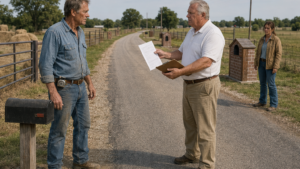
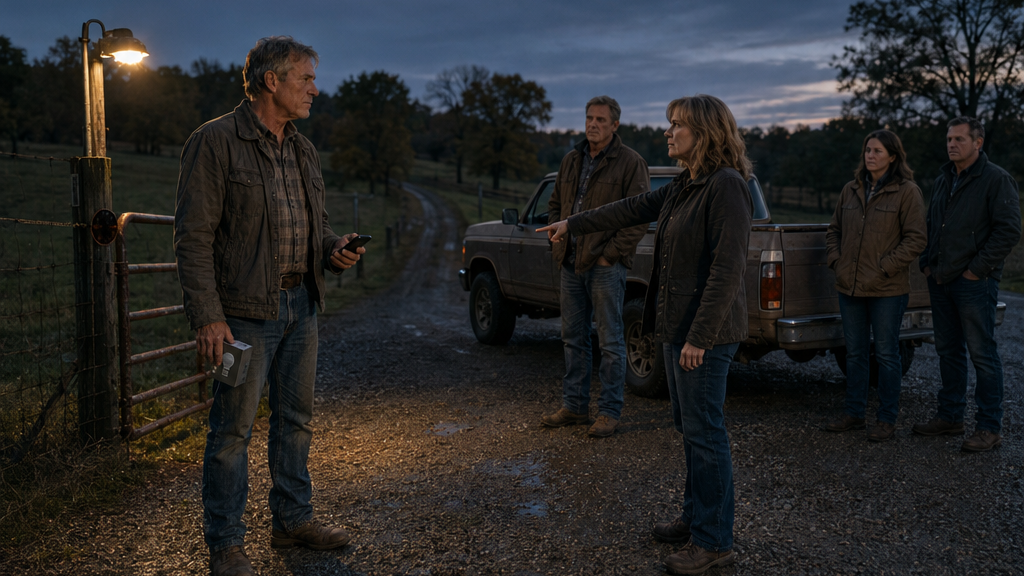
Cynthia Young was standing beneath Mark Carter’s new yard light when he came out of the equipment shed, and from thirty yards away he could tell she had not stopped there to admire it.
The LED fixture threw a hard white fan across the cattle gate, the wet gravel turnout, and the first stretch of the private lane that climbed past Mark’s pasture toward four other properties. Rain earlier that afternoon had darkened everything around it. The illuminated gravel looked almost silver.
Cynthia folded her arms.
“This is a road-safety problem.”
Mark glanced up at the fixture. He had installed it three days earlier after the old mercury-colored lamp finally failed. The new one came from the farm-supply store in town. Weatherproof housing, dusk sensor, broad beam. Nothing unusual.
“It’s a light,” he said.
“It’s a very bright light.”
“That was the idea.”
A pickup appeared at the bend above them. Its headlights came down the lane, crossed Mark’s beam, then dipped as the driver slowed for the cattle gate.
Cynthia watched it pass.
“That right there,” she said. “You can’t see the curve cleanly when you come through your light.”
Mark knew the road better than anyone living beyond his gate. His father had graded the first version of it with a borrowed tractor before Mark was old enough to drive. Mark had replaced culverts, cut back limbs, hauled gravel, and pulled two neighbors out of the ditch over the years.
He also knew Cynthia had been chair of the road association for eighteen months and had discovered, during those eighteen months, an impressive number of things that apparently required regulating.
“The curve was there yesterday,” he said.
“So was your light.”
“You said I put it up three days ago.”
Her expression tightened.
“You know what I mean.”
Mark wiped his hands on his work pants. “Then say what you mean.”
For a second, neither of them spoke.
The light hummed faintly above them.
Cynthia looked toward the houses hidden beyond the rise. “Several people have mentioned the glare.”
“How many?”
“That isn’t really the point.”
“It is if you’re standing on my property telling me several people complained.”
“The lane is shared.”
“The pole isn’t.”
Her eyes shifted to him.
That was the line Mark knew he should not have said.
He had spent years telling himself that private-road meetings were easier if he kept his mouth shut. His father had believed the same thing until the association began voting on mowing widths, ditch clearing, turnaround parking, gate setbacks, and other matters Mark remembered once being settled with a conversation between neighbors.
After his father died, Mark had watched little rules arrive one at a time.
None had seemed worth fighting.
That was what bothered him most.
Cynthia uncrossed her arms.
“I’m trying to handle this informally.”
“That sounds formal already.”
“It doesn’t have to be.”
She pointed toward the fixture. “Angle it down or replace it with something softer.”
Mark looked at the beam. It lit his gate latch, the reflector fixed to the post, the address plate, and the edge of the loading area where cattle trailers backed after dark.
“I need to see what I’m doing out here.”
“No one is asking you to work in the dark.”
“Sounds like you are.”
Cynthia let out a slow breath. “Mark, the complaint is already being prepared.”
He looked back at her.
“What complaint?”
“The road association has a lighting standard.”
Since the association mostly handled gravel bills, culverts, snow clearing, and maintenance assessments, Mark almost laughed.
Instead he said, “We have a lighting standard?”
“It’s in the rules.”
“I’ve read the rules.”
“Then you’ve seen it.”
He had not.
That bothered him more than Cynthia’s tone.
She stepped toward her SUV. “You’ll get the notice. I wanted to give you a chance before that happened.”
“You just said it’s already being prepared.”
Cynthia opened the driver’s door.
“I said I was trying to handle it informally.”
Mark watched her back out of the turnout and disappear around the bend.
The yard seemed oddly quiet after she left.
He stood beneath the LED and looked up into it until the brightness forced him to turn away.
The next morning, the association notice was clipped inside his mailbox.
It was one page, printed on white paper with the road association’s name across the top. The language was more polished than Cynthia’s conversation had been.
EXTERIOR LIGHTING NONCOMPLIANCE.
The fixture at the Carter property entrance allegedly created excessive glare affecting safe travel on the shared lane.
Mark read the paragraph twice.
Then the deadline.
Ten days to correct the condition.
Below that was the section Cynthia had mentioned.
Section 4.7.
He carried the notice into the kitchen and laid it flat beside his coffee.
For several minutes he did nothing except look at the number.
He knew the road agreement well enough to recognize most sections by subject. Drainage. Surface maintenance. Snow removal. Gate clearance.
Section 4.7 meant nothing to him.
That meant one of two things.
Either Cynthia had found a rule Mark had overlooked for years.
Or she was counting on him not to read it closely.
He pulled his laptop across the kitchen table.
Chapter 2: The Minimum Hidden Inside the Rule
The word that stopped Mark was not “glare.”
It was “minimum.”
He had found Section 4.7 halfway down a scanned copy of the road-association rules, buried beneath language about maintaining clear sightlines at drive entrances.
He read the paragraph once.
Then again.
Exterior fixtures visible from the shared access lane were to remain within an approved illumination range sufficient for identification of gates, address markers, and access points while avoiding direct glare toward approaching traffic.
Below it were two numerical standards.
One maximum.
One minimum.
Mark leaned closer to the screen.
“Twenty-five.”
He said it aloud because the number looked almost ridiculous sitting there.
The rule did not simply say lights could not be too bright. It said designated entrance lighting had to remain above a minimum output level so that gates and address markers were visible from the lane.
Twenty-five.
He turned the violation notice over and checked Cynthia’s wording.
Excessive glare.
No measurement.
No meter reading.
No fixture rating.
Nothing showing what his existing light produced at the road.
He went back to Section 4.7.
There was also language about shielding and direction.
That was less convenient.
Mark noticed it and kept reading anyway.
The fixture was not supposed to throw direct illumination into an approaching driver’s line of sight. His new LED probably did exactly that from the upper bend.
Cynthia had not invented the entire complaint.
But she had written the notice as though brightness itself settled the issue.
Mark sat back.
For a few seconds he considered walking outside, loosening the mounting bracket, and tipping the fixture downward.
That would probably end it.
Instead, he looked again at the number twenty-five.
By noon he was in the equipment shed with the original packaging from the LED spread across his workbench. The rating printed on the side was far beyond the minimum and well within what he considered ordinary farm lighting, but the association rule did not give him a clean answer about how brightness was supposed to be measured at a fixture mounted above a gate.
That irritated him.
Rules that could cost a man money ought to be written better than that.
He called the farm-supply store.
The clerk told him the lowest-output outdoor lamp they stocked was still considerably brighter than twenty-five.
“Anything lower than that is usually decorative,” the clerk said.
“What about twenty-six?”
There was silence.
“Twenty-six what?”
“Output.”
“You trying to light something or prove a point?”
Mark looked at the violation notice lying on the workbench.
“Both.”
The clerk laughed once, then said he could check specialty stock through another supplier.
Late that afternoon Mark drove into town.
The clerk had found several small low-output lamps intended for enclosed fixtures, walkway markers, and specialty applications. Most were too weak or unsuitable for outdoor exposure. One weather-rated unit, however, was listed at twenty-six.
Mark picked up the box.
Twenty-six.
One unit above the written minimum.
He felt a small, hard satisfaction settle into place.
The clerk watched him study the packaging.
“That really enough for a farm gate?”
“According to the people telling me how bright my farm gate can be.”
The clerk raised his eyebrows but did not ask.
On the drive home, Mark knew exactly what he was doing.
That was the part he did not bother excusing.
He was not simply seeking compliance. He was looking for the narrowest version of compliance he could force Cynthia to accept.
His father would have called it cutting a fence post too short because somebody criticized the height.
Mark could almost hear him.
If you make the point harder than the problem, son, pretty soon the point is the problem.
Mark turned onto the county road and ignored the memory.
At the farm, he set the twenty-six-unit lamp on the kitchen table beside the printed copy of Section 4.7.
Twenty-five minimum.
Twenty-six on the box.
The contrast pleased him more than it should have.
He photographed them together.
Then he emailed the association secretary a short response stating that he intended to bring the entrance lighting into documented compliance before the deadline.
He did not explain how.
That evening, with the sun dropping behind the hayfield, Mark carried a ladder to the gate.
The bright LED came off first.
When he switched the power back on, the replacement gave off a modest warm pool of light that barely reached the outer edge of the gravel turnout.
He stepped back.
The difference was almost comical.
The white blaze that had filled the entrance was gone. The cattle gate remained visible from the yard side. The number plate could still be read if you stood near it. The rust-dark reflector on the far gatepost gave a faint glint when Mark swept a flashlight over it.
From the lane, however, the whole entrance seemed to retreat into the evening.
Mark checked the package again.
Twenty-six.
He checked Section 4.7.
Twenty-five minimum.
He smiled.
Then he switched off his flashlight and let the new lamp stand on its own.
For the first time in years, his farm entrance looked smaller than the road beyond it.
He noticed that.
He simply did not yet care.
Chapter 3: Twenty-Six, Documented and Still Wrong
Cynthia came back before Mark had finished feeding the cattle the next evening.
This time she brought two board members.
Mark saw their vehicles parked near the gate and knew immediately that his email had not ended anything.
The new fixture was already on. Its warm glow reached the latch, part of the address plate, and not much else.
Cynthia stood beneath it, looking toward the road.
“This cannot stay like this.”
Mark closed the feed-room door behind him.
“That was quick.”
“One of the neighbors drove past last night and could barely identify your entrance.”
“You wanted less light.”
“I wanted safe lighting.”
“And now you have it.”
Cynthia turned toward him. “You honestly think this is safe?”
Mark walked to the tool shelf just inside the shed and picked up the empty package he had saved.
“Yes.”
One of the board members glanced at Cynthia.
She stepped closer.
“The standard requires adequate visibility.”
“It does.”
“This doesn’t provide it.”
Mark held up the box.
“Twenty-six.”
Cynthia stared at him.
He took out his phone, opened the photograph he had made on the kitchen table, then pulled up the association document itself.
“Section 4.7. Minimum twenty-five.”
He held the screen where all three could see it.
“Fixture is rated twenty-six.”
Nobody spoke.
Mark tapped the relevant line.
“Documented. Compliant.”
The satisfaction returned, sharper now because Cynthia was standing beneath the proof.
She took the phone from his hand without asking and read the paragraph.
Then she scrolled upward.
“You’re ignoring the visibility language.”
“I’m meeting the minimum your own rule gives for visibility.”
“That isn’t what it means.”
“That’s what it says.”
One of the board members leaned toward the screen. “Twenty-five is written there.”
Cynthia handed the phone back.
“That number was never intended to let somebody make the entrance almost invisible.”
Mark slipped the phone into his pocket.
“Then the association should have written a different number.”
Her jaw tightened.
“You did this deliberately.”
“Yes.”
The answer seemed to surprise her.
Mark saw no reason to pretend.
“You sent me a violation without measuring my old light. You told me it was too bright. I changed it to something you cannot reasonably call too bright.”
Cynthia looked toward the low fixture.
“No one measured it because the glare was obvious.”
“Obvious isn’t a number.”
“There are things you don’t need an instrument to recognize.”
“If you’re fining people over them, maybe you do.”
The second board member shifted his weight.
“Was the original fixture ever tested?”
Cynthia did not answer immediately.
Mark looked at her.
“That would be no.”
“We received multiple complaints.”
“That’s not what he asked.”
Cynthia’s eyes hardened. “This is exactly the problem, Mark. Everything becomes a contest with you.”
He almost laughed.
“You brought two board members to my gate.”
“Because you replaced a useful light with that.”
She pointed at the dim fixture.
“After you ordered me to change it.”
“I ordered you to correct the glare.”
“No. Your notice says my fixture exceeded the association’s lighting standard.”
“And it did.”
“According to what measurement?”
Again, no answer.
That was the moment Mark believed he had won.
Not eventually.
Not technically.
Right there.
He could feel the scene rearranging itself around Cynthia’s silence. One board member was rereading Section 4.7 on his own phone now. The other was staring at the fixture as though twenty-six had become an accusation all by itself.
Then tires crunched on the upper bend.
A pickup slowed and rolled toward them.
Jacob Martin was driving.
He stopped beside the turnout and lowered his window.
“What’s going on?”
“Lighting review,” Cynthia said.
Jacob looked at Mark, then at the new fixture.
“You changed it?”
“Compliant,” Mark said.
Jacob’s expression did not change.
“With what?”
Mark held up the box.
“Twenty-six. Rule says twenty-five minimum.”
Jacob looked toward the gate.
Then he glanced back up the lane.
“You mind trying something?”
Mark crossed his arms.
“Depends.”
Jacob ignored the tone.
“Come up to the curve with me.”
Cynthia started to say something, but Jacob lifted a hand.
“I’m not taking anybody’s side. I want to see it from the road.”
That annoyed Mark more than if Jacob had openly disagreed.
Still, he climbed into Jacob’s passenger seat.
They drove less than two hundred yards uphill.
At the bend, Jacob stopped.
From there Mark’s farm entrance sat below them at an angle. Under the old LED, the gravel turnout would have been obvious.
Now there was a small amber point where the fixture hung.
The gate itself seemed to dissolve into the dark fence line.
Jacob shut off the headlights.
The entrance nearly disappeared.
“Where’s your reflector?” he asked.
Mark knew exactly where it was.
Right-hand gatepost, chest high, bolted to the weathered steel.
He stared down the lane.
He could not see it.
Jacob turned the headlights on again.
The reflector flashed for an instant, then vanished as the beam angle changed.
“Coming from the county road, you get it,” Jacob said. “Coming from up here, not much.”
Mark said nothing.
Jacob was volunteer fire captain for the district. He had driven that lane in rain, smoke, snow, and darkness. He was not a man Cynthia could easily use as decoration for an argument.
“House number?” Jacob asked.
Mark found the plate eventually.
It took longer than he wanted.
“There.”
“Yeah,” Jacob said. “Once you know where to look.”
Mark looked toward the little twenty-six-unit light.
The box was still in his hand.
A few minutes earlier, it had felt like evidence.
Now it felt lighter than cardboard ought to.
“You saying Cynthia was right?” he asked.
Jacob rested both hands on the steering wheel.
“I’m saying her notice and your light might both be wrong.”
Mark turned toward him.
Jacob nodded toward the gate.
“You proved the rule says twenty-five. Fine. Now stand here and tell me you’d want an ambulance looking for that entrance at two in the morning.”
Down at the turnout, Cynthia and the board members were waiting under Mark’s perfectly compliant light.
Mark stared at his own gate.
For the first time, he could not immediately pick it out from the darkness.
Chapter 4: The Night the Gate Disappeared
The feed truck passed Mark’s gate at nearly thirty miles an hour before its brake lights flared red in the darkness.
Mark was standing beside the equipment shed with a wrench in one hand when he heard the tires scrape loose gravel. The truck went another fifty yards, slowed hard near the ditch, then backed toward the turnout with its reverse alarm sounding across the pasture.
He set the wrench down.
Two nights had passed since Jacob had made him stand at the upper curve and look for his own gate.
Since then, Mark had done the same thing three more times.
Once from his pickup.
Once on foot.
Once with the headlights on low beam.
Every time, he had found the entrance eventually.
That word bothered him.
Eventually.
The feed-truck driver climbed down from the cab and walked toward him.
“Sorry about that.”
“You’ve been here before.”
“Plenty.”
The driver looked toward the lane.
“Did you change something?”
Mark’s eyes went to the dim fixture.
“Light.”
“That explains it.”
The answer landed harder than Mark expected.
The driver pointed toward the curve. “Coming down from up there, I was looking for the reflector. Didn’t catch it until I was past.”
Mark folded his arms.
“You almost hit the ditch?”
“No. But if I’d been pulling a longer trailer, I’d have made a mess backing around.”
He gave Mark a brief nod and went to handle the delivery.
Mark stayed near the gate.
The twenty-six-unit bulb glowed exactly as it had the night before.
Nothing about it had changed.
Only Mark’s willingness to call the result acceptable.
By the time the truck left, Jacob’s pickup was coming down the lane.
He stopped beside Mark without being waved in.
“Heard that from my place.”
“Truck missed the entrance.”
Jacob looked toward the dim fixture.
“I figured.”
Mark did not answer.
Jacob stepped out.
“You still planning to leave it?”
“It meets the rule.”
“That wasn’t what I asked.”
Mark looked at him.
Jacob leaned against the pickup door.
“You know we’ve had trouble with addresses out here before.”
“Cynthia mentioned safety. She didn’t say anything specific.”
“She might not have wanted to.”
“Since when does that stop her?”
Jacob almost smiled, but it faded quickly.
“Last winter, county dispatch sent an ambulance up this road after midnight. Wrong driveway first. Then they overshot the right one because two markers were hard to see.”
Mark straightened.
“How long?”
“Not much.”
“How long?”
“Couple minutes.”
Mark looked toward the houses beyond the rise.
“Anybody hurt because of it?”
“No.”
“Then don’t make it bigger than it was.”
“I’m not.”
Jacob pushed away from the truck.
“I’m telling you why I care about the gates being visible.”
Mark’s mouth tightened.
“You knew that when Cynthia filed the complaint?”
“I knew there had been complaints about visibility. I didn’t know she was writing you up over glare.”
“That difference matters.”
“Yes.”
The easy agreement disarmed him.
Jacob walked to the cattle gate and touched the reflector.
“This thing is fine when headlights hit it straight. From the upper bend, they don’t.”
“So the reflector’s the problem.”
“Part of it.”
“And the road angle.”
“Part of it.”
“And nobody wrote any of that into the rule.”
Jacob looked at him.
“That’s probably the biggest part.”
Mark let out a breath through his nose.
For two days he had wanted someone else to say exactly that.
Now that Jacob had, it did not feel like victory.
A vehicle turned onto the lane from the county road.
Cynthia’s SUV.
She stopped on the opposite side of the turnout.
Mark knew the conversation was coming before she got out.
“We need an emergency board vote,” she said.
No greeting.
No pretense.
Mark laughed once.
“Of course we do.”
She ignored the tone.
“The current standard is obviously inadequate.”
“Funny. Three days ago it was good enough to cite me under.”
“The problem has changed.”
“No. The problem got visible.”
Cynthia looked toward the feed tracks in the gravel.
“I heard about the truck.”
“News travels fast.”
“On a private road with six households and two farms? Yes.”
Jacob stepped between their lines of sight without actually standing between them.
“What are you proposing?”
“A temporary minimum brightness requirement until the board can revise the language.”
Mark stared at her.
“You’re going to change the rule before my appeal?”
“I’m going to keep the road safe.”
“You’re going to move the line because I landed on the right side of the old one.”
Cynthia’s face tightened.
“That is not what this is.”
“It’s exactly what it looks like.”
“You installed that lamp because you wanted to prove a point.”
Mark did not answer.
That silence was enough.
Cynthia nodded once.
“At least we agree on something.”
Mark stepped closer.
“You don’t get to issue a citation under one rule, discover it doesn’t support you, and then write a different rule before I challenge the first one.”
“If the existing rule creates a hazard, the board has an obligation to address it.”
“Then address the hazard. Don’t rewrite history.”
Jacob looked at Cynthia.
“When’s the vote?”
“Tomorrow evening.”
Mark’s eyes snapped toward him.
“You’re serious?”
Cynthia was already moving back toward her SUV.
“Seven o’clock.”
“My appeal isn’t until next week.”
“I know.”
“That’s the point.”
She stopped at the door.
“No, Mark. The point is that if an ambulance misses a driveway next week because we spent seven days arguing over wording, I’m the one who gets asked why we did nothing.”
For the first time, her voice lost its administrative flatness.
There was fear under it.
Not much.
But enough that Mark heard it.
Then she got into the SUV and left.
Jacob remained beside the gate.
Mark looked at the dim light overhead.
“You knew she was planning this?”
“No.”
“You think she can do it?”
“I think she’ll try.”
“That wasn’t my question.”
Jacob looked toward the upper bend.
“No. I don’t know if she can.”
Mark walked toward the house.
Inside, he opened the road-association bylaws and searched for emergency amendments.
He found procedures for urgent maintenance.
Temporary road closures.
Storm damage.
Drainage failures.
Nothing that clearly allowed the board chair to replace an existing lighting standard with twenty-four hours’ notice.
Then an email arrived.
Subject: EMERGENCY LIGHTING REVIEW.
The proposed language was attached.
Mark read it once.
Then again.
The new minimum was nearly six times higher than the number in Section 4.7.
At the bottom, Cynthia had added one sentence:
Effective immediately upon board approval.
Mark stared at those words until the screen dimmed.
His appeal had not even happened yet.
But by tomorrow night, Cynthia intended to make the rule he had followed disappear.
Chapter 5: The Rule Nobody Had Actually Changed
Margaret Clark searched the association records for twenty minutes before she said the sentence Mark had been waiting to hear.
“I can’t find an amendment.”
They were in the small room off the back of her house that she still called an office even though she had retired four years earlier. Metal filing cabinets covered one wall. Three ring binders lay open across a desk, and another stack sat on the floor beside Mark’s chair.
Margaret adjusted her glasses.
“You’re sure Cynthia said this brighter standard had already been adopted?”
“She said everybody had been following it.”
“That isn’t the same thing.”
“She treats it like it is.”
Margaret looked uncomfortable.
That interested Mark.
“Margaret.”
“I heard you.”
“Then what am I missing?”
She closed one binder and reached for another.
“The association discussed revised lighting guidance several years ago.”
“Guidance.”
“Yes.”
“Not a rule.”
“I’m looking.”
Mark sat back.
The emergency vote had passed the night before, three to two.
He had attended, objected, and been told the new requirement was temporary until formal review. His existing twenty-six-unit lamp was now out of compliance under the temporary minimum, although Cynthia had agreed not to issue a second citation before his appeal.
A concession presented as generosity.
Mark had driven home angry enough to remove the fixture out of spite and leave the gate completely dark.
He had not done it.
Jacob’s question from the curve had stopped him.
Would you want an ambulance looking for that entrance at two in the morning?
Margaret opened a thin folder.
“Here.”
The meeting minutes were dated five years earlier.
Mark leaned over the desk.
A winter medical response had prompted discussion about entrance visibility along the private road. The notes mentioned reflective markers, house numbers, and exterior lighting. A brighter recommended threshold appeared in a draft proposal.
Mark tapped the page.
“That’s Cynthia’s number.”
“Yes.”
“Where’s the vote?”
Margaret turned the page.
There was none.
Instead, the minutes ended with a motion to obtain additional technical guidance before changing the standard.
“Next meeting,” Mark said.
Margaret pulled another binder toward her.
The following month contained discussion of drainage damage and a contractor dispute. No lighting vote.
The month after that, snow-removal expenses.
Nothing.
Mark looked up.
“So it never passed.”
“I don’t see that it did.”
“Then why has Cynthia been telling people it’s the standard?”
Margaret’s fingers rested on the edge of the folder.
“Because for years, people treated the recommendation like it was.”
Mark stared at her.
“You included.”
She nodded.
There it was.
Not corruption.
Not conspiracy.
Something almost more frustrating.
Habit.
A draft had been discussed, repeated, remembered, and eventually treated as law because nobody had bothered to ask when it became law.
Margaret took off her glasses.
“I should have caught it.”
Mark said nothing.
“I was secretary then too. We started putting the brighter number in reminder letters. Not violation notices. Just recommendations.”
“And eventually nobody remembered the difference.”
“That’s about right.”
Mark looked back at the minutes.
“Why did Cynthia care so much?”
Margaret hesitated.
“You know about the ambulance call.”
“Jacob told me.”
“She was the one who met them at the road.”
Mark looked up.
Margaret continued quietly.
“The patient lived at the far end. Cynthia heard the siren stop, then start again. She drove down and found them turning around after trying the wrong drive.”
“How bad was it?”
“The person recovered.”
“That isn’t what I asked.”
Margaret folded her hands.
“It scared her.”
Mark thought of Cynthia at his gate.
If an ambulance misses a driveway next week, I’m the one who gets asked why we did nothing.
Until now, he had heard that as authority talking.
He heard it differently in Margaret’s office.
Not better.
Just differently.
“She still cited me under a rule she didn’t understand.”
“Yes.”
“She didn’t measure my original light.”
“No.”
“She pushed an emergency vote before my appeal.”
“Yes.”
Margaret met his eyes.
“Understanding why somebody does something isn’t the same as saying they were right.”
Mark leaned back.
He had come looking for a clean piece of paper that would make Cynthia entirely wrong.
Instead he had found something messier.
Cynthia had overreached.
The association had allowed informal guidance to masquerade as policy.
And beneath both mistakes was a problem the road genuinely had.
Margaret pulled another folder from the bottom drawer.
“This may be what they were waiting for.”
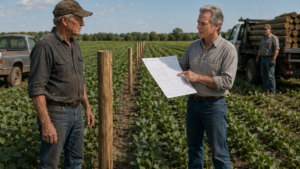
Inside was an old technical sketch from a utility consultant.
Mark unfolded it.
The drawing showed a rural entrance viewed from above. A fixture sat near the gate, but unlike Mark’s old LED, its beam did not spread straight across the road.
The illuminated area was angled sideways and downward.
The lane itself stayed comparatively dark.
The gate, address marker, and shoulder were bright.
Mark studied it.
“What is this?”
“A recommendation from the consultant. It came after the first discussion.”
“Why wasn’t it adopted?”
Margaret gave him a tired look.
“By then everyone had moved on to the bridge culvert.”
Mark almost smiled.
Of course they had.
He traced the beam pattern with one finger.
“This doesn’t solve brightness with a bigger number.”
“No.”
“It solves direction.”
“That’s how I read it.”
The notes beside the diagram referred to shielding, mounting angle, line of sight, and visible address markers.
Raw output appeared only once.
Mark looked at the page for a long time.
His original LED had been too broad.
His twenty-six-unit replacement was too weak from the upper approach.
Neither Cynthia’s informal brighter number nor Mark’s exact-compliance trick dealt with the actual geometry of the road.
Margaret watched him.
“You thinking about trying it?”
“I’m thinking about whether I can build it without giving Cynthia the satisfaction.”
Margaret smiled despite herself.
“That sounds like you.”
Mark folded the sketch carefully.
At the door, she stopped him.
“Mark.”
He turned.
“If you prove the old citation was wrong, don’t make that the only thing you prove.”
He said nothing.
She nodded toward the drawing in his hand.
“That might be worth more.”
Outside, Mark stood beside his pickup and opened the sketch again.
A shielded beam.
Bright where it needed to be.
Dark where it did not.
For the first time since Cynthia had stood beneath his original light, Mark had something better than an argument.
He had a design neither of them had been using.
Chapter 6: A Better Light Than Either Side Wanted
Mark removed the twenty-six-unit bulb before sunrise.
No order had arrived.
No board member was watching.
No deadline required it.
That made the act harder than he expected.
He climbed the ladder, unscrewed the little warm lamp, and held it in his palm.
For several days it had represented everything he wanted from the dispute: proof, precision, a line Cynthia could not cross.
Now it looked like what it was.
A very dim bulb.
He put it back in its box and carried it into the equipment shed.
The old consultant sketch lay flat on his workbench.
By midmorning, Mark had built a temporary shield from sheet metal and mounted a medium-output outdoor fixture lower on the pole. Instead of throwing light toward the road, he angled it down across the gate latch, reflector, address plate, and gravel apron.
Then he waited for dark.
Jacob arrived just after seven.
Mark did not tell him what to expect.
“Drive the upper approach first.”
Jacob looked at the fixture.
“That new?”
“Just drive.”
Jacob grinned and got back into his pickup.
Mark stayed at the gate.
The truck disappeared around the upper bend.
A minute later, headlights appeared.
The gate reflector flashed immediately.
Not because the new lamp was brighter than Mark’s first LED.
Because Mark had moved the illuminated surface into the angle where approaching headlights and the shielded beam could both catch it.
Jacob slowed cleanly and turned into the turnout.
He lowered the window.
“House number’s clear.”
“Glare?”
“None.”
“Again.”
Jacob laughed.
“You planning to qualify me on your driveway?”
“Again.”
They tested the entrance from the county-road side.
Then from the upper bend.
Low beams.
High beams.
Mark stood at different points along the shoulder and adjusted the shield twice.
The last time Jacob returned, he parked and climbed out.
“That works.”
Mark looked toward the lane.
The gate was visible.
The number plate was visible.
But the road beyond remained dark enough that approaching headlights did not fight against Mark’s fixture.
Jacob walked beneath the light.
“You could’ve done this the first day.”
Mark gave him a look.
“So could the association.”
“Fair.”
Mark tightened the last mounting bolt.
“I still want the violation withdrawn.”
“You should.”
“And I want the emergency rule reviewed.”
“You should.”
Mark glanced at him.
Jacob understood.
“You thought I was going to tell you to let it go?”
“I thought you might.”
“No. Cynthia overreached.”
Mark waited.
Jacob added, “So did you.”
There it was.
Mark looked up at the fixture.
“Twenty-six was legal.”
“I didn’t say it wasn’t.”
“That distinction keeps getting lost.”
Jacob leaned against the gate.
“You chose it because it was the lowest number you could defend.”
“Yes.”
“Not because it worked.”
Mark tightened the wrench until the metal bit into his palm.
“No.”
Jacob nodded.
“Then we’re getting somewhere.”
Two days later, the road-association board scheduled Mark’s appeal.
Before the meeting, Cynthia drove by the farm and stopped.
She did not get out.
Mark walked to the driver’s window.
She looked at the new fixture.
“What is that?”
“Light.”
Her expression suggested she remembered the first conversation.
“I can see that.”
“Shielded. Lower mount. Different angle.”
“You’re above the temporary minimum?”
“Yes.”
“Then I assume the emergency rule worked.”
Mark stared at her.
“No.”
Cynthia’s mouth tightened.
“The entrance is brighter.”
“The entrance is visible. The lane isn’t flooded.”
“That’s what we wanted.”
“It’s what the old consultant wanted.”
She looked at him.
Mark held up a copy of the sketch.
For the first time since the dispute began, Cynthia seemed genuinely uncertain.
“Where did you get that?”
“Association files.”
She took the page through the window and studied it.
“This was never adopted.”
“Neither was the number you were enforcing for five years.”
Her eyes lifted.
Mark did not soften the statement.
Cynthia looked back at the drawing.
“The board treated it as standard practice.”
“Practice isn’t a rule.”
“You know why we raised the minimum.”
“I know about the ambulance.”
That changed her face.
Only slightly.
But Mark saw it.
She looked out through the windshield.
“You don’t know everything about that night.”
“I don’t need to.”
“No?”
“No. I need to know whether you had authority to cite me. You didn’t.”
She handed the sketch back.
“And yet you changed the light.”
“Yes.”
“Because I was right about the safety issue.”
“Partly.”
Cynthia gave him a thin, humorless smile.
“You always have to leave yourself that word.”
“Partly is an important word.”
She was quiet.
Mark rested one hand on the window frame.
“I’m not asking the board to keep the twenty-six-unit setup.”
“What are you asking?”
“Withdraw the citation. Suspend the emergency number. Replace both with something measurable.”
“Such as?”
“Glare at the travel lane. Visible address markers. Gate identification from both approaches. Shielding requirements.”
Cynthia looked toward the new fixture.
“And who measures all that?”
“We figure that out.”
“You make it sound simple.”
“No. I’m saying the simple rule was the problem.”
For a moment they looked at each other without anger doing all the work.
Then Cynthia said, “I still think the violation should stand.”
Mark stepped back.
“Why?”
“Because if we withdraw every enforcement action whenever the wording has a flaw, no one will take the standards seriously.”
There it was.
Not safety.
Authority.
At least partly.
Mark nodded.
“Then you and I still have something to settle.”
That evening, the association met in the small community room beside the volunteer fire building.
Mark arrived carrying a thin folder under one arm.
Inside it were the old consultant sketch, the current Section 4.7 language, the emergency amendment, photographs of the original LED glare pattern, and photographs of the corrected shielded fixture.
In his other hand, he carried the small cardboard box.
Twenty-six.
Documented.
Compliant.
The object that had once felt like his whole case.
Cynthia was already seated at the front table.
The two board members from his gate sat beside her. Margaret had a notebook open near the end.
Jacob stood along the wall.
Mark took his seat.
Cynthia looked at the little box in his hand, then at the folder.
“You brought both.”
Mark set them on the table.
“I figured we should talk about the rule we had and the light we actually need.”
Chapter 7: The Rule Was Wrong Before Either of Them Were
Cynthia asked the board to uphold Mark’s violation before anyone had discussed whether the rule supporting it had ever been valid.
Mark sat across from her with the small twenty-six-unit bulb box beside his folder.
The community room was quiet enough that he could hear the heating vent tick in the wall.
Cynthia kept both hands flat on the table.
“I agree the older lighting guidance was never formally adopted,” she said. “But the original notice addressed a real safety condition. Withdrawing it entirely suggests the association had no basis to intervene.”
One board member looked toward Margaret.
Margaret’s pen had stopped moving.
Mark leaned back.
There it was.
Not whether his old light had caused glare.
Not whether the new light solved anything.
Whether the association could admit it had acted without the authority it thought it possessed.
The other board member opened Mark’s appeal packet.
“Cynthia, the notice cites Section 4.7.”
“I know.”
“And Section 4.7 contains the twenty-five minimum.”
“Yes.”
“And there was no measurement of the original fixture.”
“The glare was observable.”
Mark spoke for the first time.
“Observable isn’t the same as documented.”
Cynthia turned toward him.
“No one is disputing that the wording could be better.”
“I am disputing the citation.”
“You’ve made that clear.”
Mark placed the twenty-six-unit bulb box in the center of the table.
“This is what your rule allowed.”
No one touched it.
“It met the minimum,” he continued. “It also made my gate harder to identify from the upper curve. Both things are true.”
Cynthia’s expression shifted slightly.
Mark opened his folder and laid the consultant sketch beside the bulb.
“And this is what the association had in its own records for five years.”
The drawing showed the shielded beam, the gate, the road, and the controlled angle of illumination.
Jacob stepped closer from the wall.
“I tested Mark’s new setup from both approaches,” he said. “Gate’s visible. Number’s visible. No direct glare.”
Cynthia looked at him.
“Under the temporary minimum?”
“Yes.”
“That supports the emergency rule.”
Jacob shook his head.
“Not really.”
Her mouth tightened.
“The output is higher.”
“The direction matters more.”
He pointed at the sketch.
“If he mounted the same fixture wrong, we’d be back where we started.”
One board member leaned forward.
“So a single brightness number doesn’t solve it.”
“No,” Jacob said.
Mark watched Cynthia.
She had stopped looking at him.
Instead she stared at the old drawing.
For several seconds no one spoke.
Then Margaret cleared her throat.
“There’s something that should be entered into the record.”
Cynthia looked toward her.
Margaret turned back several pages in her notebook.
“The brighter figure we’ve been using in letters was never adopted as an amendment.”
“We established that,” Cynthia said.
“I’m not finished.”
The room went still again.
Margaret looked down.
“I was secretary when the draft was circulated. I used that number in later reminder letters because I believed the board intended to adopt it. After a few years, those letters became our reference point.”
Mark looked at her.
She did not avoid his eyes.
“That was my mistake too.”
Cynthia’s shoulders lowered by a fraction.
The admission seemed to change the room more than any rule citation had.
There was no single person left to blame for the entire mess.
Mark had chosen the dimmest possible light to make a point.
Margaret had allowed informal guidance to become institutional habit.
The board had stopped checking the difference.
Cynthia had turned that habit into enforcement.
And underneath all of it, the bend in the road still existed.
Cynthia finally said, “You all know why I pushed this.”
No one answered.
She looked at Jacob, then Margaret, and finally Mark.
“The ambulance call wasn’t just an inconvenience.”
Her voice had lost the clipped tone she used at meetings.
“I was at the county road when they came in. I could hear the siren coming. Then it stopped.”
Mark stayed still.
“They went past the correct drive. Tried another one. Had to back out.”
She folded her hands.
“It was probably two minutes. Maybe less.”
Jacob said nothing.
Cynthia continued.
“The person was fine later. But standing there, waiting for headlights to come back down that road, two minutes didn’t feel small.”
Mark remembered Margaret saying it had scared her.
Now he could see that fear had never really left.
Cynthia looked toward the bulb box.
“When you installed that thing at twenty-six, I thought you were treating the whole issue like a joke.”
“I wasn’t joking.”
“No. You were proving something.”
Mark nodded.
“I was.”
“And you made the entrance harder to see.”
“Yes.”
That word cost him more than he expected.
He could have qualified it.
He could have blamed the rule.
Instead he let it stand.
Cynthia watched him.
Mark slid the consultant drawing toward the center of the table.
“I still don’t think fear gives the board authority it doesn’t have.”
“No.”
The answer came quietly.
It was the first time Cynthia had said it without argument.
Mark continued.
“But being right about that doesn’t make my twenty-six-unit setup a good solution.”
One of the board members exhaled and leaned back.
“So what are you asking us to do?”
Mark looked at the papers he had brought.
A week earlier, he would have answered immediately.
Withdraw the citation.
Admit Cynthia was wrong.
Leave his gate alone.
Now those things felt incomplete.
“Withdraw the original citation because it wasn’t properly supported,” he said. “Suspend the temporary brightness number until it goes through the normal amendment process.”
Cynthia’s eyes narrowed slightly.
“And then?”
“Write a standard around the actual problem.”
He pointed toward the sketch.
“Measure glare at the travel lane. Require visible address markers from both approaches. Require shields where a fixture faces the road. Set a reasonable illumination range if you want one, but don’t pretend one number fixes every entrance.”
A board member looked toward Jacob.
“Can that be tested?”
“Yes.”
“How?”
Jacob pulled a chair closer.
“Simple approach checks for visibility. A light meter if the board wants actual thresholds. Mounting angle and shielding can be inspected.”
Cynthia looked at Mark.
“You came prepared.”
“I had a few evenings free after somebody turned my yard light into a government project.”
A faint sound escaped Margaret before she covered it with a cough.
Even Cynthia almost smiled.
Almost.
Then Mark said, “And I’m not asking you to resign.”
The room changed again.
Cynthia’s eyes lifted sharply.
“I didn’t say you were.”
“You thought I might.”
She did not answer.
Mark had considered it.
More than once.
He could have argued that a chair who enforced an unadopted standard had no business remaining in the position.
A week earlier, he might have enjoyed making the case.
But removing Cynthia would not correct Section 4.7.
It would not fix the bend.
And it would not make him any less responsible for choosing a deliberately useless light just because he could.
“I want the record corrected,” he said. “Not a head on the wall.”
Margaret lowered her pen.
One board member made the motion.
The original citation against Mark Carter would be withdrawn because the association had not established that his initial fixture violated the written standard through any defined measurement or inspection.
The motion passed.
Cynthia voted yes.
The emergency brightness rule came next.
That vote was harder.
Cynthia wanted to keep it temporarily.
Mark expected that.
Instead of arguing again, he asked for a thirty-day interim process: no new lighting citations unless an entrance created direct glare or failed a simple visibility check, with permanent language to be drafted from the old consultant recommendation and current measurements.
Jacob agreed to help test the approach.
Margaret agreed to circulate the actual amendment language before any vote.
The board approved it.
When Margaret read the final item into the minutes, Cynthia stopped her.
“Add one sentence.”
Margaret looked up.
Cynthia glanced at Mark.
“The association’s prior use of the brighter recommendation did not constitute formal adoption.”
No one moved.
Margaret wrote it down.
Mark looked at Cynthia.
She did not apologize.
He was glad she did not.
An apology would have made the moment too simple.
Instead she put in the record the thing she had resisted saying from the beginning.
The old practice had not been the rule.
After the meeting, Mark picked up the twenty-six-unit bulb.
Cynthia gathered her papers.
At the door she stopped beside him.
“The new light at your gate really works?”
“You drove past it.”
“I was looking at the fixture, not the road.”
Mark considered that.
“Come by after dark tomorrow.”
She nodded.
That was all.
The next evening, Mark finished checking the cattle before driving to the county road.
He turned around and approached his farm the way a delivery truck or ambulance would.
The new shielded fixture appeared ahead without dominating the darkness.
The gravel lane remained dark enough for his headlights to define the curve.
Then the cattle-gate reflector caught.
A clean red-white flash.
A moment later, the address plate became readable.
No glare filled the windshield.
No white light spilled across the neighbor’s pasture.
Mark slowed and turned through the gate.
From the turnout, he could see the beam doing exactly what the old consultant drawing had shown years earlier.
Lighting the place that needed light.
Leaving the rest alone.
Cynthia’s SUV was parked farther up the lane.
She had stopped near the bend.
Mark saw her headlights pause there for several seconds before she drove on.
She did not come down to the gate.
She did not need to.
Mark climbed out of his pickup and stood beneath the fixture.
Inside the equipment shed, the twenty-six-unit bulb was still in its cardboard box.
He had decided to keep it.
Not as proof that he had beaten Cynthia.
Not anymore.
It was a reminder of how easy it had been to reduce a real problem to a number because the number happened to favor him.
Above the gate, the shielded light cast a steady pool across the latch, reflector, address plate, and gravel shoulder.
Beyond that, the lane disappeared naturally into the dark.
Mark looked once toward the upper curve.
This time, he did not need to prove whose rule had won.
He could simply see the road.
The story has ended.