He Poured a Farm Entrance Across My Boundary—Then the Survey Found What Ran Beneath It
Chapter 1: The Concrete Was Still Wet When Scott Saw the Line
The concrete truck was already backing toward Scott Mitchell’s hayfield when he came over the rise in his pickup.
Its warning alarm pulsed across the roadside ditch—beep, beep, beep—while an excavation crew waved the driver toward the widened entrance beside Raymond Harris’s old barn. A shallow wooden form had been built along the edge of the gravel road, and gray concrete was already sliding down the chute.
Scott braked hard enough to make the fencing pliers on his passenger floorboard jump.
For half a second he stared through the windshield, trying to understand what bothered him.
Then he saw it.
The new apron did not stop where Raymond’s gravel entrance had stopped for as long as Scott could remember. The forms pushed farther west, into the narrow grass strip beside Scott’s lower hayfield.
Scott parked on the shoulder and climbed out.
Kevin Brown, the contractor, stood in rubber boots with a rake in one hand. “Morning, Scott.”
Scott nodded toward the nearest form board. “How far are you taking this?”
Kevin looked at the slab. “Just widening the mouth. Raymond needs room for trailers.”
“That board’s on my side.”
Kevin’s expression tightened.
Before he could answer, Raymond came down from the barn in work jeans and a clean tan shirt, walking with the impatient stride of a man who had already spent too much money that morning.
“What’s going on?”
Scott pointed to the wet apron. “I think you crossed the line.”
Raymond glanced once at the grass.
“You think?”
“I’m telling you that entrance used to stop east of that pin.”
“What pin?”
Scott looked toward the ditch.
That was the problem.
For years, neither man had needed to see the boundary. It ran somewhere through grass, thistle and crushed limestone, important on paper but almost invisible in daily life. Their fathers had known where it was. Scott had known where it was. Raymond had known well enough not to build on it.
Or Scott had assumed he had.
Kevin rested his rake against his shoulder. “We laid this off the existing drive.”
“You widened the existing drive,” Scott said.
Raymond exhaled through his nose. “By a few inches.”
“Then a few inches should be easy not to pour.”
The truck engine idled behind them.
One of the crew looked at Kevin.
Kevin said, “We’re already loaded.”
Scott stepped closer to the form. The concrete behind it shone wet and smooth, still soft enough that a boot heel would sink into it.
“Then stop here.”
Raymond’s face changed.
Not much. Just enough.
“You’re going to shut down a pour over grass?”
“It isn’t the grass.”
“What is it, then?”
“The line.”
Raymond gave a short laugh with no humor in it. “Scott, we’ve been crossing that corner since we were kids.”
“With equipment.”
“Exactly.”
“Equipment leaves.”
Raymond looked at the slab. “This is an entrance.”
“Concrete doesn’t leave.”
For a moment the only sound was the truck.
Kevin moved his rake from one shoulder to the other. “You two want me to wait?”
“Yes,” Scott said.
“No,” Raymond said at the same time.
They looked at each other.
Scott felt something old and familiar rise in him: the urge to step aside rather than make a public fight of something. It was the same instinct that had made him wave tractors through that strip during wet harvests, the same instinct that had led him to say nothing when Raymond’s father occasionally swung a wagon over the corner.
Neighbors helped neighbors.
That was how Scott had always understood it.
But help had never meant ownership.
He walked into the grass and searched near the ditch.
Raymond followed a few steps. “What are you doing?”
“Finding the marker.”
“You don’t even know where it is.”
Scott ignored him.
Near a clump of foxtail, he found a patch of ground where the grass grew thinner. He scraped at it with the heel of his boot, then crouched.
Something dark showed beneath the dirt.
He brushed away another inch.
A rusted iron pin emerged, barely thicker than his thumb.
Scott stayed crouched for a second, relieved by the sight of it.
“There.”
Raymond came closer.
Kevin did too.
The pin sat several feet from the road, old enough that neither man could say when it had last been exposed.
Scott stood and sighted from the pin toward the distant fence corner separating their back acreage.
The form board sat plainly on Scott’s side of that imagined line.
Raymond folded his arms.
“That doesn’t prove anything.”
“It proves there’s a marker here.”
“It proves there’s a piece of iron in the dirt.”
Scott stared at him.
Raymond continued, quieter now. “My dad turned combines through here. Your dad let him. I’ve brought trailers through here. You never said a word.”
“Crossing isn’t the same as pouring.”
“You never told me there was some sacred sixteen-inch strip I couldn’t touch.”
“I’m telling you now.”
Kevin cleared his throat. “Concrete’s getting hot.”
Scott looked at him.
He did not blame Kevin entirely. A contractor worked from the information he was given. But the crew had already poured enough that stopping would cost time and money.
That was precisely why Scott had driven over instead of waiting.
“Raymond,” he said, “don’t finish this until we know.”
Raymond looked toward the barn.
The old structure had changed over the summer. New siding covered the south wall. A gravel parking area had been graded beside it. Strings of black outdoor lights hung under the eaves, still unlit in the morning.
Scott knew Raymond had borrowed heavily to turn the place into an event barn.
He also knew that did not move a property line.
Raymond rubbed a hand across his jaw.
“I’ve got deliveries starting Monday.”
“Then we settle it before Monday.”
“With what? A fifty-year-old pin and your memory?”
“With a survey if that’s what it takes.”
Raymond shook his head. “You’re making this bigger than it is.”
Scott looked at the wet concrete.
“No. You are.”
The words came out sharper than he intended.
Raymond heard it.
So did Kevin.
Scott almost softened them. Almost added something about working it out later, because that was what he usually did when tension rose.
Instead he remained silent.
Raymond turned toward Kevin.
“Finish it.”
Kevin hesitated.
“Raymond—”
“You heard me.”
Scott took one step forward. “I’m asking you not to.”
Raymond met his eyes.
“And I’m telling you the entrance is going in.”
Kevin looked from one man to the other, then signaled the driver.
The chute lowered again.
Wet concrete began sliding into the disputed form.
Scott stood beside the old iron pin and watched it spread.
Chapter 2: Raymond Said Two Words Scott Could Not Ignore
The farm-supply truck arrived Monday morning and immediately proved why Raymond had wanted a wider entrance.
It was a long straight truck loaded with stacked panels and feed equipment, and the driver could not make the turn without letting his rear tires cross Scott’s grass.
Scott was repairing fence fifty yards away when he heard the diesel engine strain.
By the time he reached the road, one rear wheel had pressed a dark crescent into the edge of his field.
The driver leaned out his window. “This yours?”
“The field is.”
“The entrance?”
Scott looked at Raymond, who stood near the new slab with Kevin.
“Depends who you ask.”
Raymond frowned.
The truck idled between them, too large to ignore and too awkward to move without backing into the county road.
Raymond waved the driver forward. “You’ve got room.”
Scott stepped aside.
The truck eased across the concrete apron, its rear tire missing the old iron pin by less than two feet.
Raymond watched it go with a satisfaction Scott understood better than he wanted to.
The widened entrance worked.
That was part of the problem.
When the truck had cleared the road, Raymond turned to Scott.
“See?”
“I saw.”
“It needs the width.”
“That doesn’t make the width yours.”
Kevin glanced toward the barn as if wishing himself elsewhere.
Raymond’s patience thinned. “We did this for safety. Trailers were cutting the ditch. Delivery trucks couldn’t swing in.”
“You could’ve widened east.”
“There’s a culvert.”
“Then move the culvert legally.”
“And spend another ten grand?”
Scott said nothing.
Raymond pointed toward the tire mark in Scott’s grass.
“You’ve let people cross that corner for twenty years.”
“Temporarily.”
“You never said temporarily.”
Scott felt the truth of that more than he wanted to.
He had never put it in writing. Never painted the line. Never told Raymond’s father, before he died, that the privilege ended after harvest. He had relied on the kind of understanding that worked until someone needed it to mean something else.
Still, there was wet-looking gray concrete where grass had been four days earlier.
Scott nodded toward the iron pin.
“That marker was there before either of us.”
Raymond gave a tired laugh.
“There you go again.”
“What?”
“Talking like the pin settled it.”
“It marks something.”
“Then show me what.”
The delivery driver had climbed down from the truck and was tightening a strap near the rear. Kevin stood close enough to hear every word.
Scott disliked that.
Private disagreements were easier. In private, people could change their minds without feeling watched.
Raymond seemed to feel the opposite.
He stepped onto the apron and tapped one boot against the concrete.
“You say this is yours.”
“Part of it.”
“You say I crossed your line.”
“Yes.”
Raymond spread his hands.
“Prove it.”
The driver looked up.
Kevin looked down.
Something in Scott went still.
Raymond had meant the words as a dismissal, but they relieved Scott of a burden he had been carrying since Friday. He no longer had to persuade Raymond from memory, custom or neighborly trust.
Proof could be hired.
“All right,” Scott said.
Raymond blinked.
Scott pointed once at the slab.
“I’ll pay for the survey.”
Raymond’s mouth tightened into a half-smile. “That’s your money.”
“It is.”
“And when it shows this entrance is fine?”
“Then I’ll say I was wrong.”
That answer seemed to irritate Raymond more than an argument would have.
Scott continued, “But until then, don’t add anything else.”
“We’re not adding anything.”
“Lights, posts, signs, drainage pipe. Nothing permanent along that edge.”
Raymond folded his arms. “You don’t get to shut down my project.”
“I’m asking you not to make the problem bigger.”
“You’re assuming there is one.”
Scott glanced at Kevin. “You heard me.”
Kevin lifted both hands. “I heard both of you.”
Scott returned to his pickup.
By noon he had called three surveyors.
Two could not come for weeks.
The third call went to Nicole Wright.
She asked for the parcel numbers before she asked for the story.
Scott liked that.
“You have an old survey?” she said.
“Maybe in the house files.”
“Recorded plat?”
“County should.”
“Known monuments?”
“One iron pin at the road. Fence corner in back.”
“Don’t move the pin.”
“I wasn’t planning to.”
“You’d be surprised.”
She could come Thursday afternoon.
Her fee was four hundred and twenty dollars for field work and a boundary sketch if the monuments agreed with the record. More if the records were complicated.
Scott gave her the go-ahead.
When he told Raymond that evening, Raymond was carrying folding tables into the renovated barn.
“Thursday,” Scott said.
Raymond kept walking. “Thursday what?”
“Survey.”
That made him stop.
“You really hired one?”
“You told me to prove it.”
Raymond set the table down.
“I told you because I think you’re wrong.”
“Then Thursday should be good news for you.”
Raymond looked toward the entrance.
For the first time since the pour, Scott saw something less than certainty in his face.
It vanished quickly.
“You’re going to spend four hundred bucks to find out we’ve both been using that edge forever.”
“Maybe.”
“I’m serious, Scott. There’s nothing there worth fighting about.”
Scott thought of the slab hardening by the hour.
“That depends where the line is.”
Thursday came dry and clear.
Nicole arrived in a white pickup with survey equipment secured in the bed. She was younger than Scott expected, perhaps early forties, with a sun-faded cap and the calm manner of someone accustomed to people wanting measurements to agree with them.
Raymond came down from the barn before she had unloaded her tripod.
“I suppose I’m part of this,” he said.
“You own the adjoining parcel?” Nicole asked.
“Yes.”
“Then you should know what I’m doing.”
She showed both men the parcel map on her tablet.
“This isn’t a legal opinion. I’m locating the boundary from recorded information and available monuments.”
Raymond nodded impatiently.
Scott said, “Fine.”
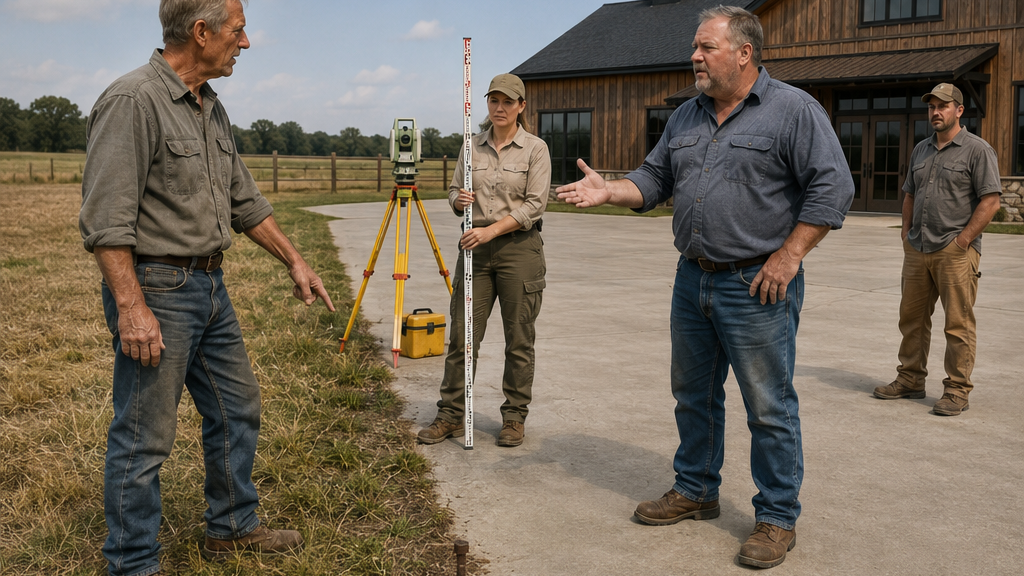
Nicole found the roadside iron pin, checked it, then disappeared toward the back fence with an assistant from her crew. She returned twenty minutes later and set the instrument in the grass.
Scott watched her work.
He had imagined the survey would feel dramatic. It did not. There were no arguments, no declarations. Just measurements, quiet numbers and repeated checks.
That made Raymond restless.
“How long does this take?”
“As long as it takes to be right,” Nicole said.
Scott hid the beginning of a smile.
Nicole moved toward the entrance with a measuring rod.
She paused near the western edge of the new concrete.
Then she stepped onto the slab.
Raymond’s face changed.
Nicole lowered the rod onto the concrete itself.
Scott looked from the rod to the old iron pin.
“How far?” he asked.
Nicole did not answer immediately.
She checked the instrument again.
Then she moved the rod farther onto the slab.
Chapter 3: The Survey Proved Scott Right and Made Things Worse
Nicole drove the first fluorescent stake into Scott’s grass six inches from the new concrete.
The second stake landed beside the slab.
The third required no grass at all.
She marked the point directly on the concrete with bright paint.
Raymond stared at it.
Scott did too.
Nicole walked another ten feet toward the barn entrance and made a second painted mark on the slab.
Then another.
The marks formed a straight fluorescent line that did something Scott’s memory never could.
They made the invisible boundary visible.
Raymond finally spoke.
“How much?”
Nicole checked her notes.
“The concrete crosses the property line.”
“I can see that.”
“At the widest point, about sixteen inches.”
Raymond looked at Scott.
Scott said nothing.
Nicole continued. “The encroachment runs a little over twenty feet along the western edge.”
The words landed differently than Scott expected.
For four days he had imagined being proven right would feel like relief.
Instead he looked at the entrance and saw how difficult sixteen inches of cured reinforced concrete would be to remove.
Raymond squatted beside one of the painted marks.
“That can’t be right.”
Nicole did not react.
“The rear monument and roadside monument fit the recorded plat within normal tolerance.”
“My father used this strip.”
“I’m not addressing historic use.”
“We’ve driven over it for decades.”
“That may matter to an attorney. It doesn’t change where the surveyed record line falls.”
Raymond stood.
“So he owns sixteen inches of my entrance.”
Nicole corrected him gently.
“Your entrance occupies approximately sixteen inches of his parcel at the widest point.”
Scott almost wished she had phrased it less precisely.
Raymond looked at him.
There it was—the moment Scott had expected to want.
He could have repeated Raymond’s challenge.
Prove it.
He could have pointed at the fluorescent line and let the silence do the rest.
Instead he said, “I wanted you to stop before it cured.”
Raymond’s jaw tightened.
“You wanted to be right.”
“No.”
“You paid four hundred dollars to measure grass.”
Scott felt heat climb his neck.
“I paid because you kept pouring.”
Nicole stepped away from them and began packing one of her tools.
“The sketch will give you both the measurements,” she said. “I’ll email it.”
Raymond walked toward the barn without answering.
Scott watched him go.
Nicole remained by the road.
“You got what you hired me for,” she said.
“Doesn’t feel like it.”
“It rarely does in boundary disputes.”
Scott looked down at the paint.
The line cut cleanly across the slab.
“What happens now?”
“That’s not really a surveying question.”
“I know.”
She picked up her field notebook but did not leave.
“Before you decide anything, I want to check one other record.”
Scott looked at her.
“What record?”
Nicole pointed toward the shallow ditch running along the county road.
“Did anybody review the drainage easement before this entrance was widened?”
Scott frowned.
“What drainage easement?”
Nicole studied him.
“That answers my question.”
Raymond had disappeared inside the barn.
Scott lowered his voice anyway.
“There’s an easement here?”
“There appears to be one on the plat. I noticed the notation when I pulled the parcel documents, but I was focused on the boundary first.”
“What kind?”
“I need the recorded instrument before I tell you.”
Scott looked at the concrete.
The apron sat slightly higher than the grass on his side. Kevin’s crew had shaped it to shed water toward the road, with a new compacted shoulder pressed against the western edge.
Scott had seen drainage easements before. Usually they appeared as pale lines on old maps that nobody thought much about until someone wanted to build.
“How wide?”
“I don’t know yet.”
“Does the concrete sit in it?”
Nicole paused.
“Possibly.”
That one word changed the afternoon.
The boundary question had been simple. Wrong side. Right side. Sixteen inches.
A drainage easement was different.
It meant purpose.
Scott followed Nicole into town the next morning.
The county records office occupied the ground floor of an aging brick building behind the courthouse. A clerk helped them pull an older plat and a separate recorded drainage instrument tied to several parcels along the road.
The paper looked ordinary enough.
Scott leaned over it while Nicole traced a narrow band with one finger.
“There.”
A corridor ran parallel to the roadside before angling across the corners of both properties.
Scott recognized the shape immediately.
It followed the low ground.
His father had always kept that strip free of hay bales, parked machinery and fill dirt. When Scott was young, he had assumed it was simply because water gathered there after hard rain.
Nicole read the description twice.
“This restricts permanent improvements within the drainage corridor unless they maintain the designed flow.”
Scott pointed at a measurement.
“Eighteen inches?”
“Clearance language from the defined line, yes, but I want the drainage technician to interpret exactly how the county applies it now.”
“And Raymond’s apron?”
Nicole looked at him.
“Part of it appears to occupy the corridor.”
Scott sat back.
For the first time, the argument over sixteen inches seemed almost small.
He remembered his father clearing branches from that roadside swale with a shovel after summer storms.
Never block water just because it looks dry today.
Scott had heard the sentence so many times as a boy that he had stopped thinking of it as advice.
Now he heard it clearly.
Nicole tapped another note on the document.
“This may also explain why the original entrance was narrower.”
Scott studied the old plat.
The former driveway mouth curved away from the low strip. Raymond’s new concrete had squared that curve and pushed directly over it.
“Could this affect his land too?”
“Yes.”
“The road?”
“Potentially.”
“My hayfield?”
“Yes.”
Scott rubbed a thumb across the edge of the paper.
He had come to town expecting a weapon.
Instead he had found a responsibility.
Nicole watched him.
“You should talk to the county drainage technician before you send demands to anybody.”
Scott nodded.
That afternoon he printed the boundary sketch and carried it across to Raymond’s barn.
Raymond was fastening trim near the side entrance when Scott approached.
“I’ve got the survey.”
“I know what it says.”
“There’s something else.”
Raymond kept working.
Scott held out the plat.
Raymond finally looked down.
“What?”
“A recorded drainage corridor.”
That stopped him.
Scott pointed to the line.
“It runs under part of the new entrance.”
Raymond stared at the document for several seconds.
Then he shook his head.
“I had permits.”
“I’m not saying you didn’t.”
“Kevin checked the county.”
“I’m telling you what the surveyor found.”
Raymond looked toward the apron.
“You think I’m tearing out concrete because of another line on another piece of paper?”
“I think we should find out what the line means before either of us decides anything.”
Raymond’s face hardened again, but the certainty from Monday was gone.
Scott folded the plat.
He could have pressed harder.
Instead he said, “I’m going to the drainage office tomorrow.”
Raymond gave no answer.
Scott walked back toward his farm.
At the roadside, the fluorescent survey paint glowed against the gray slab.
The ownership line stopped at the concrete.
The drainage line on the plat did not.
It continued beneath Raymond’s entrance, across the low ground, and toward both farms.
Chapter 4: Scott’s Old Silence Became Raymond’s Best Defense
Raymond was waiting at Scott’s kitchen door two mornings later with a manila envelope tucked under one arm.
He did not knock.
He stood on the porch until Scott looked up from the coffee pot and saw him through the glass.
When Scott opened the door, Raymond held out the envelope.
“You ought to see these before you go filing anything.”
Scott looked at the envelope, then at Raymond.
“Come in.”
Raymond stepped inside but did not remove his cap.
Scott cleared a space on the kitchen table between a seed catalog and the printed survey sketch. Raymond sat across from him and emptied the envelope.
Photographs slid onto the wood.
Scott recognized the first one immediately.
His father was standing beside an older combine, one hand raised toward Raymond’s father, who was easing the machine through the entrance between the two properties. The photograph had been taken at least twenty years earlier. The combine’s rear tire rode well onto Scott’s side of the present survey line.
The second picture showed a loaded hay wagon making the same turn.
The third showed Raymond himself, younger and thinner, backing a stock trailer over the strip.
Scott picked it up.
“When was this?”
“Eleven years ago.”
Scott remembered.
A washed-out culvert had narrowed Raymond’s usual approach during harvest. Scott had moved a few fence posts and told him to swing wide until repairs were done.
Raymond tapped the photograph.
“You knew.”
“I knew you crossed.”
“And you let me.”
“Yes.”
Raymond spread both hands. “Then why are we pretending I stole something?”
Scott leaned back.
“Because driving over ground isn’t the same as pouring concrete on it.”
“You never said that.”
“I didn’t think I had to.”
“That’s convenient.”
Scott looked at him sharply.
Raymond did not flinch.
“I’m serious. Every time we needed that corner, you said fine. Your dad did too.”
Scott looked back at the photographs.
There was no fence line. No paint. No sign. No stake taller than the grass.
In every picture, the boundary existed only in memory.
He could hear his own voice from years earlier.
Use what you need during harvest.
He had said it to Raymond’s father.
More than once.
The memory arrived with an uncomfortable precision.
He had never added, But don’t ever build there.
He had assumed no one would.
Raymond tapped another photograph. “You can’t act like this came out of nowhere.”
“It didn’t.”
Raymond seemed surprised by the admission.
Scott continued. “But temporary use doesn’t transfer ownership.”
“I’m not claiming ownership.”
“You poured an entrance over it.”
“Because I thought that strip was effectively shared.”
Scott gave a humorless laugh. “There is no ‘effectively shared’ on a recorded parcel.”
“There was for thirty years.”
The words sat between them.
Scott could have ended the conversation with the survey.
The line was the line.
But the photographs had done what Raymond intended. They had broken the easy version of the story.
Scott was right about the property.
Raymond was not entirely dishonest about how he had come to believe the edge was flexible.
Scott slid the photos into a neat stack.
“You should’ve asked before making something permanent.”
Raymond’s expression hardened. “And you should’ve told me before I paid Kevin to pour it.”
“I did.”
“On the morning the truck was sitting there loaded.”
“That was when I saw it.”
“You’ve watched the grading for weeks.”
Scott had no answer ready.
He had seen equipment near the entrance. He had assumed Raymond was improving his own side. He had not walked over. He had not asked for the plans.
Because that would have felt nosy.
Because neighborly peace had always depended on leaving some things unsaid.
Scott suddenly hated how noble that had once sounded.
Raymond stood.
“I’ve got events booked. Deposits paid. Vendors lined up. I can’t redesign that entrance every time you remember a rule.”
“The drainage issue isn’t my rule.”
Raymond looked away.
“You’ve actually talked to the county?”
“Not yet.”
Raymond’s eyes came back to him. “Then don’t.”
Scott said nothing.
“I mean it, Scott. Let us look at it first.”
“Who’s us?”
“Me and Kevin.”
“The surveyor already found the record.”
“A record doesn’t mean the county cares.”
“And if they do?”
Raymond pressed his lips together.
For the first time, the financial pressure showed plainly.
“This barn has to work.”
Scott glanced through the kitchen window toward the distant roofline of Raymond’s renovated building.
“I know.”
“No, you don’t.”
Raymond’s voice stayed low.
“I borrowed against the north forty. We’ve got three weekends booked this month. If they shut access down now, I’m refunding money I don’t have.”
Scott felt his anger shift, not disappear.
“You should’ve checked first.”
“I thought I had.”
Raymond gathered the photographs but left one on the table.
It showed the two fathers beside the old entrance, both smiling, a wagon wheel deep into Scott’s side.
Raymond looked at it.
“So did they.”
He left.
Scott stood alone in the kitchen.
The photograph remained on the table.
By noon, dark clouds had gathered west of the county road.
Scott spent the afternoon moving cattle from the lower pasture and clearing loose hay from a ditch inlet. The air smelled metallic before the first drops fell.
Rain came hard after dusk.
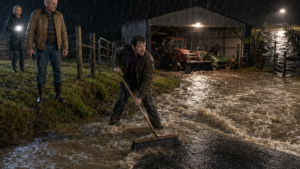
Not a steady fall—a pounding September storm that flattened grass and hammered the barn roof so loudly Scott could barely hear the radio.
At ten, water was already running down the lane.
Scott pulled on boots and a raincoat.
He told himself he was checking the cattle.
Instead he drove toward the boundary.
His headlights swept across the new concrete entrance.
Water sheeted over it.
For a moment, nothing looked unusual.
Then Scott saw where the flow went.
The apron’s raised western shoulder pushed the runoff away from the old low channel.
Water curled along the fluorescent survey line, spilled into Scott’s grass, and began moving toward the hayfield instead of the roadside ditch.
Scott got out into the rain.
The orange paint had almost disappeared beneath muddy water.
He followed the flow with his flashlight.
It spread wider with every yard.
Behind him, across the boundary, water was beginning to collect against Raymond’s new gravel approach too.
Scott stood ankle-deep in the low strip and watched the drainage line from the county plat become visible in the only way that mattered.
Not as ink.
As water.
Chapter 5: One Night of Rain Changed What Sixteen Inches Meant
By daylight, the lower hayfield had a pond in it.
Scott stopped the pickup at the edge and stared through the windshield.
The field had taken hard rain before. Water collected in shallow pockets, then moved toward the roadside swale and disappeared.
This was different.
A sheet of brown water stretched across the low end, bending the cut stems beneath it. The nearest windrow floated apart in loose pieces.
Scott got out with his phone.
He photographed the waterline against fence posts, the blocked swale, the concrete entrance and the muddy flow running along its western shoulder.
Then he walked the route himself.
The fluorescent paint Nicole had sprayed was barely visible under the standing water.
Scott crouched and pushed a stick into the grass.
Water moved slowly around it, searching for somewhere to go.
A pickup door slammed behind him.
Raymond crossed the road in rubber boots.
Neither man spoke at first.
Raymond looked at the hayfield.
Scott looked toward Raymond’s barn.
Water had collected there too.
The new gravel approach was darker in one long band, and a shallow pool sat near the lower corner of the parking area.
Raymond shoved his hands into his jacket pockets.
“How bad?”
“Won’t know until it drains.”
“My east approach is holding water.”
“I saw.”
Raymond looked at the concrete.
“You think that caused all this?”
“I think it changed something.”
“That’s not the same thing.”
“No.”
Raymond glanced at him.
Scott lifted his phone.
“I’m documenting it. Not saying more than I know.”
The restraint cost him something.
A week earlier, he might have wanted to say, I told you so.
Now the standing water made that feel childish.
Raymond walked to the edge of the slab and studied the western shoulder Kevin’s crew had compacted.
“What did the drainage paper actually say?”
“Permanent improvements can’t interfere with the corridor.”
“Does it say this interferes?”
“Not in those words.”
Raymond nodded once, almost grateful.
Scott added, “That’s why I’m having the county look.”
Raymond’s face closed.
“Scott.”
“I’m not accusing you of flooding me. I want to know what the grade was supposed to do.”
“I told you what happens if they put a stop on this place.”
“And what happens if the next storm is bigger?”
Raymond had no answer.
A truck slowed on the county road, tires hissing over wet pavement, then passed.
Scott pointed toward the hayfield.
“That water used to go through here.”
Raymond followed his finger.
The old swale was easy to see now because the water itself outlined it. It came down from higher ground on Raymond’s side, crossed near the entrance, then bent along Scott’s field toward the county ditch.
The concrete apron occupied the narrowest part.
Raymond rubbed his forehead.
“My dad never said anything about an easement.”
“Mine didn’t either.”
“Then how were we supposed to know?”
Scott almost said, By checking.
But that would have made him a hypocrite.
He had inherited the same records Raymond had ignored. He had understood the land by habit, not paperwork.
“My father kept this open,” Scott said instead.
Raymond looked at him.
“He used to clean it every spring. Cut brush, dig silt out.”
“Mine too.”
That surprised Scott.
Raymond pointed toward the road.
“When I was a kid, Dad used to send me down with a shovel after storms. Said if the road ditch plugged, we’d have water all the way back to the machine shed.”
For the first time since the concrete truck arrived, they were remembering the same thing instead of arguing over different versions of it.
Scott looked at the pooled water.
“So they knew what the low strip did.”
“They probably didn’t know the legal name.”
“Maybe they didn’t need one.”
Raymond gave a tired breath.
The answer landed heavily between them.
Their fathers had protected the drainage by practice.
Scott and Raymond had inherited the practice, forgotten the reason, then argued over the paperwork after the physical system was already altered.
The county drainage technician came that afternoon.
Scott had called early and expected a visit later in the week, but the photographs prompted a faster look.
The technician walked the entrance with a level rod, studied the old plat Scott had printed, and took several measurements along the road ditch.
Raymond stayed for all of it.
Kevin arrived halfway through.
“What are we looking at?” Kevin asked.
The technician pointed toward the compacted shoulder.
“The original low path seems to have carried water west before joining the county ditch. Your fill raised this edge.”
Kevin crouched and examined it.
“We matched the entrance grade.”
“On the east side.”
“Yes.”
“But you changed the cross-flow here.”
Kevin stood.
“Can it be fixed without cutting concrete?”
The technician did not answer immediately.
“Maybe partially. I need the recorded dimensions and original drainage design.”
Raymond seized on the word.
“Partially?”
“I didn’t say it was compliant.”
Raymond fell silent.
Scott watched Kevin walk the slab.
The contractor no longer looked defensive. He looked like a man calculating labor.
By late afternoon, the water in Scott’s field had dropped only a few inches.
The technician left with copies of Nicole’s survey and promised a written assessment.
Raymond remained near the entrance.
“My Saturday event has eighty people.”
Scott looked at him.
“Next Saturday?”
“Yes.”
“You can still use your entrance.”
“For now.”
Scott heard the fear behind the words.
“I’m not trying to close your barn.”
“You may not have to try.”
Raymond kicked lightly at the gravel.
“I’ve got deposits I used to finish the bathrooms. The next three bookings pay the note.”
Scott considered that.
“Then fix the drainage before somebody makes you.”
Raymond gave him a sharp look.
“You make that sound cheap.”
“I didn’t.”
“Cutting that slab means rebuilding half the entrance.”
“Maybe.”
“You’re very comfortable saying maybe when it’s my money.”
Scott felt his temper stir.
“And you were comfortable pouring when it was my land.”
Raymond looked away.
The fragile understanding broke.
Scott regretted the sentence as soon as it left him, though not because it was false.
That evening, Scott organized the photographs by time and location.
He attached Nicole’s survey and the drainage record to an email draft for the county office.
Before sending it, he stared at the screen.
Once the county had everything formally, the dispute would stop belonging only to two neighbors.
Scott thought about Raymond’s booked events.
Then he thought about the water sitting where hay should have been.
His phone buzzed.
A text from Raymond.
Scott opened it.
I talked to Kevin. We’ll improve the shoulder and drainage. I’m not removing the entrance.
Scott read the message twice.
Then he looked at the unsent email.
The choice Raymond had avoided was now Scott’s.
He clicked Send.
Chapter 6: Scott Filed the Papers but Refused the Easy Revenge
The county clerk slid the complaint form back across the counter.
“You need to sign at the bottom.”
Scott already had the pen in his hand.
He looked through the glass doors toward the parking lot.
It was Friday morning.
Raymond’s next event was Saturday evening.
Scott knew because trucks had been delivering chairs and temporary fencing to the barn all week.
He signed.
The pen scratched louder than it should have.
The clerk gathered the form, survey sketch, drainage record and photographs.
“This goes to land use and drainage review.”
“What happens next?”
“They’ll determine whether there’s an actionable violation.”
“If there is?”
“You’ll receive notice. So will the adjoining owner.”
Scott nodded.
He could still have asked for the packet back.
The clerk stamped the top page.
The choice became official.
On the drive home, Scott passed Raymond’s entrance without slowing.
A white rental van sat near the barn. Two workers were carrying tables inside.
The concrete looked ordinary.
That remained the strangest part.
Nothing about sixteen inches of gray slab suggested county files, standing water, borrowed money or two families’ habits stretching back decades.
Three days later, the notice came by email.
The county’s preliminary assessment stated that the expanded apron and fill appeared to interfere with the recorded drainage corridor. Additional work within the corridor was to stop pending remediation. The county requested a corrective plan within sixty days.
It also noted that continuing noncompliance could trigger civil penalties.
Scott read the paragraph twice.
He had wanted validation.
Now that he had it, the possibilities felt larger than the problem he wanted solved.
He called the drainage technician.
“I don’t want his business shut down.”
“That isn’t what the notice says.”
“It says penalties.”
“If he ignores remediation.”
“What if he fixes it?”
“Then that’s the point.”
Scott rubbed his forehead.
“Does the whole slab have to come out?”
“That depends on the corrective design. But the encroaching edge and the grade are the main issue.”
Scott looked across his field toward Raymond’s barn.
“So there’s a smaller fix.”
“There may be.”
“Can you put that in writing?”
“We can approve a compliant plan. We don’t design it for him.”
That distinction mattered.
It meant Scott did not have to choose between surrender and destruction.
He could ask for exactly what needed correcting.
No more.
Kevin called before Raymond did.
Scott was greasing the loader when his phone rang.
“Scott, it’s Kevin Brown.”
“I know.”
A pause.
“I got a copy of the county notice.”
Scott wiped his hand on a rag.
“All right.”
“I want to talk about a correction.”
“Talk.”
Kevin exhaled.
“If we saw-cut the western edge back to the survey line, remove the raised shoulder, and regrade the swale, I think we can keep most of the entrance.”
“You think?”
“I talked to the drainage technician.”
That caught Scott’s attention.
“And?”
“They won’t promise approval until they see elevations, but yes. It looks workable.”
Scott leaned against the loader tire.
“What about the width?”
“It loses some.”
“How much?”
“Enough that Raymond won’t like it.”
Scott almost smiled.
He did not.
“Then it sounds like Raymond has a decision.”
Kevin was quiet for a moment.
“I should’ve stopped Friday.”
Scott looked toward the road.
“You had a loaded truck and a customer telling you to keep pouring.”
“Still should’ve stopped.”
There was no point punishing a man who had already reached the correct conclusion.
“Fix it right,” Scott said.
“That’s what I’m trying to do.”
Raymond appeared at Scott’s barn the following morning.
He looked exhausted.
Not defeated.
That would have been easier.
Just tired.
“I talked to Kevin.”
Scott nodded.
“He says you can save most of the entrance.”
“He says the county might approve that.”
Raymond leaned against a fence post.
“What do you want?”
“The concrete off my parcel. The drainage restored. County signs off.”
“That’s it?”
Scott studied him.
“What else would I want?”
Raymond gave a short laugh.
“I don’t know anymore.”
He pulled a folded estimate from his pocket.
“Cutting, hauling, regrading, resealing. It’s not nothing.”
Scott did not reach for the paper.
Raymond unfolded it anyway.
“I’ll split it.”
“No.”
Raymond looked up.
“Scott, you admitted we used that strip for years.”
“We drove over it.”
“And you never marked it.”
“That part is on me.”
“Then split it.”
Scott shook his head.
“My silence helped create the misunderstanding. It didn’t tell you to pour after I asked you to stop.”
Raymond’s jaw worked.
“You’re saying you share blame but none of the cost.”
“I’m saying I’ll pay to survey and permanently mark the line. I’ll pay my share if we need a recorded agreement for temporary equipment access in the future.”
Raymond stared at him.
“But the concrete correction is yours.”
“That convenient distinction again.”
“No. It’s the distinction I should’ve made fifteen years ago.”
Raymond looked toward the entrance.
Scott let the silence remain.
He had spent years filling silence with concessions because he feared what directness might damage.
Now he understood silence could damage things too.
Finally Raymond said, “What happens to the complaint?”
“When the county signs off, I tell them the property issue is resolved.”
“And the legal side?”
“I haven’t filed anything beyond the county complaint.”
Raymond looked surprised.
“You talked about attorneys.”
“I consulted one.”
“You could push this farther.”
“I could.”
Raymond studied him.
“Why aren’t you?”
Scott folded the rag in his hands.
“Because I want my land back. I don’t want your barn.”
Raymond’s eyes dropped.
For several seconds neither man spoke.
Then Scott added, “Kevin cuts it back to Nicole’s line. He restores the drainage grade to what the county approves. You cover the work. I mark the property line properly and sign a written temporary-access agreement for farm equipment if we both want one.”
Raymond looked at him again.
“No permanent use.”
“No.”
“No implied right because a trailer crosses.”
“No.”
“And when it’s fixed, you withdraw your complaint.”
“When the county signs off.”
Raymond folded the estimate.
He did not offer his hand.
Neither did Scott.
“I’ll talk to Kevin.”
He started toward his truck, then stopped.
“You should’ve told me years ago.”
Scott felt the old instinct to defend himself.
Instead he said, “Yes.”
Raymond waited.
Scott continued.
“And you should’ve stopped the pour.”
Raymond looked toward the road.
“Yes.”
He walked away.
That afternoon Kevin called again.
“We can start Thursday.”
Scott looked across the hayfield toward the gray entrance.
“Thursday works.”
After the call ended, he walked down to the old rust-dark iron pin.
The fluorescent paint around it had faded from rain and tires.
Scott cleared the grass with his boot until the metal showed cleanly again.
For decades, the line had depended on people remembering what it meant.
On Thursday, a saw would make forgetting harder.
Chapter 7: The Saw Cut More Than Concrete Between Their Farms
The concrete saw started before sunrise.
Scott heard it from his kitchen while the coffee was still dripping.
The first burst came as a low mechanical growl, followed by the higher scream of the blade biting into cured concrete. A few seconds later it stopped.
Then started again.
Scott stood at the window with one hand around his mug.
Down by the county road, work lights cast a pale rectangle across Raymond’s entrance. Kevin’s truck sat on the shoulder. A small trailer held the saw, hoses, pry bars and a compact loader.
The sound carried farther than Scott expected.
He put on his boots.
By the time he reached the entrance, Kevin had already snapped a chalk line beside the fluorescent marks Nicole had left. Water ran over the blade to keep the dust down, turning the concrete slurry into a gray stream along the edge.
Raymond stood near the barn with his hands in his coat pockets.
He looked at Scott once.
“Morning.”
“Morning.”
That was all.
Kevin shut off the saw and walked over.
“I want both of you to see where we’re cutting before I go farther.”
He pointed to the line.
“This follows Nicole’s boundary, then we remove the shoulder here and regrade the drainage strip. County wants the cross-flow restored before we reseal.”
Scott looked down.
The planned cut took away only a narrow section of concrete, but from this angle the loss was obvious. The smooth, generous sweep Raymond had paid for would become tighter on the western side.
“Truck still makes it?” Scott asked.
Kevin nodded. “Straight trucks, yes. Longer trailers have to set up wider from the road.”
Raymond said, “Which means they may cross the centerline.”
“Depends on the driver.”
“That’s why I widened it.”
Kevin did not answer.
Scott understood Raymond’s frustration.
The entrance had not been widened for vanity. The extra width had solved a real problem. The mistake was where Raymond had chosen to solve it.
Kevin looked at Scott.
“You’re satisfied with this line?”
“If Nicole verifies it.”
“She’s coming after lunch.”
Raymond shifted his weight.
“And after that?”
Scott knew what he meant.
“The complaint?”
“Yes.”
“When the drainage is restored and the county signs off, I tell them the property portion is settled.”
Raymond watched him carefully.
“You really will?”
Scott frowned. “I said I would.”
“You also could keep pushing.”
“I could.”
Raymond looked toward the saw.
The blade was positioned directly over the line he had once told Scott to prove.
Scott saw that recognition pass across his face.
Raymond said, “And you’re not going to?”
“No.”
“Why?”
Scott looked at the wet chalk line.
“Because the point wasn’t to make you lose.”
Raymond gave a dry laugh. “Doesn’t feel much like winning from here.”
“It isn’t supposed to.”
Kevin stepped away, giving them space without making a show of it.
Scott took another sip of coffee.
“I should’ve marked the boundary years ago.”
Raymond looked at him.
Scott continued before he could retreat into habit.
“I should’ve put temporary access in writing. I should’ve told you that swinging a wagon across the corner didn’t mean permanent use.”
Raymond said nothing.
“I relied on you understanding what I meant.”
“You relied on me reading your mind.”
“Pretty much.”
That earned the smallest change in Raymond’s expression.
Not a smile.
But something close to one.
Scott nodded toward the entrance.
“You still should’ve stopped when I asked.”
“I know.”
There was no argument attached to it this time.
Kevin started the saw again.
The blade entered the concrete directly over the fluorescent line.
Water sprayed.
The cut moved slowly toward the road, loud enough to end the conversation.
Scott watched the blade follow a boundary that had existed for decades without either man needing to see it.
Now the line appeared as a dark groove.
A physical separation.
But not a fence.
By midmorning, Kevin’s crew had cut the entire encroaching strip into manageable sections. The compact loader lifted the broken pieces one by one and placed them into a dump trailer.
Raymond stood near the barn as the first piece came free.
Scott expected the sight to satisfy him.
Instead it reminded him how avoidable the whole thing had been.
The crew stripped away compacted fill beside the slab and exposed darker soil underneath. Kevin used a laser level while another worker shaped a shallow channel through the restored strip.
By noon, water from a hose poured along the upper edge.
This time it crossed the entrance area, followed the old low ground and entered the roadside ditch without backing toward Scott’s field.
Kevin watched it for several minutes.
“That’s better.”
Raymond crouched near the channel.
“It looks like nothing.”
Scott understood exactly what he meant.
The drainage corridor did not look important when it worked.
Only when it failed.
Nicole arrived shortly after one.
She set up her instrument near the rust-dark iron pin and checked the cut edge at several points.
Scott and Raymond waited beside the road.
Nicole finally straightened.
“The concrete is clear of Scott’s parcel.”
Raymond exhaled.
“And the grade?”
“Boundary is my part. County handles drainage approval.”
Kevin held up his phone. “Technician’s on the way.”
Nicole packed the rod.
Scott stopped her.
“One more thing.”
She looked at him.
“I want permanent markers visible enough that nobody has to guess again.”
“We can set witness posts back from the actual monuments.”
“Do it.”
Raymond said, “Both ends?”
Scott looked at him.
“Both ends.”
Raymond nodded.
“And the equipment access?”
Scott had already discussed it with the attorney.
“I’ll have a simple agreement drafted. Temporary crossing for farm equipment when both sides consent. No permanent structures. No ownership claim created by use.”
Raymond considered that.
“So if I need to swing a long trailer through during harvest—”
“You ask.”
“And if you need my lane when your field entrance washes out?”
Scott paused.
The possibility had not occurred to him.
Then he nodded.
“Same rule.”
Something shifted there.
Not reconciliation exactly.
Clarity.
The county drainage technician arrived before three. He walked the regraded strip, checked the elevations and watched another hose test.
“The flow path is restored,” he said. “Once Kevin stabilizes the soil and files the final photos, I can close the remediation item.”
Raymond looked at Scott.
Scott gave a small nod.
Kevin began resealing the exposed concrete edge.
The new seam was darker than the rest of the apron, impossible to miss up close.
Late in the afternoon, the trucks pulled away.
Scott remained beside the road.
Raymond walked down from the barn carrying two temporary marker posts Nicole had left for placement.
He handed one to Scott.
“Where do you want it?”
Scott showed him.
Together they set the posts several feet back from the monuments, visible from the road but far enough away that a tractor would not clip them.
When they finished, Raymond stood beside the old iron pin.
“My dad would’ve laughed at us.”
Scott looked at the marker.
“Mine too.”
“Probably would’ve told us to get a shovel instead of hiring half the county.”
Scott almost laughed.
“Maybe.”
Raymond brushed dirt from his gloves.
“You going to miss those sixteen inches?”
Scott looked across the restored strip.
“No.”
Raymond waited.
Scott added, “I was never fighting for sixteen inches.”
Raymond nodded slowly.
“I know that now.”
The sunlight had dropped low enough to catch the fresh seam along the entrance.
The cut line was straight, visible and final.
Beyond it, the drainage strip remained open.
Beyond that, Scott’s hayfield stretched toward the back fence.
Raymond started toward his barn, then stopped.
“Scott.”
“Yes?”
“Next spring, if that lower culvert gives you trouble, call me before you bring a backhoe through my side.”
Scott looked at him.
“I will.”
Raymond nodded.
Then he walked away.
Scott stayed by the entrance until the last work truck disappeared over the hill.
For years, he had thought being a good neighbor meant leaving room for things to remain unsaid.
The line in front of him suggested something different.
A clear boundary did not have to end cooperation.
Sometimes it was what made cooperation possible.
He bent down and brushed the remaining dried concrete dust away from the rust-dark survey pin.
Then he stood and followed the new seam with his eyes from the road to the grass.
Nothing had been taken from Raymond except what never belonged there permanently.
Nothing had been added to Scott except a line both men could finally see.
The story has ended.