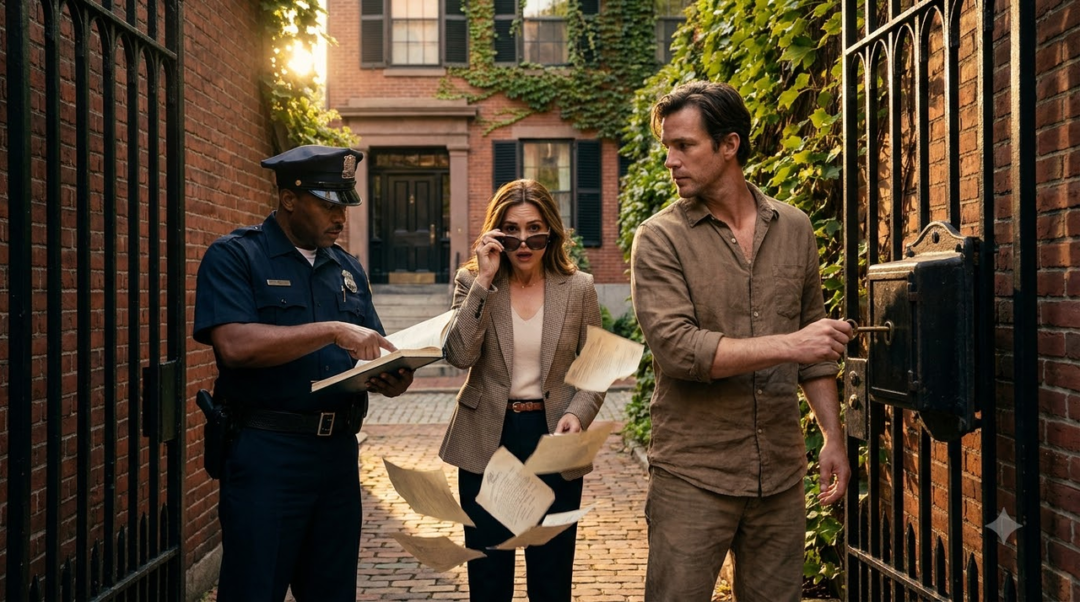
The Brass Master Key In The Historic Brownstone Courtyard Alley
CHAPTER 1: THE COBBLESTONE CONFRONTATION
The October sun cut across the narrow chimneys of Beacon Hill at a sharp, golden angle, casting the elongated shadows of 19th-century wrought-iron gas lamps across Blackwood Alley. Tucked behind the boutique-lined bustle of Charles Street, the alley was a hidden corridor paved with uneven, water-smoothed cobblestones that had settled into the Boston loam over two centuries. At the end of the corridor, framed by hand-laid Flemish-bond red brick and draped in dying Boston ivy, stood the private garden courtyard of Number 14—a four-story Federal-style brownstone with black louvered shutters and fluted stone lintels.
Alistair Sterling stepped quietly over the granite threshold of the alley. At forty years old, he possessed the calm, measured gait of an architect who spent more time in construction tunnels and sub-basements than in polished corporate boardrooms. He wore a heavy, unbuttoned work shirt of dust-gray linen over a faded cotton henley, sturdy canvas work trousers tucked into scuffed leather boots, and a worn leather tool pouch at his hip. Tucked firmly beneath his left arm was a heavy black architectural tube bound in water-resistant Cordura, containing rolled municipal survey maps and structural elevation schematics. In his calloused right hand, he held a single, antique brass key—heavy, five inches long, with an intricate six-bit barrel and a burnished teardrop bow that had been turned in Boston locks for over a hundred years.
He paused before the heavy, eight-foot wrought-iron gate that guarded the entrance to the courtyard. The ironwork was exquisite—hand-forged acanthus leaves and twisted finials from the 1880s—though a thick layer of industrial polyurethane enamel had recently been sloppily brushed over the vintage hinges. Alistair lifted his brass key toward the central mortise lock embedded in the brick gatepost.
The heavy plate-glass door of the ground-floor commercial storefront swung violently outward with an abrasive shudder that echoed off the brick walls.
“Excuse me! Hey! Step away from that gate right now!”
Out onto the cobblestones strode Camille Dupont. At thirty-five, she was the sole proprietor of Maison Dupont, a self-styled haute couture and custom bridal salon that occupied the garden-level retail space of the brownstone. She was dressed in an extravagant houndstooth tweed cape with a fox-fur collar, tight black designer trousers, and four-inch Italian leather stilettos that clicked sharply against the uneven cobblestones. Oversized tortoiseshell designer sunglasses concealed her eyes, and a silk scarf fluttered around her throat as she closed the distance between them with aggressive, theatrical indignation.
Behind her, through the pristine display windows of her boutique, gilded mannequins draped in imported silk gowns stood beneath crystal chandeliers, while two nervous junior sales associates watched through the glass with wide eyes.
“Can you not read English?” Camille demanded, her voice shrill, nasal, and dripping with condescension as she planted her heels on the cobblestones six inches from Alistair. She pointed a manicured crimson fingernail at a custom brass placard she had illegally affixed to the historic ironwork: PRIVATE VIP COURTYARD – RESERVED EXCLUSIVELY FOR CLIENTS OF MAISON DUPONT – TRESPASSERS WILL BE PROSECUTED.
Alistair didn’t flinch. He didn’t take a step back. He stood with his shoulders relaxed, his blue-gray eyes studying the modern drywall screws she had drilled directly into the landmarked 1840 masonry to hang her vanity sign.
“Good afternoon,” Alistair said, his voice low, steady, and entirely devoid of irritation. “I’m conducting an exterior structural survey of the parcel foundation. I need access through the gate.”
“I don’t give a damn what you’re surveying!” Camille snapped, her voice carrying down the alleyway and drawing the curious glances of passersby on Charles Street. “This courtyard is strictly for my high-profile clientele who pay ten thousand dollars a dress for privacy and champagne service! It is not a staging ground for manual laborers in filthy clothes! Take your construction junk and your dirty boots around to the trash alley on Pinckney Street where you belong!”
Before Alistair could reply, Camille lunged forward. With a swift, practiced jerk of her arm, she snatched the heavy black architectural blueprint tube from beneath his elbow.
“Hey—” Alistair began, his brow furrowing.
“I said get out!” Camille shrieked. With a vicious, dismissive swing of her arm, she threw the heavy blueprint tube directly down onto the historic cobblestones.
The hard plastic end-cap shattered upon impact with a hollow, violent crack. The tube skidded across the damp stones, and three large rolls of architectural vellum and notarized legal deeds spilled out into the gutter, unrolling against the wet moss. Visible across the thick linen paper were embossed gold municipal notary seals, red certified survey stamps, and the official eagle crest of the Suffolk County Registry of Deeds.
“There’s your junk!” Camille sneered, adjusting her tweed cape with a satisfied toss of her hair. “Now get off my property before I have you thrown in a holding cell!”
She whipped her head toward the entrance of Blackwood Alley, where a uniformed municipal officer in a navy jacket and duty belt was walking his afternoon patrol beat.
“Officer! Officer, come here immediately!” Camille called out, waving her hand frantically in the air.
Officer Thomas Drake, a veteran forty-eight-year-old municipal code enforcement inspector assigned to the Beacon Hill Historic District, turned into the alley. He walked with measured, professional deliberate steps, his eyes sweeping over the shattered blueprint tube, the unrolled deeds in the damp cobblestones, and the tense confrontation before the iron gate.
“What seems to be the problem here, Ms. Dupont?” Officer Drake asked, his tone neutral but weary, having dealt with Camille’s frequent territorial complaints against delivery couriers and city street cleaners in the past.
“This vagrant contractor tried to pick the lock on my private courtyard gate!” Camille claimed, pointing an accusing finger at Alistair’s chest. “He refused to identify himself, he trespassed on my leased commercial curtilage, and when I told him to leave, he became menacing and tried to intimidate me! I want him cited for criminal trespassing and disorderly conduct immediately! I pay thirty thousand dollars a month in commercial taxes in this district, and I expect the city to protect my business from common street trash!”
Officer Drake turned his gaze to Alistair. His eyes took in the dusty linen shirt, the worn work trousers, and the quiet, unflinching composure of the man standing before him.
“Sir,” Drake said politely, “do you have business at this address?”
Alistair didn’t raise his voice. He didn’t offer a defense. Instead, he knelt down on the cobblestones, carefully picked up the rolled linen deeds, gently brushed the damp street dust from the parchment, and placed them neatly under his arm.
Then, he turned toward the brick wall directly beside the boutique’s private glass entrance.
Mounted flush into the Flemish-bond brickwork was an antique cast-iron utility box—an authentic 1890 landlord’s registry cabinet, painted matte black, secured by an intricate double-tumbler brass lock that had remained untouched for decades.
Alistair reached into his pocket and lifted the heavy, five-inch brass master key.
Camille let out a harsh, mocking laugh. “What are you doing, you idiot? That utility box has been welded shut since the nineteen-seventies! The previous landlord lost the key thirty years ago!”
Alistair ignored her. He aligned the intricate six-bit barrel with the heavy iron keyway and inserted the brass key. It slid into the antique lock with a smooth, perfectly machined fit. With a firm, effortless turn of his wrist, the heavy internal levers tripped with a deep, authoritative mechanical CLACK that resonated through the quiet brick courtyard like a muffled gunshot.
Camille’s mocking laugh died instantly in her throat. Her painted lips parted in sudden, disoriented silence.
Alistair pulled the heavy iron door of the box open on its oiled hinges.
Inside, protected from moisture by heavy rubber gaskets, was an engraved municipal master plate of solid brass, mounted above a leather-bound folio containing the official certified property registry. Alistair withdrew the top document—a crisp, gold-embossed Certificate of Title from the Land Court of the Commonwealth of Massachusetts, stamped and signed at 9:15 AM that very morning.
Alistair turned and presented the document directly to Officer Drake.
“Officer Drake,” Alistair said in a calm, clear voice that echoed through the alley. “Please verify the parcel deed. My name is Alistair Sterling, managing director of Sterling Heritage Holdings. At nine o’clock this morning, my firm completed the all-cash acquisition of the entire brownstone block, including Number Twelve, Fourteen, and Sixteen Blackwood Alley, together with all residential units, commercial retail spaces, and common courtyard easements.”
Officer Drake took the certified deed. He scanned the embossed municipal seals, the Land Court docket number, and the clear, unambiguous signature of the City Registrar. He looked from the document to the brass registry plate inside the open iron box, which read in crisp block letters: PROPERTY OF STERLING HERITAGE HOLDINGS – ALL COMMON AREAS RESTRICTED UNDER HISTORIC RESTORATION COVENANT.
Drake lowered the document, looked up at Alistair, and offered a respectful, formal nod. “Everything is in perfect order, Mr. Sterling. Welcome to Beacon Hill.”
Drake turned slowly toward Camille Dupont. His expression had hardened into an unyielding, professional mask. He reached down to his duty belt, unhooking his electronic municipal citation terminal.
“Ms. Dupont,” Officer Drake said, his voice flat and stern. “Mr. Sterling is the registered, deeded owner of this entire building and the sole legal proprietor of Blackwood Courtyard. Under Massachusetts General Laws Chapter 186, Section Fourteen, interfering with a landlord’s lawful inspection of common utility infrastructure is a serious statutory violation. Furthermore, throwing his property into the street constitutes disorderly conduct and criminal mischief. Would you like me to issue the citations right now, or would you prefer to step back into your shop?”
Camille stood frozen on the cobblestones. The color had fled from her face, leaving her cheeks the shade of cold chalk beneath her bronzer. Her hands, adorned with heavy gold rings, began to tremble uncontrollably as she slowly reached up and lowered her oversized tortoiseshell sunglasses, staring at the man in the dusty linen shirt in absolute, paralyzing horror.
She had just assaulted the personal property of the man who owned every square inch of the ground beneath her feet.
Alistair stepped forward, closing the heavy iron door of the utility box with a firm, solid thud. He looked down at Camille with a calm, unbothered gaze that chilled her to the marrow of her bones.
“By the way, Ms. Dupont,” Alistair said quietly, his tone as pleasant and indifferent as if he were discussing the weather. “I reviewed your commercial lease file during the closing this morning. Your previous five-year term expired eighteen months ago. You have been operating under an informal, unwritten month-to-month tenancy at the discretion of the owner.”
Alistair tucked the brass key back into his pocket.
“Your thirty-day notice of non-renewal was electronically filed with the Boston Housing Court at noon,” Alistair continued softly. “You have until Friday afternoon to vacate the premises and restore the common courtyard to its original historic condition.”
Camille gasped—a sharp, strangled intake of breath that sounded like she had been plunged into icy water. But before she could speak, Officer Drake bent down to hand Alistair the remaining vellum map from the cobblestones.
As Drake handed over the parchment, his eyes caught the bright crimson seal stamped across the bottom margin: an emergency structural hazard notification issued seventy-two hours earlier by the Boston Fire Department’s structural collapse unit, detailing an active, catastrophic foundation shift beneath the very cobblestones upon which they stood.