The Quick Set Concrete Curing Under the Red Coupe Axles
CHAPTER 1: TWELVE INCHES OF LIQUID STONE
The diesel exhaust of the hundred-ton Liebherr mobile crane hung heavy in the damp mountain air along Pennsylvania Route 144, mingling with the alkaline reek of raw portland cement. Below the sheer limestone face of Kettle Mountain, the two-lane state highway had been sheared in half by an early autumn washout. A fifty-foot trench cut straight across both asphalt lanes, descending twelve feet into a churn of fractured shale and rushing mountain runoff where an emergency crew from the United States Army Corps of Engineers was setting a massive reinforced culvert box.
Trooper Frank Calloway stood on the cold asphalt ten paces ahead of the first row of fluorescent orange reflection barrels. His high-visibility yellow vest was streaked with lime dust, his broad-brimmed campaign hat pulled low against the sharp river wind cutting off the West Branch Susquehanna. In his left hand, he held an octagonal aluminum stop paddle, its reflective face scuffed by flying gravel. In his right hand rested a heavy steel citation clipboard, the spring clip holding a thick stack of state summons forms.
Behind Calloway, two heavy three-axle batch trucks were emptying the last seven cubic yards of rapid-curing Type III hydraulic concrete into the roadbed. The slurry hissed like wet gravel as it tumbled from the vibrating steel chutes, thick and viscous as wet lead, spreading twelve inches deep between the freshly anchored steel screed rails. Two highway workers in rubber hip waders were guiding a vibrating truss screed across the surface, leveling the gray porridge into an unbroken, gleaming plain.
A sharp, high-pitched mechanical howl echoed up the winding mountain pass, cutting cleanly through the rumble of the diesel generators. It was the twin-turbo whine of an imported sports coupe taking the blind curves at three times the posted construction speed, downshifting aggressively as the exhaust barked against the hemlock-covered ravine walls.
Seconds later, a low-slung crimson coupe crested the ridge at fifty miles per hour, its wide performance tires skittering violently across the loose aggregate shoulder. The driver locked the ceramic brakes, the red coupe fishtailing before sliding to a violent halt less than two feet from the first row of reflective barrels. Dust and pulverized shale billowed over the pristine red paint.
The driver’s door popped open immediately. A young man stepped out onto the asphalt with theatrical arrogance. He appeared no older than twenty-six, dressed in an Italian silk bomber jacket, designer sunglasses with heavy gold rims, and immaculate white leather designer sneakers. His jaw was clenched tight with furious impatience, his dark eyes scanning the idling crane, the wet trench, and the barrier blocking the road.
“What in the hell is this circus?” the young man barked, marching directly toward Calloway with his chest thrust forward. “Move those barrels right now. I have a private twin-engine charter flight waiting for me at the State College airport, and wheels-up is in forty-five minutes.”
Calloway did not shift his stance by a single millimeter. His boots remained planted on the double yellow line. “Highway is closed to all civilian traffic, sir. Culvert replacement and emergency structural deck stabilization. Turn your vehicle around, head back down the grade, and take the Bald Eagle valley bypass.”
“Do you have any idea who you’re talking to, trooper?” The young man reached into his breast pocket with a dramatic flourish, pulling out an embossed leather card case. He flicked it open, displaying a gold-embossed municipal authority shield. “My name is Julian Vance. My uncle is Harlan Vance, Chief Deputy District Attorney for this entire judicial district. He signs off on your troop’s capital budget requests and reviews every felony prosecution in three counties. I don’t sit behind orange barrels for county ditch diggers.”
“Turn the car around, Mr. Vance,” Calloway said. His voice was level, flat as an iron plate, carrying neither anger nor hesitation. “The valley bypass will add twenty-five minutes to your trip. There is no passage through this cut.”
Julian’s face flushed a dark, mottled red, his composure fraying into shrill outrage. “I am not driving forty miles out of my way on backwoods gravel because some highway crew decided to pour mud on a Friday morning! My uncle will have your badge stripped and hung from the state capitol flagpole before your shift ends!”
Before Calloway could raise his stop paddle, Julian lunged forward with sudden, desperate speed. With a sharp snap of his wrists, he wrenched the heavy steel citation clipboard right out of Calloway’s grip. Julian spun toward the wooden barricade, cocked his arm, and hurled the metal clipboard sideways with all his strength.
The clipboard spun through the air, flashing in the gray daylight, and landed with a heavy, wet smack squarely in the center of a contractor’s wooden wheelbarrow filled with wet stone mortar. The clipboard sank instantly, grey slurry splashing across its steel clamp.
Julian kicked an orange traffic cone violently into the roadside ditch. “Go fetch your clipboard, highway cop! I’m driving through!”
Julian turned on his heel, sprinted back to the crimson coupe, and threw himself into the low leather bucket seat. The starter whined, and the twin-turbocharged engine roared to life with a concussive blast that rattled the plastic barrels. He slammed the gear selector into drive, whipped the steering wheel hard to the left, and punched the throttle, steering around the edge of the wooden barricade.
Calloway did not draw his sidearm. He did not chase the car. He calmly stepped three paces to his right, stepping up onto the dry concrete curb beside Major Dan Bradley, the Army Corps project engineer. Calloway reached up with his left hand, thumbed the button on his shoulder microphone, and keyed the radio channel.
“Troop F dispatch, this is Unit 412,” Calloway said into the mic. “I have a non-compliant civilian vehicle entering the hot pour zone at Milepost Nineteen.”
The red coupe surged forward, rear tires chirping loudly as they clawed for traction on the dry asphalt. Five yards past the barrels, the old pavement abruptly ended where the road crews had milled the deck down to bare shale. Julian aimed the car straight for what looked like a freshly smoothed, dark gray lane of newly paved highway.
The crimson coupe hit the wet slab at twenty-five miles per hour.
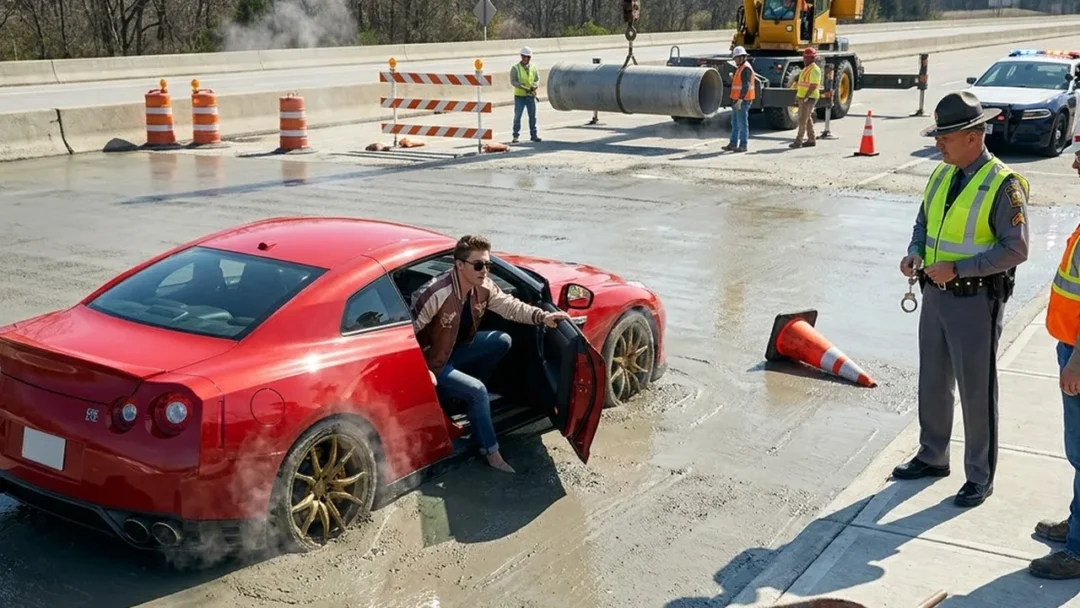
There was no screech of rubber. There was no skidding stop. Instead, a violent, sickening suction sound erupted from underneath the chassis. The low front carbon-fiber splitter plunged nose-first into twelve inches of dense, unhardened hydraulic concrete. A heavy wave of liquid cement crested over the crimson hood, splashing against the windshield in a thick, opaque gray sheet that blinded the cabin.
The coupe’s eighteen-inch forged alloy wheels vanished completely beneath the surface. The high-performance tires spun wildly, churning the heavy gray slurry into frothing rooster tails that sprayed across the red fiberglass fenders and undercarriage before bogging down completely. The transmission let out a mechanical shriek as the drive wheels bogged to a dead halt, the twin-turbo engine stalling out with a strangled gasp of white steam from the submerged exhaust tips.
Julian slammed his foot on the accelerator again, but the starter only clicked in useless protest. The crimson coupe sat stranded, axle-deep in eighty thousand pounds of wet industrial stone, dead center in the middle of the bridge deck.
Trooper Calloway lowered his shoulder microphone. Beside him, Major Bradley clicked his stopwatch, then checked the project manifest on his handheld tablet.
“Quick-cure Type III with three percent calcium chloride accelerator,” Bradley said dryly, watching the slurry begin to settle around the coupe’s gold brake calipers. “Ambient temperature fifty-eight degrees. That pour hits initial set in eighteen minutes.”
Calloway unhooked a pair of stainless-steel handcuffs from his duty belt. As he stepped along the edge of the dry concrete curb toward the sinking car, the crackle of a second siren rolled down the canyon road. A marked State Police cruiser appeared around the crest of the hill, emergency lights flashing blue and red, its dashboard computer already chiming with an urgent high-priority bulletin.