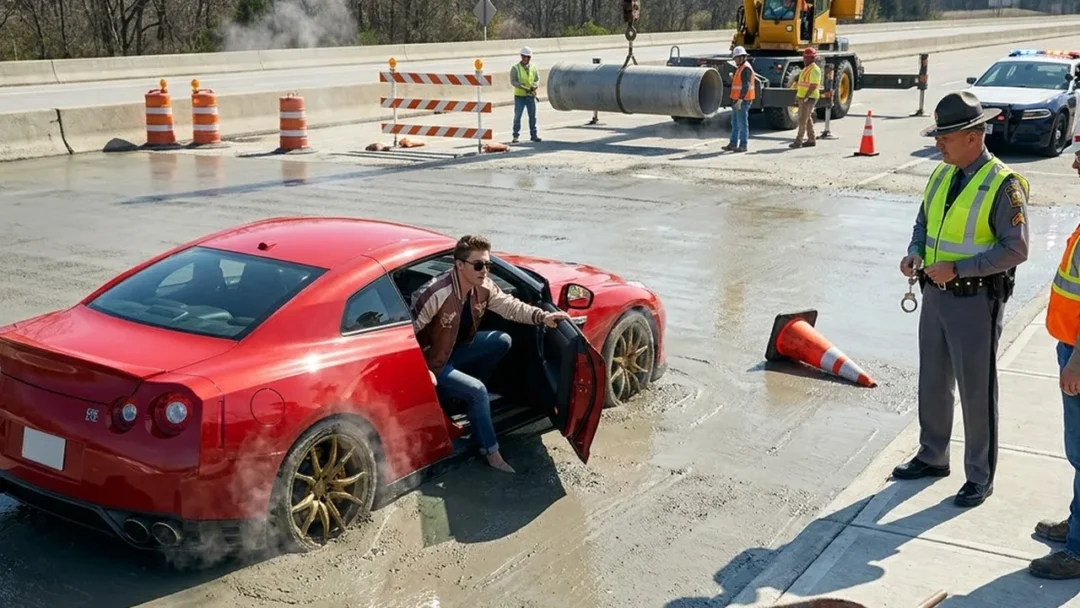
The Quick Set Concrete Curing Under the Red Coupe Axles
CHAPTER 5: THE THERMAL LOCK
Major Bradley stepped forward, holding an infrared thermal imaging camera. He pointed the high-resolution display screen directly toward Harlan Vance and the wrecker driver.
On the screen, the concrete deck glowed in violent shades of crimson and bright yellow. The digital temperature reading in the center of the slab was spiking: 142 degrees Fahrenheit.
“Take a look at the physics before you pull that winch cable, Counselor,” Bradley said, his voice flat and technical. “Rapid-cure Type III cement generates an intense exothermic reaction during crystallization. The hydration process produces massive thermal expansion. That concrete has already locked onto the aluminum suspension arms and the stainless-steel exhaust pipes. If your driver puts forty thousand pounds of hydraulic line pull on that frame right now, the tension won’t slide the car forward. It will shear the fuel tank against the subframe.”
Bradley pointed toward the undercarriage, where faint wisps of white chemical vapor were curling up around the coupe’s rocker panels.
“The fuel tank is molded polyethylene,” Bradley continued, taking a step closer. “The concrete is hot enough to soften the plastic. You put tensile torque on that chassis, you fracture the fuel line, and forty gallons of high-octane gasoline will spill directly onto six hundred square feet of curing concrete at a hundred and forty degrees. You won’t be towing a car to Bellefonte. You’ll be standing in front of an open-air magnesium and fuel fire that will vaporize everything inside that cabin.”
Harlan Vance froze. His eyes flickered toward the closed trunk of the crimson car. A heavy bead of sweat broke on his forehead, rolling down his temple despite the chilly river wind.
“Julian,” Harlan muttered under his breath, his hands trembling inside his coat pockets.
Behind them, seated in the back of Brennan’s cruiser with the rear window cracked, Julian Vance began kicking frantically against the heavy steel security screen.
“Uncle Harlan!” Julian shrieked through the glass, his voice cracking with hysteria. “Don’t let them cut into it! You told me the state would never look at the auxiliary accounts! You told me Croft had the filings sealed in the county archives!”
Harlan spun toward the cruiser, his fists clenching until his knuckles turned bloodless white. “Shut your mouth, Julian!”
Calloway looked at Captain Brennan. “The heat is rising inside that shell. If there are electronic storage devices or paper records in that trunk, the internal compartment temperature is going to exceed safe limits within the hour. We need to cool the hull and breach the lid.”
“Major Bradley, can we run a water line from your utility tanker?” Brennan asked.
“Already on it,” Bradley said. He signaled two of his Army Corps technicians waiting by the pump trailer. Within thirty seconds, the crew had rolled out a two-inch industrial fire hose connected to the project’s fresh water tender.
“Keep that water away from that vehicle!” Harlan shouted, trying to lunge toward the hose line. Deputy Collins reached out to assist him, but Calloway moved with blinding speed. He stepped into Collins’ path, his shoulder striking the deputy’s chest with immovable force, driving him back two paces onto the gravel shoulder.
“Deputy Collins, keep your hands off state equipment,” Calloway warned, his voice dead and dangerous. “You make one more aggressive move in this construction zone, and you will join Julian in the back of that cruiser.”
Collins swallowed hard, looking at Calloway’s steady eyes, then looked back at Harlan Vance. Collins stepped back, held up both palms, and allowed his hands to drop to his sides.
The Army Corps technician opened the brass nozzle. A wide, fine mist of chilled mountain water swept across the crimson roof and the setting concrete deck. Steam hissed violently into the air as the cold water hit the 140-degree stone, creating a thick white curtain of vapor that enveloped the trapped coupe like a cloud.
Underneath the red coupe, a sharp, hollow crack echoed through the stone. The concrete had achieved its final structural set. The crimson car was no longer sitting in liquid mud.
It was encased in three feet of solid, unyielding granite-hard rock.