The Quick Set Concrete Curing Under the Red Coupe Axles
CHAPTER 6: ULTRASONIC SIGNATURES
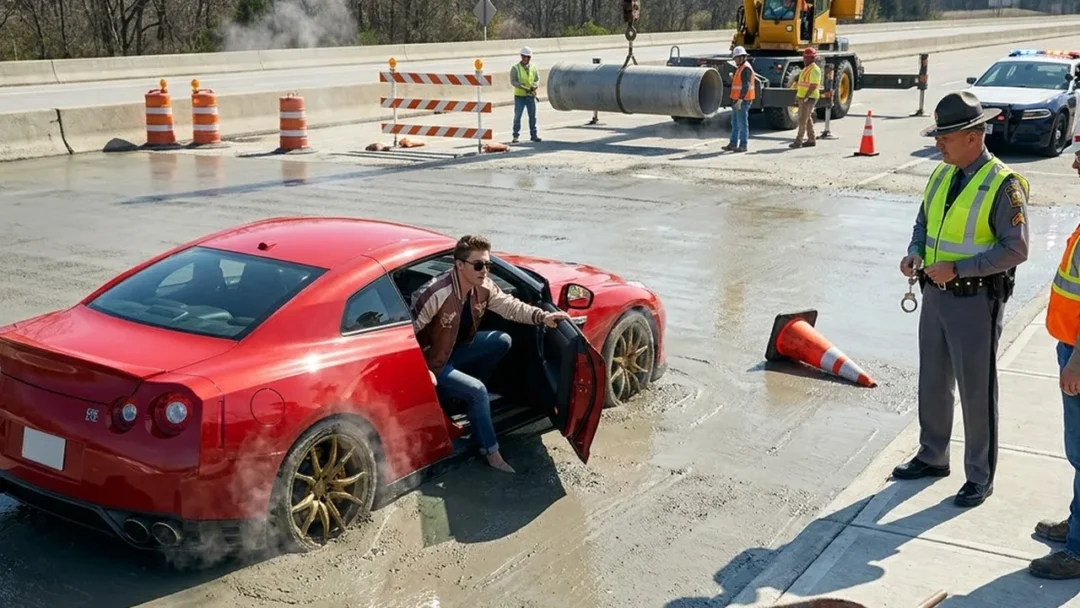
Twenty minutes later, a white mobile laboratory van bearing the blue keystone seal of the Pennsylvania Department of Transportation pulled through the outer perimeter barrels. Two forensic civil engineers stepped out, carrying heavy yellow pelican cases containing ultrasonic pulse velocity test equipment.
The rain from the gathering mountain storm had begun to fall in earnest now, a steady, cold drizzle that tapped against the patrol cruiser windshields and slicked the dark rock face of Kettle Mountain. Overhead, the crane operator swung the boom into a locked weather-vane position, securing the suspended culvert box until the structural deck could be cleared.
Major Bradley led the state engineers onto the wooden boardwalks laid across the hardened slab. One of the technicians pressed a pair of piezoelectric transducers against the cured gray concrete five inches from the coupe’s left rear tire. He triggered a high-frequency acoustic pulse, watching the digital oscilloscope trace a green wave across the screen.
“Pulse velocity is twenty-two hundred meters per second,” the technician announced, shaking his head in disbelief. “Standard Class AAA structural bridge concrete requires forty-five hundred. The compressive strength is barely twelve hundred PSI.”
“It’s crumbling from within,” Bradley said, taking the digital printout. “The calcium chloride accelerator forced a rapid surface set, but the matrix is contaminated with reactive aggregate. It’s expanding and cracking internally before the chemical cure is even complete.”
Bradley walked across the wooden boards, holding the printout directly in front of Harlan Vance’s face.
“Recognize this signature, Mr. Vance?” Bradley asked coldly. “This exact ultrasonic reading was taken three weeks ago from the bridge abutments on Interstate 80 at Milepost 174. The same high-velocity surface crust, the same internal crumbling. Four million dollars of state infrastructure money was paid to Blackwood Aggregate for high-durability river quartz. Instead, you and your nephew dumped unwashed quarry silt into the state batch plants and pocketed the difference through your offshore shell accounts.”
Harlan Vance’s jaw twitched, but he maintained his rigid, arrogant posture. “A material defect from an independent subcontractor is a civil contractual dispute. It has nothing to do with me or my office. You have no legal standing to inspect that vehicle without a judicial warrant from a competent jurisdiction.”
“Then it’s a good thing the wire came through,” Captain Brennan said, stepping out of his command vehicle holding a ruggedized tablet computer.
Brennan tapped the glass screen, displaying a signed, electronically authenticated search warrant issued ten minutes prior by Justice Eleanor Vance-Holloway of the Pennsylvania Supreme Court.
“Full authority to search, inventory, and seize all contents, electronic devices, and hidden compartments within the registered vehicle, VANCE-1,” Brennan read aloud. “Furthermore, the Supreme Court has issued an immediate order of recusal and suspension against County Judge Marcus Croft for conflict of interest and obstruction of justice.”
Harlan Vance stepped back, his back hitting the cold steel door of the Peterbilt wrecker. The paper folder in his hand slipped from his fingers, spilling its worthless county forms into the muddy gravel at his feet.
From down the road, another siren sounded. It was not a single cruiser. Two unmarked black Suburbans belonging to the Pennsylvania Attorney General’s Special Investigations Unit were climbing the pass, their blue emergency lights reflecting off the wet pavement like cutting blades.
“Frank,” Brennan nodded toward the trapped red car. “Open the trunk.”