The Quick Set Concrete Curing Under the Red Coupe Axles
CHAPTER 3: CORE SAMPLES AT MILEPOST NINETEEN
Major Bradley knelt beside the curb with a pneumatic core drill. The machine’s diamond-tipped steel barrel whirred with an ear-splitting shriek as it bit into the original asphalt roadway ten yards upstream from the wet pour. Water from a pressurized tank flushed white slurry across the roadbed, cooling the spinning cutting teeth.
Calloway stood guard at the perimeter. The wind from the river gorge was turning colder, carrying the sharp scent of ozone, damp moss, and wet pine. Down in the valley, thunder rumbled across the ridgeline like heavy artillery. The river level below the embankment had risen six inches in the last hour, its muddy brown current swirling aggressively around the project’s temporary timber shoring.
Bradley killed the drill motor, loosened the chuck, and extracted the cylindrical core sample with a pair of steel calipers. He held the six-inch plug up to the overcast daylight, examining the layered stone with a jeweler’s loupe.
“Look at this, Frank,” Bradley said, gesturing with the hardened tip of a pocket screwdriver.
Calloway stepped over. The cross-section of the road core was pitted with crumbly, porous pockets. Instead of a dense, homogenous matrix of crushed blue stone and cured paste, the cylinder was fragile and brittle. Bradley pressed his thumb firmly against the middle aggregate layer; a corner of the rock crumbled into chalky white powder, drifting away on the wind.
“Unwashed limestone tailings,” Bradley said, disgust coating his words. “Zero tensile integrity. When the heavy spring rains hit, water seeped into these air pockets, dissolved the lime dust, and washed out the sub-base. That’s why this culvert collapsed under that milk tanker last Tuesday. The county road department stamped this mix as approved Class AAA highway bridge concrete three years ago.”
“Who held the county testing contract?” Calloway asked.
“Blackwood Materials,” Bradley replied, pointing a grease-stained thumb toward the stranded red coupe. “Julian Vance’s holding firm. His uncle Harlan sat on the municipal authority that awarded the sole-source testing tender without a public bidding process. They took three million dollars in state infrastructure grants and delivered chalk.”
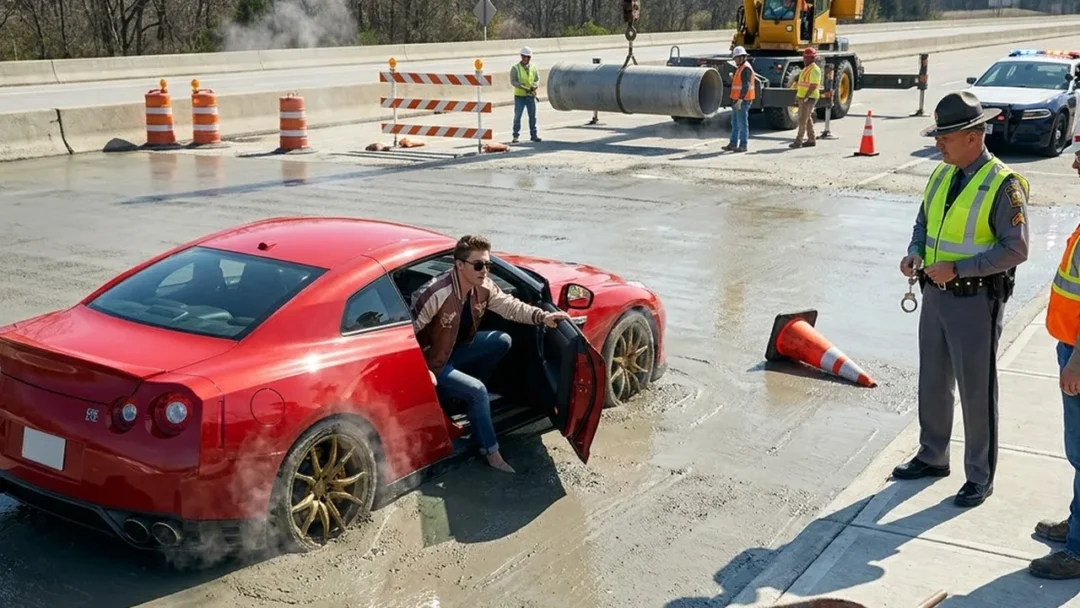
Calloway looked back at the red coupe. The slurry had ceased to ripple. Its surface was turning a dull, matte gray, devoid of surface sheen. The heat radiating from the curing slab was palpable now, sending visible waves of warm air upward along the red fiberglass fenders and cooking the trapped rubber tires.
Captain Brennan walked over from the mobile command post set up in the back of his cruiser. He had a secure satellite phone pressed tightly against his ear.
“Understood, Mr. Attorney General. The perimeter is sealed. Troop F will maintain chain of custody,” Brennan said into the handset before snapping it closed. He looked at Calloway and Bradley with a grim expression. “Harlan Vance just contacted the State Police Commissioner in Harrisburg. He claims this construction zone was improperly marked, that Julian was the victim of unlawful entrapment by an overzealous road trooper, and that the vehicle contains sensitive county work product that must be returned to county custody immediately.”
“Entrapment?” Bradley laughed bitterly. “There are four advance warning signs, three blinking arrow trailers, and two hundred feet of orange barrels. You’d have to be criminally blind or completely reckless to miss this closure.”
“He’s not relying on the facts,” Brennan said. “He’s relying on leverage. Harlan just dispatched a heavy-duty rotator wrecker from Miller’s Commercial Towing in Bellefonte. The driver has a signed emergency impound warrant from County Judge Marcus Croft.”
Calloway’s jaw tightened. “Judge Croft is Harlan Vance’s brother-in-law.”
“Exactly,” Brennan said. “They’re claiming the red coupe is county property under an administrative lease agreement, which would give them legal authority to remove it from our jurisdiction before we can execute a state search warrant on the contents.”
A low rumble vibrated through the asphalt under their boots. Calloway looked up the winding mountain pass. Coming down the double yellow line at high speed was a massive sixty-ton Peterbilt twin-steer rotator wrecker, its high-intensity strobe bars flashing amber and purple. Flanking the wrecker was a marked county sheriff’s patrol SUV, tires howling as it rounded the sharp cliffside bend.
The county had arrived to take the car by force.